Knife carry in France: what the law says
Published on · 9 min read · Anthony Baillon
In France, a knife may be neither carried nor transported outside the home without a legitimate reason. Daggers and dagger-knives are Category D weapons, and according to the interior minister pocket knives can be too. Free to buy, banned to carry: up to one year's imprisonment and a €15,000 fine.
At a glance
| Knife | Category | Carrying or transporting without a legitimate reason |
|---|---|---|
| Dagger, dagger-knife | D a) | Criminal offense: 1 year, €15,000 |
| Pocket knife | D a), according to the minister | Criminal offense: 1 year, €15,000 |
| Butterfly knife, automatic switchblade | D a), arrêté of 4 July 2025 | Criminal offense: 1 year, €15,000 |
| So-called "zombie" knife | A1, 13°, since 7 September 2025 | Banned even at home; carrying: 7 years, €100,000 |
- No blade length is set by the code: size does not change the rule.
- The €500 fixed fine counts as an admission of guilt and goes on the criminal record, with consequences for anyone who holds sport-shooting or hunting firearms.
Knife carry: a criminal offense without a legitimate reason
The code defines the « arme blanche », the bladed or blunt weapon, as « toute arme dont l'action perforante, tranchante ou contondante n'est due qu'à la force humaine » [any weapon whose piercing, cutting or blunt action is due to human force alone] (R311-1, I, 10°)1. The knife is its most common example.
Article R315-1 bans « le port et le transport sans motif légitime » [carrying and transporting without a legitimate reason] weapons of Categories C and D2. Article L317-8 punishes this offense, for Category D, with one year's imprisonment and a €15,000 fine, « même s'il en est régulièrement détenteur » [even if he holds it lawfully]3. Bought lawfully, carried for no reason: the offense is the same.
For two or more people found together carrying weapons, the penalty rises to two years and €30,000 (L317-9)4. It remains to be seen which knives the code files in Category D.
Pocket knife: in Category D according to the minister
Article R311-2 classifies in Category D, at item a), « tous objets susceptibles de constituer une arme dangereuse pour la sécurité publique » [all objects liable to constitute a weapon dangerous to public safety]. It names « les poignards, les couteaux-poignards, les matraques » [daggers, dagger-knives, batons] and refers to a ministerial order for the other weapons5. The pocket knife is not named there.
The interior minister brings it in. In an answer published on 3 June 2025, he covers « tous les autres types de couteaux, également ceux appelés « de poche » » [all other types of knife, including those called pocket knives]6. They can be considered to represent a danger to public safety. Carrying or transporting them is then « susceptible de constituer une infraction » [liable to constitute an offense] if the check does not allow a legitimate reason to be shown.
Kitchen knife, DIY knife or hiking knife: none is named by the code, none is excluded by that answer. One question then comes back: does the size of the blade count?
Blade length: no threshold in the code
None. Article R311-2 sets no blade length for any knife, in any category5. The arrêté of 4 July 2025, which completes the list of item a of Category D, sets none either7.
A small folding blade and a long fixed knife therefore fall under the same carry rule. The difference is decided elsewhere: in the assessment of the legitimate reason, case by case.
Butterfly knife, automatic switchblade: Category D
The arrêté of 4 July 2025, in force since 7 July 2025, names four weapons at item a of Category D7:
- So-called butterfly knives, whose handle is formed of two pivoting grips that cover the closed blade.
- Switchblades « avec mécanisme d'ouverture automatique » [with an automatic opening mechanism].
- Throwing stars.
- Combination weapons of a model earlier than 1 January 1946, which join brass knuckles and a blade.
For these knives as for the others, buying and holding remain free (L311-2)8, and carrying without a legitimate reason remains a criminal offense23. One model, on the other hand, now falls under Category A.
"Zombie" knife: Category A since September 2025
Since the decree of 5 September 2025, article R311-2 classifies in Category A1, 13°, « couteaux, coutelas et machettes, à lame fixe » [fixed-blade knives, cutlasses and machetes] that meet all of these criteria5:
- A fixed blade, with a cutting side and a pointed end.
- A serrated side.
- And one of the two: more than one hole in the blade, or several sharp points.
The criteria are cumulative. A folding knife with a serrated blade is not covered, for want of a fixed blade. Item 14° also classifies in A1 brass knuckles of a model later than 1 January 19005.
Acquiring and holding Category A is banned, exemptions aside (L312-2)9. Carrying it falls under article 222-54 of the code pénal, the criminal code: seven years' imprisonment and a €100,000 fine10.
Legitimate reason for a knife: assessed case by case
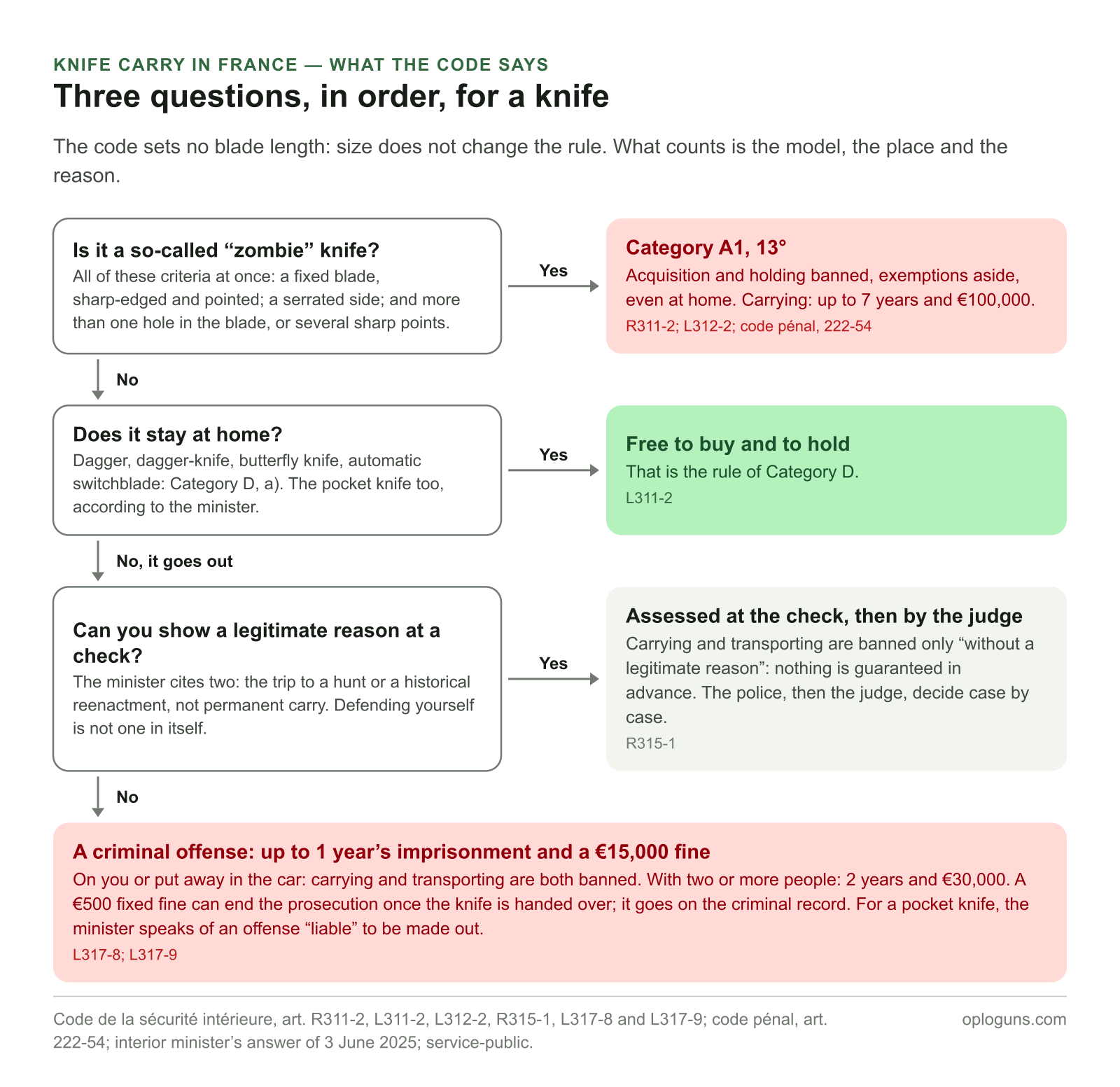
The legitimate reason is assessed case by case. The police, or the judge, take into account « des circonstances de lieu, de temps, du type d'arme portée et du profil du détenteur » [the circumstances of place and time, the type of weapon carried and the holder's profile]11. For the pocket knife, the minister describes an assessment « au cas par cas » [case by case], « sous le contrôle de l'autorité judiciaire » [under the supervision of the judicial authority]6.
Two reasons are recognized by the minister in so many words: going to a hunt, or to a historical reenactment6. For personal defense, Service-Public, the official government information site, settles it: claiming the weapon would serve to face an altercation or a danger « ne constitue pas un motif légitime en soi » [is not a legitimate reason in itself]11.
Knife in the car: transport banned without a reason
Carrying is the « fait d'avoir une arme sur soi utilisable immédiatement » [having a weapon on you, immediately usable]. Transporting, the « fait de déplacer une arme en l'ayant auprès de soi et inutilisable immédiatement » [moving a weapon while keeping it with you, not immediately usable] (R311-1, III)1. A knife put away is not carried. It is transported.
For a knife, the distinction changes nothing: R315-1 bans both without a legitimate reason2. Service-Public cites the car precisely: carrying and transporting outside the home, « par exemple, dans votre voiture » [for example, in your car], are banned without a legitimate reason11.
Fixed fine for a knife: €500 and the criminal record
A knife is not a firearm: it comes within the scope of the fixed fine, the « amende forfaitaire », of article L317-8. Once the knife has been voluntarily handed to the officer, the prosecution can be ended by paying €5003. The amount is reduced to €400 or increased to €1,000 depending on how quickly it is paid.
According to the minister, this procedure has been tried out from 17 April 2024 in thirteen tribunaux judiciaires, the first-instance courts, including Paris, Lyon, Marseille, Lille and Bordeaux6. And it leaves a trace:
- Payment « vaut ainsi reconnaissance de culpabilité » [thus counts as an admission of guilt] and leads to an entry on the criminal record6.
- Since 20 August 2026, the fixed fine for a criminal offense stays three years on bulletin no. 2, the extract of the record that the administration consults, counted from its payment (article 775, 17°, of the code de procédure pénale, the code of criminal procedure)12.
- That entry on bulletin no. 2 bars acquiring and holding weapons of Categories A, B and C (L312-3)13.
A knife in the pocket can thus cost a holder their sport-shooting or hunting firearms. The detail: carrying a Category D weapon. See also the Category B authorization and declaring a Category C firearm.
Knife in the range bag: outside the transport document
The shooting license covers the transport of Category D weapons « utilisés dans la pratique du sport relevant de ladite fédération » [used in the practice of the sport governed by that federation] (R315-2, 3°)14. No shooting discipline is practiced with a knife. A knife slipped into the range bag therefore travels outside that document. See transporting a firearm to the range.
Four misconceptions about knife carry
- "A pocket knife is not a weapon." The interior minister files pocket knives among the objects that can come under item a of Category D6.
- "A small blade can be carried freely." No classification text sets a blade length57.
- "The knife is a 6th-category weapon." Article L311-2 recognizes only four categories, from A to D8.
- "Put away in the glove box, it does not count." Put away, it is transported, and transport remains banned without a legitimate reason12.
Knife carry: what the law holds in your case
Three situations, three readings of the text
For a hunter or a participant in a historical reenactment, the minister recognizes as a legitimate reason the fact of going to the hunt or to the reenactment. His answer covers that trip, not permanent carry.
For a licensed shooter who holds firearms, a fixed fine for a knife costs more than €500. It leaves a three-year entry on bulletin no. 2, and the L312-3 ban on their Category A, B and C weapons.
For an everyday knife, everything is decided at the check. The legitimate reason is assessed case by case: the place, the time, the object, the person. Defending yourself is not one in itself, according to Service-Public.
Sources 14 references
The articles of the code de la sécurité intérieure (CSI), of the code pénal and of the code de procédure pénale were reread on Légifrance in their version in force on 1 November 2026, with the in-force date displayed on each page. The arrêté of 4 July 2025, the ministerial answer and the Service-Public page were read the same day. All documents are in French. Click a note marker in the text to highlight the matching source.
- Légifrance — article R311-1 du CSI, version in force since 7 September 2025 (decree no. 2025-894 of 5 September 2025, art. 1), consulted on 1 November 2026: I, 10° arme blanche, « toute arme dont l'action perforante, tranchante ou contondante n'est due qu'à la force humaine » [any weapon whose piercing, cutting or blunt action is due to human force alone]; III, 10° carrying a weapon, « fait d'avoir une arme sur soi utilisable immédiatement » [having a weapon on you, immediately usable]; 13° transporting a weapon, « fait de déplacer une arme en l'ayant auprès de soi et inutilisable immédiatement » [moving a weapon while keeping it with you, not immediately usable].
- Légifrance — article R315-1 du CSI, version in force since 1 August 2018 (decree no. 2018-542 of 29 June 2018, art. 16), consulted on 1 November 2026: « Sont interdits : […] 3° Le port et le transport sans motif légitime des armes, éléments d'arme et munitions des catégories C et D. » [Banned: carrying and transporting without a legitimate reason weapons, weapon components and ammunition of Categories C and D.]
- Légifrance — article L317-8 du CSI, version in force since 26 January 2023 (law no. 2023-22 of 24 January 2023, art. 25), consulted on 1 November 2026: carrying or transporting without a legitimate reason, « même s'il en est régulièrement détenteur »; 3° Category D, one year's imprisonment and a €15,000 fine; for this offense, « sauf s'il s'agit d'armes à feu » [except for firearms], where the weapon is voluntarily handed to the reporting officer, the prosecution ends through a fixed fine of €500 (reduced €400, increased €1,000), under the conditions of articles 495-17 to 495-25 of the code de procédure pénale. A future version, from ordonnance no. 2025-1091 of 19 November 2025 (art. 40), will apply on 1 January 2029.
- Légifrance — article L317-9 du CSI, version in force since 21 June 2019 (ordonnance no. 2019-610 of 19 June 2019, art. 14), consulted on 1 November 2026: at least two people found together carrying weapons, or transport carried out by at least two people; 3° Category D, two years' imprisonment and a €30,000 fine.
- Légifrance — article R311-2 du CSI, version in force since 7 September 2025 (decree no. 2025-894 of 5 September 2025), consulted on 1 November 2026: IV, a) Category D, « Tous objets susceptibles de constituer une arme dangereuse pour la sécurité publique », including « les poignards, les couteaux-poignards, les matraques », and « autres armes figurant sur un arrêté du ministre de l'intérieur » [other weapons appearing in an order of the interior minister]; I, A1, 13° « Couteaux, coutelas et machettes, à lame fixe », with a cutting side, a pointed end, a serrated side, and more than one hole in the blade or several sharp points; 14° brass knuckles of a model later than 1 January 1900; no blade length is set.
- Assemblée nationale — question écrite n° 1081 de M. Pierre Cordier, « Réglementation applicable au port d'un couteau de poche » [written question on the rules applicable to carrying a pocket knife], question published in the Journal officiel of 22 October 2024, answer from the interior ministry published in the Journal officiel of 3 June 2025, page 4457, consulted on 1 November 2026: « Le fait de se rendre à une action de chasse ou de reconstitution historique est un motif légitime » [going to a hunt or a historical reenactment is a legitimate reason]; « tous les autres types de couteaux, également ceux appelés « de poche », parce qu'ils sont susceptibles de blesser ou tuer s'ils sont détournés de leur usage, peuvent être considérés comme représentant un danger pour la sécurité publique » [all other types of knife, including those called pocket knives, because they are liable to injure or kill if misused, can be considered to represent a danger to public safety]; « le port ou transport de ces objets est en effet susceptible de constituer une infraction si les conditions du contrôle ne permettent pas de justifier d'un motif légitime » [carrying or transporting these objects is liable to constitute an offense if the conditions of the check do not allow a legitimate reason to be shown]; « Cette appréciation des circonstances de temps, de lieux et de contexte est opérée au cas par cas par les forces de sécurité intérieure et sous le contrôle de l'autorité judiciaire » [this assessment of the circumstances of time, place and context is made case by case by the security forces, under the supervision of the judicial authority]; experiment with the fixed fine « menée depuis le 17 avril 2024 » in the jurisdictions of the tribunaux judiciaires of Rennes, Lille, Nantes, Bobigny, Pontoise, Bordeaux, Lyon, Saint-Étienne, Marseille, Nice, Montpellier, Paris and Toulouse; payment « vaut ainsi reconnaissance de culpabilité et entraîne l'inscription de cette infraction au casier judiciaire de l'individu » [thus counts as an admission of guilt and leads to the offense being entered on the individual's criminal record].
- Légifrance — arrêté du 4 juillet 2025 fixant la liste des autres armes classées au a de la catégorie D [order setting the list of the other weapons classified at item a of Category D], Journal officiel no. 0156 of 6 July 2025, in force the day after its publication, consulted on 1 November 2026: article 1, « papillon » or « Balisong » knives, switchblades with an automatic opening mechanism, throwing stars, combination weapons of a model earlier than 1 January 1946 joining brass knuckles and a blade; no blade-length condition.
- Légifrance — article L311-2 du CSI, version in force since 21 June 2019 (ordonnance no. 2019-610, art. 9), consulted on 1 November 2026: four categories, from A to D; « 4° Catégorie D : armes et matériels de guerre dont l'acquisition et la détention sont libres. » [4° Category D: weapons and war materiel whose acquisition and holding are free.]
- Légifrance — article L312-2 du CSI, version in force since 21 June 2019, consulted on 1 November 2026: acquiring and holding Category A weapons is banned, except for the needs of national defense and public security and within the exemptions set by decree.
- Légifrance — article 222-54 du code pénal, version in force since 5 June 2016 (law no. 2016-731 of 3 June 2016, art. 26), consulted on 1 November 2026: carrying or transporting outside the home, without a legitimate reason, weapons « relevant des catégories A ou B, même en en étant régulièrement détenteur » [of Categories A or B, even when holding them lawfully], seven years' imprisonment and a €100,000 fine. A future version, from ordonnance no. 2025-1091 of 19 November 2025 (art. 31), will apply on 1 January 2029.
- Service-Public (DILA) — Armes de catégorie D (acquisition et détention libres), fiche F2251 [Category D weapons, free acquisition and holding], checked on 24 October 2025, consulted on 1 November 2026: « Le port et le transport d'une arme de catégorie D hors de votre domicile (par exemple, dans votre voiture) sont interdits sans motif légitime » [carrying and transporting a Category D weapon outside your home (for example, in your car) are banned without a legitimate reason]; the police, or the judge, « tiennent compte des circonstances de lieu, de temps, du type d'arme portée et du profil du détenteur »; « prétendre que l'arme servirait à mieux affronter une altercation ou un danger ne constitue pas un motif légitime en soi » [claiming the weapon would serve to better face an altercation or a danger is not a legitimate reason in itself].
- Légifrance — article 775 du code de procédure pénale, version in force since 20 August 2026 (law no. 2026-798 of 18 August 2026, art. 29), consulted on 1 November 2026: do not appear on bulletin no. 2, 17° « Les amendes forfaitaires délictuelles à l'expiration d'un délai de trois ans à compter de leur paiement ou à l'expiration du délai mentionné au second alinéa de l'article 495-19 » [fixed fines for criminal offenses once three years have passed since their payment, or on expiry of the time limit of article 495-19].
- Légifrance — article L312-3 du CSI, version in force since 20 March 2024 (law no. 2024-233 of 18 March 2024, art. 7), consulted on 1 November 2026: « Sont interdites d'acquisition et de détention d'armes, de munitions et de leurs éléments des catégories A, B et C » [are barred from acquiring and holding weapons, ammunition and their components of Categories A, B and C] people whose bulletin no. 2 carries an entry of conviction for, among others, « port, transport et expéditions d'armes, de munitions ou de leurs éléments des catégories C ou D sans motif légitime ».
- Légifrance — article R315-2 du CSI, version in force since 1 August 2018 (decree no. 2018-542, art. 16), consulted on 1 November 2026: 3° the current shooting license counts as a legitimate transport document for weapons of Categories A, B and C « ainsi que des armes, éléments d'arme et munitions de la catégorie D utilisés dans la pratique du sport relevant de ladite fédération » [and for Category D weapons, components and ammunition used in the sport governed by that federation].
The text in force prevails, and this is not legal advice. This article describes the texts in force on 1 November 2026. New versions of article L317-8 of the code de la sécurité intérieure and of article 222-54 of the code pénal will apply on 1 January 2029. Next review: 1 May 2027 at the latest. If you are being prosecuted, the person to talk to is a lawyer.
Frequently asked questions
Is a pocket knife a Category D weapon?
The code classifies in Category D, at item a), « tous objets susceptibles de constituer une arme dangereuse pour la sécurité publique » [all objects liable to constitute a weapon dangerous to public safety], and names daggers and dagger-knives (article R311-2 of the code de la sécurité intérieure, the French internal security code, in force on 1 November 2026). According to the ministerial answer published in the Journal officiel of 3 June 2025, pocket knives can also be considered dangerous to public safety.
Is there a permitted blade length?
No. Neither article R311-2 of the code de la sécurité intérieure nor the arrêté of 4 July 2025, which names other weapons of item a of Category D, sets a blade length. Carrying and transporting without a legitimate reason are banned whatever the size of the knife (article R315-1).
What do you risk for carrying a knife without a legitimate reason?
Up to one year's imprisonment and a €15,000 fine (article L317-8 of the code de la sécurité intérieure, in force on 1 November 2026), two years and €30,000 for two or more people (L317-9). The prosecution can be ended by a €500 fixed fine, once the knife is handed over, in the court districts where the procedure is applied.
Can you keep a knife in your car?
Not without a legitimate reason. Within the meaning of article R311-1, a knife put away and not immediately usable is being transported, and article R315-1 bans both carrying and transporting Category D weapons without a legitimate reason. Service-Public, the official government information site, cites the car as its example.
Are so-called zombie knives banned?
Yes, since 7 September 2025: article R311-2 classifies in Category A1, 13°, fixed-blade knives, cutlasses and machetes that combine a cutting edge, a point, a serrated side, and either more than one hole in the blade or several sharp points. Acquiring and holding Category A is banned (L312-2).
Spotted an error, or a rule that has changed since we checked? Report an error