Criminal record and the French shooting license: who consults what, and when
Published on · 9 min read · Anthony Baillon
No, a French shooting license does not require a clean criminal record: the sports code asks only for a medical certificate. What counts comes later, and without you: bulletin no. 2, which the prefecture requests before a firearm authorization, and the FINIADA, the file of persons banned from holding firearms, which the federation and the dealer can consult.
At a glance
| Moment | What is checked | Text |
|---|---|---|
| Taking out a license | Medical certificate less than a year old | Code du sport, L231-2-3 |
| Introductory session | FINIADA, before the first shot | CSI, R312-43-1 |
| Buying a B or C firearm | Bulletin no. 2 and FINIADA | CSI, L312-3 |
- Only the offenses listed by article L312-3 close access to firearms, and only if they appear on bulletin no. 2.
- No extract has to be supplied: the prefecture requests bulletin no. 2 itself.
Clean record: the shooting license does not require it
The code du sport, the French sports code, sets the condition for the shooting license. For disciplines « comportant l'utilisation d'armes à feu ou à air comprimé » [involving the use of firearms or air guns] (D231-1-5, 3°)1, issuing or renewing the license is subject « à la production d'un certificat médical datant de moins d'un an » [to producing a medical certificate less than a year old] (L231-2-3)2. The article says nothing about the criminal record.
The criminal-record condition exists, but elsewhere, and for something else. Article L312-3 of the code de la sécurité intérieure (CSI), the internal security code, makes « interdites d'acquisition et de détention d'armes, de munitions et de leurs éléments des catégories A, B et C » [banned from acquiring and holding Category A, B and C firearms, ammunition and their components] those whose bulletin no. 2 shows a conviction for certain offenses3. It concerns firearms. Not the license.
Two nuances, then. A record that is not clean does not close everything. And a record that is "clean" in the everyday sense does not say which of the three bulletins is being looked at.
Criminal record: three bulletins, only one for firearms
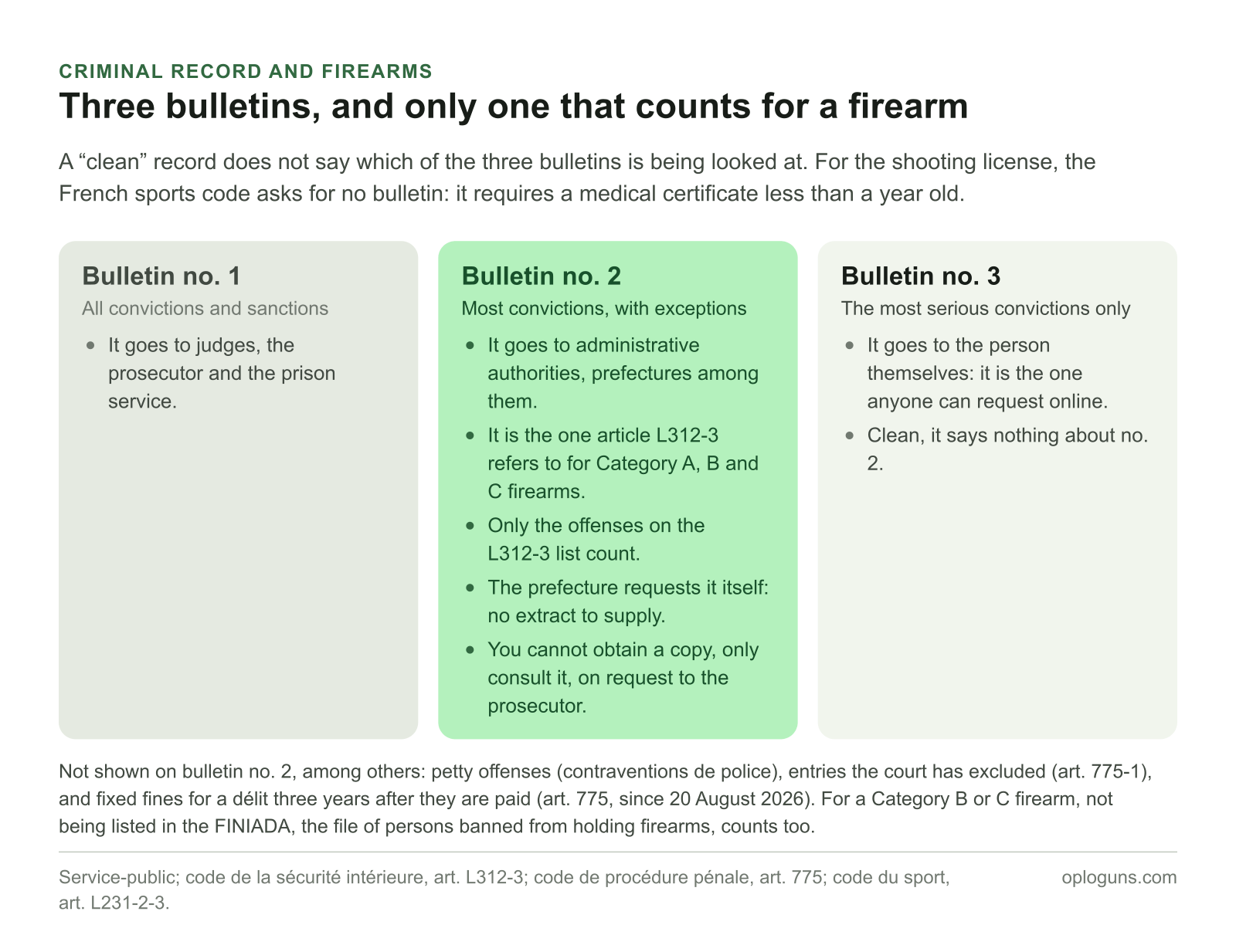
The French criminal record, the casier judiciaire, is read in three bulletins, which do not contain the same entries and do not go to the same people4:
| Bulletin | What it contains | Who receives it |
|---|---|---|
| No. 1 | All convictions and sanctions | Judges, prosecutor, prison service |
| No. 2 | Most convictions, with exceptions | Administrative authorities, prefectures among them |
| No. 3 | The most serious convictions only | The person themselves |
Article L312-3 refers to bulletin no. 23. Yet the person cannot obtain a copy of it: they can only consult it, on request to the public prosecutor for their place of residence4. Bulletin no. 3, the one anyone can request online, contains only the heaviest sentences. A clean bulletin no. 3 therefore says nothing about no. 2.
Criminal record bulletin no. 2: the convictions that count
Article L312-3 draws up a list of offenses, a long one: on bulletin no. 2, only the convictions on that list count3. Service-public gives examples: murder, premeditated murder, torture, acts of barbarity, intentional violence, rape, sexual assault, drug trafficking5. The list also names « port, transport et expéditions d'armes […] des catégories C ou D sans motif légitime » [carrying, transporting and shipping Category C or D weapons without a legitimate reason]3.
Some decisions do not appear on bulletin no. 2 (article 775 of the code de procédure pénale, the code of criminal procedure)6:
- Convictions for contraventions de police, the lowest class of offense (3°).
- Convictions whose entry has been excluded by the court, under article 775-1 (2°).
- Fixed fines for a délit, the middle class of offense (amendes forfaitaires délictuelles), three years after they are paid (17°, since 20 August 2026).
During those three years, a €500 fixed fine paid for a knife carried without a legitimate reason therefore appears on bulletin no. 264. Three shooting seasons. See carrying a Category D weapon.
Who consults what, and when: from first session to firearm
At each step, it is neither the same register nor the same person:
| Step | Who checks | What they consult | Text |
|---|---|---|---|
| Introductory session | Federation representatives | FINIADA, beforehand | CSI, R312-43-1 |
| License | Club | Medical certificate | Code du sport, L231-2-3 |
| Shooting federation | Its representatives | FINIADA status, on individual request | CSI, R312-81 |
| Category B authorization | Prefecture | Bulletin no. 2, FINIADA | F2250; CSI, R312-79 |
| Category C purchase | Dealer, prefecture | FINIADA; bulletin no. 2 conditions | CSI, R312-81; F2246 |
| Coaching at the club | Integrity check | Listed convictions, FIJAIS | Code du sport, L212-9 |
Introductory session: FINIADA checked before the first shot
Without a license, a person may take part in two introductory sessions per twelve-month period (R312-43-1)7. Before the session, the federation's representatives « s'assurent au préalable de l'absence d'inscription de la personne » [make sure beforehand that the person is not listed] in the FINIADA, the national file of persons banned from acquiring and holding firearms7.
If the person is listed, « le signalement en est fait sans délai » [it is reported without delay] to the competent police station or gendarmerie brigade7. This check bears on the file, never on the criminal record itself. See the introductory session without a license.
License: the federation may consult the FINIADA
The FINIADA lists the persons banned from acquiring and holding firearms, including those of article L312-3 (L312-16)8. Article R312-81 places among its recipients « les représentants des fédérations sportives » [the representatives of the sports federations] delegated for shooting or ball-trap9. They consult a copy of the status of the persons recorded, « sur requête individuelle et dans la limite de leurs attributions légales » [on individual request and within the limits of their legal remit]9.
Article R312-81 does not tie this consultation to issuing the license. What the federation decides about the license of a listed person is a matter for its own regulations.
Category B: the prefecture consults the criminal record
For a Category B firearm, service-public lists the record and file conditions5:
- Not being listed in the FINIADA.
- No listed conviction on bulletin no. 2 of the criminal record.
- No behavior giving reason to fear dangerous use of the firearm.
The fact sheet adds: « C'est la préfecture qui fait la demande de bulletin » [it is the prefecture that requests the bulletin]5. Prefecture staff in charge of firearms also have direct access to the FINIADA (R312-79)9. The applicant supplies no extract: see the Category B authorization and the federation's prior opinion.
Category C: the dealer may consult the FINIADA
The same conditions apply to Category C: no FINIADA listing, no listed conviction on bulletin no. 2, no worrying behavior10. Dealers appear, with the federations, among the recipients of a copy of the FINIADA status (R312-81)9. See declaring a Category C firearm.
A later conviction: the criminal record feeds the FINIADA
The check does not stop at the purchase. Article L312-16-1 authorizes the interconnection of the automated national criminal record with the FINIADA, for the bans of 1° of L312-38. A listed conviction, entered on bulletin no. 2, thus reaches the file.
The prefect can then order the holder to give up their firearms, within the time limit the prefect sets, and without an adversarial procedure when the ban comes from L312-3 (L312-11)11. The file keeps its data for twenty years from the lifting of the ban (R312-78)9.
Removing an entry from the criminal record: article 775-1
The court that hands down a conviction can exclude its entry from bulletin no. 2, « soit dans le jugement de condamnation, soit par jugement rendu postérieurement sur la requête du condamné » [either in the judgment of conviction, or by a judgment given later at the convicted person's request] (775-1)12. The exclusion « emporte relèvement de toutes les interdictions, déchéances ou incapacités » [lifts all bans, forfeitures or incapacities]12.
It is not open for convictions for the offenses of article 706-47 of the code de procédure pénale12. For a specific case, the request is prepared with a lawyer.
Coaching at the club: a separate criminal-record check
Coaching is not practicing. Article L212-9 of the code du sport bans from teaching, leading or supervising a sporting activity, « à titre rémunéré ou bénévole » [whether paid or as a volunteer], anyone convicted of a crime, the most serious class of offense in French law (roughly a felony), or of certain délits13. The check also draws on the national automated judicial file of perpetrators of sexual or violent offenses, the FIJAIS13.
The ordinary license holder is not covered by this text. The club's volunteer coach is, since the text covers these functions exercised « à titre rémunéré ou bénévole » [whether paid or as a volunteer].
Four misconceptions about the criminal record and shooting
- "You need a clean criminal record to hold a license." The license requires a medical certificate (L231-2-3); the record condition of L312-3 concerns firearms, and only the listed offenses23.
- "A criminal-record extract is attached to the file." « C'est la préfecture qui fait la demande de bulletin » [it is the prefecture that requests the bulletin]5.
- "A clean bulletin no. 3 is enough." It contains only the most serious convictions; the firearms ban is read on bulletin no. 243.
- "Any conviction closes access to firearms." Only the offenses on the L312-3 list count, and contraventions de police do not appear on bulletin no. 236.
Criminal record and sport shooting: what counts in your case
Three situations, three checks
To take out a license, the text asks for a medical certificate less than a year old; before an introductory session, it is the FINIADA that is checked, not the criminal record.
To buy a Category B or C firearm (see the legal routes to a firearm), what counts is bulletin no. 2, for the offenses listed by L312-3 only, and not being listed in the FINIADA. The prefecture requests the bulletin itself.
To coach at the club, even as a volunteer, there is in addition the integrity check of article L212-9 of the code du sport.
Sources 13 references
The articles of the code du sport, the code de la sécurité intérieure (CSI) and the code de procédure pénale (CPP) were reread on Légifrance in their version in force on 1 November 2026, with the in-force date shown by each page. The service-public fact sheets were read on the same day. All documents are in French. Click a note marker in the text to highlight the matching source.
- Légifrance — article D231-1-5 du code du sport, version in force since 3 September 2023 (decree no. 2023-853 of 31 August 2023, art. 1), consulted on 1 November 2026: 3° « Les disciplines sportives comportant l'utilisation d'armes à feu ou à air comprimé » [sporting disciplines involving the use of firearms or air guns].
- Légifrance — article L231-2-3 du code du sport, version in force since 4 March 2022 (law no. 2022-296 of 2 March 2022, art. 24), consulted on 1 November 2026: for the disciplines listed by decree, « la délivrance ou le renouvellement de la licence ainsi que la participation à des compétitions » [issuing or renewing the license and taking part in competitions] are subject « à la production d'un certificat médical datant de moins d'un an » [to producing a medical certificate less than a year old].
- Légifrance — article L312-3 du CSI, version in force since 20 March 2024 (law no. 2024-233 of 18 March 2024, art. 7), consulted on 1 November 2026: « Sont interdites d'acquisition et de détention d'armes, de munitions et de leurs éléments des catégories A, B et C » [the following are banned from acquiring and holding Category A, B and C firearms, ammunition and their components]; 1° persons whose bulletin no. 2 of the criminal record shows a conviction for one of the listed offenses, including « port, transport et expéditions d'armes, de munitions ou de leurs éléments des catégories C ou D sans motif légitime » [carrying, transporting and shipping Category C or D weapons, ammunition or their components without a legitimate reason]; 2° persons sentenced to a ban on holding or carrying a weapon, or to confiscation.
- Service-Public (DILA) — Casier judiciaire : bulletins n°1, n°2 et n°3, fiche F14710 [Criminal record: bulletins no. 1, no. 2 and no. 3], checked on 20 August 2026, consulted on 1 November 2026: bulletin no. 1 issued to judges, the public prosecutor and the prison service; bulletin no. 2 issued to « autorités administratives (exemple : les mairies et préfectures) » [administrative authorities (for example town halls and prefectures)], the convicted person « ne peut pas solliciter une copie de son bulletin n°2 » [cannot request a copy of their bulletin no. 2] but can consult it on request to the public prosecutor for their place of residence; not shown on bulletin no. 2, among others, « Condamnations et amendes forfaitaires prononcées pour contraventions » [convictions and fixed fines for contraventions] and the « Amende forfaitaire délictuelle après 3 ans suivant leur paiement » [fixed fine for a délit three years after payment]; bulletin no. 3, « uniquement les condamnations les plus graves » [only the most serious convictions], requested by the convicted person alone.
- Service-Public (DILA) — Armes de catégorie B pour un tireur sportif (soumises à autorisation), fiche F2250 [Category B firearms for a sport shooter, subject to authorization], checked on 20 March 2025, consulted on 1 November 2026: conditions « Ne pas être inscrit au FINIADA » [not being listed in the FINIADA]; « Ne pas avoir sur votre bulletin n°2 du casier judiciaire de condamnations pour certaines infractions : meurtre, assassinat, tortures, actes de barbarie, violences volontaires, viol, agressions sexuelles, trafic de stupéfiant… C'est la préfecture qui fait la demande de bulletin » [having no convictions on your bulletin no. 2 for certain offenses: murder, premeditated murder, torture, acts of barbarity, intentional violence, rape, sexual assault, drug trafficking… It is the prefecture that requests the bulletin]; « Ne pas avoir un comportement laissant craindre une utilisation de l'arme dangereuse pour vous-même ou pour autrui » [not behaving in a way that gives reason to fear a use of the firearm dangerous to yourself or others].
- Légifrance — article 775 du CPP, version in force since 20 August 2026 (law no. 2026-798 of 18 August 2026, art. 29), consulted on 1 November 2026: not shown on bulletin no. 2, 2° « Les condamnations dont la mention au bulletin n° 2 a été expressément exclue en application de l'article 775-1 » [convictions whose entry on bulletin no. 2 has been expressly excluded under article 775-1]; 3° « Les condamnations prononcées pour contraventions de police » [convictions for contraventions de police]; 17° « Les amendes forfaitaires délictuelles à l'expiration d'un délai de trois ans à compter de leur paiement ou à l'expiration du délai mentionné au second alinéa de l'article 495-19 » [fixed fines for a délit, once three years have passed since they were paid or once the period mentioned in the second paragraph of article 495-19 has expired].
- Légifrance — article R312-43-1 du CSI, version in force since 10 February 2022 (decree no. 2022-144 of 8 February 2022, art. 2), consulted on 1 November 2026: « Elles ne peuvent participer à plus de deux séances de tir d'initiation par période de douze mois » [they may not take part in more than two introductory shooting sessions per twelve-month period]; « Les représentants de la fédération concernée s'assurent au préalable de l'absence d'inscription de la personne au fichier national des interdits d'acquisition et de détention d'armes » [the representatives of the federation concerned make sure beforehand that the person is not listed in the national file of persons banned from acquiring and holding firearms]; « En cas d'inscription, le signalement en est fait sans délai » [if the person is listed, it is reported without delay] to the territorially competent police station or gendarmerie brigade.
- Légifrance — article L312-16 du CSI, version in force since 30 December 2019, and article L312-16-1, version in force since 26 January 2022, consulted on 1 November 2026: « fichier national automatisé nominatif » [automated national file of named persons] of the persons banned from acquiring and holding firearms under, among others, L312-3; interconnection authorized between the automated national criminal record and that file for the bans made under 1° of L312-3.
- Légifrance — articles R312-77 à R312-83 du CSI, FINIADA, consulted on 1 November 2026: R312-78 (version of 30 April 2020), data kept « durant vingt ans à compter de la date de levée de l'interdiction » [for twenty years from the date the ban is lifted]; R312-79 (version of 30 April 2020), direct access for staff of the Service central des armes and for prefecture staff in charge of firearms regulation; R312-81 (version of 30 April 2020), copy of the status of the persons recorded, « sur requête individuelle et dans la limite de leurs attributions légales » [on individual request and within the limits of their legal remit], for the Office français de la biodiversité, dealers, representatives of the Fédération nationale des chasseurs and « les représentants des fédérations sportives » [the representatives of the sports federations] delegated for shooting or ball-trap.
- Service-Public (DILA) — Armes de catégorie C (soumise à déclaration), fiche F2246 [Category C firearms, subject to declaration], checked on 20 March 2025, consulted on 1 November 2026: for an adult, conditions « Ne pas être inscrit au FINIADA » [not being listed in the FINIADA], « Ne pas avoir sur votre bulletin n°2 du casier judiciaire de condamnations pour certaines infractions » [having no convictions on your bulletin no. 2 for certain offenses], « Ne pas avoir un comportement laissant craindre une utilisation de l'arme dangereuse » [not behaving in a way that gives reason to fear dangerous use of the firearm]; « C'est la préfecture qui fait la demande de bulletin » [it is the prefecture that requests the bulletin].
- Légifrance — article L312-11 du CSI, version in force since 26 January 2022, consulted on 1 November 2026: the prefect can order any holder of firearms to give them up; « Le représentant de l'Etat dans le département fixe le délai au terme duquel le détenteur doit s'être dessaisi » [the State's representative in the département sets the time limit by which the holder must have given them up]; when the ban is made under L312-3 or L312-3-2, the provisions on the adversarial procedure do not apply.
- Légifrance — article 775-1 du CPP, version in force since 20 August 2026 (law no. 2026-798 of 18 August 2026, art. 29), consulted on 1 November 2026: « Le tribunal qui prononce une condamnation peut exclure expressément sa mention au bulletin n° 2 soit dans le jugement de condamnation, soit par jugement rendu postérieurement sur la requête du condamné » [the court that hands down a conviction can expressly exclude its entry from bulletin no. 2, either in the judgment of conviction, or by a judgment given later at the convicted person's request]; the exclusion « emporte relèvement de toutes les interdictions, déchéances ou incapacités » [lifts all bans, forfeitures or incapacities]; « Les dispositions du présent article ne sont pas applicables aux personnes condamnées pour l'une des infractions mentionnées à l'article 706-47 » [the provisions of this article do not apply to persons convicted of one of the offenses mentioned in article 706-47].
- Légifrance — article L212-9 du code du sport, version in force since 10 March 2024 (law no. 2024-201 of 8 March 2024, art. 1), consulted on 1 November 2026: no one may exercise the teaching, leading or supervising functions mentioned in article L212-1, « à titre rémunéré ou bénévole » [whether paid or as a volunteer], if they have been convicted of a crime or of one of the listed délits; I bis, access to the information in the national automated judicial file of perpetrators of sexual or violent offenses, under the conditions of article 706-53-7 of the CPP.
The text in force prevails, and this is not legal advice. This article describes the texts in force on 1 November 2026. Article 775 of the code de procédure pénale was amended on 20 August 2026. The articles of that code on the criminal record are repealed with deferred effect by ordonnance no. 2025-1091 of 19 November 2025. Next review: by 1 May 2027 at the latest, and before 1 January 2029. For a specific case, the person to see is a lawyer.
Frequently asked questions
Do you need a clean criminal record to get a French shooting license?
No. The code du sport, the French sports code, makes the shooting license conditional on a medical certificate less than a year old (articles L231-2-3 and D231-1-5, in force on 1 November 2026). The criminal-record condition of the code de la sécurité intérieure, the internal security code, concerns firearms: article L312-3 bans from acquiring and holding Category A, B and C firearms those whose bulletin no. 2 shows a conviction for certain offenses.
Which bulletin of the criminal record counts for holding a firearm?
Bulletin no. 2. Article L312-3 of the code de la sécurité intérieure refers to the convictions shown on it, and according to service-public it is the prefecture that requests the bulletin. Bulletin no. 3, the only one a person can request themselves, contains only the most serious convictions.
Does a criminal-record extract have to be attached to a firearm authorization file?
No. For the Category B authorization as for Category C, the service-public fact sheet states that « C'est la préfecture qui fait la demande de bulletin » [it is the prefecture that requests the bulletin]. The FINIADA, the file of persons banned from holding firearms, is consulted directly by prefecture staff (article R312-79 of the code de la sécurité intérieure).
Does the club check the criminal record before an introductory session?
No, it checks the FINIADA. Article R312-43-1 of the code de la sécurité intérieure requires the federation's representatives to make sure « au préalable de l'absence d'inscription de la personne » [beforehand that the person is not listed] in the file of persons banned from holding firearms, before any introductory session for a non-member. If the person is listed, it is reported without delay to the police or the gendarmerie.
Does a conviction for a petty offense prevent you from having firearms?
Convictions for contraventions de police, the lowest class of offense, do not appear on bulletin no. 2 (article 775, 3°, of the code de procédure pénale, the code of criminal procedure), and the ban in article L312-3 covers only convictions entered on that bulletin for the offenses it lists.
Spotted an error, or a rule that has changed since we checked? Report an error