Pistol dry fire: five drills, and how to measure your progress
Published on · Updated on · 14 min read · Anthony Baillon
Five pistol dry-fire drills: the trigger release facing a wall, the coin on the slide, aiming on a par time, the presentation, the hold on a sensor. They are worth something only when measured, over many repetitions: a 7 out of 10 says almost nothing. It takes a hundred repetitions to conclude.
At a glance
| Pistol dry fire | |
|---|---|
| Safety | No ammunition in the room, a backstop behind the point of aim |
| Drills | Five, each with a written success rule |
| Measurement | Blocks of 100 repetitions: 10 say almost nothing |
| Duration | No standard: 30 to 60 minutes a week according to the NRA |
| Effect on score | Two studies, neither conclusive |
- To get started: the trigger release facing a wall; a wall and a notebook are enough for the protocol.
- To know whether you are improving: compare two blocks of one hundred, never two sets.
Pistol dry fire: pros and cons
Pros
Cons
- No recoil and no report: what the drill removes, no tool can measure.
- A risk that cannot be undone: one forgotten round turns the drill into live fire; hence the ammunition kept in another room1.
- An unproven effect on score: one favorable study of thirty students, one counter-test with three people1415.
- Go easy on rimfire: guns in .22 LR call for the most caution12.
Dry-fire safety: no ammunition in the room
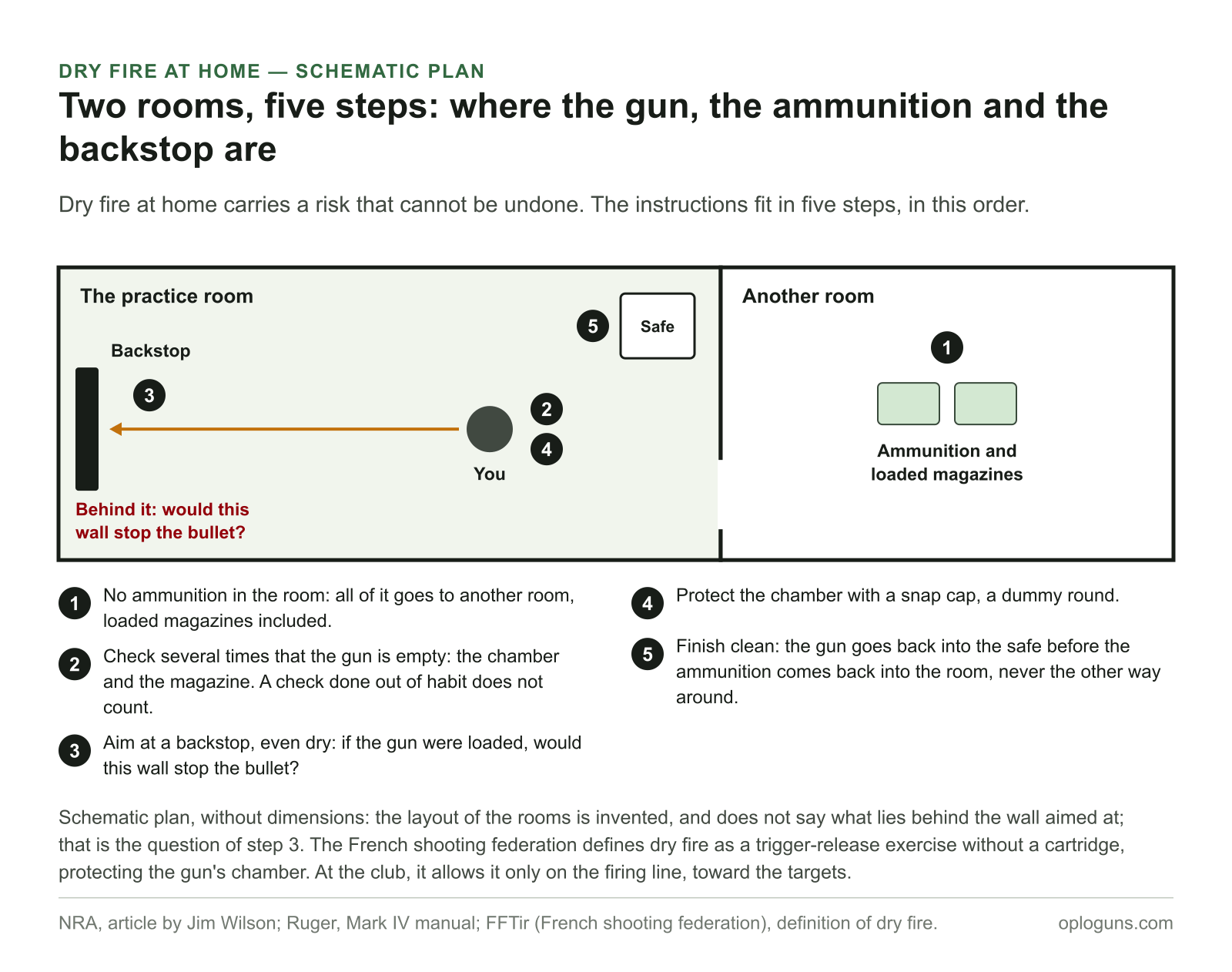
A gun you believe is empty. A cartridge forgotten on the table. A partition wall behind the front sight. Dry fire at home carries a risk that cannot be undone.
The instructions fit in five steps, in this order:
- No ammunition in the room. Jim Wilson, who writes for the NRA, leaves no margin: all the ammunition for the gun goes in another room1. Loaded magazines too.
- Check several times that the gun is empty. The chamber and the magazine, the Ruger Mark IV manual specifies2. Several times, the NRA article insists1. A check done out of habit does not count.
- Aim at a backstop, even in dry fire. Ruger spells it out: "Be sure of the bullet stop behind your target, even when dry-firing"2. Ask the question before the first repetition: if the gun were loaded, would this wall stop the bullet?
- Protect the chamber. A snap cap — a dummy cartridge that cushions the firing pin's strike — goes into the chamber before you start. It costs €27 for five in 9mm and €20 for six in .22 LR1617.
- Finish cleanly. Ten to fifteen minutes are enough, Jim Wilson estimates1. The gun goes back in the safe before the ammunition comes back into the room, never the other way round.
That safe obeys its own rules: what the law requires of a gun safe in France.
The federation has already said it all, in one line. The French shooting federation defines dry fire as an « exercice de lâcher sans cartouche en protégeant la chambre de l'arme » [a trigger-release exercise without a cartridge, protecting the gun's chamber]3. Two instructions fit in that definition: no cartridge, and a protected chamber. The first protects the home. The second protects the gun.
One question remains that safety does not settle. Can your gun take thousands of empty clicks?
Dry fire in 9mm and .22 LR: what the manufacturers say
Glock answers plainly: "It's ok to dry fire your GLOCK pistol". With one reservation, a snap cap "if you will be dry firing for a long period of time"4.
Ruger says the same of its Mark IV, a pistol in .22 Long Rifle. Dry fire is accepted there "in moderation". For "extensive" practice, the snap cap becomes the rule2.
Two manufacturers, two types of ignition, one line. A few clicks cost nothing; thousands call for preparation.
Rimfire — the ignition of the .22 LR, where the firing pin strikes the rim of the cartridge2 — calls for the most caution. The NRA article in fact recommends dummy cartridges first for two families of guns: rimfire guns, and old single-action revolvers1. For yours, the manual prevails. It alone says what your gun tolerates.
The 10-meter air pistol raises the question differently. The ISSF rulebook includes in dry fire air or gas guns "fitted with a device which enables the trigger to be operated without releasing the propelling charge"5. Walther lists this "dry firing mode" among the features of its LP5006. If your air pistol has one, there is nothing to add: no pellet, no air released.
The gun is ready. What remains is deciding what you are going to repeat.
Five dry-fire drills, each with its measurement
A drill you do not score cannot be compared. Each of the five therefore has a binary success rule: pass or fail, judged the same way at every repetition.
| Drill | What it trains | Pass if… | Tool |
|---|---|---|---|
| Trigger release facing a wall | the release alone | front sight still at the click | none |
| Coin on the slide | a release without a jerk | the coin stays in place | a coin |
| Aim and release on a par time | the release, timed | click before the second signal | a timer |
| Presentation on a par time | position, aim, release | same, from the start position | a timer |
| Hold and release on a sensor | the last second | score above your threshold | a sensor |
- The trigger release facing a wall. A bare wall, one or two meters away. All the attention goes to the front sight, which must stay still in the rear sight notch at the moment of the click. If it dips or drifts, the repetition is a fail.
- The coin on the slide. A coin laid flat on the slide, near the front sight, falls at the slightest jerk. Pass if it stays. On a gun whose trigger resets only by working the slide, the coin is replaced at every repetition; how a trigger resets decides the rhythm of the drill.
- Aim and release on a par time. The timer gives a start, then a second signal after a set delay: the par time. Pass if the click comes before that second signal, sights aligned. A shot timer is enough for this.
- The presentation on a par time. Same rule, but from the start position set by the rulebook of your discipline. The drill measures the whole sequence, not the release alone.
- Hold and release on a sensor. SCATT, an optical sensor mounted on the gun, traces the path of the point of aim on the target, before and after the shot, and isolates the last second before it breaks7. Its S1 indicator measures the length of that trace over that second8. Mantis, for its part, scores each shot out of 100 by the deviation from the point of aim during the trigger press; a 100 is, according to the manufacturer, "basically impossible unless locked in a vise"9.
A sensor score can only be compared with a score from the same device, set the same way. And whatever the tool, one question remains: how many repetitions does it take for a score to mean something?
Ten repetitions measure almost nothing
Seven successes out of ten. The figure looks like a measurement. It only looks like one.
Behind that observed 70% hides your true rate, the one you would get over thousands of repetitions. A calculation gives the range where it is likely to lie: the 95% Wilson interval, which the NIST statistics handbook presents as recommended in virtually every case1011.
For a 7 out of 10, that range runs from 40 to 89%. You could just as well succeed less than one time in two as almost nine times in ten.
What a "7 out of 10" is worth, by number of repetitions
Observed success rate: 70%. 95% range calculated by the Wilson method. A calculation, not a measurement: it holds for any drill scored pass or fail
The range is the 95% Wilson confidence interval, which the NIST statistics handbook presents as recommended for virtually all sample sizes10, and which statistics software also documents11. It narrows slowly: you have to quadruple the number of repetitions to roughly halve it.
View the data
| Repetitions | Successes | Observed rate | True rate, 95% range |
|---|---|---|---|
| 10 | 7 | 70% | 40 to 89% |
| 20 | 14 | 70% | 48 to 85% |
| 30 | 21 | 70% | 52 to 83% |
| 50 | 35 | 70% | 56 to 81% |
| 100 | 70 | 70% | 60 to 78% |
| 200 | 140 | 70% | 63 to 76% |
The real question is harder still: have I improved? Between a session at 60% and a session at 80%, the two ranges stop overlapping only around one hundred repetitions each. Below that, the progress may be real or down to chance, and nothing lets you decide.
The criterion of separate ranges is a cautious one. For a shooter alone with a notebook, that is a quality: it will never make you believe in progress that does not exist.
Why most dry-fire sessions prove nothing. An ordinary session counts a few dozen clicks, judged by feel, and is compared from memory with the previous one. Three flaws at once: too few repetitions, no written success rule, no record. The protocol that follows corrects all three.
The measurement protocol: blocks of one hundred
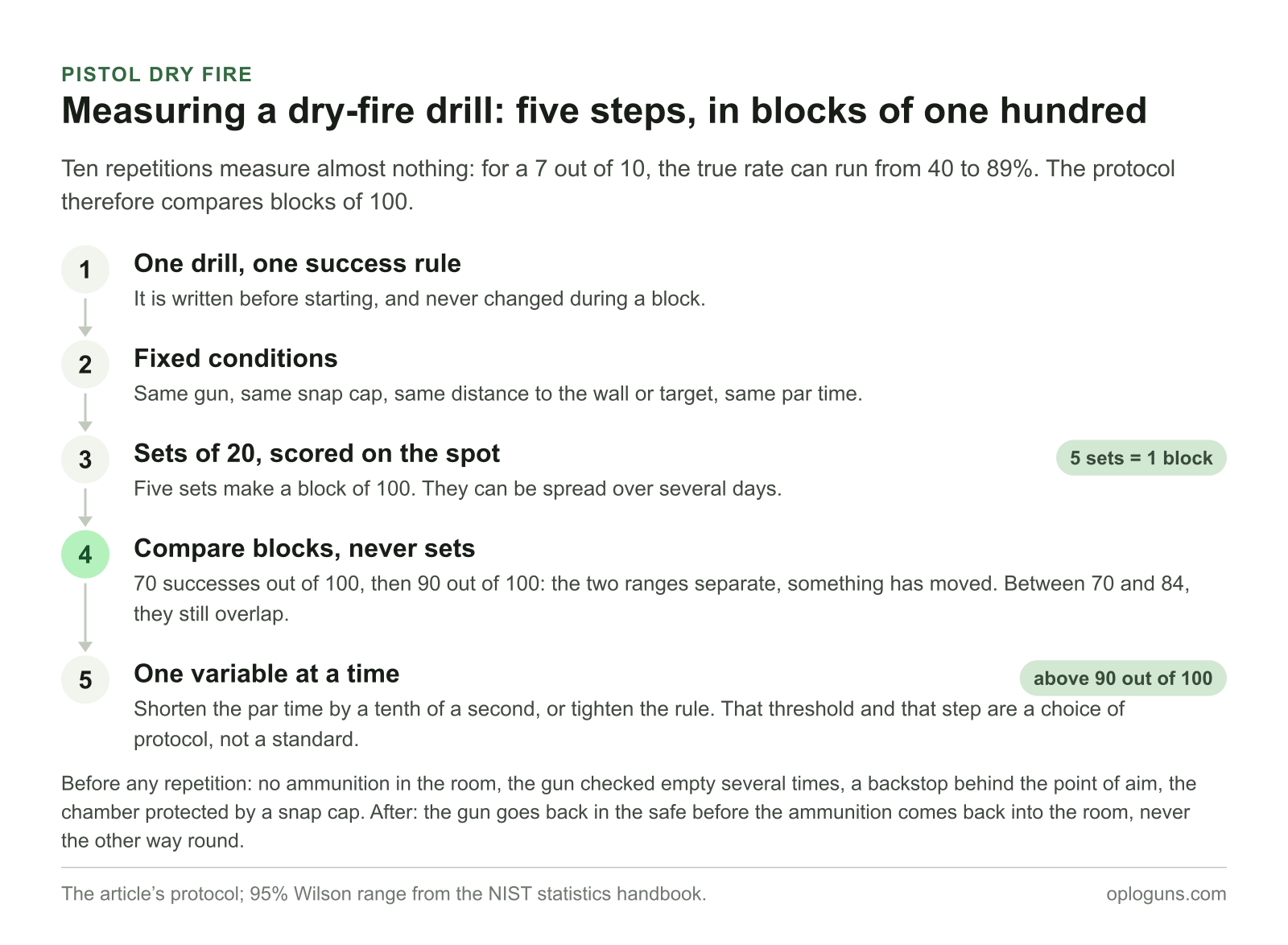
Five steps, to follow in order:
- One drill, one success rule. Written before starting, never changed during a block.
- Fixed conditions. Same gun, same snap cap, same distance to the wall or target, same par time.
- Sets of 20, scored on the spot. Five sets make a block of 100. They can be spread over several days.
- Compare blocks, never sets. 70 successes out of 100, then 90 out of 100: there, the two ranges separate, and something has moved. Between 70 and 84, they still overlap.
- One variable at a time. Above 90 successes out of 100, shorten the par time by a tenth of a second, or tighten the rule. That threshold and that step are a choice of protocol, not a standard; what matters is keeping them.
The notebook fits on one page, one line per set:
| Column | What you write in it |
|---|---|
| Date | the day of the set |
| Drill | one of the five, always named the same way |
| Conditions | the par time, the distance, the gun |
| Successes | out of 20, written down at once |
| Remark | what changed: the time of day, fatigue, the gun |
Some timers even hear the click. AMG Lab claims it for its Commander, "sensitive enough to pick up dry fire"12. Time then replaces the rate: twenty recorded times give a mean and a standard deviation — the typical spread of your times around that mean. In a spreadsheet, the function is STDEV.S, called ECARTYPE.STANDARD in a French-language one: it estimates the standard deviation « en se basant sur un échantillon » [based on a sample]13.
If the mean falls while the standard deviation grows, you are faster on average and less consistent. The next block will say whether the trend holds.
Timer, sensor or laser: no tool measures everything
No tool measures everything. Each has a blind spot, worth knowing before you buy.
| Tool | What it measures | What it does not measure |
|---|---|---|
| None (wall, coin) | pass or fail, judged by eye | what the eye does not see |
| Timer on a par time | whether a time limit was met | the quality of the release |
| Timer that hears the click | a time at every repetition | the quality of the release |
| Motion sensor | the movement of the gun during the press, scored out of 100 | whether you were aiming true |
| Optical sensor | the trace of the point of aim on the target, before and after the shot | what recoil would cost |
| Laser cartridge | the point aimed at the instant of the click, marked by a flash | the path of the point of aim before and after |
The laser cartridge goes into the chamber like a snap cap. At the click, the firing pin triggers a 100 ms flash on the target, and a rubber tip protects the firing pin21.
The last line holds for all of them. In dry fire, there is neither report nor recoil: no tool can measure what the drill has removed.
The price of these tools runs from zero to more than €1,500:
| Tool | Price |
|---|---|
| None (wall, coin) | €0 |
| Timer on a par time | €160 to €26018 |
| Timer that hears the click | $18912 |
| Motion sensor | €248 to €36319 |
| Optical sensor | €1,57320 |
| Laser cartridge, in 9mm | €55 to €642122 |
The simplest of the six tools — a wall and a notebook — is enough to apply the protocol. The sensor adds finesse, not rigor. Rigor comes from the blocks of one hundred.
Drills and score: two studies, neither conclusive
The honest answer fits in two studies, and neither is enough.
The first, published in 2023, covers thirty students aged 14 to 16 from a school in Yavatmal, India, split into two groups of fifteen. The dry-fire group trains 45 minutes, five days a week, for six weeks. In the final test, with a .22 LR rifle at 10 meters, it averages 12 points, against 7.47 for the control group14. The result points the right way. A single school, beginners, a general engineering journal: it goes no further.
The second barely deserves the name of study. In January 2016, a training institute put three members of its team to the test: two dry fire thirty minutes three days in a row, the third does nothing. In the live-fire test, she is the one who improves most: +60% and +83% success, against +6% and −20%, then 0% and +50% for the other two15. The authors say so themselves: "these results were not statistically significant".
One favorable study of thirty teenagers, one counter-test with three people. Neither says what dry fire will bring you, personally. Our twelve-week improvement plan had already reached the same finding on the federations' side. Your own block of one hundred will say it better than they do.
Drill duration: no standard, 30 to 60 minutes
No duration is established. The figures in circulation are opinions.
Jim Wilson, for the NRA, judges that three to four sessions a week are "probably" plenty1, at ten to fifteen minutes each. That is 30 to 60 minutes a week. The Indian study imposed 225, four to eight times more14.
Between the two, your notebook decides. If the last set falls lower than the first ones, session after session, the session is too long.
Dry fire replaces neither recoil nor the range
First, recoil and the report. They do not exist in dry fire, and that is the whole point of the drill as well as its limit.
Next, the range rules. At the club, the French shooting federation allows dry fire « qu'au pas de tir, en direction des cibles » [only on the firing line, toward the targets]3. In ISSF competition, it remains permitted during match firing5. In a final, outside the times provided for it, it costs one point — one hit in a 25 m pistol final. And dry fire outside the designated area can mean disqualification5.
Finally, the paperwork. The three controlled sessions of a first French authorization application take place within an approved association, under the club's supervision. No drill done at home counts toward them.
What dry fire brings, by discipline
In air pistol, at 10 meters, the drill assumes a gun with a dry-fire mode. The trigger release facing a wall, in blocks of one hundred, needs no sensor at all.
At 25 meters or in centerfire, the snap cap protects the chamber, and the coin on the slide judges the release. For a gun in .22 LR, the manual says what it tolerates.
In IPSC shooting, the presentation on a par time measures the whole sequence, from the discipline's start position; the par time is shortened by a tenth of a second at each block that exceeds 90 out of 100.
In all three cases, the first session serves to write the success rule; measurement starts at the second.
The rules in force prevail. The rules cited are those of the ISSF rulebook, 2025 edition in force on 1 July 2026, and of the French shooting federation's page of 20 October 2022. For what your gun tolerates, the manufacturer's manual overrides any general instruction, those of this article included.
Sources 22 references
The shooting rules were reread in the texts of the ISSF and the FFTir. What each gun tolerates comes from its manufacturer's manual or official page. The Wilson range is recalculated from the formula published by NIST, cross-checked against a second statistics reference. The pages of sensor and timer manufacturers are flagged ⚠️: they describe their own product. The prices, recorded at retailers on 23 September 2026, are flagged too: they change without notice.
- NRA Family — "How to Dry-Fire Your Gun Safely", Jim Wilson, 27 March 2024: all the ammunition for the gun in another room, gun checked "several times", dummy cartridges recommended for rimfire guns and old single-action revolvers, sessions of 10 to 15 minutes, three to four times a week "probably plenty". ⚠️ A writer's opinion, not a standard.
- Sturm, Ruger & Co. — Mark IV pistol manual (PDF): .22 Long Rifle cartridge that fires when the firing pin strikes "the relatively soft cartridge case rim"; page 14, "Dry Firing": chamber and magazine empty, dry fire accepted "in moderation", snap cap "for extensive dry-fire practice"; safety rules: "Be sure of the bullet stop behind your target, even when dry-firing".
- FFTir — règles de sécurité, « L'arrivée au pas de tir » [safety rules, arriving at the firing line] (in French), 20 October 2022: dry fire, « exercice de lâcher sans cartouche en protégeant la chambre de l'arme » [a trigger-release exercise without a cartridge, protecting the gun's chamber], is allowed « qu'au pas de tir, en direction des cibles » [only on the firing line, toward the targets]; in competition, the officials make a place available.
- Glock — owners' frequently asked questions: "It's ok to dry fire your GLOCK pistol, but we recommend using a snap cap or dummy round if you will be dry firing for a long period of time."
- ISSF — Rule Book, 2025 edition, second print 07/2026, in force on 1 July 2026 (PDF): rule 6.2.4.1, definition of dry fire, including for air or gas guns fitted with a device for releasing the trigger without releasing the charge, and possible disqualification outside the designated area; rule 6.11.1.2 b), dry fire permitted during match firing; rule 6.17.1.14 e), in a final, a one-point penalty — one hit in a 25 m pistol final — outside the times provided.
- Carl Walther — LP500 air pistol product page: "Dry firing mode" among the features. ⚠️ Commercial source.
- SCATT — "What is SCATT": optical sensor mounted on the gun, trace of the point of aim before and after the shot, highlighting of the last second, dry training "without ammunition". ⚠️ Commercial source.
- SCATT — SCATT Basic software: the S1 indicator "shows the length of the aiming trace for one second before the shot". ⚠️ Commercial source.
- Mantis — "How Does MantisX Work?": motion sensors, tracking of the gun during the trigger press, each shot scored by the deviation from the point of aim, "The perfect score is 100 (basically impossible unless locked in a vise)". ⚠️ Commercial source.
- NIST/SEMATECH — e-Handbook of Statistical Methods, section 7.2.4.1, "Confidence intervals": Wilson formula for the confidence interval of a proportion, recommended "for virtually all combinations of n and p", alongside the classic normal approximation.
- NCSS — PASS software documentation, "Confidence Intervals for One Proportion" (PDF): Wilson score interval, "based on inverting the z-test for a single proportion".
- AMG Lab — Commander timer page: "Commander is sensitive enough to pick up dry fire", adjustable sensitivity; price recorded 23 September 2026: US$189.00, all colors, awaiting restock ("backorder"). ⚠️ Commercial source, manufacturer's claim.
- Microsoft — fonction ECARTYPE.STANDARD (in French; STDEV.S in English-language spreadsheets): « évalue l'écart type d'une population en se basant sur un échantillon » [estimates the standard deviation of a population based on a sample], "n-1" method.
- Pradip Saini, T. Onima Reddy, Vikram Singh — "Influence of Dry Fire Practice on Rifle Shooting Performance of School Going Students", International Journal for Research in Applied Science & Engineering Technology, 2023: 30 students aged 14 to 16 from a school in Yavatmal, two groups of 15, 45 minutes five days a week for six weeks; final test with a .22 LR rifle at 10 meters, 12 ± 3.84 against 7.47 ± 2.45. ⚠️ Small sample, a single school.
- Mountain Tactical Institute — "Dry Fire Mini-Study Results", January 2016: three participants, two dry firing 30 minutes three days in a row, one control; in live fire, +60% and +83% for the control, +6% and −20%, then 0% and +50% for the other two; "these results were not statistically significant". ⚠️ Mini-study outside any journal, not significant by its authors' own admission.
- Terräng Armurerie — 5 cartouches de manipulation 9x19 mm rouges A-Zoom (in French), recorded 23 September 2026: €27.00 for the set of five, out of stock on the site and available in store. ⚠️ Commercial data.
- Armurerie de la Bourse — cartouches de manipulation A-Zoom .22 LR par six (in French), recorded 23 September 2026: €20.00 for the set of six, in stock. ⚠️ Commercial data.
- IPSCStore — shot timers category, recorded 23 September 2026: Special Pie M1A2-W+ Gen2 at €159.95, CED7000 GEN-2 at €160.03 (€176.04 with RF), DAA EDGE at €259.95; the AMG Lab Commander is out of stock there. ⚠️ Commercial data.
- Terräng Armurerie — systèmes d'entraînement Mantis (in French), recorded 23 September 2026: Mantis X3 at €247.50, Mantis X10 Elite at €363.00. ⚠️ Commercial data.
- Armurerie Fontaine — SCATT MX-02 (in French), recorded 23 September 2026: €1,573.00. ⚠️ Commercial data.
- Conditions Extrêmes — cartouche laser d'entraînement LaserLyte, calibre 9 mm (in French), recorded 1 November 2026: €54.90; « L'activation par percuteur garantit un entraînement réaliste avec flash de 100 ms à chaque tir » [firing-pin activation guarantees realistic training with a 100 ms flash at every shot]; « Le snap cap caoutchouc intégré protège le percuteur de votre arme » [the built-in rubber snap cap protects your gun's firing pin]; three 377 batteries. ⚠️ Commercial data.
- AP Armement — cartouche d'entraînement laser Mantis Pink Rhino, 9 mm (in French), recorded 1 November 2026: €64.00, « Cartouche d'entraînement laser en laiton pour le tir à sec » [brass laser training cartridge for dry fire]. ⚠️ Commercial data, item shown as out of stock when recorded.
Frequently asked questions
Does dry fire damage a pistol?
A few clicks, no, for guns whose manufacturer allows it. Glock writes that its pistols can be dry fired, recommending a snap cap for prolonged practice. Ruger says the same of its Mark IV, in .22 LR: dry fire 'in moderation', a snap cap for extensive practice. Your gun's manual prevails, especially for a rimfire gun.
How much time should you spend on dry fire?
No duration is established. An NRA writer estimates that 10 to 15 minutes, three to four times a week, is probably plenty. An Indian study favorable to dry fire had its students work 45 minutes, five days a week. The right benchmark is your own: if your last sets regularly fall lower than the first, the session is too long.
How many repetitions does it take to know whether you are improving?
About a hundred per block. Over ten repetitions, a 7 out of 10 leaves the true rate between 40 and 89%; over a hundred, between 60 and 78%. To tell a session at 60% from a session at 80% without the two ranges overlapping, it takes about a hundred repetitions on each side.
Can you dry fire an air pistol?
Yes, if the gun has a mode designed for it. The ISSF rulebook defines dry fire of an air or gas gun as the release of a trigger fitted with a device that does not release the charge of air or gas. The Walther LP500 air pistol, for example, lists this mode among its features.
Does dry fire count toward the controlled sessions?
No. In France, the three controlled sessions of a first authorization application take place within an approved association, under the club's supervision. A drill done at home does not count, however long it lasts.
Spotted an error, or a rule that has changed since we checked? Report an error