Self-adhesive reactive targets: what they are for, which ones to choose
Published on · 8 min read · Anthony Baillon
A self-adhesive reactive target is a two-layer paper: the projectile uncovers a brightly colored halo around the hit. It is for seeing your shots from the firing point, to zero or to train. In 20 cm, it costs from €0.32 to €2.83. It does not replace the regulation target of a match.
At a glance
| Self-adhesive reactive target | |
|---|---|
| Principle | Two layers; the hit uncovers a bright color |
| What it brings | The hit is read from the firing point |
| Formats | Rounds of 7.5 to 28 cm, sheets up to 45 × 30 cm, silhouettes |
| Price in 20 cm | €0.32 to €2.83 each |
| In competition | No: an ISSF-approved target is required |
- The pasters: supplied with the target, they cover the hits and extend its use.
- On a C 50, the French name for the 25 and 50 m pistol target: what is replaced is the center of the target, from €0.11 to €0.25 each.
Reactive target: two layers, a halo at the impact
At 50 m, a .22 LR hole is too small for the naked eye: it takes a magnification of ×2.6 to see it with 20/20 vision, according to our calculation of the magnification needed to see your hits. The reactive target answers that by the way it is made: two layers of paper, one dark, the other bright2.
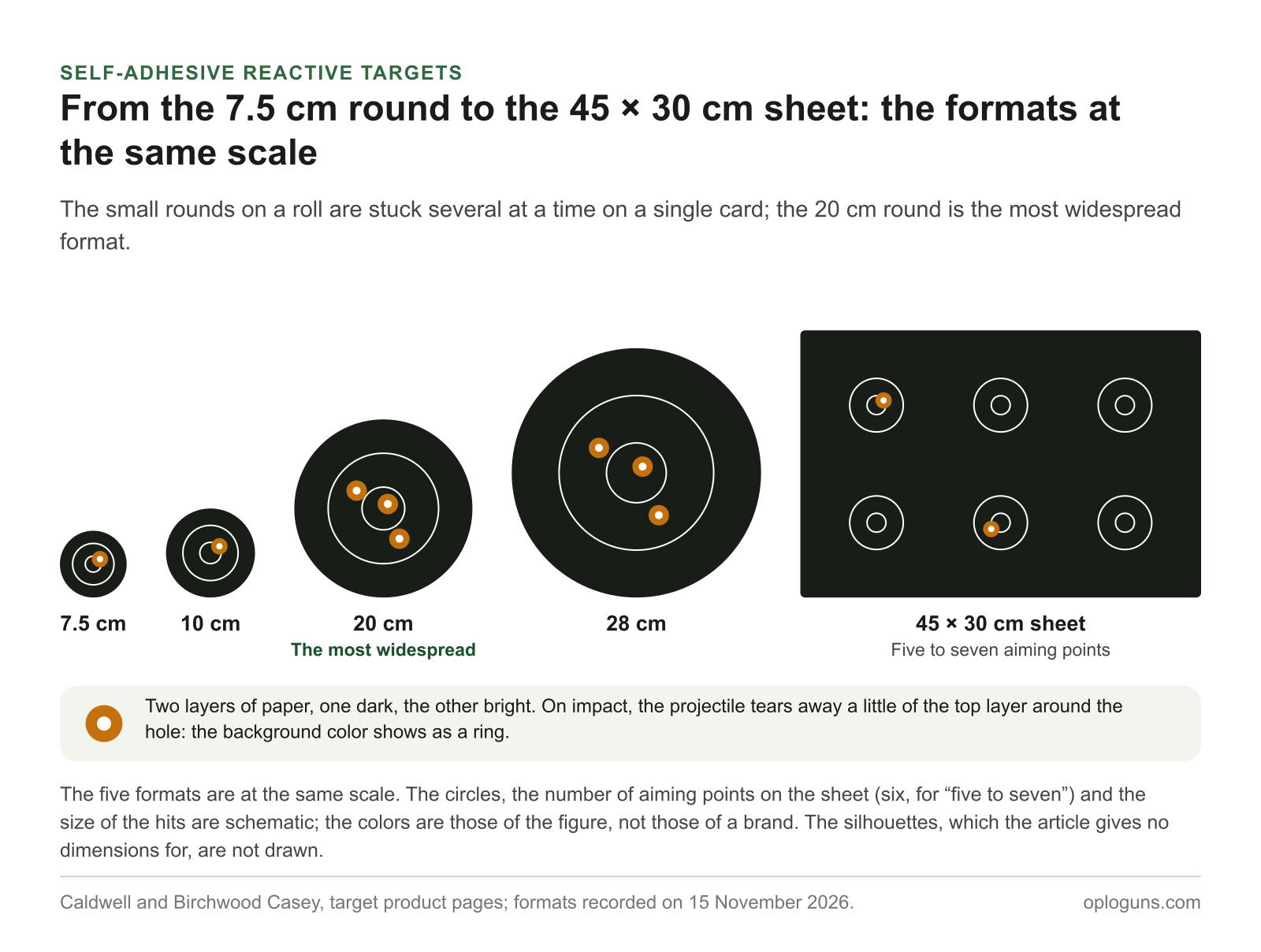
At the impact, the projectile tears away a little of the top layer around the hole. The background color shows as a ring. Caldwell describes a dual-color flake-off technology for its Orange Peel targets1. The product page of Birchwood Casey's Shoot-N-C pasters speaks of two thicknesses of paper, with a fluorescent yellow background that appears as soon as a projectile pierces the paster2.
Three features recur from one brand to the next:
- An adhesive back: the target sticks to almost any surface, without staples or thumbtacks1.
- Repair pasters: they are stuck over the hits and react like the target12.
- A contrasting background: black and yellow, black and green, or orange and black at Caldwell, for aiming with a scope13.
The word has a wider meaning. Any target that reacts to the shot is called reactive: a gong that rings, a plate that tips over. Those targets are covered in gongs and steel targets and in plinking.
What a reactive target is for: reading hits from the line
Every trip to the target and back stops the shooting. The reactive target removes some of them: the hit is read from the firing point, by eye or with a more modest optic.
It is used for three things:
- Zeroing sights: one shot, one reading, one correction. Some sheets carry a grid and several aiming dots, seven on a model about thirty centimeters square3. Converting an offset into clicks is in zeroing your riflescope.
- Working on a group: the ring of color draws the group without waiting for the end of the string.
- Testing ammunition: the comparison is read as you go.
It does not always spare you an optic: the halo enlarges the mark, it does not bring the target closer.
That leaves the choice of format.
Reactive target formats: from a 7.5 cm round to a sheet
| Format | Packaging recorded | Price per target |
|---|---|---|
| 7.5 cm round | Rolls of 100 or 200 | €0.07 to €0.11 |
| 10 cm round | Roll of 100 | €0.12 |
| 20 cm round | Packs of 6 to 25 | €0.32 to €2.83 |
| 28 cm round | Pack of 25 | €0.72 |
| 45 × 30 cm sheet | Pack of 10 | €0.99 |
| Silhouette | Pack of 5 | €4.90 |
Prices recorded on 15 November 2026345.
The 20 cm round is the most widespread format345. The small rounds on a roll are stuck several at a time on a single card. The sheets carry five to seven aiming points, for as many groups3.
Reactive target price: €0.32 to €2.83 in 20 cm
Prices vary ninefold for the same diameter. By 25, a 20 cm target comes to €0.32. By 6, the same size costs €1.33 at one seller and €2.83 at another345.
The ordinary card target is far cheaper:
- 14 × 14 cm card: €0.05 each by 1006.
- 17 × 17 cm card, the 10 m pistol format: €0.09 each by 2506.
- C 50: €0.55 to €1.00 each6.
Over a session of ten 20 cm targets, the reactive target therefore costs €3 to €28. The pasters narrow the gap.
Pasters and stickers: a reactive target can be repaired
A 20 cm target comes with its pasters: about a dozen per target in one line, fourteen black and three red in another34. Stuck over a hit, the paster restores the area. It reacts in turn.
Pasters are also sold on their own: 432 black pasters for €6.13 at the day's price, or €0.014 each4. A target already shot then serves for several strings.
In competition: only the approved target counts
A match is shot on the target its rules specify. ISSF rule 6.3.1.2 sets two conditions: targets that conform to the specifications, and are approved by the ISSF7. A reactive target meets neither: its zones are not those of the rules.
The C 50 shows the scale of the difference. The 25 and 50 m pistol target is a card 550 mm wide (rule 6.3.4.5)7; the most widespread reactive targets are 20 cm. What is sold to renew a C 50 is a replacement center, of 21 × 21 or 26 × 26 cm: from €0.11 to €0.25 each6.
The dimensions of each target are in sport shooting target dimensions. To train on the right dimensions without a store-bought card, printable targets to scale fit on an A4 sheet at 10 m.
Reactive target or paper target: pros and cons
The reactive target
Pros
The paper or card target
Pros
Cons
- Hits hard to see: without an optic, you have to walk to the target or bring it back.
- One target per string: a riddled card can no longer be read.
Putting up a self-adhesive target at the range
The adhesive back holds on almost any surface1. At the range, that surface is the backing card of the target holder, or a target already shot.
Two remarks come from the guides:
- No hard fasteners: to fix a target backing, adhesive tape rather than thumbtacks, clips or paper clips, which can make a projectile ricochet8.
- On steel, paint: Action Target's guide provides for a coat of store-bought paint so the next hit can be read9.
The range's rules decide what may be hung at the firing line. The holder itself is covered in target holders and pellet traps.
Three misconceptions about reactive targets
- "A reactive target replaces the match target." ISSF rule 6.3.1.2 requires a target that conforms and is approved by the ISSF7.
- "A reactive target is used only once." It comes with pasters, twelve to seventeen per 20 cm target, which cover the hits34.
- "They all cost the same." From €0.32 to €2.83 each for a 20 cm round, depending on the brand and the pack34.
Which reactive target for your shooting
Zeroing a scope or a red dot
A gridded sheet with several aiming points gives one group per adjustment, readable from the firing point. In return, it costs about €1 and says nothing about a score.
Training with a pistol at 25 m
The 20 cm round shows every shot without a spotting scope. In return, it has neither the zones nor the size of the C 50: a scored session is shot on the card the rules specify.
Shooting air guns at 10 m
The small 7.5 or 10 cm rounds, at €0.07 or €0.12 each, are stuck several at a time on a card. In return, the ordinary 10 m card costs even less, €0.05 to €0.09, and carries the dimensions of the event.
Preparing for a competition
The approved target, or its copy printed to the right dimensions, teaches the sight picture of the match. In return, the hit is harder to read on it: that is the job of the optic, or of the target carrier.
Sources 9 references
Principle described from one manufacturer and from the product pages of the lines sold in France; competition rules taken from the ISSF technical rules translated by the FFTir, the French shooting federation; prices recorded at three French gun shops. Click a reference number in the text to highlight the matching source.
- Caldwell — Gen 2 Orange Peel "Bullseye" Targets, product page consulted 15 November 2026: "dual color flake-off technology"; high-contrast orange background and black target for aiming with a scope; adhesive back that holds on almost any surface, without staples or thumbtacks; repair pasters supplied in every pack. ⚠️ Manufacturer's data.
- Armurerie Auxerre (in French) — pastilles noires Shoot-N-C pour cibles Birchwood Casey, product page consulted 15 November 2026: reactive line made « de deux épaisseurs de papier » [of two thicknesses of paper], fluorescent yellow background that appears as soon as a projectile pierces the paster; 12 sheets, 432 pasters. ⚠️ A seller's page: Birchwood Casey's site refuses automated reading.
- Armurerie Loisir (in French) — cibles de tir, recorded 15 November 2026: 25 Elite Airgun reactive targets of 20 cm, black and yellow, €7.90, with 14 black and 3 red pasters per target; 25 targets of 28 cm €17.90; 200 targets of 7.5 cm on a roll €14.90, 100 targets of 7.5 cm €10.90; 100 targets of 10 cm, black and green, €11.90; 10 Splatter Pro Targets of 45 × 30 cm, yellow grid, five red dots, €9.90; 5 Ruger Splash targets, gridded, seven one-inch aiming dots, €15.90. ⚠️ Commercial data; apart from the 20 cm round, each format is recorded at a single seller.
- Armurerie Auxerre (in French) — cibles and cibles réactives Birchwood Casey Shoot-N-C 20 cm, recorded 15 November 2026: 6 Shoot-N-C targets of 20 cm €17.00, « une douzaine de gommettes » [about a dozen pasters] per target; 5 Shoot-N-C silhouette targets €24.50; 432 black Shoot-N-C pasters €6.13 (regular price €8.17). ⚠️ Commercial data.
- Armurerie de la Bourse (in French) — cibles et simulateurs, recorded 15 November 2026: 6 Birchwood Casey reactive targets of 8 inches (20 cm) €8.00. ⚠️ Commercial data.
- Prices of card targets, recorded 15 November 2026 (in French): Armurerie Auxerre, cibles, 100 targets of 14 × 14 cm €4.50, C 50 from €0.55 to €0.65 each, 50 C 50 centers of 21 × 21 cm €5.50, of 26 × 26 cm €8.00; Armurerie de la Bourse, cibles et simulateurs, 17 × 17 cm target for 10 m €23.00 per 250, C 50 €1.00, C 50 centers €25.00 per 100. ⚠️ Commercial data.
- FFTir, CNS Arbitrage — Règles techniques ISSF pour toutes les disciplines de tir, édition 2025 [ISSF general technical rules for all shooting disciplines, 2025 edition, in French] (PDF, 2nd printing in force on 1 July 2026, updated 4 July 2026), consulted 15 November 2026: 6.3.1.2, targets conforming to the specifications and which « doivent être approuvées par l'ISSF » [must be approved by the ISSF]; 6.3.4.5, card of the 25 and 50 m pistol target, 550 mm wide; 6.3.4.6, card of 170 × 170 mm for 10 m pistol.
- National 4-H Shooting Sports — Fact Sheet 22, Air Gun Range Setup, Donald L. Burtchin (PDF, revised October 2014), consulted 15 November 2026: fix targets with adhesive tape; thumbtacks, clips and paper clips "can cause ricochets".
- Action Target — Steel Target Safety Guide (6-page PDF, © 2016), consulted 15 November 2026: a steel target is repainted with store-bought paint after shooting.
The rules of the event and of the range prevail. The prices are those of 15 November 2026 and change; the specifications of the targets are those stated by their manufacturers and sellers. A reactive target is a training target: in competition, only the target the discipline's rules specify is allowed.
Frequently asked questions
What is a reactive target?
A paper target with two layers. The projectile tears away a little of the dark layer around the hole and uncovers a bright color, yellow or green depending on the model: the hit is ringed with a halo. Caldwell speaks of a dual-color flake-off technology. Most are self-adhesive and come with pasters that cover the hits.
What is a self-adhesive reactive target for?
For seeing your hits from the firing point, without walking to the target. It is used for zeroing sights or a scope, for working on a group, for testing ammunition. It is not used for counting a match score: its zones are not those of a regulation target.
Is there a reactive C50 target?
The C 50, as French shooters call it, is the card target for 25 and 50 meter pistol, 550 mm wide. A reactive target stuck on it does not make it an approved target: ISSF rule 6.3.1.2 requires targets that conform to the specifications and are approved by the ISSF. To renew a C 50, replacement centers are sold, in 21 × 21 or 26 × 26 cm.
How much does a reactive target cost?
On 15 November 2026, in France, a 20 cm round target cost from €0.32 each, by 25, to €2.83 each, by 6, depending on the brand. The small 7.5 cm rounds on a roll came to €0.07 each, a 45 × 30 cm sheet to €0.99. An ordinary 14 × 14 cm card target costs €0.05.
Does a reactive target work with an air rifle?
Yes: reactive targets are sold under an air gun accessories brand, in rounds of 7.5 to 28 cm, and the product page of a 45 × 30 cm sheet rates it for air rifles as well as for .22 LR. The smallest rounds, 7.5 and 10 cm, are sold in rolls of 100 or 200.
Shoot-N-C, Orange Peel, Splatter: what is the difference?
They are product-line names for the same principle. Shoot-N-C is Birchwood Casey's line, Orange Peel is Caldwell's; "splatter" or "splash" name the halo effect at other brands. The differences come down to the color, the format, the number of pasters supplied and the price per target.
Spotted an error, or a rule that has changed since we checked? Report an error