Steel targets and gongs: steel grade, thickness, distance by caliber, from pellets to big bore
Published on · 14 min read · Anthony Baillon
A steel shooting target, or gong, is a plate of hardened steel, close to 500 Brinell. Its minimum distance is read from its manual: Shoot Steel asks for 100 yards (91.5 m) for its AR500 rifle plates, and 200 yards (182.9 m) beyond 914 m/s at the muzzle. It is shot on a range that allows it.
At a glance
| Plate, according to its manufacturer | Ammunition | Minimum distance |
|---|---|---|
| 6.35 mm of AR500, Action Target | 40-grain .22 LR, 384 m/s at most | 10 yards (9.2 m) |
| 9.5 mm of AR500, Action Target | 124-grain 9 mm, 394 m/s at most | 10 yards (9.2 m) |
| 9.5 mm of AR500, Shoot Steel | Rifle, up to 914 m/s at the muzzle | 100 yards (91.5 m) |
| 9.5 mm of AR500, Shoot Steel | Rifle, beyond 914 m/s | 200 yards (182.9 m) |
| 12.7 mm of AR550, Action Target | .338 Lapua, 1,014 m/s at most | 100 yards (91.5 m) |
- The rule: the minimum distance is read from the plate's manual; it holds neither for another plate nor for a worn one.
- In a match: IPSC sets 7 m for handguns and 50 m for rifles, for its own targets.
- The place: a range whose rules allow metal targets; safety glasses for everyone.
Steel target: hardened steel, never ordinary plate
A bullet that strikes a hard, flat plate shatters, and its fragments, the splatter, leave in the plane of the plate. A steel that is too soft craters. The crater changes the direction of the splatter, and where it goes becomes unpredictable6.
Manufacturers rate these steels by their Brinell hardness. Action Target uses only AR500 and AR550: softer, and the plate pits; harder, and it becomes brittle6. Hardox 500, from the steelmaker SSAB, belongs to the same class: between 470 and 530 HBW guaranteed on plate from 4 to 32 mm9.
The metallic silhouette rulebook, translated by the French shooting federation, names another grade. For safety reasons, it strongly recommends T1 steel, an American standard, or equivalent, and states that Creusabro 8000 is suitable in France. That steel becomes mandatory for big-bore chickens and for field pistol4.
So a gong for firearms is not a piece of sheet metal. The question that remains is how thick.
Steel target thickness: 6.35 mm in .22 LR up to 12.7 mm
A quarter of an inch, or 6.35 mm: roughly the thickness of a pencil. That is the plate Action Target and Caldwell sell for rimfire, in AR500 steel68.
| Source | Target and ammunition | Thickness and steel |
|---|---|---|
| Action Target | .22 LR | 6.35 mm of AR500 |
| Action Target | Centerfire handgun, birdshot | 9.5 mm of AR500 |
| Action Target | Centerfire rifle, shotgun slug | 9.5 mm of AR550 |
| Action Target | .338 Lapua, .50 BMG | 12.7 mm of AR550 |
| French federation's TAR rulebook | Pistol and revolver gongs, shot at 25 m | 12 mm; grade not set |
| IMSSU rulebook, French federation's translation | Big-bore silhouettes, shot at 50 m and beyond | 12 mm (chickens, pigs), 10 mm (turkeys, rams); T1 steel or equivalent |
| IMSSU rulebook | Field pistol silhouettes | 10 or 12 mm; T1 steel or equivalent |
| IMSSU rulebook | .22 LR silhouettes, shot at 25 m and beyond | 6 mm; grade not set |
Sources: Action Target guide6, TAR rulebook 2025-20263, IMSSU rulebook 20254. Action Target's thicknesses are converted from inches: ¼, ⅜ and ½.
The thicknesses in the rulebooks hold for their targets, at the distances of their events. They do not say from what distance to shoot a plate bought in a shop.
A French federation gong does exist: the one used in tir aux armes réglementaires (TAR), the federation's discipline for service arms. Five white plates of 200 × 200 mm, 12 mm thick, spaced 20 cm apart3. The events that use it are described in our article on service-arms shooting, and its dimensions in target dimensions.
Caldwell reserves its quarter-inch plates for rimfire and non-magnum handguns8. The French product pages for Hardox 500 gongs of 10 and 12 mm list calibers, from .22 LR to .300 Winchester Magnum, without giving a distance15. The distance is read elsewhere.
Minimum distance on steel: the manual's, plate by plate
A minimum distance belongs to a plate, not to a caliber. Each manufacturer gives it for its own target, in its grade and thickness, with an ammunition and sometimes a velocity. Shoot Steel writes it: there is no single distance for every steel target7.
| Ammunition | Plate, according to its manufacturer | Minimum distance |
|---|---|---|
| .22 LR | 6.35 mm of AR500, Action Target | 10 yards (9.2 m) |
| 9 mm, .40 S&W, .45 ACP | 9.5 mm of AR500, Action Target; Shoot Steel AR500 plates rated for handguns | 10 yards (9.2 m) |
| Magnum handguns | Shoot Steel plates | 25 yards (22.9 m) and more |
| Shotgun, birdshot or buckshot | 9.5 mm of AR500, Action Target | 10 yards (9.2 m) |
| Shotgun, slug | 9.5 mm of AR550, Action Target | 100 yards (91.5 m) |
| Rifle, up to 914 m/s at the muzzle | 9.5 mm of AR500, Shoot Steel | 100 yards (91.5 m) |
| Rifle, beyond 914 m/s at the muzzle | 9.5 mm of AR500, Shoot Steel | 200 yards (182.9 m) |
| Rifle, from 5.56 to .300 Winchester Magnum | 9.5 mm of AR550, Action Target | 100 yards (91.5 m) |
| .338 Lapua, .50 BMG | 12.7 mm of AR550, Action Target | 100 yards (91.5 m) |
| Long-action and magnum rifles | Shoot Steel plates rated for these cartridges | 200 yards (182.9 m) and more |
Sources: Action Target6, Shoot Steel7. The manufacturers count in yards; the meters are rounded up to the next decimeter. Action Target gives its table for reference only, for its own targets and at the maximum velocities it lists there: 384 m/s for rifle .22 LR, 394 m/s for 124-grain 9 mm, 1,032 m/s for 55-grain 5.56, 883 m/s for .308 and .300 Winchester Magnum, 1,014 m/s for .338 Lapua, 914 m/s for .50 BMG.
These distances hold for a new plate of the brand that publishes them. The velocity threshold weighs on the .223: Action Target lists 55-grain 5.56 × 45 at 3,388 feet per second, or 1,032 m/s6. On a 9.5 mm AR500 plate, Shoot Steel then asks for 200 yards, not 1007.
In a match, each rulebook sets its distances
- IPSC, handgun: at least 7 m from metal targets, fault lines at 8 m1.
- IPSC, rifle: 50 m, fault lines at 51 m2.
- IPSC, shotgun: 5 m with birdshot and buckshot, 40 m with slugs2.
- IPSC, Mini Rifle in .22 LR: 5 m2.
- Service-arms shooting (TAR): gongs at 25 m3.
- Metallic silhouettes: the chickens, the closest targets, at 25 m with a .22 LR pistol, 40 m with a .22 LR rifle, 50 m with a big-bore pistol, 200 m with a big-bore rifle5.
These figures hold for each rulebook's targets, in a match, under the authority of the range officers. They do not carry over to a plate you buy: for that one, the manual sets the minimum.
IPSC backs its own with a penalty: a shot fired at a metal target from inside the minimum distance disqualifies the shooter12. The detail is in our article on the IPSC target, its poppers and its plates. Silhouettes are introduced in getting started in metallic silhouettes.
Bullet velocity: the 914 m/s threshold on steel
Caliber does not tell the whole story. A small, very fast .223 Remington bullet is harder on the plate than a big, slower pistol bullet7.
Shoot Steel sets its distances by muzzle velocity7:
- Up to 914 m/s (3,000 feet per second): 100 yards (91.5 m) at least on its 9.5 mm AR500 plates.
- Beyond 914 m/s: 200 yards (182.9 m) at least on the same plates.
- 12.7 mm AR550 plates: 100 yards (91.5 m) under 853 m/s, 150 yards (137.2 m) above, 200 yards (182.9 m) for long-action rifles.
Caldwell, for its part, rates its 9.5 mm AR500 plates up to 914 m/s at impact, and 4,745 joules8. A cartridge's velocity is read on its box or on a chronograph.
A thicker plate is not shot from closer. It takes more powerful cartridges, at the distance its manual states7.
Angling and hanging a steel target: splatter to the ground
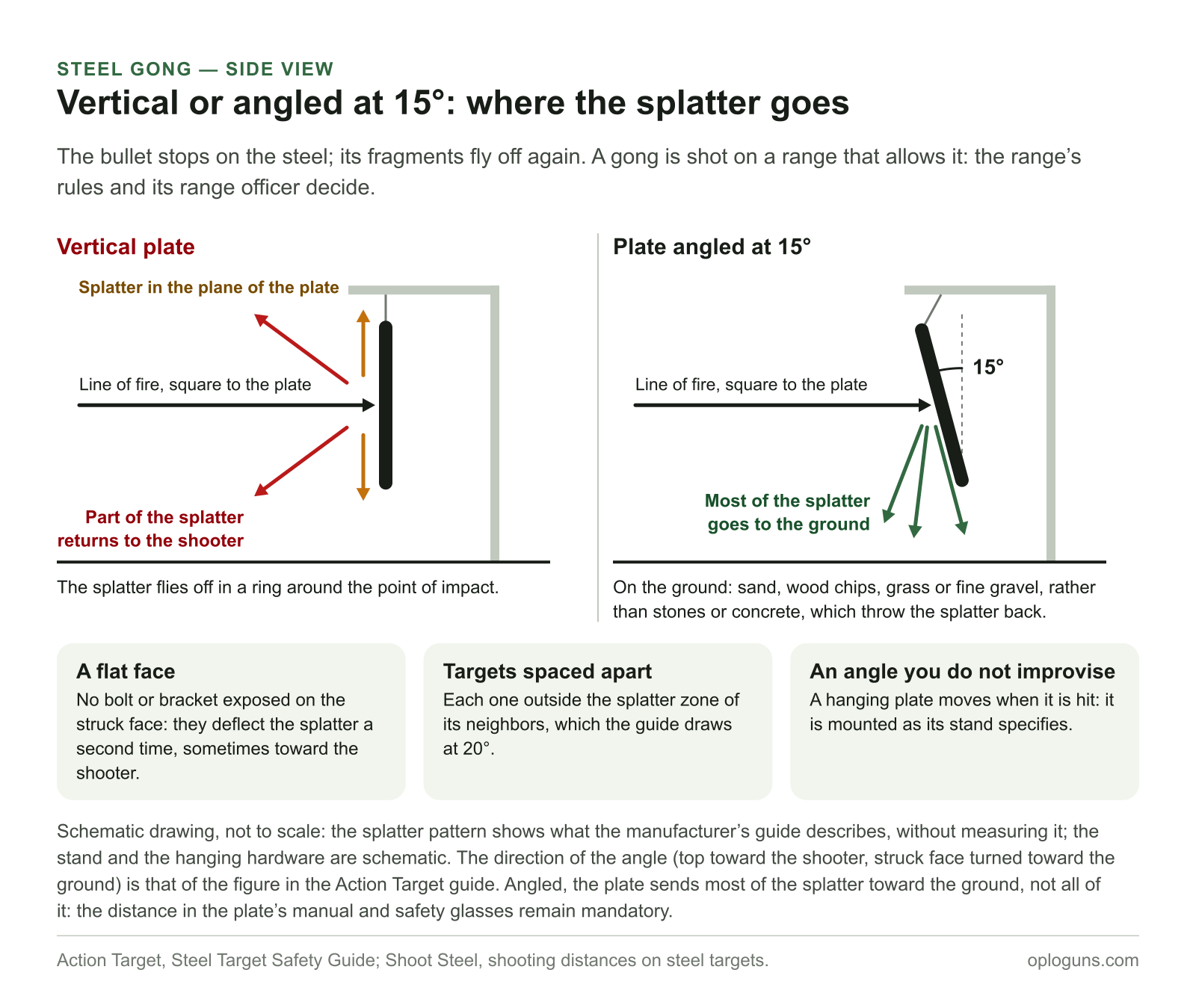
The bullet stops on the steel; its fragments fly off again. Setting up a gong is entirely about sending them toward the ground.
- The angle: a vertical plate throws the splatter out in a ring, part of it toward the shooter. Angled at 15°, it directs most of it downward6.
- A flat face: no exposed bolts or brackets on the struck face. They deflect the splatter a second time, sometimes toward the shooter6.
- The spacing: each target sits outside the splatter zone of its neighbors, which the guide draws over 20°6.
- The ground: sand, wood chips, grass or fine gravel, rather than rocks or concrete, which throw the splatter back6.
- The line of fire: square to the plate, not at an angle7.
The rulebooks point the same way. IPSC prohibits metal targets that can turn edge-on when hit1. The TAR rulebook allows gongs mounted on a fixed axle that can be reset from the firing line, their center 1.40 m above the ground at 25 m3.
A hanging plate moves when it is hit. Shoot Steel asks that it be mounted the way its stand provides, without improvising its angle7.
Ammunition ruled out on steel: armor-piercing, tracer
Three families of ammunition are excluded by the manufacturers: steel-core bullets, armor-piercing bullets and tracers67. What counts is the inside of the bullet, not its jacket: a jacketed bullet with a lead core is suitable, on a plate made for its caliber7.
The silhouette rulebook says the same for the big-bore rifle. Armor-piercing or tracer bullets are not allowed there4.
Action Target adds a lower bound. No ammunition slower than 122 m/s, no BBs, no airsoft, on its steel targets6. A hard BB that strikes a hard surface bounces back toward the shooter12.
Worn steel target: at the first crater, distance goes up
A sound plate loses nothing but its paint. One pass with a spray can, and the next hit shows again6.
A crater changes everything. Action Target sets three stages6:
- At the first shot: inspect the plate. Any dent, and the distance goes up.
- Light cratering: the plate is now shot only at 100 yards (91.5 m) and beyond, whatever the gun.
- Deep craters, holes or cracks: the plate is taken out of service.
The silhouette rulebook lets the match director ban a load that pierces the plate or digs a crater deeper than a quarter of its thickness4. On a 12 mm plate, that makes 3 mm.
Steel also holds on to the lead dust from the impacts. Action Target advises gloves for handling its targets, and washing your hands before eating6. The subject is covered in our article on lead at the shooting range.
Knock-down steel targets for airguns: another family
The gong makers' guides give neither a plate nor a distance for airgun pellets67. Metal targets for pellets are a different object: sheet steel, paddles that tip or swing, often a tray that collects the pellets.
Gamo sells several kinds: paddles that flip up and that a shot on the center paddle resets, a box with five swinging plates, field target silhouettes that fall and are pulled back up by a string11. This kind of recreational shooting at targets that react has a name, plinking.
The limit of these targets is counted in joules, and it varies from one model to the next:
- 7.5 joules: the power Umarex France allows for its 17 × 17 cm target holder with swinging targets10.
- 20 joules: the maximum power one retailer states for a target holder with five gongs, at more than 25 m; it gives 7.5 joules at 10 m as the minimum13.
- .22 LR: some plate racks are sold for 4.5 mm pellets as well as for .22 LR; their product page sets .22 LR as the maximum13.
The projectile counts as much as the power. A steel BB, being hard, readily bounces back toward the shooter when it strikes a hard surface; a lead pellet, being soft, flattens and loses its energy12. The difference between these projectiles is set out in steel BB, diabolo pellet or airsoft BB. To stop pellets behind a paper target, the target holder and the pellet trap do a different job.
Steel target prices: €15 for airguns to €130 in .22 LR
Prices recorded on 15 November 2026.
| Family | Example | Price |
|---|---|---|
| Knock-down targets for airguns | Paddle rack, five-gong box, field target | €15 to €7513 |
| Gongs for rimfire | Set of eight 6.35 mm AR500 discs on a frame | €129 to €13014 |
The plate is not everything: a hanging gong also needs a stand, and chains or straps.
At the range: the range rules decide on steel targets
A gong is shot on a range that allows it. A range may refuse it: steel calls for a distance, a ground surface and a line of fire that not every firing line offers. The range's rules and its range officer decide.
Within the French shooting federation, steel is found in three disciplines:
- Service-arms shooting (TAR): five gongs at 25 m, in two pistol and revolver events; one .22 LR rifle event is shot on five biathlon-style knock-down targets, at 25 or 50 m3.
- Metallic silhouettes: steel targets to knock over, from 25 to 500 m depending on the gun5.
- Tir sportif de vitesse (TSV), the French name for IPSC shooting: poppers and plates, at 7 m at least1. The entry requirements are in getting started in TSV.
Steel Challenge, shot entirely on steel plates, does not appear in the French federation's list of disciplines16: our article on Steel Challenge in France takes stock. The distances for big-bore rifles, for their part, lead to the question of where to shoot beyond 300 m.
Last, the eyes. The TAR rulebook imposes safety glasses on every person present at the firing line3. Action Target asks for wraparound ones in front of steel6. The marking to read on the frame is explained in safety glasses and the EN 166 standard. To find a firing line, there is the directory of French shooting ranges.
Three misconceptions about shooting steel targets
- "A hard steel eliminates ricochets." It makes them predictable. A vertical plate still sends part of the splatter back toward the shooter, according to Action Target6.
- "Thicker, so closer." A 12.7 mm plate takes more powerful cartridges; it keeps its minimum distance, writes Shoot Steel7.
- "A small caliber goes easy on the steel." Velocity wears more than diameter: beyond 914 m/s at the muzzle, Shoot Steel doubles the distance on its 9.5 mm AR500 plates, from 100 to 200 yards7.
Which steel target for your gun
Airguns, up to 20 joules
A knock-down target made for pellets gives the same pleasure as a gong, for €15 to €75. In return, its manual sets a power, 7.5 or 20 joules depending on the model, and it is not suitable for steel BBs unless the manufacturer says so.
.22 LR
Action Target and Caldwell sell 6.35 mm AR500 plates for rimfire; Action Target gives 10 yards (9.2 m) at least for its own. In return, that plate takes nothing else: no centerfire rifle, no magnum caliber.
Pistol, 9 mm to .45 ACP
A 9.5 mm AR500 plate covers these calibers, at the distance in its manual: 10 yards (9.2 m) at Action Target and Shoot Steel. IPSC sets 7 m for its own targets, in a match. In return, these are the distances at which the most splatter comes back: angle, flat face and safety glasses matter more here than anywhere else.
Big-bore rifle
An AR500 or AR550 plate rated for the cartridge, at the distance in its manual: 100 yards (91.5 m) at least at both manufacturers, 200 yards (182.9 m) beyond 914 m/s at the muzzle on Shoot Steel's 9.5 mm AR500 plates. In return, few firing lines offer these distances, and the plate needs watching: at the first crater, it moves back or comes down.
Sources 16 references
Regulatory distances and thicknesses come from the rulebooks of IPSC and of the FFTir, the French shooting federation; safety instructions from the guides of steel target manufacturers; prices from readings at French gun shops. The federation's documents and the retailers' pages are in French, the IPSC rules and the manufacturers' guides in English. Click a note marker in the text to highlight the matching source.
- IPSC — IPSC Handgun Competition Rules, January 2026 Edition (81-page PDF, final version of 29 December 2025, linked from the IPSC's "Rule Books" page), consulted on 15 November 2026: 2.1.3, "a minimum distance of 7 meters" from metal targets, fault lines at 8 meters at least; 10.4.7, shot fired at a metal target from less than 7 meters, in the disqualifications section; 4.3.1.1, prohibition of metal targets that can turn edge-on when hit.
- IPSC — Rifle Competition Rules and Shotgun Competition Rules, January 2024 edition (copies from the IPSC's Czech region), and Mini Rifle Competition Rules, April 2023 edition, consulted on 15 November 2026: rule 2.1.3 of each rulebook, 50 meters for rifle (fault lines at 51 meters; 10.4.7), 5 meters for shotgun with birdshot and buckshot, 40 meters with slugs, 5 meters in Mini Rifle. ⚠️ 2023 and 2024 editions: the edition in force is checked on the IPSC's "Rule Books" page, which refuses automated reading.
- FFTir, CNS TAR — Règlement TAR 2025-2026 [TAR rulebook 2025-2026] (PDF, circulated on 12 January 2026), consulted on 15 November 2026: chapter VII.1, gong made up of five white knock-down targets « de 200 x 200 mm, ép. 12 mm » [200 × 200 mm, 12 mm thick], spaced 20 cm edge to edge, center at 1.40 m (± 10 cm) at 25 m, gong systems on a fixed axle that can be reset from the firing line allowed; events 830 and 832, two series of five shots on gongs, 5 points per gong, calibers from 7.62 to 11.60; event 821, .22 LR rifle, five biathlon-style knock-down targets, at 25 or 50 m; chapter III, 10, safety glasses for shooters and every person present at the firing line.
- IMSSU, FFTir translation — Règlement sportif officiel IMSSU 2025 [official IMSSU sporting rules 2025] (PDF, updated by the CNS Arbitrage in March 2025), consulted on 15 November 2026: general technical rules, section III, B, T1 steel « ou équivalent » [or equivalent] strongly recommended for big-bore silhouettes, mandatory for field pistol and big-bore chickens, Creusabro 8000 cited for France; specific rules, steel thickness of 12 mm (chickens and pigs) and 10 mm (turkeys and rams) for big-bore pistol and rifle, 6 mm for smallbore pistol and rifle, 10 or 12 mm in field pistol; big-bore rifle, armor-piercing or tracer bullets not allowed, crater of more than a quarter of the plate's thickness.
- FFTir — discipline « Silhouettes métalliques » [metallic silhouettes], consulted on 15 November 2026: « 25-50-75-100 mètres pour les armes de poing petit calibre » [25-50-75-100 meters for smallbore handguns], 50 to 200 meters for big-bore handguns, 40 to 100 meters for smallbore long guns, 200 to 500 meters for big-bore ones.
- Action Target — Steel Target Safety Guide (6-page PDF, © 2016), consulted on 15 November 2026: only AR500 and AR550 used; soft steel that craters, harder steel brittle; flat face, with no bolts or brackets; plate at 90° and at 15°; 20° splatter zone; ground free of rocks and concrete; steel table: ¼ inch of AR500 for rimfire and ⅜ inch of AR500 for centerfire handguns and birdshot, "10 Yards"; ⅜ inch of AR550 for centerfire rifles and shotgun slugs, ½ inch of AR550 for .338 Lapua and .50 BMG, "100 Yards"; no ammunition under 400 feet per second, no BBs, no airsoft, no armor-piercing or steel-core ammunition; inspection, craters, removal; wraparound glasses, gloves, lead dust. ⚠️ Guide from an American manufacturer, valid for its targets; table given "for reference only".
- Shoot Steel — How Far Away Should You Shoot Steel Targets? Safe Distances by Caliber, 14 July 2026, consulted on 15 November 2026: 10 yards for 9 mm, .40 S&W and .45 ACP, 25 yards and more for magnum handguns, 100 yards for .223, .308 and 6.5 Creedmoor, 150 to 200 yards and more for fast or magnum rifles; threshold of 3,000 feet per second on ⅜-inch AR500 plates, of 2,800 on ½-inch AR550 plates; "There is no single safe distance for every steel target"; thickness and distance; steel-core, armor-piercing and tracer ammunition excluded; shooting square to the plate; mounting according to the stand. ⚠️ American manufacturer; distances specific to its targets.
- Caldwell — AR500 5" Caldwell C and AR500 1/4" Rimfire/Handgun 8" Plates, product pages consulted on 15 November 2026: ⅜-inch AR500 steel, "Rated up to 3,000 fps impact velocity", 3,500 ft-lb of impact energy (4,745 J); ¼-inch plates for all rimfire cartridges and non-magnum handgun cartridges. ⚠️ Manufacturer's technical data.
- SSAB — Hardox 500, data sheet consulted on 15 November 2026: plate from 4 to 32 mm, hardness of 470 to 530 HBW; plate from 32.1 to 103 mm, 450 to 540 HBW. ⚠️ Data sheet for a wear steel: SSAB gives no shooting instructions in it.
- Umarex France — porte-cible 17 × 17 Perfecta [Perfecta 17 × 17 target holder], product page consulted on 15 November 2026: « conçu pour le tir à air comprimé jusqu'à 7,5 joules » [designed for airgun shooting up to 7.5 joules], deflector, swinging targets (two ducks and two 35 mm circles) or 17 × 17 cm paper targets.
- Gamo — Targets, pages consulted on 15 November 2026: Rocker Bullet Trap (paddles that lock in the up position, reset by a shot on the center target), 5 Targets Pellet Trap Box, Squirrel Field Target (the target falls, reset by a 45 m string), Plinking Target. ⚠️ No energy limit on these pages.
- National 4-H Shooting Sports — Fact Sheet 22, Air Gun Range Setup, Donald L. Burtchin (PDF, revised in October 2014), consulted on 15 November 2026: BBs, being hard, bounce back toward the shooter off a hard surface; pellets, made of soft lead, deform and lose their energy; eye protection mandatory.
- Prices of metal targets for airguns, recorded on 15 November 2026: Armurerie Auxerre, cibles métalliques, from €14.50 (rack of nine targets) to €66.90 (Gamo Rocker), and porte-cibles Gamo 5 gongs, €61.90, « Max 20 joules », minimum power of 7.5 J at 10 meters; Armurerie Loisir, cibles de tir, from €15.90 to €59.90, including a three-plate rack (€24.90) and a five-zone spinning target (€34.90) rated for 4.5 mm pellets and .22 LR; Armurerie de la Bourse, Gamo Rocker €65.00; Armurerie Douillet, Gamo 5 gongs, €75.00. ⚠️ Commercial data; the powers allowed are those on the retailers' pages.
- Prices of gongs for rimfire, recorded on 15 November 2026: Armurerie Auxerre, Caldwell AR500 KYL Challenge Target, eight ¼-inch AR500 discs, €129.00; Armurerie de la Bourse, cibles et simulateurs, Caldwell Rimfire KYL €129.00 and €130.00. ⚠️ Commercial data.
- Armurerie Lavaux — gongs Gun Gong and gongs MTS, product pages consulted on 15 November 2026: Hardox 500 gongs of 10 mm (Gun Gong, 200 × 200 mm square) and 12 mm (MTS, 200 mm round); calibers advertised from .22 LR to .300 Winchester Magnum; no shooting distance on these pages. ⚠️ A retailer's product pages.
- FFTir — Règlement de gestion sportive 2026-2027, Vie nationale [sporting management rules 2026-2027] (PDF, version of 29 September 2026), consulted on 15 November 2026: list of disciplines — Carabine, Pistolet, Para-tir, Plateau; Arbalète, Armes anciennes, Bench-Rest, Silhouettes métalliques, Tir sportif de vitesse; Écoles de tir, Tir aux armes réglementaires [rifle, pistol, para shooting, clay; crossbow, historic arms, benchrest, metallic silhouettes, IPSC-style action shooting; shooting schools, service-arms shooting].
The target's manual and the range's rules prevail. The distances and thicknesses cited are those of the rulebooks and manufacturers named, for their events and for their targets; they do not carry over to a plate of another origin or to a worn plate. Shooting at metal targets is done on a range that allows it, under the authority of the range officer.
Frequently asked questions
What thickness for a .22 LR steel target?
Action Target and Caldwell sell quarter-inch plates, or 6.35 mm, in AR500 steel for rimfire. Action Target gives a minimum distance of 10 yards, or 9.2 meters, for its own, with a 40-grain .22 LR at 384 m/s at most. The metallic silhouette rulebook sets 6 mm for its smallbore targets, without naming a steel grade: those silhouettes are shot at 25 meters and beyond.
How far away should you shoot a steel target with a pistol?
At the distance given in the plate's manual. Action Target and Shoot Steel ask for 10 yards, or 9.2 meters, for their AR500 steel plates rated for handguns, in 9 mm, .40 S&W and .45 ACP; Shoot Steel asks for 25 yards, or 22.9 meters, and more for magnum calibers. In a match, IPSC imposes 7 meters for its own targets. The French service-arms discipline, TAR, places its gongs at 25 meters.
Which steel for a big-bore gong?
A hardened steel with a hardness close to 500 Brinell. Action Target uses only AR500 and AR550; SSAB guarantees its Hardox 500 between 470 and 530 HBW. The metallic silhouette rulebook asks for T1 steel or equivalent, and cites Creusabro 8000 for France, in 10 or 12 mm. The distance depends on the plate and the velocity: Shoot Steel asks for 100 yards, or 91.5 meters, on its 9.5 mm AR500 plates up to 914 m/s at the muzzle, and 200 yards, or 182.9 meters, beyond.
Can you shoot an air rifle at a gong made for firearms?
The Action Target and Shoot Steel guides give no distance for airgun pellets on their plates. Action Target rules out BBs, airsoft and any ammunition slower than 400 feet per second, or 122 m/s, on its steel targets. The knock-down targets sold for airguns are a family of their own, whose manual sets the power allowed: 7.5 joules for a target holder with swinging targets from Umarex France, for example.
Does a Hardox gong eliminate ricochets?
No. A hard steel stays flat, which makes the splatter predictable; it does not eliminate it. According to the Action Target guide, a plate held vertical still sends part of the splatter back toward the shooter. Hence the angled plate, the minimum distances and the safety glasses.
Can you set up a gong on any firing line?
No: a gong is shot on a range that allows it, under the range's own rules. Within the French federation, steel is found in service-arms shooting, metallic silhouettes and IPSC-style action shooting, with targets and distances set by each rulebook.
Spotted an error, or a rule that has changed since we checked? Report an error