Steel Challenge: the principle, the eight stages and where it stands in France
Published on · 11 min read · Anthony Baillon
Steel Challenge is an American discipline of speed shooting at steel plates: five plates per stage, eight official stages, time as the only score. Its rulebook, September 2026 edition, is published by the USPSA. In France, it is not among the disciplines of the FFTir, the French shooting federation, for the 2026-2027 season.
At a glance
| Point | What the rulebook says | Rule |
|---|---|---|
| Targets | 5 steel plates per stage, including the stop plate | 9.1.1 |
| Score | Time; the best 4 strings out of 5 | 9.1, 9.1.2 |
| Missed plate | + 3 seconds; missed stop plate: 30 seconds | 9.3, 9.4 |
| Stages | 8 official, plates from 6.40 to 32 m | Appendix B |
- The text: Steel Challenge (SCSA) Rules, edition 2026-09, in force on 1 September 2026, in English.
- In France: neither the 2026-2027 sports management rules nor the rules of tir sportif de vitesse (TSV, the FFTir's IPSC discipline) mention it.
- What exists in France on steel: the poppers and plates of tir sportif de vitesse, and metallic silhouette.
Steel Challenge: five plates, and time as the score
The rulebook states its principle in one sentence: "your time is your score; lowest time wins"1. No zones, no points, no power factor to reach.
Each stage lines up five steel plates. Four are ordinary plates; the fifth is the stop plate. Each of the first four must be hit at least once, then the stop plate stops the time (rule 9.1.1)1.
- The number of shots is free: the shooter fires as many rounds as they see fit.
- Five strings per stage: each run at the five plates is a string. The worst is thrown out, the other four are added up (rule 9.1.2).
- The match: the sum of the times of all the stages, the lowest total on top1.
Timing is done with a shot timer, a stopwatch that hears the shots: the time stops at the last shot fired, and hits are judged by eye (rules 9.2.2 and 9.5)1. The device is described in our article on the shot timer.
The eight Steel Challenge stages, from 6.40 to 32 m
The stages are not invented: there are eight of them, numbered SC-101 to SC-108, and dimensioned on the diagrams in appendix B1. Distances there are in feet; the table converts them into meters.
| Stage | Four plates | Stop plate |
|---|---|---|
| 5 to Go (SC-101) | 4 rounds of 25.4 cm, at 9.14, 10.97, 13.72 and 16.46 m | Round of 30.5 cm, at 6.40 m |
| Showdown (SC-102) | 2 rounds of 25.4 cm at 9.14 m; 2 rectangles at 22.86 m | Round of 30.5 cm, at 10.97 m |
| Smoke & Hope (SC-103) | 4 rectangles, at 6.40 and 8.23 m | Round of 30.5 cm, at 12.80 m |
| Outer Limits (SC-104) | 2 rounds of 30.5 cm at 18.29 m; 2 rectangles at 32.00 m | Round of 30.5 cm, at 16.46 m |
| Accelerator (SC-105) | 1 round of 25.4 cm and 1 rectangle at 9.14 m; 1 round of 30.5 cm and 1 rectangle at 18.29 m | Round of 30.5 cm, at 13.72 m |
| The Pendulum (SC-106) | 2 rounds of 25.4 cm and 2 of 30.5 cm, at 16.46 m | Round of 30.5 cm, at 9.14 m |
| Speed Option (SC-107) | 4 rounds of 30.5 cm, at 7.32, 9.14, 13.72 and 18.29 m | Rectangle, at 32.00 m |
| Roundabout (SC-108) | 4 rounds of 30.5 cm, at 6.40 and 13.72 m | Round of 30.5 cm, at 9.14 m |
Source: diagrams in appendix B, edition 2026-091; conversion at 0.3048 m per foot. The rectangles measure 45.7 × 61 cm.
The shooter does not move: everything is shot from a box 0.91 m square, fixed to the ground. Two stages are exceptions (rule 2.2)1:
- Showdown: two boxes, three strings in one and two in the other, with no movement during a string.
- Outer Limits: three boxes 1.22 m square, spaced 1.83 m apart. The shooter starts from the box on their weak-hand side, shoots the two plates on that side, then moves to the middle box, with the timer running. Four strings only, of which the best three count.
The eight stages therefore call for at least 195 rounds: five per string, five strings on seven stages, four on the eighth. Every missed shot adds to that.
Not every range has 32 meters. A Level II match can be limited to six stages, and leave out Outer Limits and Speed Option, the two that need them (appendix A1)1.
Steel Challenge plates: 25.4 cm, 30.5 cm, 45.7 × 61 cm
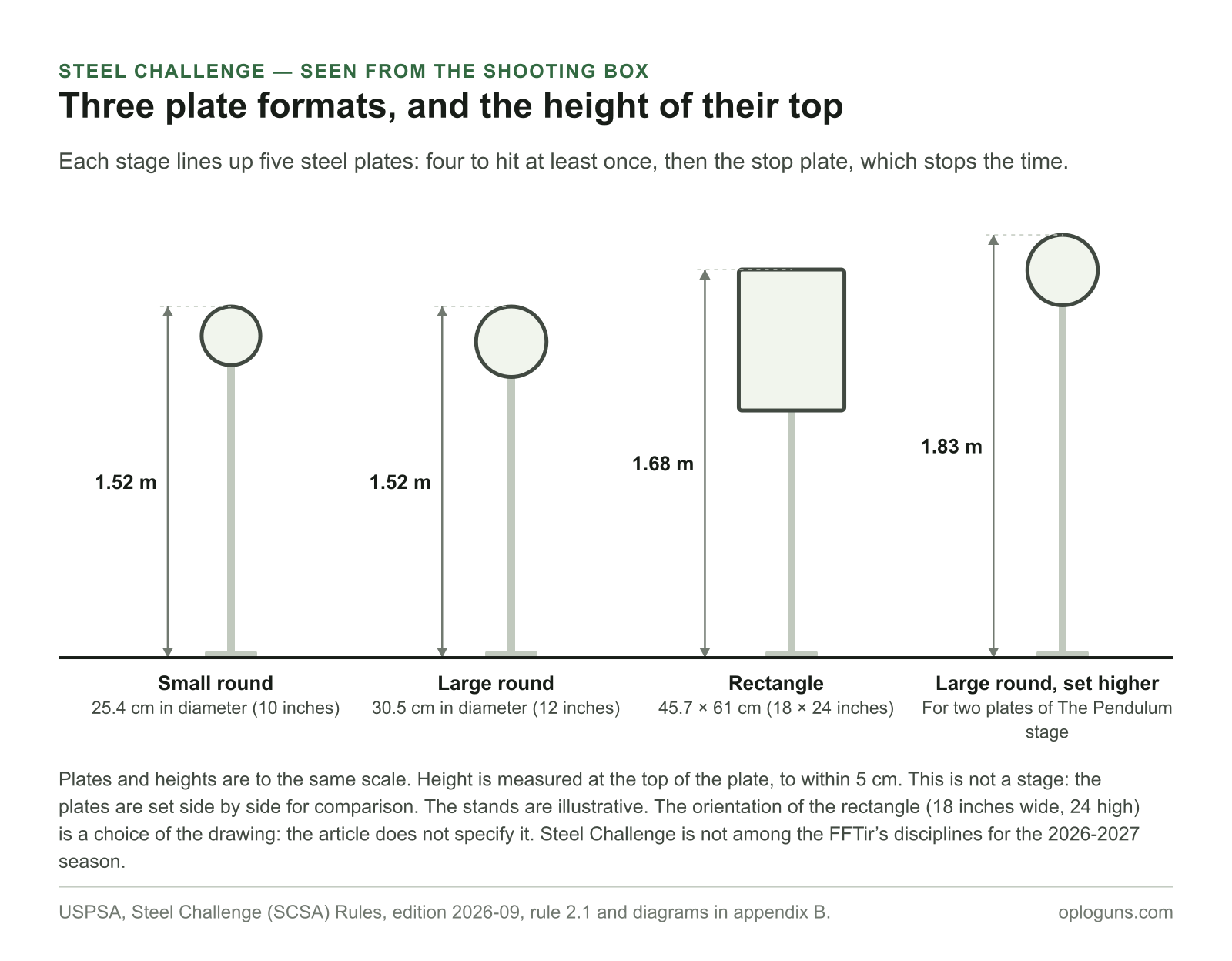
Three plate formats are enough for the eight stages, according to the captions of the diagrams1:
| Plate | Original dimension | In centimeters | Height of the top |
|---|---|---|---|
| Small round | 10 inches | 25.4 cm in diameter | 1.52 m |
| Large round | 12 inches | 30.5 cm in diameter | 1.52 m; 1.83 m for two plates of The Pendulum |
| Rectangle | 18 × 24 inches | 45.7 × 61 cm | 1.68 m |
Source: diagrams in appendix B and rule 2.11.
The small round has the diameter of a dinner plate. Heights are measured at the top of the plate, as seen from the shooting box, with a tolerance of 5 cm (rule 2.1). The plates are angled toward the box to limit ricochets (rule 2.2)1.
A hit is judged by the mark, not by a fall. A clear mark of the bullet on the edge or on the face counts (rule 9.3.2), and the plates are repainted once the range has been declared clear (rule 8.3.10)1.
Steel Challenge scoring: 3 seconds per missed plate
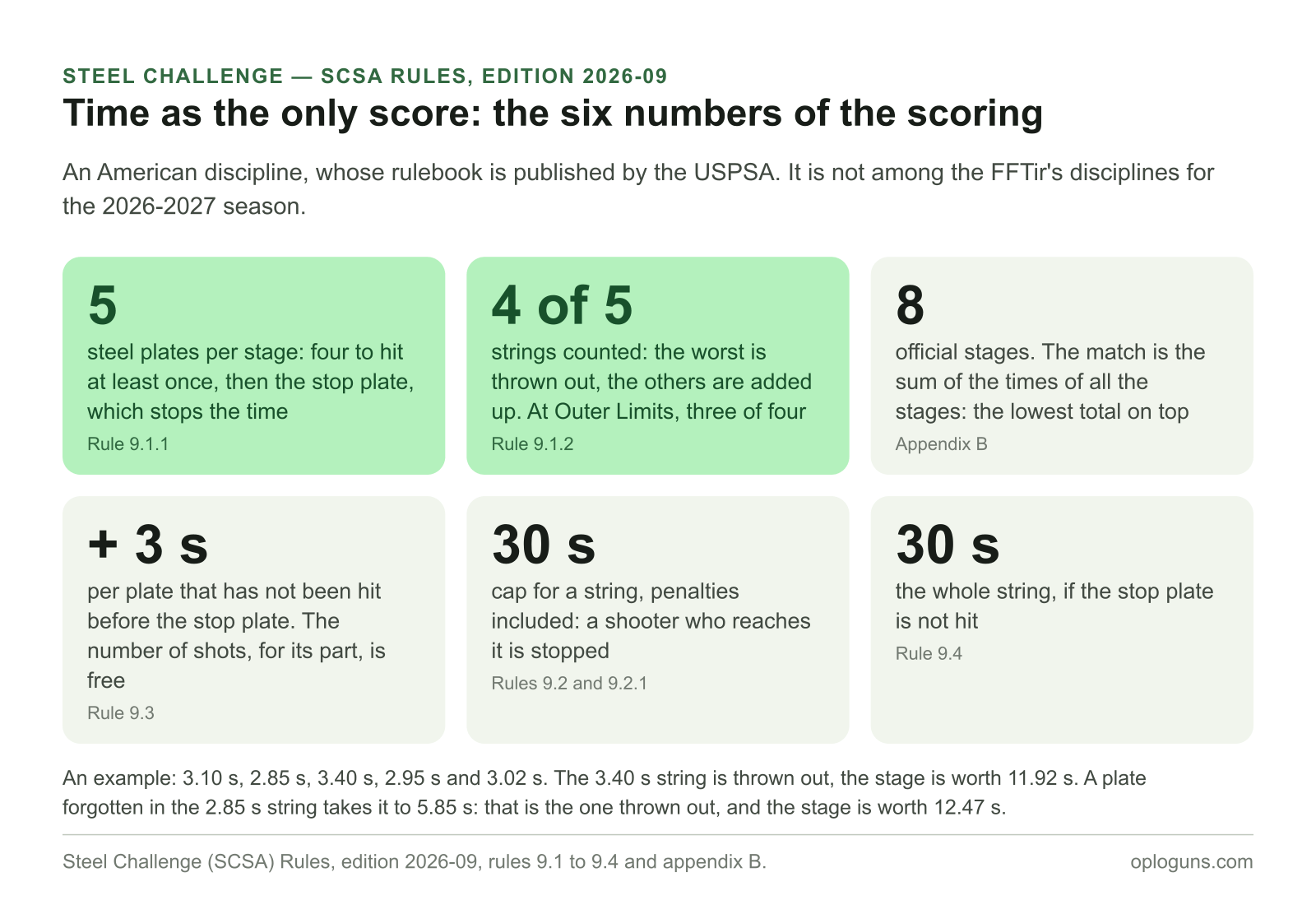
An ordinary plate that has not been hit before the stop plate counts as missed. Each one adds 3 seconds to the time of the string (rule 9.3)1.
- Cap for a string: 30 seconds, penalties included. A shooter who reaches it is stopped (rules 9.2 and 9.2.1).
- Stop plate not hit: the string is worth 30 seconds (rule 9.4).
- Challenge: it is made at the end of the string, before the next one; the range officer goes to look at the plate (rules 9.3.1 and 9.3.3)1.
An example, on a five-string stage: 3.10 s, 2.85 s, 3.40 s, 2.95 s and 3.02 s. The 3.40 s string is thrown out; the stage is worth 11.92 s. A single plate forgotten in the 2.85 s string would have taken it to 5.85 s: that is the one that would have been thrown out, and the stage would have been worth 12.47 s.
Start and commands: holstered, or muzzle on a marker
The start position depends on the gun1:
- Centerfire handgun: gun loaded in the holster, hands raised, wrists above the shoulders (rule 8.2.2).
- Rimfire pistol and rifle, pistol caliber carbine: gun in hand, pointed at a marker placed 3.05 m in front of the box, between 46 and 61 cm from the ground, finger outside the trigger guard (rule 8.2.3). Rimfire events are shot without a holster (rule 5.1.1).
The commands follow in this order (rule 8.3)1:
- "Make ready": the shooter prepares their gun, facing the targets. They have one minute at most, and may take a sight picture.
- "Are you ready?": no answer counts as agreement.
- "Stand by": the start signal follows within 1 to 4 seconds.
- "If you are finished, unload and show clear", after the last string: the shooter unloads their gun and presents it.
- "If clear, hammer down, holster": last check, then back into the holster or the bag.
- "Range is clear": the stage is over.
Steel Challenge divisions: eleven, including PCC
The September 2026 edition has eleven equipment divisions, detailed in appendices D1 to D111:
- Seven handgun divisions: Open, Limited, Production, Single Stack, Revolver, Carry Optics, Limited Optics.
- Three rimfire divisions: Rimfire Pistol and Rimfire Revolver for handguns, the latter on a provisional basis, and Rimfire Rifle for rifles.
- One pistol caliber carbine division: Pistol Caliber Carbine, with or without an optic.
A shooter can enter several divisions of the same match, with a single gun per division (rule 6.3.3)1.
In Production, the power factor lines of the table read "NA for Steel Challenge": no minimum power is required, and the magazine is limited to 15 rounds (appendix D4). For carbines, velocity is capped at 1,600 feet per second, or 488 m/s, and a shoulder stock is compulsory (appendix D8)1. The carbine itself, and its classification in France, are covered in our article on the 9 mm PCC.
The rulebook also provides for four match levels, from local (Level I) to the world championship (Level IV), and a shooter classification reserved for members of the USPSA and the SCSA (appendices A1 and A4)1.
Steel Challenge and IPSC: what separates them
Both disciplines are shot fast and look alike from a distance. Their rulebooks diverge on almost everything.
| Point | Steel Challenge | IPSC, TSV in France |
|---|---|---|
| Score | Time alone | Hit factor: points divided by time |
| Targets | 5 steel plates | Paper, poppers and plates; never plates alone |
| Stages | 8 fixed stages | Freestyle, with no imposed shooting position |
| Power | No minimum in Production | Minor factor of 125 at least |
| Closest steel | Plates at 6.40 m | 7 m at least |
| Rulebook | SCSA, published by the USPSA | IPSC |
Sources: Steel Challenge Rules, edition 2026-091; IPSC Handgun rules, January 2026 edition2.
Two lines of that table make the stages incompatible. IPSC forbids a stage made up of metal plates alone (rule 4.3.3.3), and requires at least 7 meters between the shooter and steel (rule 2.1.3)2. Three Steel Challenge stages place a plate at 21 feet, or 6.40 m1.
IPSC targets are detailed in our article on the IPSC target, its poppers and its plates, and the discipline in our guide to IPSC in France.
Steel Challenge in France: absent from FFTir texts
The FFTir's 2026-2027 sports management rules draw up the list of federal disciplines. Among the so-called world disciplines: crossbow, historical arms, benchrest, metallic silhouette and tir sportif de vitesse3. Steel Challenge is not there.
The federation describes itself as « affiliée aux six fédérations internationales qui gèrent les différentes disciplines de Tir sportif » [affiliated with the six international federations that govern the various sport shooting disciplines]: ISSF, MLAIC, IMSSU, IAU, IPSC and WBSF5. The Steel Challenge Shooting Association is not one of them. Its rulebook, moreover, reserves its name for matches held by a club or range affiliated with it (appendix A1)1.
Two texts collide on the holster start. The administrative rules of tir sportif de vitesse, dated the 2019-2020 season, forbid, outside an approved association or without a TSV instructor, « tout exercice de tir comportant l'usage d'une arme portée à l'étui (dégainé) » [any shooting exercise involving the use of a holstered firearm (drawing)]4. Steel Challenge, for its part, starts the centerfire handgun from the holster1.
As of 15 November 2026, then, none of these texts provides for a match, a calendar or a club for Steel Challenge. Check any local announcement with the club itself: the rulebook it applies, and its affiliation.
To shoot steel within a federal framework, two disciplines exist:
- Tir sportif de vitesse: poppers and plates sit alongside paper targets there, at an approved club. The entry conditions are in our article on getting started in TSV.
- Metallic silhouette: steel targets to knock down, one bullet per target. The discipline is presented in getting started in metallic silhouette.
Three misconceptions about Steel Challenge
- "Steel Challenge is an IPSC event." Its rulebook is that of the SCSA, published by the USPSA1; IPSC forbids a stage made of plates alone2.
- "Every missed shot costs a penalty." The number of shots is free. Only a plate that has not been hit before the stop plate adds 3 seconds1.
- "The plate has to fall." A clear mark on the edge or on the face is enough1.
Steel Challenge or federal shooting, depending on the goal
To shoot fast at steel in France, tir sportif de vitesse brings a federal framework, approved clubs and a French championship. In return, steel never comes alone there, and the score mixes points with time.
To knock metal down, metallic silhouette brings a federal discipline, from pistol to rifle. In return, the score there counts fallen targets, not time.
For Steel Challenge itself, the rulebook and its eight stages can be read online, in English. In return, no French federal text organizes it.
Sources 5 references
The rules come from the Steel Challenge rulebook, September 2026 edition, and the IPSC Handgun rulebook of January 2026, both in English; the French situation, from the FFTir's texts, in French. Click a note marker in the text to highlight the matching source.
- USPSA — Steel Challenge (SCSA) Rules, "Edition 2026-09 · effective 2026-09-01", consulted on 15 November 2026: 2.1, height of the targets, rounds "5' high to the top of the target", rectangles at 5'6", Pendulum at 6', tolerance of +/- 2"; 2.2, boxes of 3' x 3', Outer Limits 4' x 4', spaced 6' apart, plates angled toward the box; 5.1.1, "Rimfire competition does not involve the use of a holster"; 6.3.3, one gun per division; 8.2.2 and 8.2.3, start positions, marker at 10', 18-24" high; 8.3.1 to 8.3.10, commands, "a maximum of one minute after the Make Ready command", signal "within 1 to 4 seconds"; 9.1, "Steel Challenge scoring is simple: your time is your score; lowest time wins"; 9.1.1, five targets including the "stop plate", "as many rounds as they deem necessary"; 9.1.2, "best four out of five strings", Outer Limits "best three out of four"; 9.2 and 9.2.1, 30 seconds at most per string; 9.2.2 and 9.5, timing by "sound-actuated shot timers", "Hits on plates are scored visually"; 9.3, "a 3 second penalty" per missed plate; 9.3.2, "a clear mark on the edge or face of the plate"; 9.4, stop plate not hit, 30 seconds; appendix A1, Levels I to IV, "Level II matches may elect to run only 6 of the 8 Steel Challenge stages, and may omit ONLY Outer Limits and Speed Option, due to distance limitations", "NO match may use the SCSA name without being conducted at/by a SCSA affiliated club/ range"; appendix A4, classification of "USPSA/SCSA" members; appendix B, diagrams of the eight stages SC-101 to SC-108 (captions 10" Plates, 12" Plates, 18" x 24" Rectangles, 12" Stop Plate; distances from 21' to 105'); appendix D4, Production, power factor "NA for Steel Challenge", "maximum 15 rounds loaded in any magazine"; appendix D8, Pistol Caliber Carbine, "Maximum velocity 1600 FPS", stock compulsory; list of the eleven divisions D1 to D11. ⚠️ Plate dimensions and distances are read from the diagrams in appendix B, in feet and inches, and converted. The list of SCSA-affiliated clubs could not be consulted: the steelchallenge.com site refuses automated reading.
- IPSC — IPSC Handgun Competition Rules, January 2026 Edition (PDF, final version of 29 December 2025, linked from IPSC's "Rule Books" page), consulted on 15 November 2026: 1.1.5, "IPSC matches are freestyle"; 2.1.3, "a minimum distance of 7 meters" from metal targets; 4.3.3.3, "Metal plates must not be used exclusively in a course of fire"; 5.6.1.1, "Minor" factor required to appear in the results, 125 in each division (appendices D1 to D6); 9.2.1.1, hit factor.
- FFTir — Règlement de gestion sportive 2026-2027, Vie nationale [sports management rules, national level] (PDF, version of 29 September 2026), consulted on 15 November 2026: list of disciplines, « Mondiales : Arbalète, Armes anciennes, Bench-Rest, Silhouettes métalliques, Tir sportif de vitesse » [world: crossbow, historical arms, benchrest, metallic silhouette, tir sportif de vitesse]; « Nationales : Écoles de tir, Tir aux armes réglementaires » [national: shooting schools, service-arms shooting].
- FFTir — Règlement administratif du Tir Sportif de Vitesse, saison 2019/2020 [administrative rules of tir sportif de vitesse] (4-page PDF), consulted on 15 November 2026: article IV, « tout exercice de tir comportant l'usage d'une arme portée à l'étui (dégainé) […] en dehors des Associations habilitées ou pour celles qui le sont « sans la présence d'un moniteur TSV » est formellement interdite » [any shooting exercise involving the use of a holstered firearm (drawing), outside approved associations or, for those that are approved, without a TSV instructor present, is strictly forbidden]. ⚠️ 2019-2020 vintage, the only administrative rules linked from the discipline's page.
- FFTir — Projets 2025-2028, département Développement [2025-2028 projects, development department] (PDF, updated on 13 March 2026), consulted on 15 November 2026: « Aujourd'hui, la FFTir est affiliée aux six fédérations internationales qui gèrent les différentes disciplines de Tir sportif (ISSF, MLAIC, IMSSU, IAU, IPSC et WBSF). » [Today, the FFTir is affiliated with the six international federations that govern the various sport shooting disciplines.]
The regulations in force prevail. This article describes the Steel Challenge rulebook in its September 2026 edition, read on 15 November 2026; its English version is the only official one. The FFTir's texts are those online on the same date. No federal practice of Steel Challenge appears in those texts: a club that announces a match under that name is judged by its rulebook and its affiliation.
Frequently asked questions
Is Steel Challenge practiced in France?
No text of the FFTir, the French shooting federation, provides for it. The 2026-2027 sports management rules list the federal disciplines, including metallic silhouette and tir sportif de vitesse: Steel Challenge is not among them. The federation says it is affiliated with six international federations, IPSC among them; the Steel Challenge Shooting Association is not one of them. Its rulebook reserves its name for matches held by a club affiliated with it: check any local announcement with the club itself.
What are the Steel Challenge stages?
Eight official stages, dimensioned in appendix B of the rulebook: 5 to Go, Showdown, Smoke & Hope, Outer Limits, Accelerator, The Pendulum, Speed Option and Roundabout. Each lines up five steel plates, between 6.40 m and 32 m from the shooter. All are shot from a single box, except Showdown, which has two, and Outer Limits, which has three.
How is Steel Challenge scored?
There are no points: time is the score, and the lowest wins. A stage is shot in five strings, the worst is thrown out, the other four are added up. A plate not hit before the stop plate adds 3 seconds; a stop plate not hit is worth 30 seconds, the cap for a string.
What are the Steel Challenge divisions?
Eleven in the September 2026 edition: Open, Limited, Rimfire Pistol, Production, Single Stack, Revolver, Carry Optics, Pistol Caliber Carbine, Rimfire Rifle, Limited Optics and Rimfire Revolver, the last on a provisional basis. A shooter can compete in several divisions of the same match, with a single gun per division.
How big are the Steel Challenge plates?
Three formats, according to the diagrams in appendix B: round plates of 10 inches, or 25.4 cm, rounds of 12 inches, or 30.5 cm, and rectangles of 18 × 24 inches, or 45.7 × 61 cm. The top of the rounds is 1.52 m from the ground as seen from the shooting box, that of the rectangles 1.68 m.
What is the difference between Steel Challenge and IPSC?
Steel Challenge is shot at five steel plates, with no movement except on one stage, and is ranked on time alone. IPSC mixes paper targets, poppers and plates, forbids a stage made of plates alone, and ranks by hit factor: points divided by time. The first comes under the SCSA, the second under IPSC, of which tir sportif de vitesse is the French branch.
Spotted an error, or a rule that has changed since we checked? Report an error