IPSC target: dimensions, A, C and D zones, mini target, poppers and plates
Published on · 13 min read · Anthony Baillon
The IPSC target has a scoring area of 45 × 57 cm, 46 × 58 cm with the border; the mini target, 30 × 37.5 cm. The A zone is worth 5 points, the C 4 or 3, the D 2 or 1, in Major or Minor. Poppers and steel plates are worth 5 points, from at least 7 meters.
At a glance
| Target | Dimensions | Points |
|---|---|---|
| IPSC target | 450 × 570 mm, 5 mm border | A 5 · C 4 or 3 · D 2 or 1 |
| Mini target | 300 × 375 mm, 3 mm border | The same |
| Popper | 850 mm tall, 300 mm head | 5 |
| Mini popper | 560 mm tall, 200 mm head | 5 |
| Plate | Round, 200 to 300 mm; rectangular, 150 to 300 mm per side | 5 |
- The text: appendices B2, B3, C1, C2 and C3 of the IPSC Handgun rules, January 2026 edition; the dimensions of the cardboard targets and the poppers are read off the diagrams.
- The penalties: −10 points per missing hit, the miss, and per hit on a no-shoot, two at most per no-shoot.
- Steel: at least 7 meters between the shooter and the target; any closer, and the shot disqualifies.
IPSC target: 45 × 57 cm, 46 × 58 cm with the border
The IPSC target is a cardboard octagon. The text of the rules does not give its dimensions: they are marked, in centimeters, on the diagram in appendix B21. The table gives them in millimeters, measured from the top and the left edge of the scoring area.
| Element | Width | Height | Reference points on the diagram |
|---|---|---|---|
| Scoring area | 450 mm | 570 mm | Vertical sides from 190 to 380 mm from the top; top and bottom edges of 150 mm |
| A zone | 150 mm | 325 mm | From 25 to 350 mm from the top; top and base of 50 mm |
| C zone | 300 mm | 450 mm | From the top edge down to 450 mm; base of 100 mm |
| D zone | — | — | The rest of the octagon, on the sides and at the bottom |
| Non-scoring border | 5 mm | 5 mm | All around; cardboard of 460 × 580 mm |
Source: diagram in appendix B2, January 2026 edition1. The cardboard of 460 × 580 mm is the sum of the scoring area and the two borders.
So the A zone is 15 cm wide, the length of a ballpoint pen. Calculated from these dimensions, it covers 18% of the scoring surface, the C zone 36%, the D zone 45%.
The rules add three requirements1:
- The color: the scoring area is "tan colored", unless it lacks contrast with the background, which the Range Master decides (rule 4.1.2.1).
- The lines: scoring lines and border are marked on the front face, but must no longer be visible beyond 10 meters (rule 4.2.2).
- The approval: only targets approved by the IPSC Assembly and complying with appendices B and C are used in matches (rule 4.1.1).
The letter B is missing. The diagram carries only three zones: A, C and D. What remains is what each one brings in.
A, C and D zones: 5, 4, 2 in Major and 5, 3, 1 in Minor
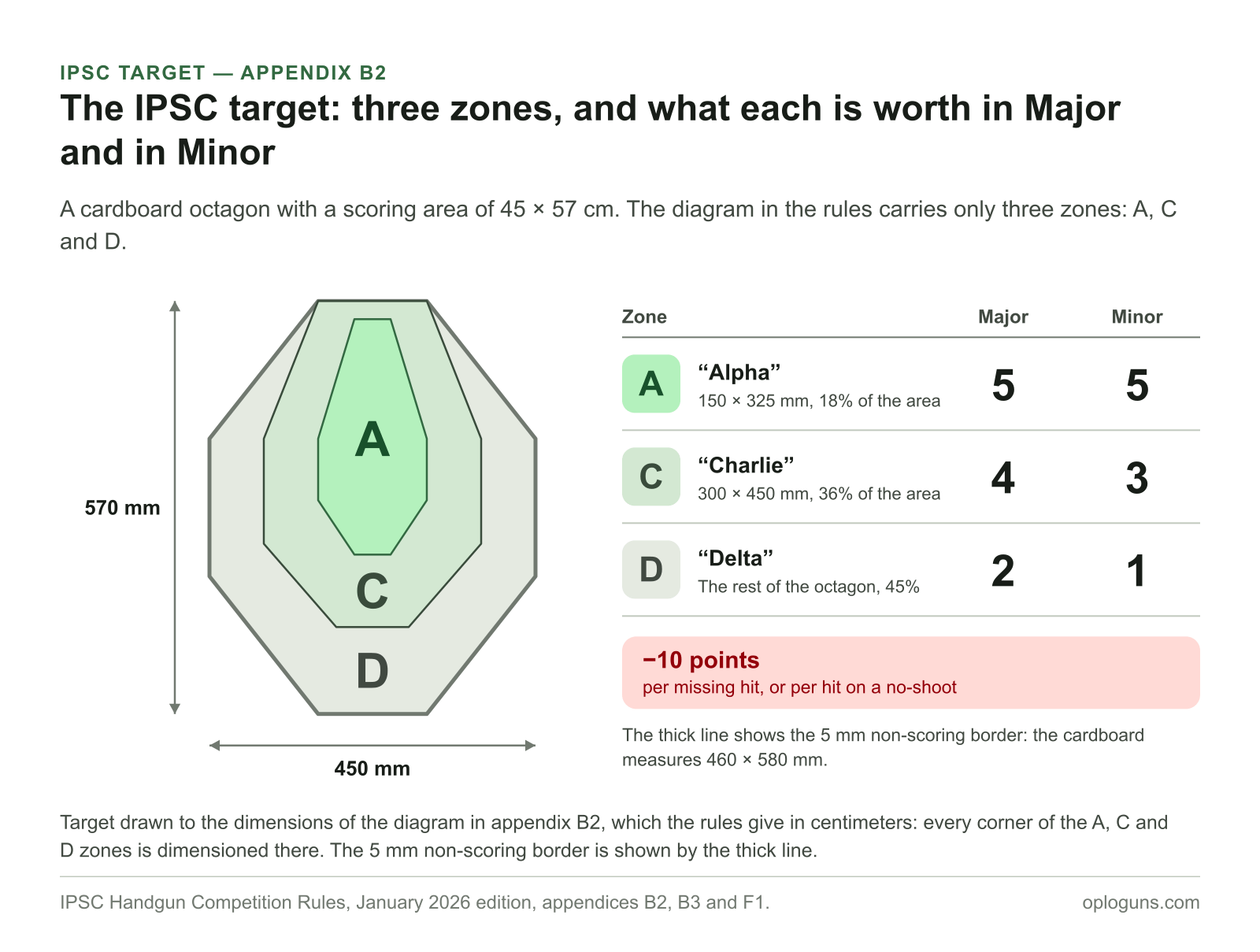
| Zone | Major | Minor | Scoring call |
|---|---|---|---|
| A | 5 | 5 | "Alpha" |
| C | 4 | 3 | "Charlie" |
| D | 2 | 1 | "Delta" |
Source: appendices B2, B3 and F11.
The center is worth the same for everyone. The gap opens at the edges: the rules write that the scoring zones "reward power" (rule 4.2.2)1. Major and Minor are two levels of power factor, calculated from the weight of the bullet and its velocity. Their thresholds, and the divisions that allow Major, are set out in our guide to IPSC in France.
Four rules decide how a cardboard target is read1:
- Two hits scored: a cardboard target is shot with at least one round, and its best two hits are kept, unless the written stage briefing says otherwise (rule 9.5.1).
- The line favors the shooter: a hit whose diameter touches the line between two zones, or between the border and a zone, takes the higher value (rule 9.5.2).
- Tears do not count: neither those radiating around the hole, nor a hole wider than the bullet with no trace of its passage (rule 9.5.4).
- Cardboard is deemed impenetrable: a bullet that has passed wholly through the scoring area of one target scores nothing on the target behind it (rule 9.1.5).
Each missing hit, the miss, costs 10 points (rule 9.4.4). Two of them, then, on a cardboard target left untouched when two hits are required. A target at which the shooter fired no round at all adds a procedural penalty (rule 9.5.6)1. How the score of a course of fire is calculated, the hit factor, is explained in the same guide to IPSC in France.
IPSC mini target: 30 × 37.5 cm, two-thirds of the full size
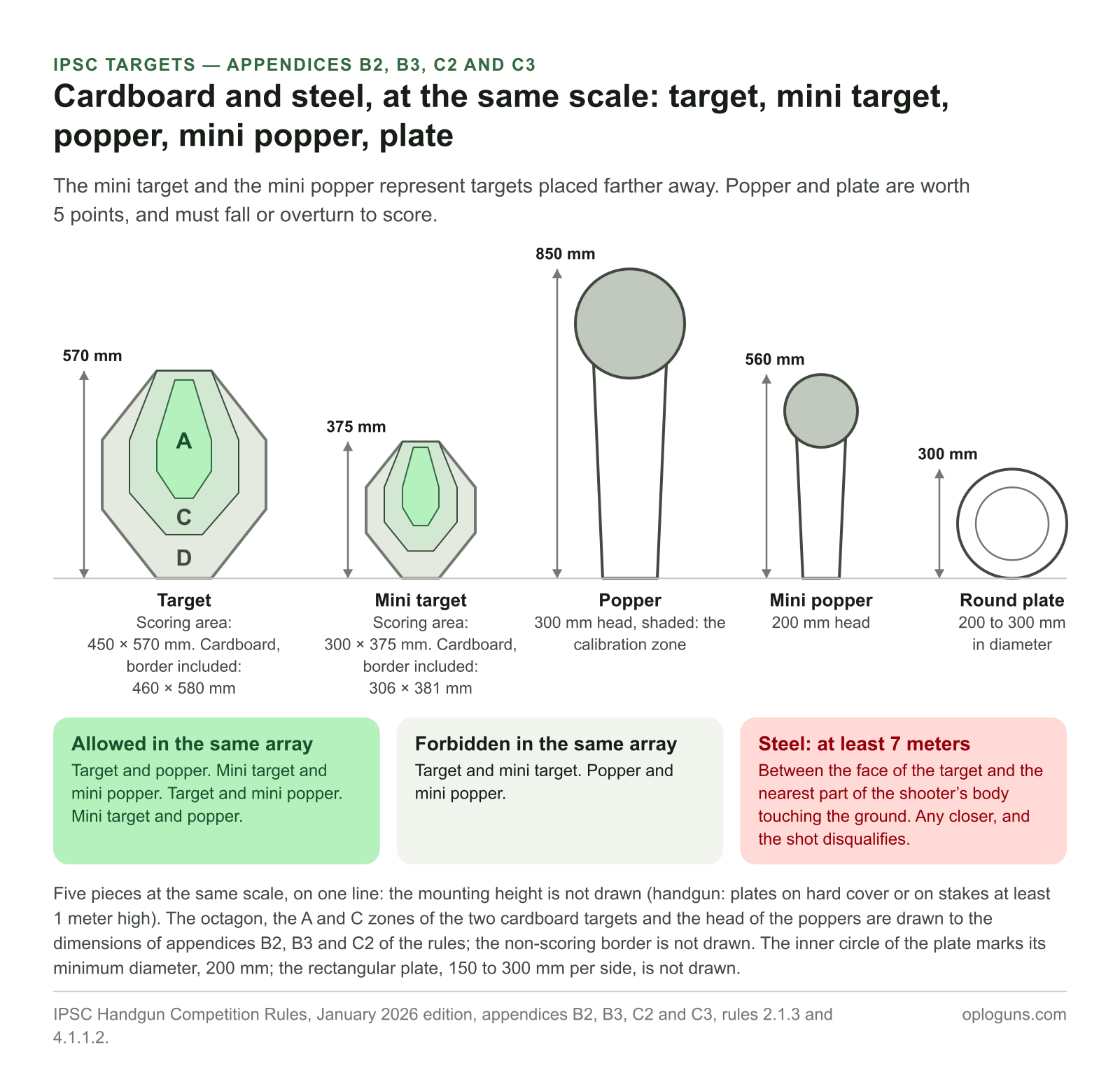
The mini target takes up the octagon, the three zones and the scoring. Only the dimensions change, marked on the diagram in appendix B31.
| Element | Width | Height | Reference points on the diagram |
|---|---|---|---|
| Scoring area | 300 mm | 375 mm | Vertical sides from 125 to 250 mm from the top; top and bottom edges of 100 mm |
| A zone | 100 mm | 215 mm | From 15 to 230 mm from the top; top and base of 40 mm |
| C zone | 200 mm | 300 mm | From the top edge down to 300 mm; base of 70 mm |
| Non-scoring border | 3 mm | 3 mm | All around; cardboard of 306 × 381 mm |
Source: diagram in appendix B3, January 2026 edition1.
It is used to simulate distance: the rules provide mini targets and mini poppers to represent targets placed farther away (rule 4.1.1.2)1. Within the same target array, the mixes are regulated:
- Allowed: target and popper; mini target and mini popper; target and mini popper; mini target and popper.
- Forbidden: target and mini target; popper and mini popper.
Fixing a mini target onto a full-size target, or declaring that one intact cardboard target represents two, is forbidden (rule 4.1.5)1.
No-shoot (penalty target): −10 per hit, two at most
A penalty target, the shooters' no-shoot, is a target not to be hit. It is recognized by a clearly visible "X", or by a single color, different from that of the targets to be shot, the same throughout the match for a given material (rule 4.1.3)1.
Each visible hit in its scoring area takes off 10 points, up to a limit of two hits per target (rules 9.4.2 and 9.4.3)1. The rule applies to cardboard as to steel, whether the steel target is made to fall or to stay up. A hit that touches both a target to be shot and a no-shoot overlapping it earns the points and the penalty (rule 9.5.3)1.
Partly hidden target: the A zone always stays visible
A course of fire often hides part of the target. The rules distinguish two kinds of cover1:
- Hard cover: deemed impenetrable. A bullet that passes wholly through it scores neither points nor penalty on the cardboard placed behind (rule 9.1.6).
- Soft cover: it merely obscures the view. Hits that have passed through it count, and the target must remain partly visible (rule 4.1.4.2).
To represent hard cover on the cardboard itself, there are three ways: actually hiding the part concerned, cutting the target from one edge to the other and redrawing the border, or painting it a single contrasting color with a sharp boundary (rule 4.2.3). In every case, part of each zone remains visible (rule 4.2.3.4). And neither hard cover nor a no-shoot may hide the A zone completely (rule 4.2.4)1.
IPSC poppers: 85 cm tall, calibrated between 120 and 125
The popper is a steel target with a round head, as tall as a kitchen countertop. It must fall to score (rule 4.3.1.4)1. Its dimensions come from the diagram in appendix C2, to within 5 mm.
| Dimension on the diagram | Popper | Mini popper |
|---|---|---|
| Overall height | 850 mm | 560 mm |
| Round head | Radius of 150 mm | Radius of 100 mm |
| Width at the bottom of the head | 200 mm | 135 mm |
| Height of the center of the head | 700 mm | 460 mm |
| Width of the base | 150 mm | 100 mm |
| Points, Minor and Major | 5 | 5 |
Source: diagram in appendix C2, "Tolerance +/- 0.5 cm"1.
The popper earns 5 points whatever the power factor, and costs 10 points if it stays up without having been knocked down1. Yet it is "designed to recognize power" (rule 4.3.2.1). That is the role of calibration, described in appendix C11.
Before the match, the Range Master designates calibration ammunition and one or more calibration guns. Measured on a chronograph, this ammunition must give a power factor of 120 to 125, that is, the Minor threshold at most. Each popper is then set to fall to a single shot in its calibration zone, the shaded head on the diagram, fired from the farthest position from which that zone can be seen1.
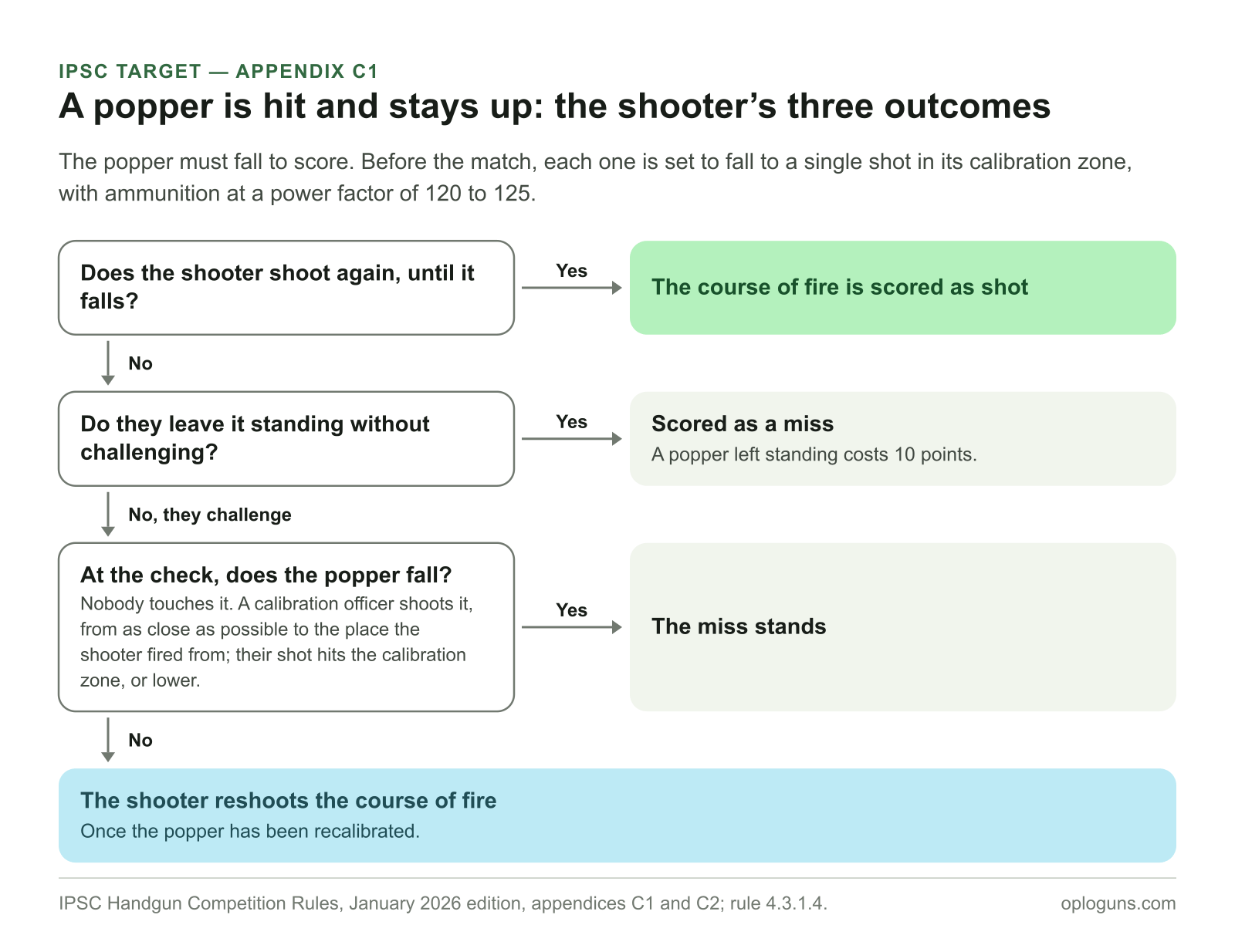
When a popper is hit and stays up, the shooter has three options1:
- Shoot again until it falls: the course of fire is scored as shot.
- Leave it standing without challenging: it is scored as a miss.
- Leave it standing and challenge: nobody touches the popper, and a calibration officer shoots it, from as close as possible to the place the shooter fired from.
At the check, if the officer's shot hits the calibration zone or lower and the popper falls, the miss stands. If it stays up, the shooter reshoots the course of fire once the popper has been recalibrated1. Choosing a load that makes the threshold is covered in our guide to 9 mm ammunition.
Metal plates: 20 to 30 cm, no calibration
The plate is the simplest of the steel targets. It is worth 5 points. It falls or overturns to score. Its dimensions are written out in appendix C31.
| Plate, handgun | Minimum | Maximum |
|---|---|---|
| Round | 200 mm in diameter | 300 mm in diameter |
| Rectangular | 150 × 150 mm | 300 × 300 mm |
Source: appendix C3, "Handgun" column1.
Three rules set it apart from the popper1:
- No calibration: the plate does not recognize power, and cannot be challenged (rule 4.3.3.2).
- Never alone: a course of fire cannot be made up of plates only. It includes at least one cardboard target or one popper to be shot (rule 4.3.3.3). Courses made of five plates belong to another discipline, Steel Challenge.
- Raised: for handgun, appendix C3 asks for plates to be mounted on hard cover or on metal stakes at least 1 meter high.
Steel targets are painted a single color, preferably white (rule 4.1.2.2), and have no non-scoring border (rule 4.3.1.3). Those that can turn edge-on when hit are forbidden (rule 4.3.1.1)1.
A short course from the 2024 French championships, shot in Aix-en-Provence, shows how it fits together: 3 IPSC targets, 2 poppers, 1 plate and a steel no-shoot, for 9 scored hits3. That is 45 points at most.
Two families of targets stay outside: frangible targets, clay pigeons or tiles, are not allowed in Handgun matches (rule 4.5.1), and self-sealing synthetic targets are excluded from Level III up (rule 4.5.2)1.
Distance from metal targets: at least 7 meters
Seven meters: that is the margin the rules put between the shooter and steel. As soon as a course of fire includes metal targets or metal hard cover, shooters and range officials stay at least 7 meters away while shooting (rule 2.1.3)1.
- Barriers: the distance is preferably guaranteed by physical obstacles.
- Fault lines: if they limit the approach, they are placed at least 8 meters away, so that a foot stepping over stays beyond 7 meters.
- The penalty: a shot fired at a metal target from less than 7 meters, measured from the face of the target to the nearest part of the shooter's body touching the ground, disqualifies (rule 10.4.7)1.
For cardboard, the Handgun rules set no distance. They even contemplate a cardboard target less than 3 meters from the shooter (rule 10.4.2)1. How a match unfolds is described in our article on your first IPSC match. Outside IPSC, the steel, the thickness and the distance of a gong for each caliber are in steel targets.
In France: federation rules limit IPSC target use
Tir sportif de vitesse (TSV), the French name for IPSC, uses these targets without modifying them: the French shooting federation's administrative rules want them « conformes aux règlements sportifs de l'I.P.S.C. » [compliant with the sport rules of the IPSC] (article XIV)2.
The same text restricts their use. Its article IV forbids, outside an approved association or without a TSV instructor present, the practice of the discipline and any exercise connected with it, and lists among them the « utilisation de cibles IPSC » [use of IPSC targets]2. These rules are dated from the 2019-2020 season; the federation links no more recent version on its page for the discipline. The conditions of access are set out in our article on getting started in TSV.
The targets of the federation's other disciplines, ISSF and service-firearm shooting, have neither this shape nor this scoring: their dimensions are in our article on sport shooting target dimensions.
Printable IPSC target: wider than an A2 sheet
The cardboard of 460 × 580 mm is bigger than an A3 sheet, 297 × 420 mm, and even than an A2, 420 mm wide4. The mini target, 306 × 381 mm with the border, exceeds an A3 by 9 mm in width and fits on an A2. An IPSC target printed on A4 is therefore a reduction, at a scale no appendix provides for.
Checking a print scale and the paper sizes are covered in our article on printable targets at scale.
Three misconceptions about the IPSC target
- "The A zone is worth more in Major." It is worth 5 points in Major as in Minor; only the C and D zones change value (appendix B2)1.
- "A plate that rings is scored." A metal target must fall or overturn to score (rule 4.3.1.4)1.
- "A hit on the line takes the lower value." It takes the higher of the two (rule 9.5.2)1.
Sources 4 references
The dimensions, the scoring and the scoring rules come from the IPSC Handgun rules, January 2026 edition; the French framework, from the administrative rules for tir sportif de vitesse of the FFTir, the French shooting federation. Click a note marker in the text to highlight the matching source.
- IPSC — IPSC Handgun Competition Rules, January 2026 Edition (81-page PDF, final version of 29 December 2025, linked from the IPSC's "Rule Books" page), consulted on 15 November 2026: 2.1.3, "a minimum distance of 7 meters" from metal targets, fault lines "at least 8 meters from the targets"; 4.1.1, targets approved and complying with appendices B and C; 4.1.1.2, two sizes of targets and poppers, mixes allowed and forbidden in the same "target array"; 4.1.2.1, scoring area "tan colored"; 4.1.2.2, metal painted a single color, "preferably white"; 4.1.3, no-shoots marked with an "X" or a single color; 4.1.4, hard cover and soft cover; 4.1.5; 4.2.2, "scoring lines and 0.5 cm (Mini Targets 0.3 cm) non-scoring borders", not visible "beyond a distance of 10 meters", "The scoring zones reward power in IPSC matches"; 4.2.3 and 4.2.4, partly hidden targets; 4.3.1.1, 4.3.1.3, 4.3.1.4, "Scoring metal targets must be shot and fall or overturn to score"; 4.3.2.1; 4.3.3.2, "Metal plates do not recognize power and are not subject to calibration"; 4.3.3.3; 4.5.1 and 4.5.2; 9.1.5 and 9.1.6; 9.4.2 to 9.4.4, −10 points per no-shoot hit, two at most, and per miss; 9.5.1, "the best two hits to score"; 9.5.2, "it will be scored the higher value"; 9.5.3, 9.5.4, 9.5.6; 10.4.2; 10.4.7; appendix B2, dimensioned diagram of the IPSC target (verticals 2.5, 19, 27.5, 33.5, 35, 38, 45 and 57 cm; horizontals 7.5, 15, 17.5, 20, 25, 27.5, 30, 37.5 and 45 cm; "0.5cm non scoring border around entire target") and scoring Major 5, 4, 2, Minor 5, 3, 1; appendix B3, dimensioned diagram of the mini target (verticals 1.5, 12.5, 18, 22, 23, 25, 30 and 37.5 cm; horizontals 5, 10, 11.5, 13, 17, 18.5, 20, 25 and 30 cm; "0.3 cm non scoring border"); appendix C1, popper calibration, calibration ammunition with a power factor "of between 120 to 125"; appendix C2, poppers, "5 points" and "Minus 10 points", diagram (85 cm, "15 cm radius", 20 cm, 70 cm, 15 cm; mini popper 56 cm, "10 cm radius", 13.5 cm, 46 cm, 10 cm), "Tolerance +/- 0.5 cm"; appendix C3, round plates from "20 cm Ø" to "30 cm Ø", rectangular from "15x15 cm" to "30x30 cm", "plates should be mounted on hard cover or on metal stakes at least 1 m high"; appendix F1, calls "Alpha", "Charlie", "Delta". ⚠️ The dimensions in appendices B2, B3 and C2 are read off diagrams, not from the text; the zone areas and the dimensions of the cardboard with its border are calculated from them. The IPSC website refuses automated reading: the edition in force should be checked on its "Rule Books" page.
- FFTir — Règlement administratif du Tir Sportif de Vitesse, saison 2019/2020 [administrative rules for tir sportif de vitesse, 2019/2020 season] (4-page PDF, in French), consulted on 15 November 2026: article IV, practice of the discipline and of « tout exercice de tir comportant l'usage d'une arme portée à l'étui (dégainé) ou développant des aspects connexes avec l'activité tels que tir en déplacement, utilisation de cibles IPSC, (commandements, scénarios, ...) en dehors des Associations habilitées ou pour celles qui le sont « sans la présence d'un moniteur TSV » […] formellement interdite » [any shooting exercise involving a holstered gun (drawing) or developing aspects related to the activity such as shooting on the move or the use of IPSC targets (commands, scenarios and so on), outside approved associations or, for those that are approved, without a TSV instructor present, is strictly forbidden]; article XIV, « Les cibles utilisées pour l'exercice de ces disciplines sont conformes aux règlements sportifs de l'I.P.S.C. » [the targets used for these disciplines comply with the sport rules of the IPSC]. ⚠️ Dated 2019-2020, the only administrative rules linked from the discipline's page.
- FFTir — livret des parcours des championnats de France Optic et Iron Sight, Aix-en-Provence, du 28 mai au 2 juin 2024 [stage booklet for the French Optic and Iron Sight championships, Aix-en-Provence, 28 May to 2 June 2024] (PDF of 28 May 2024), consulted on 15 November 2026: stage 2, "Short Course", "ROUNDS TO BE SCORED : 9", "TARGETS : 3 IPSC Targets, 2 IPSC Poppers, 1 IPSC Metal Plate, I NS steel". ⚠️ 2024 match, shot under the edition of the rules then in force.
- Microsoft — Paper Sizes, Win32 apps, consulted on 15 November 2026: "A3 297 x 420 mm", "A2 420 x 594 mm".
The rules in force prevail. This article describes the IPSC Handgun rules in their January 2026 edition, read on 15 November 2026; the English version prevails over any translation. The dimensions of the cardboard targets and the poppers are taken from the diagrams in the appendices. The edition in force should be checked on the IPSC's "Rule Books" page before making or buying targets.
Frequently asked questions
What are the dimensions of an IPSC target?
The scoring area of the cardboard IPSC target measures 450 mm wide by 570 mm high, according to the diagram in appendix B2 of the January 2026 IPSC Handgun rules. A 5 mm non-scoring border surrounds it, which brings the cardboard to 460 × 580 mm. The A zone, in the center, is 150 mm wide and 325 mm high.
How many points are the A, C and D zones worth?
The A zone is worth 5 points in Minor as in Major. The C zone is worth 4 points in Major and 3 in Minor, the D zone 2 points in Major and 1 in Minor. The best two hits on a cardboard target are scored, and a hit that touches the line between two zones takes the higher value.
How big is the IPSC mini target?
300 mm wide by 375 mm high for the scoring area, with a 3 mm border, according to the diagram in appendix B3. It keeps the A, C and D zones and the same scoring. The rules use it to simulate a target placed farther away, and forbid mixing it with a full-size target in the same target array.
What is a popper in IPSC?
A steel target that must fall to score: 850 mm tall, a round head 300 mm in diameter, 5 points in Minor as in Major. The mini popper measures 560 mm, with a 200 mm head. Every popper is calibrated before the match to fall to ammunition with a power factor of 120 to 125.
At what distance do you shoot an IPSC target?
The Handgun rules set no distance for a cardboard target. They require at least 7 meters between the shooter and any metal target while shooting: a shot fired at steel from closer brings disqualification. The fault lines that limit the approach are placed at least 8 meters away.
Can you shoot IPSC targets at any club in France?
Not according to the French shooting federation. Its administrative rules for tir sportif de vitesse, the French name for IPSC, dated from the 2019-2020 season, list the use of IPSC targets among the exercises forbidden outside an approved association, or without a TSV instructor present.
Spotted an error, or a rule that has changed since we checked? Report an error