Target holders and pellet traps: which to choose, for what power
Published on · 9 min read · Anthony Baillon
A target holder holds the card; the pellet trap behind it stops the projectile. In 14 × 14 cm, it costs €10 to €30. Its limit is counted in joules: 7.5 for a conical target holder from Umarex France, when a recreational air rifle approaches 20. Choose it by the gun, for the club's range.
At a glance
| Type | What stops the pellet | Manufacturer's limit |
|---|---|---|
| Conical, sheet steel, 14 × 14 cm | A funnel and a tray | 7.5 J at Umarex France |
| Deflector type, 17 × 17 cm | A deflector | 7.5 J at Umarex France |
| Putty trap, American | 4.5 kg of putty ahead of a 3.4 mm steel plate | 27 J, at 10 m at least |
- The sizes: 14 × 14 cm for leisure, 17 × 17 cm for the 10 m pistol card.
- .22 LR: out of reach, at 142 J and more.
- The place: the firing line of a range or a club, which decides what gets installed there.
Target holder and pellet trap: two roles, one object
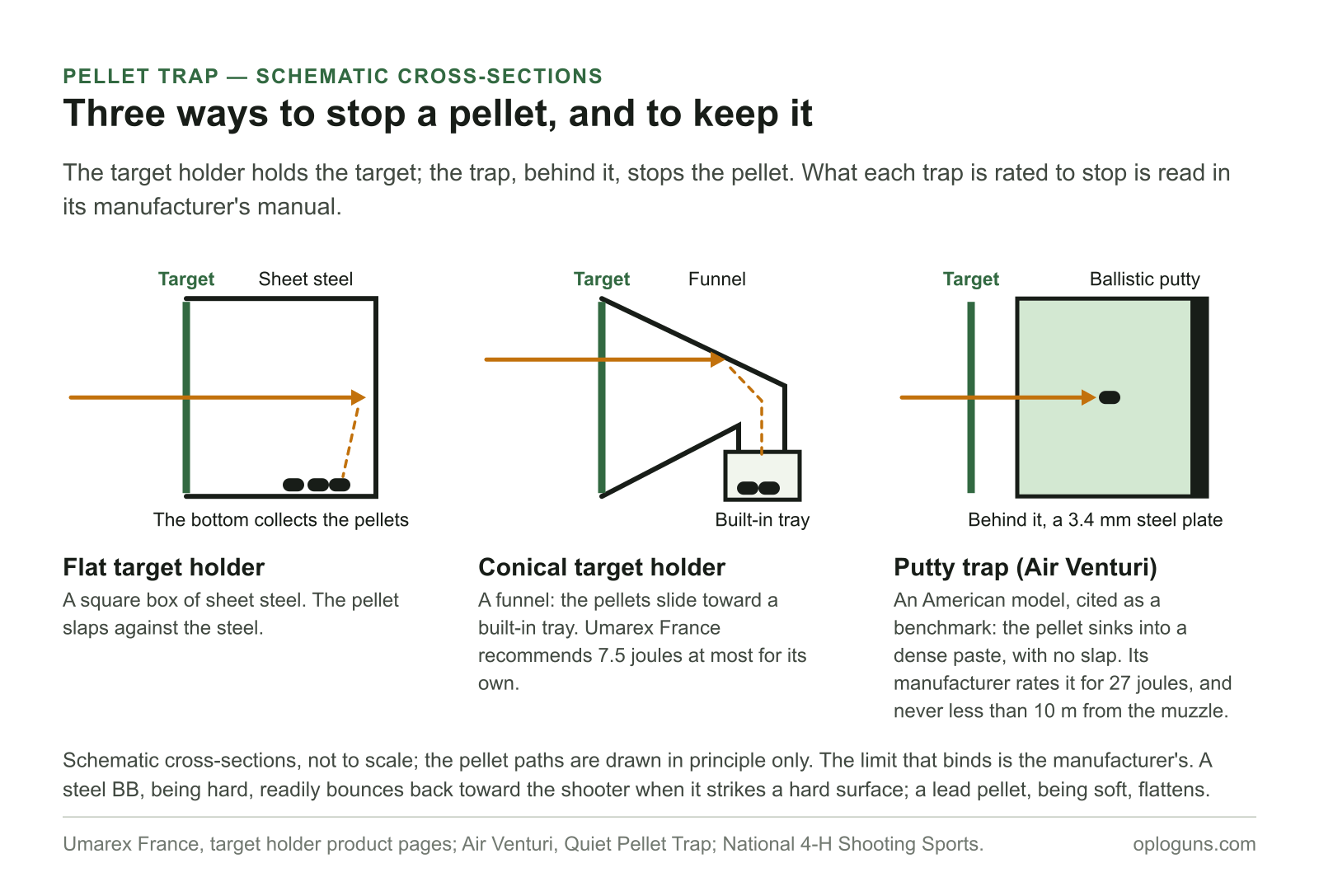
The target holder keeps the card in place. The pellet trap, or pellet catcher, stops the projectile and keeps it. In the shops, the two are often one: a sheet-steel box whose front face takes the target in slides, and whose bottom collects the pellets17.
A club equips its 10 m range the same way, before moving on to the target carrier or the electronic target. Those three pieces of equipment are compared in equipping a shooting club. Here, the point of view is the shooter's: what each trap stops, and what it does not.
Two families are sold.
Flat or conical target holder: sheet steel and a tray
The sheet-steel target holder, flat or conical
The flat one is a square box in sheet steel1. The conical one is funnel-shaped: the pellets slide toward a built-in tray1. Umarex France also sells a 17 × 17 cm deflector model, which takes paper targets or four swinging targets1.
Pros
The putty trap
The pellet sinks into a dense paste instead of hitting steel. The model described here is American: the Air Venturi trap holds 10 pounds of ballistic putty, or 4.5 kg, ahead of a 3.4 mm steel plate2.
Pros
The projectile counts as much as the trap. A steel BB, being hard, readily bounces back toward the shooter when it strikes a hard surface; a lead pellet, being soft, flattens and loses its energy4. The three airgun projectiles are told apart in steel BB, diabolo pellet or airsoft BB.
That leaves the figure that decides the choice: power.
Rated power: 7.5 joules, or "under 20 joules"
The manufacturers' limits are not in the same unit. Umarex France counts in joules, Air Venturi in ft-lb. Creedmoor, another American maker, limits its pellet curtain in feet per second. Brought back to a 0.53 g match pellet5, they can be compared.
| Benchmark | Velocity of a 0.53 g pellet | Energy |
|---|---|---|
| Perfecta conical target holder, Umarex France | 168 m/s | 7.5 J |
| Creedmoor pellet curtain, American | 183 m/s | 8.9 J |
| Gun at 20 J, top of the French 2-to-20-joule airgun class | 275 m/s | 20 J |
| Air Venturi putty trap, American | — | 27 J |
Sources: manufacturers' data sheets and manuals123; energies calculated by ½·m·v² for a 0.53 g pellet5. The two American products are cited as power benchmarks.
The first two limits, 7.5 and 8.9 J, are the order of magnitude of 10 m guns: a French maker of electronic targets rates its own for rifles and pistols to the ISSF standard, up to 7.5 joules13. At 20 joules, the same pellet leaves at 275 m/s, or 990 km/h: far beyond what a conical target holder of this type is rated to stop.
In France, 20 joules is the upper limit of category D, the legal class that covers airguns of 2 to 20 joules12. A gun's power and its category are explained in air rifles under 20 joules and the law, and what becomes of the pellet in flight in 20 joules: velocity, range and useful distance.
Retailers' listings sometimes say something else. Several 14 × 14 cm sheet-steel target holders are advertised there for guns "under 20 joules"7. The limit that binds is the manufacturer's, in its manual or on its own data sheet. An American guide to introductory airgun shooting gives the same instruction: read the manufacturer's specification, to make sure the trap suits the gun4.
Sizes: 14 × 14 cm for leisure, 17 × 17 cm for 10 m pistol
The 14 × 14 cm card is the format of recreational shooting: most target holders are sold in that size78. It is not one of the ISSF targets.
The ISSF technical rules, read here in the French federation's translation, set other dimensions6:
- 10 m rifle: card of at least 80 × 80 mm.
- 10 m pistol: card of at least 170 × 170 mm. This is the "17 × 17" format.
- Height: the center of the target 1.40 m above the floor of the firing point, to within 5 cm.
- Distance: 10 m from the firing line to the face of the target, to within 5 cm.
On a range, the distance is therefore measured to the face of the card, not to the back of the trap.
The dimensions of each target are in sport shooting target dimensions. The 10 m targets fit on an A4 sheet: printable targets to scale explains how to check their size. How the event runs is in 10 m air rifle.
Target holder prices: €10 to €30 in 14 × 14 cm
Prices recorded on 15 November 2026789.
| Target holder | Price |
|---|---|
| Flat, 14 × 14 cm | €10 to €28 |
| Conical, 14 × 14 cm | €14 to €30 |
| Flat or conical, supplied with 50 targets | €14 to €15 |
| Gehmann target holder for airguns | €25 |
| 14 × 14 cm cards, per 100 | €4.50 to €8.90 |
The cards weigh little in the budget: a hundred targets cost €4.50 to €8.90, or 5 to 9 cents apiece. Targets that show the hit cost more, as reactive splatter targets details.
Target holder for .22 LR: beyond a pellet trap's reach
None of these traps is rated for a firearm. The toughest is rated for 27 J2. A .22 LR cartridge develops 142 J at the muzzle in a match load, 193 J in high velocity, according to RWS's data sheets10. Five to seven times more.
For rimfire, steel target makers sell something else. Action Target rates its quarter-inch AR500 steel plate, 6.35 mm, for .22 LR, at 10 yards (9.1 m) at least11. Those plates are covered in gongs and steel targets.
On a 25 or 50 m range, the target holder only holds the card: the bullet is stopped by the range's installation. The cartridge's velocities and energies are detailed in .22 LR subsonic, standard or high velocity.
Emptying the pellet trap: gloves and washed hands
A full trap is a tray of lead. Action Target, for its steel targets, advises gloves for any handling, and washing your hands before eating, drinking or touching your face11.
The subject goes beyond the trap. What the studies measure and what the French shooting federation recommends is in our article on lead at the shooting range.
At the club: the pellet trap goes on a range
A target holder is used on a range: that of a shooting facility or a club, with its firing line, its rules and someone who answers for it. A club's 10 m range is already equipped, with target holders and pellet catchers, target carriers or electronic targets.
A projectile stop is chosen for an energy its manufacturer states, and on a range, it is the club that decides what gets installed there. Where to shoot, and on what conditions, is the subject of our article on recreational shooting, the license and where to shoot.
In France, two routes lead to the club.
- The license, which opens it for the year.
- The introductory session: the cap of two sessions per twelve-month period, for anyone who is not a club member, does not apply to introductory sessions with airguns (article R312-43-1 of the code de la sécurité intérieure, the French internal security code)12. The detail is in shooting without a club or a license.
Clubs can be found in the shooting range directory. Eye protection applies to everyone: the American introductory guide makes it compulsory for shooters and supervisors alike4.
Three misconceptions about pellet traps
- "Every target holder takes 20 joules." Umarex France recommends its 14 × 14 cm conical model up to 7.5 joules1.
- "14 × 14 cm is the competition format." The ISSF rules set a card of at least 170 × 170 mm for 10 m pistol, and at least 80 × 80 mm for 10 m rifle6.
- "A pellet trap stops a .22 LR." 142 to 193 J at the muzzle, against 27 J for the toughest trap recorded102.
Which target holder for your gun
10 m pistol or rifle
A conical sheet-steel target holder is rated for these power levels, up to 7.5 joules at Umarex France, for €14 to €30. The trade-off: size matters, since the pistol card needs 17 × 17 cm and most models are 14 × 14 cm.
Recreational air rifle, 10 to 20 joules
A trap its manufacturer rates for that power, such as a putty trap rated for 27 joules. The trade-off: its manual imposes 10 m at least, and the Umarex France conical model stops at 7.5 joules.
In .22 LR
No pellet trap: steel targets made for rimfire, on a range that allows them. The trade-off: steel has its own distances, those in the plate's manual.
Sources 13 references
Power limits taken from the manufacturers' data sheets and manuals; target dimensions from the ISSF technical rules as translated by the FFTir, the French shooting federation; prices recorded at three French gun shops. Click a reference number in the text to highlight the matching source.
- Umarex France — product pages (in French) consulted on 15 November 2026: porte-cible conique 14 × 14 Perfecta, « recommandé pour les armes à air comprimé allant jusqu'à 7,5 J » [recommended for airguns up to 7.5 J], funnel shape, built-in collection tray; porte-cible plat 14 × 14 Perfecta, sheet steel; porte-cible 17 × 17 Perfecta, deflector, up to 7.5 joules, swinging or paper targets.
- Air Venturi, Airgun Depot listing — Quiet Pellet Trap with Steel Backstop, consulted on 15 November 2026: 10 pounds of ballistic putty, which stops the projectile without the crack of steel traps; "10-gauge" back plate (3.4 mm); "For guns up to 20 ft-lbs. muzzle energy" (27 J); trap at least 10 meters from the muzzle; regular inspection of the plate. ⚠️ An American retailer's listing; conversions calculated.
- Creedmoor Sports — Portable Air Gun Range, Users Manual (8-page PDF), consulted on 15 November 2026: safety instructions for the pellet curtain, no gun over 600 feet per second at the muzzle (183 m/s), flat-head pellets only, safety glasses. ⚠️ American product, cited as a power benchmark.
- National 4-H Shooting Sports — Fact Sheet 22, Air Gun Range Setup, Donald L. Burtchin (PDF, revised October 2014), consulted on 15 November 2026: BBs, being hard, bounce back toward the shooter off a hard surface; pellets, made of soft lead, deform and lose their energy; for a commercial trap, read the manufacturer's specifications; eye protection compulsory for shooters and supervisors. ⚠️ Guide from an American supervised introductory program.
- RWS — RWS R10, page consulted on 15 November 2026: match pellets of 0.45 g and "0.53 g / 8.2 gr". Calculations: energy ½·m·v² for 0.53 g; 600 feet per second = 182.9 m/s, or 8.9 J; 7.5 J at 168 m/s; 20 J at 275 m/s, or 990 km/h; 20 ft-lb = 27.1 J.
- FFTir, CNS Arbitrage — Règles techniques ISSF pour toutes les disciplines de tir, édition 2025 [ISSF General Technical Rules, 2025 edition, French translation] (PDF, in French, 2nd print in force on 1 July 2026, updated 4 July 2026), consulted on 15 November 2026: 6.3.4.3, 10 m rifle, « Dimensions minimales visibles du carton : 80 mm x 80 mm » [minimum visible size of the card: 80 mm x 80 mm]; 6.3.4.6, 10 m pistol, 170 mm x 170 mm; 6.4.5, distance measured from the firing line to the face of the target, 10 m ± 0.05 m; 6.4.6.1, center of the targets at 1.40 m, ± 0.05 m at 10 m.
- Armurerie Loisir — cibles de tir et porte-cibles (in French), recorded on 15 November 2026, 14 × 14 cm target holders: Elite Airgun flat €9.90, conical €14.90, Umarex conical €19.90, Gamo flat €27.50, Gamo conical €29.90; 14 × 14 cm targets from €4.90 to €8.90 per 100; listings giving the flat and the conical for guns « d'une puissance inférieure à 20 joules » [with a power below 20 joules]. ⚠️ Commercial data; power ratings stated by the retailer.
- Armurerie Auxerre — porte-cibles (in French), recorded on 15 November 2026: flat 14 × 14 cm €12.95, conical €13.90, conical with 50 targets €14.15, flat with 50 targets €14.90, Umarex 14 × 14 cm €21.95, Gamo conical €29.00; 100 targets of 14 × 14 cm €4.50. ⚠️ Commercial data.
- Armurerie de la Bourse — cibles et simulateurs (in French), recorded on 15 November 2026: Gehmann target holders for airguns €25.00. ⚠️ Commercial data.
- RWS — data sheets consulted on 15 November 2026: Target Rifle, .22 LR, 142 J at the muzzle; High Velocity, .22 LR, 193 J at the muzzle. ⚠️ Manufacturer's technical data.
- Action Target — Steel Target Safety Guide (6-page PDF, © 2016), consulted on 15 November 2026: ¼-inch AR500 steel for rimfire, "10 Yards" at least (9.144 m); gloves for handling the targets, hands washed before eating, drinking or touching the face. ⚠️ An American manufacturer's guide, valid for its own targets.
- Légifrance — article R312-43-1 du code de la sécurité intérieure (in French), version in force since 10 February 2022, consulted on 15 November 2026: « Elles ne peuvent participer à plus de deux séances de tir d'initiation par période de douze mois » [they may not take part in more than two introductory shooting sessions per twelve-month period]; section III exempts introductory sessions with airguns; article R311-2, version in force since 7 September 2025: category D, h, muzzle energy « comprise entre 2 et 20 joules » [between 2 and 20 joules].
- Sport Quantum — SQ Air 10, manufacturer's page (in French) consulted on 15 November 2026: target for airguns at 10 meters, rifles and pistols « au standard ISSF, jusqu'à 7,5 joules » [to the ISSF standard, up to 7.5 joules]. Manufacturer's claim.
The manufacturer's manual and the range's rules prevail. The rated power levels are those stated by the named manufacturers, for their own products; a retailer's listing does not replace them. Energies are calculated for a 0.53 g pellet. A trap is installed on a range with the agreement of whoever answers for it.
Frequently asked questions
Which target holder for a 20-joule air rifle?
A trap its manufacturer rates for that power. Umarex France recommends its 14 × 14 cm Perfecta conical target holder up to 7.5 joules only. An American putty trap, the one from Air Venturi, is rated for 20 ft-lb, or 27 joules, at 10 meters at least. Some retailers' listings give sheet-steel target holders for guns under 20 joules, without the manufacturer always confirming it.
What is the difference between a flat and a conical target holder?
The flat target holder is a shallow sheet-steel box with a sloping back. The conical one is funnel-shaped: deeper, it guides the pellets toward a tray. Both sold for €10 to €30 in 14 × 14 cm on 15 November 2026.
Is a pellet trap suitable for .22 LR?
No. Pellet traps are rated for airguns, from 7.5 to 27 joules depending on the model. A .22 LR cartridge develops 142 to 193 joules at the muzzle, according to RWS's data sheets. For rimfire, target makers sell AR500 steel plates, and on a range the bullet is stopped by the range's own installation.
What target size for a target holder?
The leisure format is the 14 × 14 cm card. The ISSF rules set a card of at least 170 × 170 mm for 10-meter pistol and at least 80 × 80 mm for 10-meter rifle: a 17 × 17 cm target holder takes the first.
How high is the target on a 10-meter range?
The ISSF technical rules place the center of the target 1.40 meters above the floor of the firing point, to within 5 centimeters, and the face of the target 10 meters from the firing line, to within 5 centimeters. These dimensions are those of competition ranges.
Spotted an error, or a rule that has changed since we checked? Report an error