Sport shooting target dimensions: the ISSF figures, discipline by discipline
Published on · Updated on · 10 min read · Anthony Baillon
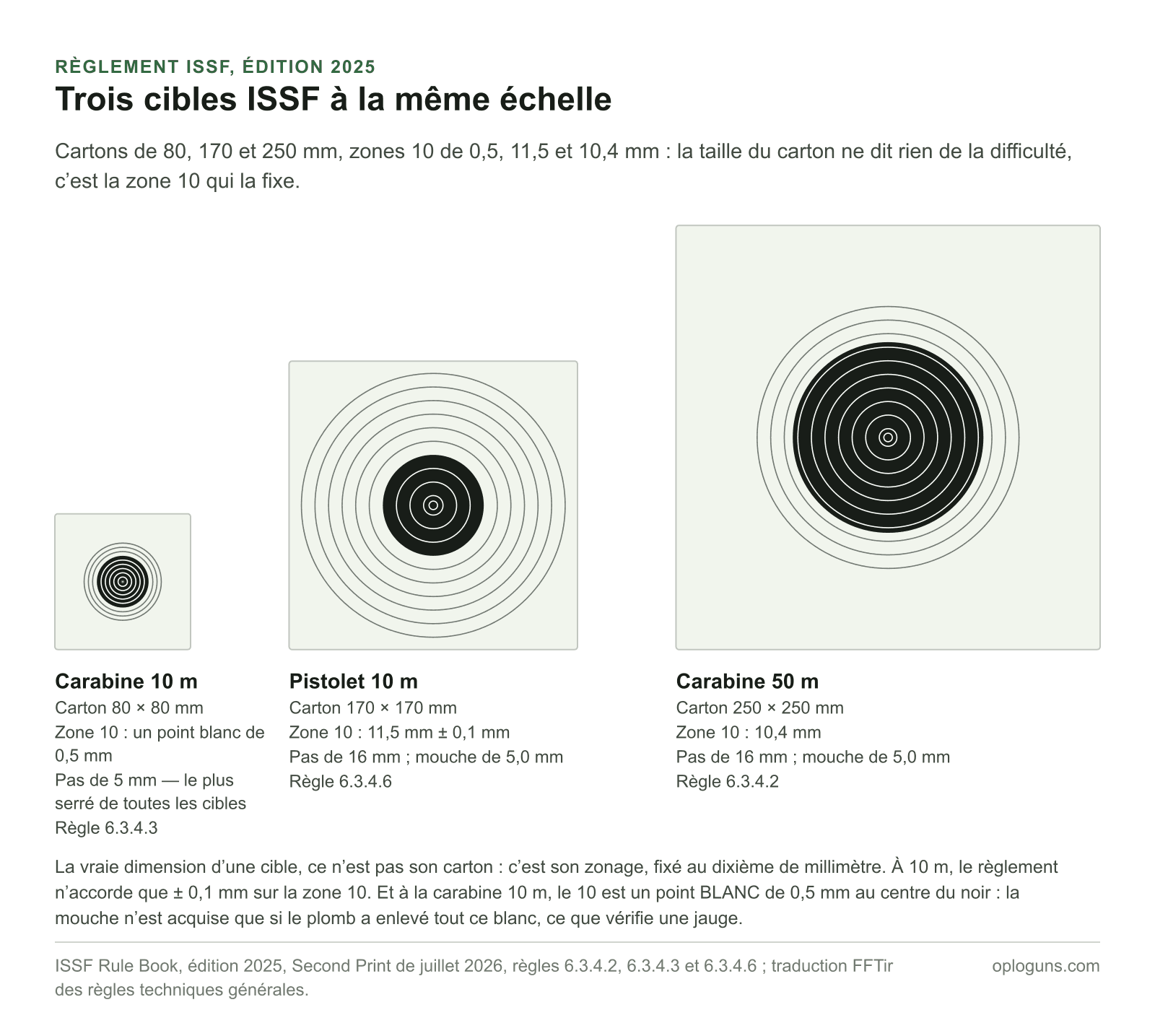
At 10 meters, the 10 ring measures 11.5 mm on the pistol target and 0.5 mm on the rifle target, a mere white dot. The official dimensions of sport shooting targets, from 10 to 300 meters, are set by the ISSF technical rules, 2025 edition, in force since 1 July 2026.
At a glance
| Target | 10 ring | Minimum card |
|---|---|---|
| 10 m pistol | 11.5 mm | 170 × 170 mm |
| 10 m rifle | 0.5 mm (white dot) | 80 × 80 mm |
| 25 and 50 m pistol | 50 mm | 550 × 520 mm |
| 50 m rifle | 10.4 mm | 250 × 250 mm |
- Center height: 1.40 m at 10 and 25 m, but 0.75 m at 50 m.
- In competition: a target to the right dimensions is not enough, it must also be approved by the ISSF.
ISSF target dimensions: from 0.5 to 100 mm for the 10
The dimensions come from the ISSF general technical rules, rules 6.3.1 to 6.3.4, which the French shooting federation publishes in French in their 2025 edition, second printing in force on 1 July 202612. Five words keep coming back:
- The card: the backing, sold in a given format (17 × 17 cm, for example).
- The black: the central black area used for aiming.
- The ring, or scoring zone: each scoring band, from 1 at the edge to 10 at the center.
- The inner ten: a mark inside the 10 that separates tied shooters.
- The ring line: the line of each ring, whose thickness is standardized.
| Target | 10 ring | Spacing | Inner ten | Black | Minimum card | Rule |
|---|---|---|---|---|---|---|
| 10 m rifle | 0.5 mm | 5 mm | white dot removed | 30.5 mm | 80 × 80 mm | 6.3.4.3 |
| 10 m pistol | 11.5 mm | 16 mm | 5.0 mm | 59.5 mm | 170 × 170 mm | 6.3.4.6 |
| 10 m running target | 5.5 mm | 5 mm | white dot of 0.5 mm | 30.5 mm | 260 × 140 mm | 6.3.4.8 |
| 50 m rifle | 10.4 mm | 16 mm | 5 mm | 112.4 mm | 250 × 250 mm | 6.3.4.2 |
| 25 and 50 m pistol | 50 mm | 50 mm | 25 mm | 200 mm | 550 × 520 mm | 6.3.4.5 |
| 25 m rapid fire pistol | 100 mm | 80 mm | 50 mm | 500 mm | 550 × 520 mm | 6.3.4.4 |
| 50 m running target | 60 mm | 34 mm | 30 mm | 94 mm aiming mark | — | 6.3.4.7 |
| 300 m rifle | 100 mm | 100 mm | 50 mm | 600 mm | 1,300 × 1,300 mm | 6.3.4.1 |
The spacing is the difference in diameter between two neighboring rings; within a target, it is constant1.
The spacing between two rings, from 5 to 100 mm
Difference in diameter between two neighboring rings, in millimeters — ISSF rules 6.3.4.1 to 6.3.4.6
The width of one ring, line to line, is half the spacing: 8 mm on the 10 m pistol target. Spacing grows with distance without making the difficulty equal: at 10 m, the rifle's 10 ring subtends about 0.05 milliradian, the pistol's 1.151.
View the data
| Target | Distance | Spacing (difference in diameter) | ISSF rule |
|---|---|---|---|
| Rifle | 10 m | 5 mm | 6.3.4.3 |
| Running target | 10 m | 5 mm | 6.3.4.8 |
| Pistol | 10 m | 16 mm | 6.3.4.6 |
| Rifle | 50 m | 16 mm | 6.3.4.2 |
| Running target | 50 m | 34 mm | 6.3.4.7 |
| Precision pistol | 25 and 50 m | 50 mm | 6.3.4.5 |
| Rapid fire pistol | 25 m | 80 mm | 6.3.4.4 |
| Rifle | 300 m | 100 mm | 6.3.4.1 |
Spacing grows with distance without making the difficulty equal. At 10 m, the rifle's 10 ring subtends about 0.05 milliradian, the pistol's 1.15: the first is twenty-three times finer.
10 m pistol target: an 11.5 mm 10 ring
The air pistol target (rule 6.3.4.6) has a 10 ring of 11.5 mm, then a ring every 16 mm of diameter; the inner ten measures 5.0 mm, and the black covers rings 7 to 10 over 59.5 mm1.
| Ring | Diameter | Tolerance |
|---|---|---|
| Inner ten | 5.0 mm | ± 0.1 mm |
| 10 | 11.5 mm | ± 0.1 mm |
| 9 | 27.5 mm | ± 0.1 mm |
| 8 | 43.5 mm | ± 0.2 mm |
| 7 | 59.5 mm | ± 0.5 mm |
| 6 | 75.5 mm | ± 0.5 mm |
| 5 | 91.5 mm | ± 0.5 mm |
| 4 | 107.5 mm | ± 0.5 mm |
| 3 | 123.5 mm | ± 0.5 mm |
| 2 | 139.5 mm | ± 0.5 mm |
| 1 | 155.5 mm | ± 0.5 mm |
Ring lines are 0.1 to 0.2 mm and the minimum visible card is 170 × 170 mm1, the format sold as "17 × 17 cm"56. The pistols suited to each event are compared in choosing a first sport pistol.
10 m rifle target: a 10 ring reduced to a white dot
On the 10 m rifle target (rule 6.3.4.3), « le 10 est un point blanc = 0,5 mm (±0,1 mm) » [the 10 is a white dot = 0.5 mm (±0.1 mm)]1. The rings follow every 5 mm of diameter, the tightest spacing of any target: 5.5 mm for the 9, 45.5 mm for the 1, every ring at ± 0.1 mm. The black, 30.5 mm, covers rings 4 to 9.
The inner ten has no diameter of its own: it is scored when the white dot of the 10 has been completely removed by the pellet, which an outward air pistol gauge checks1.
10 ring and inner ten: the two 10 m targets
Diameter in millimeters — ISSF rules 6.3.4.6 (pistol) and 6.3.4.3 (rifle), 2025 edition
The pistol's inner ten, 5.0 mm, separates tied shooters without scoring an extra point. On the rifle target, the inner ten has no diameter: it is scored when the pellet has removed the whole white dot, judged with the outward air pistol gauge1.
View the data
| 10 m target | Mark | Diameter | Tolerance | ISSF rule |
|---|---|---|---|---|
| Pistol | 10 ring | 11.5 mm | ± 0.1 mm | 6.3.4.6 |
| Pistol | Inner ten | 5.0 mm | ± 0.1 mm | 6.3.4.6 |
| Rifle | 10 ring (white dot) | 0.5 mm | ± 0.1 mm | 6.3.4.3 |
The minimum visible card is 80 × 80 mm, and the rules provide for a 170 × 170 mm card of the same color behind the target to improve visibility1.
25 m targets: one for precision, one for rapid fire
At 25 meters, two targets coexist depending on the event1:
- Precision (rule 6.3.4.5): the same as the 50 m pistol target. Ten rings, 10 ring of 50 mm, inner ten of 25 mm, 50 mm spacing, a 200 mm black covering rings 7 to 10. It serves for the 50 m pistol, the 25 m standard pistol and the precision stage of the 25 m pistol and the center-fire pistol.
- Rapid fire (rule 6.3.4.4): six rings only, from 10 to 5. 10 ring of 100 mm, inner ten of 50 mm, 80 mm spacing, a 500 mm black, and two white aiming lines of 125 × 5 mm in place of the numbers. It serves for the 25 m rapid fire pistol and the rapid fire stage of the other two events.
Both cards measure 550 mm wide and 520 to 550 mm high1. The limits each 25 m event sets on a pistol are in pistol eligibility by discipline.
50 m and 300 m targets: rifle, pistol, running target
- 50 m rifle (6.3.4.2): 10 ring of 10.4 mm, 16 mm spacing, inner ten of 5 mm, a 112.4 mm black, card of 250 × 250 mm; inserts of 200 × 200 mm are allowed1.
- 50 m pistol: it shoots on the 6.3.4.5 precision target, 10 ring of 50 mm.
- 50 m running target (6.3.4.7): one card carries two targets ringed 1 to 10 on either side of a 94 mm black aiming mark; 10 ring of 60 mm, 34 mm spacing, center of the 10 at 453 mm from the mark1.
- 10 m running target (6.3.4.8): the same principle on a small scale; 10 ring of 5.5 mm, inner ten as a 0.5 mm white dot, recommended card of 260 × 150 mm, 260 × 140 mm at minimum1.
- 300 m rifle (6.3.4.1): 10 ring of 100 mm, 100 mm spacing, inner ten of 50 mm, a 600 mm black, card of 1,300 × 1,300 mm, or 1,020 × 1,020 mm on a background of the same color1.
Target height: 1.40 m at 10 and 25 m only
Rule 6.4.6.1 measures the height of the target center from the floor of the firing point1.
The center height is not always 1.40 m
Height of the target center above the floor of the firing point, nominal value in meters — ISSF rule 6.4.6.1
Tolerances widen with distance: ± 0.05 m at 10 m, + 0.10 / − 0.20 m at 25 m, ± 0.50 m at 50 m, ± 4.00 m at 300 m1. The 10 and 50 m running targets are at 1.40 m1.
View the data
| Distance | Center height | Tolerance | ISSF rule |
|---|---|---|---|
| 10 m | 1.40 m | ± 0.05 m | 6.4.6.1 |
| 25 m | 1.40 m | + 0.10 / − 0.20 m | 6.4.6.1 |
| 50 m | 0.75 m | ± 0.50 m | 6.4.6.1 |
| 300 m | 3.00 m | ± 4.00 m | 6.4.6.1 |
In its shooting schools, the French shooting federation provides a variable-height target: 1.40 m ± 0.05 m standing, like a fixed target, and 0.60 m ± 0.05 m prone and kneeling4.
TAR targets: the C 50 and four targets of its own
This section describes French targets. Tir aux armes réglementaires (TAR) is the FFTir's service-firearm discipline. Its rulebook uses two ISSF targets and four targets of its own3, which exist only in France.
| Target | 10 ring or aiming area | Card or backing | Origin |
|---|---|---|---|
| C 50 | 10 ring of 50 mm, inner ten of 25 mm | 550 × 520 mm | ISSF 6.3.4.5 |
| 25 m rapid fire target | 10 ring of 100 mm, inner ten of 50 mm | 550 × 520 mm | ISSF 6.3.4.4 |
| C 200 Mod. 75 | 10 ring of 80 mm, 3 mm ring line | 850 × 850 mm | TAR |
| C 200 at 50% | 10 ring of 40 mm, 1.5 mm ring line | 520 × 530 mm | TAR |
| Biathlon type | 11.5 cm aiming area | 5 white falling targets | TAR |
| Gong | 200 × 200 mm plate, 12 mm thick | 5 plates 20 cm apart | TAR |
The C 50 serves for the precision stage of the 25 m handgun events and for the 50 m rifle events; the 200 m events are shot on the C 200 Mod. 75, with a dispensation at 100 m on the C 200 at 50%3. Biathlon targets have their center at 1 m at 25 m and at 1.40 m at 50 m, to within 10 cm; gongs, at 1.40 m at 25 m3.
Electronic targets: same dimensions, decimal score
Rule 6.3.2.3 requires electronic targets to have a black identical to that of the corresponding paper target, and rule 6.3.2.4 determines their values from the same rings1. What changes is the score: whole rings are divided into ten decimal rings, from 10.0 to 10.91.
The paper target
Pros
Cons
- Whole values only: decimal scoring requires an electronic target1.
- Scoring by hand, and with a gauge for shots on the line between two rings.
The electronic target
Pros
Targets on sale, for training:
| Target | Pack | Price surveyed |
|---|---|---|
| 10 m pistol, 17 × 17 cm | 250 | €105 |
| 10 m pistol, 17 × 17 cm | 100 | €56 |
| C 50, 52 × 52 cm | 100 | €387 |
| C 50, 55 × 52 cm | 200 | €806 |
A target printed at home to the right dimensions serves for training.
Three misconceptions about target dimensions
- "The inner ten of the 10 m pistol target is 11.5 mm." 11.5 mm is the diameter of the 10 ring; the inner ten is 5.01.
- "The target is always at 1.40 m." Only at 10 and 25 m: 0.75 m at 50 m, 3.00 m at 300 m1.
- "A target to the right dimensions is approved." Rule 6.3.1.2 requires it to meet the specifications and to be approved by the ISSF1.
Which target for which discipline
To start at 10 m, the pistol target offers an 11.5 mm 10 ring, readable by eye; the rifle target, a 0.5 mm dot, in return for more stable positions.
At 25 m, a single event can alternate two targets: precision, with ten rings, and rapid fire, with six rings and a 100 mm 10 ring.
For TAR, the C 50 is the ISSF precision target; the 200 m, biathlon and gong follow dimensions specific to the federation's rulebook.
Sources 7 references
The dimensions come from the French translation of the ISSF technical rules published by the FFTir, reread on 24 September 2026, and from the federal rulebooks. Prices were surveyed the same day at French retailers. Click a note marker in the text to highlight the matching source.
- FFTir, CNS Arbitrage — Règles techniques ISSF pour toutes les disciplines de tir, édition 2025 (PDF, in French; 1st printing in force on 1 January 2026, 2nd printing on 1 July 2026, updated on 4 July 2026): 6.3.1.2, targets that comply « et […] approuvées par l'ISSF » [and are approved by the ISSF]; 6.3.2.2 to 6.3.2.6, electronic targets (accuracy of at least half a decimal ring, black identical to the paper target, values from the rings of rule 6.3.4, check strip at 10 m); 6.3.3.1, decimal rings; 6.3.4.1 to 6.3.4.8, dimensions of every target, including « Le 10 est un point blanc = 0,5 mm (±0,1 mm) » [the 10 is a white dot = 0.5 mm] and the rifle inner ten « lorsque le point blanc du 10 a été enlevé complètement par le plomb comme l'indique l'utilisation d'une jauge EXTERIEURE Pistolet à air » [when the white dot of the 10 has been completely removed by the pellet, as shown by the outward air pistol gauge]; 6.4.6.1, height of target centers.
- ISSF — ISSF Rule Book 2026, Edition 2025, Second Print 07/2026 (PDF), in force since 1 July 2026: original English text of rules 6.3 and 6.4.6.
- FFTir, CNS TAR — Règlement TAR 2025-2026 (PDF, in French, issued on 12 January 2026), consulted on 24 September 2026: chapter VII.1 « Cibles » — C 50 (10 ring of 50 mm ± 0.2, inner ten of 25 mm, 550 × 520 mm), C 200 Mod. 75 (10 ring of 80 mm, 3 mm ring line, 850 × 850 mm), C 200 50% (10 ring of 40 mm, 1.5 mm ring line, 520 × 530 mm), 25 m rapid fire target, biathlon-type target (11.5 cm aiming area, centers at 1 m at 25 m and 1.40 m at 50 m, ± 10 cm), gong (200 × 200 mm, 12 mm thick, 20 cm apart, centers at 1.40 m at 25 m); event sheets for the use of the C 50 and the C 200; VII.2, no obligation for ranges to install electronic targets.
- FFTir, CNS Écoles de tir — Règlement Écoles de Tir 2026 (PDF, in French, file of 29 October 2025): ISSF targets 6.3.4.3 and 6.3.4.6; variable-height target, « debout : 1,40m +/- 0,05m (comme cible fixe) » [standing: 1.40 m ± 0.05 m, like a fixed target], « couché et genou : 0,60m +/- 0,05m » [prone and kneeling: 0.60 m ± 0.05 m].
- Objectif Cibles — 250 cibles pistolet tir à 10 m ISSF, surveyed on 24 September 2026: €10.00 incl. VAT for 250, 17 × 17 cm. ⚠️ Commercial data.
- Armurerie de Strasbourg (Recht) — cibles pistolet 10 m officiel ISSF, €5.00 for 100; cible pistolet 25/50 m précision n° 50, 55 × 52 cm, €6.00 for 10, €80.00 for 200; surveyed on 24 September 2026. ⚠️ Commercial data.
- Objectif Cibles — cibles tir 25 et 50 m, surveyed on 24 September 2026: 100 C50 targets of 52 × 52 cm at €37.50. ⚠️ Commercial data.
The rules in force prevail. The dimensions cited are those of the ISSF technical rules, 2025 edition in force on 1 July 2026, and of the French federation's TAR 2025-2026 and Shooting Schools 2026 rulebooks. The edition in force can be checked on the federation's website.
Frequently asked questions
What is the diameter of the 10 ring on a sport shooting target?
It depends on the discipline. At 10 meters, the 10 ring measures 11.5 mm on the pistol target and 0.5 mm, a white dot, on the rifle target. It measures 10.4 mm on the 50 m rifle target, 50 mm on the 25 and 50 m pistol target, 100 mm on the rapid fire pistol and 300 m rifle targets. The figures are in ISSF rules 6.3.4.1 to 6.3.4.8.
What is the difference between the 10 ring and the inner ten?
The 10 ring counts for the score. The inner ten is a smaller mark inside the 10: it scores no extra point, it separates tied shooters. On the 10 m pistol target, the 10 ring is 11.5 mm and the inner ten 5.0 mm. On the 10 m rifle target, the inner ten is scored when the pellet has removed the whole white dot of the 10.
Is a sport shooting target always 17 × 17 cm?
No. 170 × 170 mm is the minimum card of the 10 m pistol target alone. It is 80 × 80 mm for the 10 m rifle, 250 × 250 mm for the 50 m rifle, 550 mm wide for the 25 and 50 m pistol, and 1,300 × 1,300 mm for the 300 m rifle. And that is the size of the card, not of the rings.
At what height is the center of the target placed?
At 1.40 m above the floor of the firing point at 10 and 25 m, but at 0.75 m at 50 m and 3.00 m at 300 m, under ISSF rule 6.4.6.1. In the French shooting schools, the variable-height target drops to 0.60 m for the prone and kneeling positions.
What is the C 50 target in the TAR rulebook?
The French name, in the French shooting federation's TAR rulebook, for the ISSF 25 and 50 m pistol target: 10 ring of 50 mm, inner ten of 25 mm, card of 550 × 520 mm. TAR also uses the ISSF 25 m rapid fire target, and four targets of its own: C 200 Mod. 75, C 200 at 50%, biathlon-type target and gong.
Do electronic targets have the same dimensions?
Yes. ISSF rule 6.3.2.3 requires a black identical to that of the corresponding paper target, and values are determined from the same rings. The difference lies in the score: electronics give decimal values, from 10.0 to 10.9, with an accuracy of at least half a decimal ring.
Did the 2026 ISSF rulebook change target dimensions?
No. The French federation's translation of the 2025 edition covers both its printings, in force on 1 January and then 1 July 2026, with a single set of dimensions. The TAR rulebook 2025-2026 also uses the same dimensions as the ISSF for the C 50 and the rapid fire target.