First IPSC match: Levels I to V, registration and the run of a match day
Published on · 13 min read · Anthony Baillon
An IPSC match is ranked from Level I to Level V: 3 stages recommended for the first, 12 for Level III, 30 for the last. In France, registration goes through the approved club, which validates the entry. On the stage, the range officer gives the commands in English, and a safety fault ends the match.
At a glance
| Level | Stages and rounds | What sets it apart |
|---|---|---|
| I | 3 stages, 40 rounds | A "friendly" match for the FFTir, without IPSC sanctioning |
| II | 6 stages, 80 rounds | Chronograph recommended |
| III | 12 stages, 150 rounds | IPSC sanctioning, English rulebook alone valid |
| IV and V | 24 and 30 stages | International range officers, chronograph compulsory |
- Registration: license for the season, entry validated by the club president or the TSV manager, a single division declared.
- On the stage: eight steps, from "Load And Make Ready" to "Range Is Clear"; a penalty costs 10 points, a disqualification the whole match.
IPSC match levels: I to V, from 3 to 30 stages
The IPSC rules do not name their levels: they number them. Appendix A1 sets, for each, what is mandatory and what is only recommended1. A match has at least three courses of fire, the stages, shot with the same type of firearm1.
| Level | Stages | Rounds | Shooters | Officiating |
|---|---|---|---|---|
| I | 3 recommended | 40 | 10 | One national range officer per stage, recommended |
| II | 6 recommended | 80 | 50 | One national range officer per stage, recommended |
| III | 12 recommended | 150 | 120 | One national range officer per stage, mandatory |
| IV | 24 | 300 | 200 | One international range officer per stage, mandatory |
| V | 30 | 450 | 300 | One international range officer per stage, mandatory |
Rounds and shooters are recommended minimums. National range officers belong to the national range officers institute (NROI), international ones to the IROA1.
All levels follow the latest edition of the rules: the line is mandatory from I to V1. The safety rules are therefore the same at a friendly match and at a championship. Levels IV and V are approved by the IPSC Assembly, on a four-year cycle; the rules cite a European championship as an example of Level IV1.
Rounds for an IPSC handgun match, by level
Minimum recommended by Appendix A1 of the IPSC Handgun rules, January 2026 edition; chronograph test and reshoots not included
Recommended minimum for the whole match1. The chronograph test takes 8 more rounds1.
View the data
| Level | Stages | Rounds, recommended minimum |
|---|---|---|
| I | 3 recommended | 40 |
| II | 6 recommended | 80 |
| III | 12 recommended | 150 |
| IV | 24 | 300 |
| V | 30 | 450 |
Level I, II or III match: what changes
The jump comes between Level II and Level III. Below it, international sanctioning is not required: each Regional Director, in France the president of the national TSV commission, sets their own criteria12. TSV, tir sportif de vitesse, is the name under which the FFTir, the French shooting federation, runs IPSC.
The Level I or II match
Pros
The Level III match
Pros
The English text and its translations are presented in our article on the IPSC rules in French, and magazines of more than 20 rounds in the one on pistol magazines.
IPSC matches in France: declared three months ahead
The FFTir frames its matches with two rules. Any TSV event is declared to the president of the national commission, « sous peine d'interdiction » [on pain of being banned]. And the organization of a Level 1, 2 or 3 competition is submitted for their authorization at least three months before the date2. What that organization asks of the club is described in organizing an IPSC match. Friendly matches must not overlap with Level III ones2.
No qualification precedes these matches. TSV is exempt from the regional championship: its qualification is "open"3. So is the French championship, subject to validation by the TSV instructor, the club president and the federation's OCC department3.
For the 2026-2027 season, the federation's provisional calendar announces45:
- French TSV championship, handguns: at the CNTS, the federation's national sport shooting center, from 28 to 31 July 2027.
- French TSV championship, long guns: from 10 to 12 September 2027, venue to come.
These dates remain « susceptibles de modifications » [subject to change]4. The other French championships, and what the CNTS is, are in our article on qualifying for the French championship.
For the other matches, the texts establish two leads. A match of Level III or above must appear in the IPSC's match calendar1. A Level I or II match is declared to the national commission: its dates are asked of the approved club2. The discipline's « Compétitions » page, on the federal website, still shows only « À venir… » [coming soon]6.
Match registration: license, club, division
You do not register alone. A TSV match may be shot by shooters2:
- Licensed for the season, the license being validated by the doctor; with no license to show, no match3.
- Whose entry is validated by the club president or the TSV manager.
- Registered by an approved club: a shooter licensed in a non-approved club shoots under the colors of the approved association that registers them.
At federal registration, the club's manager also certifies that its shooters are « aptes à concourir en toute sécurité et en toute connaissance des règles » [fit to compete in complete safety and with full knowledge of the rules]3. For a competition on the federal calendar, the medical certificate is less than a year old on match day3.
What remains is to declare your division, a single one, before the start of the match1. A shooter may shoot a second with the match director's agreement, but only the first attempt counts1. The seven handgun divisions are described in our guide to IPSC in France; the most common one for starting out has its own article, the Production division.
A category is added to it by age or sex: Lady, Junior up to 21, Senior after 50, Super Senior after 60, among others1. It is recognized only with at least five shooters1.
IPSC match day: from equipment check to last stage
A day follows the same order, whatever the level1:
- Present your equipment: the range officers may check that it matches the declared division, before the first stage (6.2.3).
- Go through the chronograph, if there is one: 8 rounds are taken, one bullet is weighed, three are fired (5.6.3.2, 5.6.3.3).
- Join your squad on time: a shooter absent at the scheduled time for a stage scores zero on it, unless the match director agrees otherwise (6.6.1).
- Listen to the briefing: the range officer reads the stage text word for word and shows the start position (3.2.2).
- Walk the stage: the walkthrough has a length set by the range officer, the same for everyone (3.2.4). You aim with your hands there, never with a firearm or a replica (8.7.2).
- Shoot the stage, on the range officer's command.
- Follow the scoring, then sign your score sheet (9.6.1, 9.7.1).
Between two stages, the firearm stays in the holster or in its case. It comes out only in a safety area or on the range officer's order1. These handling rules are detailed in our article on starting TSV, and ammunition testing in our guide to the shooting chronograph.
Range officer's commands: eight steps in English
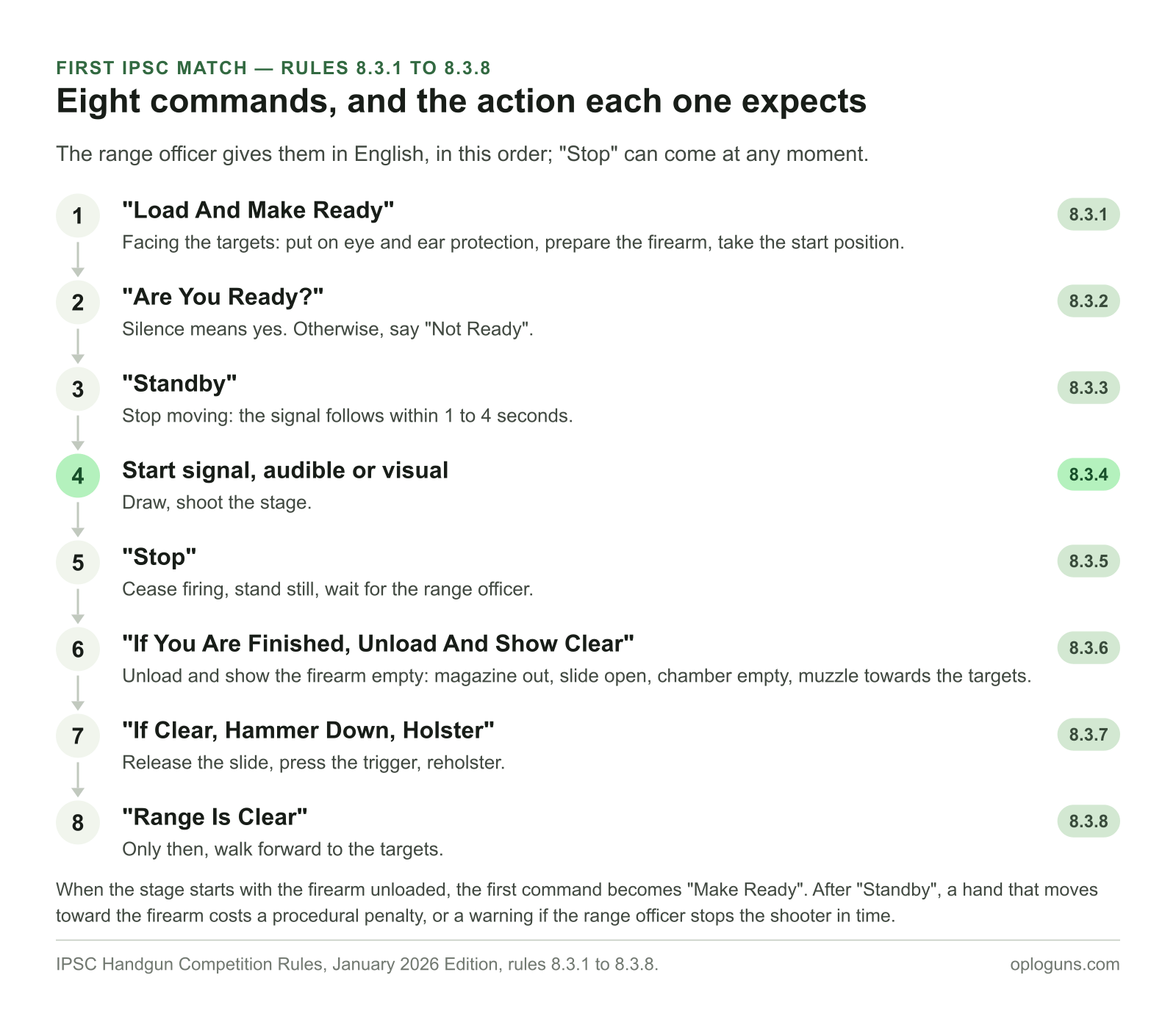
The Range Officer on the stage uses the commands set by the rules, in this order1:
| Command | In plain words | What the shooter does | Rule |
|---|---|---|---|
| "Load And Make Ready" | Get ready to shoot | Facing the targets, put on eye and ear protection, prepare the firearm, take the start position | 8.3.1 |
| "Are You Ready?" | Last check before the start | Silence means yes; otherwise say "Not Ready" | 8.3.2 |
| "Standby" | The signal is coming | Stop moving: the signal follows within 1 to 4 seconds | 8.3.3 |
| Start signal | Audible or visual signal | Draw, shoot the stage | 8.3.4 |
| "Stop" | Cease fire at once | Cease firing, stand still, wait | 8.3.5 |
| "If You Are Finished, Unload And Show Clear" | Unload and show the firearm empty | Magazine out, slide open, chamber empty, muzzle towards the targets | 8.3.6 |
| "If Clear, Hammer Down, Holster" | Make the firearm safe and holster it | Release the slide, press the trigger, reholster | 8.3.7 |
| "Range Is Clear" | The range is safe | Only then, walk forward to the targets | 8.3.8 |
When the stage starts with the firearm unloaded, the first command becomes "Make Ready"1. By default, the shooter waits standing, facing the targets, loaded firearm holstered, arms at the sides1.
After "Standby", the hands no longer move toward the firearm: the movement costs a procedural penalty, or a warning if the range officer stops the shooter in time1. A start before the signal is not penalized: the range officer stops the shooter and restarts them1. And the course of fire ends only once the firearm is holstered and the hands are clear of it1.
Match scoring: score sheet and challenges
After "Range Is Clear", the shooter accompanies the range officer to the targets1. Three rules hold the scoring together:
- Do not touch the targets, or come within one meter of them without the range officer's agreement (9.1.1, 9.1.2).
- Challenge before the patching: once the target has been patched or repainted, the challenge is no longer accepted (9.6.4).
- Sign the sheet: signed by the range officer and the shooter, it is conclusive for the time, the points and the penalties (9.7.4).
The time is recorded to the hundredth of a second, and only one counts: that of the shot timer the range officer holds1. A disagreement over a hit goes up to the chief range officer, then to the Range Master, whose decision is final1. An error in the posted results is reported within the hour after they are posted1.
The calculation itself, points divided by time, is explained in our IPSC guide, in the section on the hit factor. The zones of the target are in our article on the IPSC target.
Penalties and disqualification: 10 points, or the match
A procedural penalty takes away 10 points1. The most common at a first match1:
- Shooting with a foot outside the area, beyond a fault line: one penalty per occurrence (10.2.1).
- Not following the briefing's procedure: one penalty per occurrence (10.2.2).
- Moving after "Standby": one penalty (10.2.6).
- Forgetting a target: one penalty per target not engaged, plus the misses (10.2.7).
A miss also costs 10 points, as does each hit on a target not to be shot, the no-shoot, up to two per target1. The score for a stage never goes below zero1.
Disqualification is of another nature. The shooter shoots no further stage of the match1. Four families of faults lead to it: the accidental discharge (10.4), unsafe gun handling (10.5), unsportsmanlike conduct (10.6) and prohibited substances (10.7)1. The most frequent safety faults are listed in our IPSC guide, in the section on the faults that disqualify.
An appeal remains possible, in writing, within the hour, to the Range Master, with an appeal fee of 100 US dollars at most1. For a safety fault, it covers only exceptional circumstances: the fault observed by the range officer is not open to debate1.
What to bring to a first IPSC match
- The license for the season, and a medical certificate less than a year old3.
- A single firearm, the same for all stages, with the same type of sights1.
- Belt, holster and magazine pouches, in a position that does not change from one stage to the next1.
- The rounds for the match: 40 at Level I, 80 at Level II, 150 at Level III as the recommended minimum, plus the 8 for the chronograph and a margin for a stage to reshoot1.
- Eye and ear protection: the range officer stops a shooter who has lost them, and has them reshoot the stage1.
- Sports clothing: the IPSC discourages camouflage; in federal competitions, « camouflage », « combat » or « police » outfits are banned13.
A long course requires up to 32 rounds1. In Production, where a magazine starts with 15 rounds at most, three magazines are the minimum. The detail is in our article on IPSC gear, and the journey in our guide to transporting your firearm.
For a match abroad, the FFTir asks for written agreement: the shooter has a request for authorization to leave the territory signed by the federal bodies2.
Three misconceptions about the first IPSC match
- "A Level I has lighter rules." The format may be lighter, not the safety: the latest edition of the rules applies at all levels1.
- "You have to qualify for the French championship." Qualification is "open", subject to validation by the club3.
- "A disqualification cancels only the stage." It bars all the remaining stages of the match1.
Which first IPSC match, by goal
What you gain, what you give up
To discover competition, a Level I or II match takes 40 to 80 rounds and is shot in an approved club. In return, it does not count toward the long-magazine certificate.
To open access to long magazines, you need a Level III match in the division you are aiming for. In return, at least 150 rounds, 12 stages and a rulebook that is valid only in English.
To shoot the French championship, there is no stage to get through: validation by the instructor, the president and the OCC department stands in for qualification. In return, the date and the venue are unique, late July 2027 at the CNTS for handguns.
Sources 6 references
The levels, the commands, the scoring and the penalties come from the IPSC Handgun rules of January 2026; registration and the organization of matches in France, from the FFTir's rules and calendar. The federal documents are in French. Click a note marker in the text to highlight the matching source.
- IPSC — IPSC Handgun Competition Rules, January 2026 Edition (81-page PDF, final version of 29 December 2025, linked from the IPSC's "Rule Books" page), consulted on 15 November 2026: Appendix A1, "IPSC Match Levels", "R = Recommended, M = Mandatory" — line 1, "Must follow latest edition IPSC rules", M from I to V; line 8, "One NROI official per stage", R at I and II, M from III to V; line 9, "One IROA official per stage", R at III, M at IV and V; lines 13, 14 and 18, approval of the stages by the IPSC, "IPSC sanctioning" and "Inclusion in IPSC Match Calendar", M from III to V; line 15, "Chronograph", R at II and III, M at IV and V; line 16, "Three month advance registration with IPSC", M at III; line 17, "IPSC Assembly approval on four year cycle", M at IV and V; lines 20 to 22, in handgun, rounds 40, 80, 150, 300, 450, stages 3, 6, 12 recommended then 24 and 30, shooters 10, 50, 120, 200, 300; point 24, "International sanctioning of Level I and Level II matches is not required. However, each Regional Director is entitled to establish his own criteria"; Appendix A2, divisions recognized at 5 shooters (recommended) at I and II, 10 (mandatory) at III, 20 at IV and V, categories at 5 shooters, Lady, Junior "under the age of 21", Senior "over the age of 50", Super Senior "over the age of 60"; 1.1.5.1, "Level I and Level II matches are not required to comply strictly with the freestyle requirements or round count limitations"; 1.2.1.3, long course of 32 rounds at most; 3.2.2 and 3.2.4, briefing read "verbatim", walkthrough of equal length for all; 5.1.7, same firearm and same type of sights for the whole match; 5.2.2, handling in a safety area or on command; 5.2.4.2, position of the equipment unchanged from one stage to the next; 5.3.1, camouflage clothing "discouraged"; 5.4.3, protection lost, stage to be reshot; 5.6.3.2 and 5.6.3.3, 8 rounds taken, 1 bullet weighed, 3 fired; 6.1.3, "Match – Consists of a minimum of 3 stages"; 6.2.3 and 6.2.4, one division declared before the match, only the first attempt counts; 6.4.1.1, European championship cited for Level IV; 6.6.1, absence at the scheduled time, zero for the stage; 8.2.2, default start position; 8.3.1 to 8.3.8, commands, "Standby" followed by the signal "within 1 to 4 seconds", false start restarted (8.3.4.1), end of the course of fire when the hands are clear of the holstered firearm (8.3.7.3); 8.7.2, hands only for sight pictures during the walkthrough; 9.1.1 and 9.1.2, targets at more than one meter, without touching them; 9.4.2 to 9.4.4, −10 points per no-shoot hit (two at most) and per miss; 9.5.5, minimum score of zero; 9.6.1 to 9.6.6, checking and challenging the scoring; 9.7.1 and 9.7.4, time "recorded to 2 decimal places", signed sheet "conclusive evidence"; 9.8.3, error in the results to be reported "within 1 hour"; 9.10.1, "Only the timing device operated by a Range Officer must be used to record the official elapsed time"; 10.1.2, procedural penalty of −10 points; 10.2.1, 10.2.2, 10.2.6 and 10.2.7, examples of penalties; 10.3.1, the disqualified shooter "will be prohibited from attempting any remaining courses of fire"; 10.4 to 10.7, grounds for disqualification; 6.2.2, division below the threshold kept "without official IPSC recognition"; 10.2.6, warning for the first offense if the range officer stops the shooter in time; 11.1.2 and 11.3.1, written appeal "within one hour", limited to exceptional circumstances for a safety fault; 11.4.1, appeal fee of "US$100.00" or the highest entry fee of the match, whichever is lower, at Level III and above, capped at 100 dollars at the other levels; 11.4.2, national range officers institutes (NROI) and international association (IROA). ⚠️ The IPSC website refused automated reading on 15 November 2026: the edition in force and the match calendar are checked on ipsc.org.
- FFTir — Règlement administratif du Tir Sportif de Vitesse, saison 2019/2020 [TSV administrative rules, 2019/2020 season] (4-page PDF), consulted on 15 November 2026: article VII, « seul le règlement officiel de l'IPSC en anglais est valable sur les compétitions de Niveau III et plus » [only the official IPSC rules in English are valid at Level III competitions and above]; article IX, shooters from non-approved associations ranked « sous les couleurs de l'Association habilitée » [under the colors of the approved association]; article X, « Les Associations habilitées sont encouragées à organiser des compétitions amicales de niveau I ou II, mais doivent respecter le calendrier Officiel de la Fédération Française de Tir et ne pas les superposer à celles de Niveau III. La déclaration de toute manifestation TSV au président de la CNS est obligatoire, sous peine d'interdiction de celle-ci. La validation de l'organisation d'une compétition de niveau 1, 2 ou 3 est obligatoire. Elle est soumise au moins trois mois avant à l'autorisation du Regional Director (président de la CNS TSV). » [approved associations are encouraged to organize friendly Level I or II competitions, but must respect the federation's official calendar and not overlap them with Level III ones; declaring any TSV event to the president of the national commission is compulsory, on pain of its being banned; the organization of a Level 1, 2 or 3 competition must be validated, and is submitted at least three months beforehand for the authorization of the Regional Director, the president of the national TSV commission]; article XV, license « validée par […] le médecin » [validated by the doctor], entry validated « par le Président ou le responsable TSV de l'association, ou par le Regional Director » [by the president or the TSV manager of the association, or by the Regional Director]; article XVI, long-magazine certificate issued on « justifiant de leur participation à une compétition de niveau 3 pour la division sollicitée » [proof of having taken part in a Level 3 competition in the division applied for]; article XVII, written agreement and « demande d'autorisation de sortie de territoire » [request for authorization to leave the territory] for a competition abroad. ⚠️ 2019/2020 edition: it is the only TSV administrative rulebook linked from the federation's website at this date.
- FFTir — Règlement de Gestion Sportive 2026-2027, Vie Nationale [sports management rules 2026-2027] (PDF, V1, « Version du 29/09/2026 »), consulted on 15 November 2026: A.1.1, license for the season and medical certificate « de moins d'un an à la date de la compétition » [less than a year old on the date of the competition]; A.1.2, « Pour toutes les disciplines, les tenues dites « camouflage », « combat » ou « police » sont interdites » [for all disciplines, so-called camouflage, combat or police outfits are banned]; A.1.6.1, the club's manager certifies that its shooters « sont aptes à concourir en toute sécurité et en toute connaissance des règles de compétitions » [are fit to compete in complete safety and with full knowledge of the competition rules]; A.4.1, regional championships compulsory « sauf pour les disciplines Bench-Rest gros calibre et Tir Sportif de Vitesse, dont les principes de qualification sont open » [except for centerfire Bench-Rest and TSV, whose qualification is open]; B.10.1, « tout tireur ne pouvant présenter sa licence ne peut en aucun cas y participer » [any shooter who cannot show their license may not take part under any circumstances]; B10.2.1, French championship « open sous réserve de validation par le moniteur TSV du club, le président du club et le service OCC » [open subject to validation by the club's TSV instructor, the club president and the OCC department]. ⚠️ The « Rappel des catégories d'âge IPSC » [reminder of IPSC age categories] in B.10.1.1 counts Juniors and Super Juniors on the first day of the match; Appendix A2 of the IPSC rules counts them until 31 December of the year they turn 21 and 18. The same paragraph specifies that the IPSC rules apply to competitions with an international ranking.
- FFTir — Calendrier sportif prévisionnel, saison 2026/2027 [provisional sporting calendar, 2026/2027 season] (PDF, « Mise à jour le 15/10/2026 »), consulted on 15 November 2026: « Tir sportif de vitesse, armes de poing » [handguns], French championship at the CNTS « du 28 au 31 juillet », with no regional championship deadline; « Tir sportif de vitesse, armes d'épaule » [long guns], venue « À venir », « du 10 au 12 septembre »; « Ces dates sont susceptibles de modifications en fonction des impératifs dictés par les calendriers des fédérations internationales » [these dates may change depending on the constraints set by the international federations' calendars].
- FFTir — page « Les calendriers » [calendars], consulted on 15 November 2026: link to the 2026/2027 provisional sporting calendar, version 4.
- FFTir — Tir sportif de vitesse — Compétitions, consulted on 15 November 2026: the page carries only the words « À venir… » [coming soon]. ⚠️ No calendar of Level I, II or III matches is published there at this date.
The rules in force prevail. This article describes the IPSC Handgun rules of January 2026 and the FFTir's texts as they read on 15 November 2026. The dates in the federal calendar are provisional, and the conditions of a match are confirmed with its organizer.
Frequently asked questions
What are the IPSC match levels?
Five, numbered I to V by Appendix A1 of the IPSC rules. In handgun, Level I recommends 3 stages and at least 40 rounds, Level II 6 stages and 80 rounds, Level III 12 stages and 150 rounds; Levels IV and V have 24 and 30 stages. IPSC sanctioning is compulsory from Level III up.
How do you register for an IPSC match in France?
Through your TSV-approved club (TSV, tir sportif de vitesse, is the French name for IPSC). The TSV administrative rules reserve competitions for shooters whose FFTir license for the season is validated by the doctor, and whose entry is validated by the club president or the TSV manager. The shooter then declares a single division before the start of the match.
Do you have to qualify for a tir sportif de vitesse match?
No. The 2026-2027 sports management rules exempt TSV from the regional championship: qualification there is "open". The French championship remains subject to validation by the club's TSV instructor, the club president and the federation's OCC department.
Where can you find the calendar of IPSC matches in France?
The French championship appears in the FFTir's provisional sporting calendar: for 2026-2027, handguns are shot at the CNTS, the federation's national sport shooting center, from 28 to 31 July 2027. Matches of Level III and above must be entered in the IPSC's match calendar. Level I and II matches are declared to the national TSV commission: their dates are asked of the club.
What are the range officer's commands in IPSC?
In order: "Load And Make Ready", "Are You Ready?", "Standby", then the start signal, given 1 to 4 seconds later. At the end: "If You Are Finished, Unload And Show Clear", "If Clear, Hammer Down, Holster", and "Range Is Clear". "Stop" can come at any moment: the shooter ceases firing and stands still.
How many rounds do you need for an IPSC match?
The rules recommend at least 40 rounds for a Level I match, 80 at Level II, 150 at Level III, 300 at Level IV and 450 at Level V. On top come the 8 rounds taken for the chronograph test, when there is one, and enough to reshoot a stage.
Spotted an error, or a rule that has changed since we checked? Report an error