IPSC Standard Division: the box, the magazines, Minor and Major
Published on · 11 min read · Anthony Baillon
In Standard Division, the pistol ready to fire, empty magazine inserted, fits wholly inside a box of 225 × 150 × 45 mm. No optic, no compensator; no limit on capacity or trigger pull. Minor requires a power factor of 125, Major 170, with a bullet of at least 10 mm.
At a glance
| Appendix D2 item | What the rulebook sets | No. |
|---|---|---|
| Size | Box of 225 × 150 × 45 mm, magazine inserted | 15 |
| Magazine | No capacity set; the box limits the length | 8 and 9 |
| Minor | Factor 125, from 9 mm up | 2 and 4 |
| Major | Factor 170, bullet of at least 10 mm | 1 and 5 |
| Sights | Open, with no compensator | 12 and 13 |
- The 9 mm is allowed, in Minor only; the .357 SIG makes Major under a concession, until 31 December 2029.
- The check: eight cartridges drawn, one bullet weighed, three fired in the shooter's own pistol.
- The entry cost: €1,093 to €2,769 in 9 mm, €2,226 to €4,529 in .40 S&W, pistol and equipment, at the prices of 15 November 2026.
IPSC Standard: Appendix D2, line by line
Standard fits on one page of the IPSC rulebook: Appendix D2 of the January 2026 edition, fourteen lines and four special conditions1. Our article on the IPSC rulebook in French says where to read this text, and which version prevails.
| Line | What Appendix D2 governs | Standard |
|---|---|---|
| 1 | Minimum power factor, Major | 170 |
| 2 | Minimum power factor, Minor | 125 |
| 3 | Minimum bullet weight | None |
| 4 | Minimum caliber and case length | 9 mm and 19 mm |
| 5 | Minimum caliber for Major | 10 mm (.40) |
| 6 | Minimum trigger pull | None |
| 7 | Maximum handgun size | The box |
| 8 | Maximum magazine length | The box |
| 9 | Maximum capacity | None |
| 10 | Distance of handgun and equipment from the belt | 50 mm at most |
| 11 | Equipment behind the hip bone | Yes |
| 12 | Optical or electronic sights | No |
| 13 | Compensator, ports, sound suppressor, flash suppressor | No |
| 14 | Weight attached to the barrel, extending beyond the muzzle | No |
No list of handguns, no minimum trigger pull, no list of permitted parts: any pistol that goes into the box, with open sights and no compensator, is a Standard pistol1. Single action is allowed, starting hammer cocked with the safety applied1.
The FFTir, the French shooting federation, has tir sportif de vitesse (TSV, the French name for IPSC) practiced « selon les règles internationales » [according to the international rules]2, and Standard is one of the six handgun divisions of the 2026-2027 French championship3. The overall table of divisions is in our guide to IPSC in France.
The Standard box: 225 × 150 × 45 mm, magazine inserted
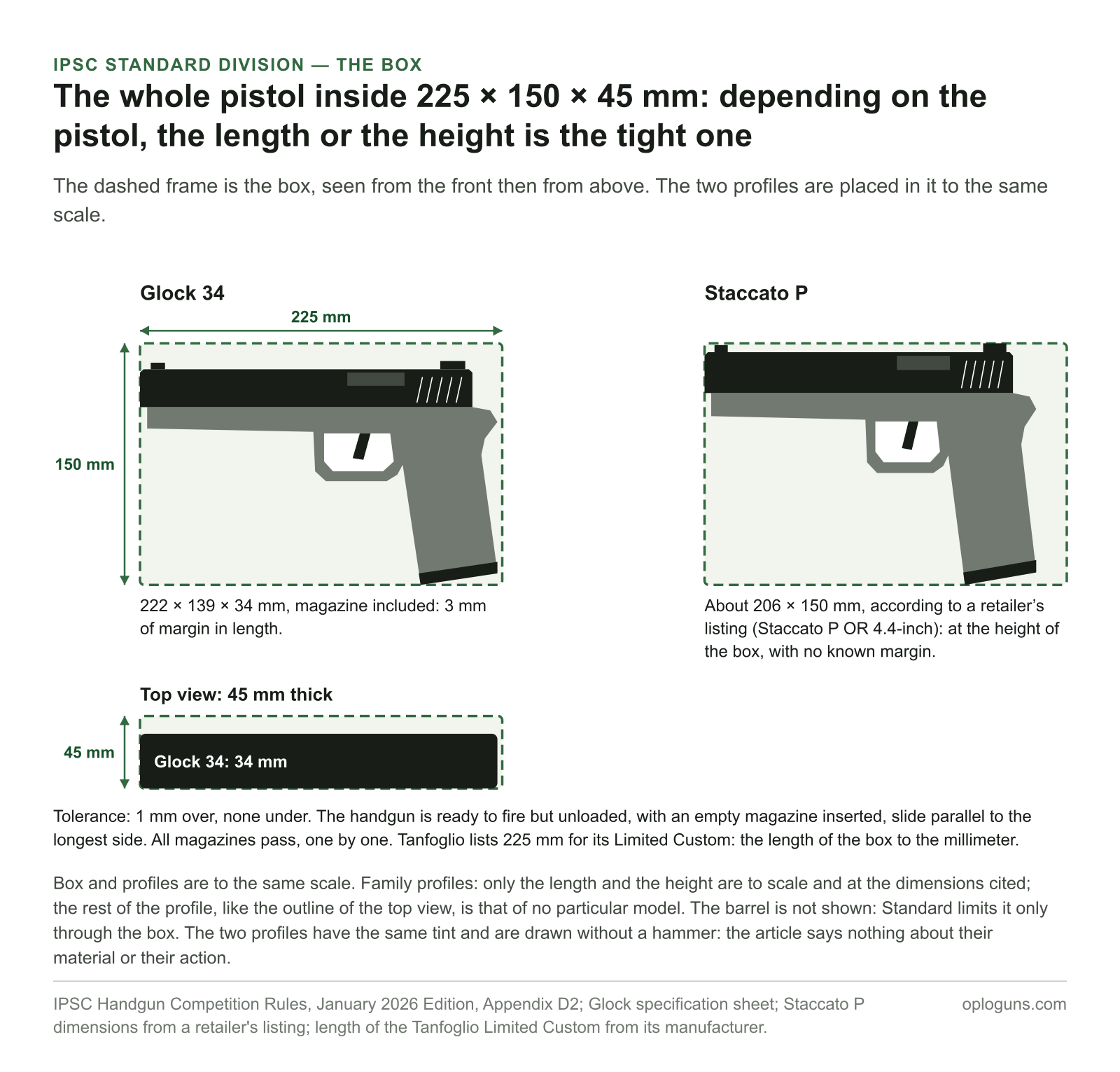
Three internal dimensions: 225 mm long, 150 mm high, 45 mm thick, with a tolerance of 1 mm over and none under1. A little more than an A5 sheet, 45 mm thick11.
The measurement follows a written protocol1:
- The handgun is ready to fire, but unloaded, with an empty magazine inserted.
- The shooter places it in the box themselves, then removes it, slide parallel to the longest side.
- The slide is fully forward; only an adjustable rear sight may be slightly depressed.
- Anything that deploys is measured deployed: folding sights, slide racker, thumb rest, grip panels.
- All magazines pass, one by one.
The text itself therefore names the thumb rest and the slide racker: Standard does not prohibit them, it counts them inside the box1.
Depending on the pistol, the height or the length is the tight one. A Glock 34 measures 222 × 139 × 34 mm, magazine included6. A Staccato P, 206 × 150 mm: the very height of the box7. Tanfoglio lists 225 mm for its Limited Custom, the length of the box to the millimeter4.
Magazines in Standard: the box sets the length
The rulebook gives neither a capacity nor a length in figures. On lines 8 and 9, capacity is unrestricted, and length refers back to the box: "all magazines must comply"1. A magazine is too long when the handgun, magazine inserted, no longer fits in 150 mm of height.
Two parts are prohibited in so many words: telescoping magazines, and compressible base pads1.
Retailers translate the rule into lengths. One gun shop thus sells a 2011 magazine in .40 S&W of 126 mm, 15 rounds, presented as accepted in Standard Division, at €929.
In France, another limit is added, that of the law. Beyond 20 rounds, a handgun magazine is classified in Category A1; the federation certificate that opens it to TSV shooters is described in our article on Open Division.
Minor or Major in Standard: 125, or 170 in 10 mm
The power factor ranks the ammunition, not the pistol. Minor is the floor that allows a shooter to be ranked; Major, offered by some divisions only, earns more points for peripheral hits1.
The calculation, set out in our guide to IPSC in France, multiplies the bullet weight in grains by its velocity in feet per second, then divides by 1,000. A 180-grain bullet at 967.8 feet per second gives 174.2, so 174: decimals are ignored, never rounded1. A grain weighs 0.0648 g, and one foot per second equals 0.3048 m/s111.
In Standard, Major has two conditions1:
- A factor of at least 170, against 160 in Open.
- A bullet of at least 10 mm (.40). The .357 SIG is admitted under a concession, extended until 31 December 2029.
The 9 mm therefore stays in Minor, whatever its charge. On the target, the A zone is worth 5 points in both cases; the C zone is worth 4 points in Major against 3, the D zone 2 against 11. The full scale is in our guide to IPSC in France, the zones in our article on the IPSC target.
Power factor of five factory cartridges
Bullet weight (grains) × velocity listed by the manufacturer (feet per second) ÷ 1,000, decimals ignored; Standard Division thresholds: 125 for Minor, 170 for Major
Velocities listed by the manufacturer5; at the match, the ammunition is measured in the shooter's own firearm1. In Standard, Major requires 170 and a bullet of at least 10 mm: 9 mm stays in Minor whatever its factor1.
View the data
| Cartridge | Listed velocity | Factor | In Standard |
|---|---|---|---|
| .45 ACP FMJ, 230 grains | 260 m/s | 196 | Major |
| .357 SIG FMJ, 140 grains | 412 m/s | 189 | Major |
| .40 S&W FMJ, 180 grains | 295 m/s | 174 | Major |
| .40 S&W FMJ, 165 grains | 313 m/s | 169 | Minor |
| 9 mm Luger FMJ, 124 grains | 360 m/s | 146 | Minor |
Major can be bought off the shelf, narrowly. A .40 S&W cartridge with a 180-grain bullet, listed at 295 m/s, gives 174; the 165-grain one, listed at 313 m/s, stops at 169511. Four points of margin in one case, one point short in the other.
Minor or Major on the chronograph: eight cartridges
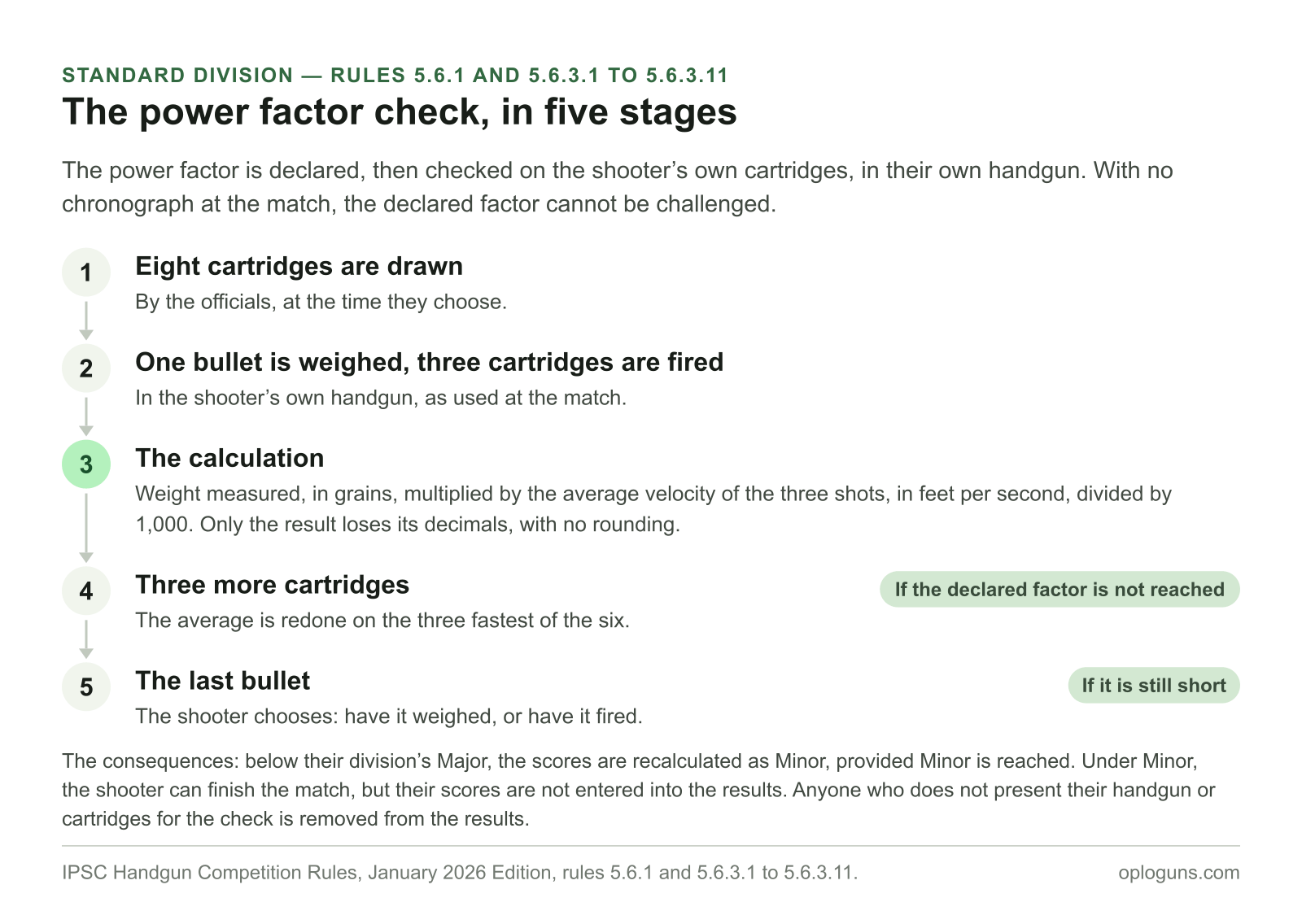
The power factor is declared, then checked. A chronograph is recommended at Level II and III matches, mandatory at Levels IV and V; without a chronograph, the declared factor cannot be challenged1.
The check runs as follows1:
- Eight cartridges are drawn by the officials, at the time they choose.
- One bullet is pulled and weighed; three cartridges are fired in the shooter's own handgun, as used at the match.
- The calculation takes the weight measured and the average velocity of the three shots. The instruments are read at face value; only the result loses its decimals.
- If the declared factor is not reached, three more cartridges are fired, and the average is redone on the three fastest of the six.
- If it is still short, the shooter chooses: have the last bullet weighed, or have it fired.
The consequences depend on the threshold missed. Below their division's Major, the scores are recalculated as Minor, provided Minor is reached. Under Minor, the shooter can finish the match, but their scores are not entered into the results1. Anyone who does not present their handgun or cartridges for the check is removed from the results1.
Hence the practice of loading above the threshold. Chris Christian, in the magazine Shooting Sports USA, speaks of five points of margin, to absorb temperature and chronograph variances10. Measuring your own ammunition, in your own pistol, is the subject of our guide to the shooting chronograph.
Standard: no optic, no compensator, ported slide
Three lines close the division to Open's accessories1:
- No optical or electronic sights. Open sights are those that use neither circuitry nor lenses; a fiber optic is not a lens.
- No compensator, meaning no part fitted to the muzzle to divert the gases and counter muzzle rise.
- No weight attached to the barrel and extending beyond the muzzle.
Line 13 carries a nuance. Only ports cut in the barrel are prohibited: "Slides may be ported"1.
Equipment follows the common rule: 50 mm at most from the belt, and nothing forward of the hip bone at the start signal1. The detail is in our guide to IPSC gear.
Standard pistols: Minor in 9 mm or Major in .40
The choice of caliber comes before the choice of pistol. The models are compared in our guide to which pistol for TSV, division by division.
Standard in Minor, with a 9 mm
Pros
Standard in Major, in .40 S&W
Pros
Two manufacturers aim a pistol at the division. CZ presents the TS 2, with a single action listed at 8 N, or 816 g, as its base model for Standard411. Tanfoglio intends its Limited Custom for it, a single-action pistol weighing 1,330 g, offered from 9 mm to .45 ACP by way of .40 S&W4.
Entry budget for Standard: €1,093 to €4,529
Assumption: a new pistol, a belt, a holster and three magazine pouches, then 200 cartridges a month. Prices recorded on 15 November 2026.
| Item | In 9 mm, Minor | In .40 S&W, Major |
|---|---|---|
| New pistol | €866 to €2,2307 | €1,999 to €3,9907 |
| Belt, holster, three magazine pouches | €227 to €5399 | €227 to €539 |
| Total specific to the division, first year | €1,093 to €2,769 | €2,226 to €4,529 |
| 2,400 cartridges, every year | €624 to €6628 | €1,344 to €1,7288 |
In 9 mm, the range runs from the Glock 34 Gen5 MOS, €866 to €959, to the CZ TS 2, €2,085 to €2,230; the Tanfoglio Limited Custom sits between the two, from €1,765 to €1,9997.
In .40 S&W, the Limited Custom, 225 mm long, costs €1,999 to €2,099; two STP pistols with 5-inch barrels, €3,440 and €3,9907. The listing for the latter does not give their overall length: whether they pass the box is to be checked before buying.
In the following years, only the ammunition comes back. At 200 rounds a month, .40 S&W costs €720 to €1,066 more a year than 9 mm11. Reloading, which changes this calculation, is presented in our guide to equipment for getting started in reloading. The full budget for the discipline, license and gun safe included, is in our guide to IPSC in France.
Four common mistakes in Standard Division
- "The magazine is limited to a given length." No length is written down: the handgun must fit in the box with each of its magazines1.
- "A hot-loaded 9 mm makes Major." Major requires a bullet of at least 10 mm, .357 SIG excepted1.
- "Every .40 S&W cartridge is Major." The 165-grain one listed at 313 m/s gives 1695.
- "A ported slide is a compensator." Only barrel ports are prohibited; the slide may be ported1.
Standard Division by goal
What you gain, what you give up
To keep your 9 mm, with open sights, Standard in Minor admits a pistol that Production refuses: single action, a barrel over 127 mm, a magwell. In return, one point fewer per hit in the C or D zone against shooters in Major.
To shoot Major with open sights, .40 S&W reaches 170 with a factory cartridge. In return, ammunition at €0.56 to €0.72 a round, and a chronograph check to pass.
To shoot with a red dot, the same pistol changes division: Optics in Minor, Open with the compensator. In return, the box no longer applies there, but other dimensions take over.
Sources 11 references
The rules come from the IPSC Handgun rulebook in its January 2026 edition, the French framework from the FFTir's rules, specifications and velocities from manufacturers' sheets, prices from surveys dated 15 November 2026 at French gun shops. Click a note marker in the text to highlight the matching source.
- IPSC — IPSC Handgun Competition Rules, January 2026 Edition (PDF, final version of 29 December 2025, linked from the IPSC "Rule Books" page), reread on 15 November 2026: Appendix D2, Standard Division, p. 56 — lines 1 to 14, including "Minimum power factor for Major : 170", "Minimum power factor for Minor : 125", "Minimum bullet caliber for Major : 10 mm (0.40"), see below", "Minimum trigger pull : No", "Maximum handgun size : Yes, see below", "Maximum magazine length : Yes, see below", "Maximum ammunition capacity : No", "Optical/electronic sights : No", "Compensators, ports, sound and/or flash suppressors : No, see below"; 15, "A handgun in its ready condition (see Section 8.1), but unloaded and with an empty magazine inserted or empty cylinder closed, must fit wholly within the confines of a box which has internal dimensions of 225 mm x 150 mm x 45 mm (tolerance of +1 mm, -0 mm). Note that all magazines must comply"; 16, handgun placed and removed by the shooter "with the slide parallel to the longest side of the box", "Rear adjustable sights may be slightly depressed but the slide must be fully forward", "all other features of the handgun, (e.g. collapsible and/or folding sights, slide rackers, thumb rests, grips etc.), must be fully extended or deployed", "telescoping magazines and/or magazines with compressible base pads are expressly prohibited"; 17, "Only porting of barrels is prohibited. Slides may be ported"; 18, "357SIG is also an approved caliber for Major […] This concession has been extended until 31 December 2029". Appendix A1, line 15, chronograph recommended at Levels II and III, mandatory at Levels IV and V. Appendix B2, A, C and D zones at 5, 4 and 2 points in Major, 5, 3 and 1 in Minor. Rules 5.1.3.1, "Open sights […] Fiber-optic inserts are deemed not to be lenses"; 5.1.4, no trigger pull weight outside a division's requirement; 5.2.5 and 5.2.10, equipment 50 mm from the belt and behind the hip bone; 5.6.1, "In the absence of chronographs, the power factor declared by a competitor cannot be challenged"; 5.6.1.1 and 5.6.1.2, definitions of Minor and Major, the latter for "more points for peripheral shots"; 5.6.3.1 to 5.6.3.3, ammunition checked in the shooter's own firearm, "An initial 8 sample rounds", "1 bullet is removed and weighed […] and 3 bullets are fired over the chronograph", displays read "at face value (i.e. without rounding or truncation)"; 5.6.3.5, formula and "a result of 124.9999 is not 125"; 5.6.3.6 and 5.6.3.7, three more shots, then weighing or firing of the last bullet; 5.6.3.8, "the competitor's scores will be recalculated as Minor, if achieved"; 5.6.3.9, scores out of the results under Minor; 5.6.3.11, removal from the results for failing to present handgun or cartridges; 8.1.2.1, "'Single action' – Chamber loaded, hammer cocked, with external safety applied"; glossary, "Compensator : A device fitted to the muzzle end of a barrel to counter muzzle rise by diverting away escaping gasses", "1 grain = 0.0648 grams". ⚠️ The IPSC also publishes interpretations during the year on its Rule Books page: to be checked before a match.
- FFTir — Règlement administratif du Tir Sportif de Vitesse, saison 2019/2020 [administrative rules for TSV, 2019/2020 season] (4-page PDF hosted by the federation, in French), reread on 15 November 2026: article I, a discipline « régie au niveau international par l'IPSC » [governed internationally by the IPSC]; article VII, « seul le règlement officiel de l'IPSC en anglais est valable sur les compétitions de Niveau III et plus » [only the official IPSC rulebook in English is valid at Level III competitions and above]; article XII, « Ces disciplines seront pratiquées selon les règles internationales » [these disciplines will be practiced according to the international rules]. ⚠️ 2019-2020 edition, the latest version published by the federation.
- FFTir — Règlement de Gestion Sportive 2026-2027, Vie Nationale [sports management rules 2026-2027, national competitions] (PDF, V1, « Version du 29/09/2026 », in French), reread on 15 November 2026: B.10.1.1, events "HANDGUN : Open, Standard, Classic, Production, Optic, Production Optic, PCC Optic, PCC Iron".
- Manufacturers' sheets, reread on 15 November 2026: CZ, CZ TS 2, "Base model of the sport special for competing in the IPSC Standard Division or for target shooting", "Precise SA trigger with a clearly defined break and a short reset 8 N"; Tanfoglio, Limited Custom (in Italian), "prestazioni eccellenti nella Divisione di Tiro Standard I.P.S.C." (excellent performance in IPSC Standard Division), overall length 225 mm, 121 mm barrel, 1,330 g, "S.A." action, calibers 9x19, 9x21, .38 SA, .40 S&W, 10 mm Auto and .45 ACP.
- Sellier & Bellot — manufacturer's sheets, reread on 15 November 2026: .40 S&W, FMJ 180 grains, V0 295 m/s, and FMJ 165 grains, V0 313 m/s; 9 mm Luger, FMJ 124 grains, V0 360 m/s; .357 SIG, FMJ 140 grains, V0 412 m/s; .45 ACP, FMJ 230 grains, V0 260 m/s. ⚠️ Velocities listed by the manufacturer, with no indication of the test barrel length on these pages; the velocity the match chronograph measures depends on the firearm.
- GLOCK — G34 Gen5 MOS FS, manufacturer specification sheet, reread on 9 November 2026: length 222 mm, width 34 mm, height with magazine 139 mm, 135 mm barrel, 17 rounds.
- New pistols, prices recorded on 15 November 2026 (pages in French). Glock 34 Gen5 MOS: Armurerie Auxerre, product page, €865.50; Armurerie Douillet, product page, €925.00; Le Pistolier, product page, €959.00. Tanfoglio Limited Custom 9x19: Le Pistolier, Limited Custom Teal Blue, €1,765.00; Armurerie de la Bourse, Limited Custom Tungsten, €1,999.00. CZ TS 2 9x19: Armurerie FMR, product page, €2,085.00; Armurerie de la Bourse, product page, €2,225.00; Le Pistolier, CZ TS 2 Entry Model, €2,230.00. Tanfoglio Limited Custom .40 S&W: Armurerie de la Bourse, chromed small frame, €1,999.00, « produit pour les compétitions IPSC/TSV en division Standard » [made for IPSC/TSV competitions in Standard Division], length 225 mm, and Tungsten large frame, €2,099.00. STP in .40 S&W, Deville Armory: Sentry 5.0, €3,440.00; Loki 5.0, €3,990.00, « Plateforme : 1911 », « Canon : 5 pouces » [barrel: 5 inches], presented for an "IPSC Limited Major" division, with no overall length. Staccato P dimensions: Armurerie Gilles, Staccato P OR 4.4", « Dimensions : 8,1" x 1,5" x 5,9" (environ 206 x 38 x 150 mm) » [about 206 x 38 x 150 mm]. ⚠️ Commercial data; pistols in .40 S&W were found new at only two gun shops, and the STP pistols' compliance with the 225 mm box is not established by their listing.
- Ammunition, prices recorded on 15 November 2026 (pages in French). 9 mm by the case of 1,000: Armurerie Centrale, munitions 9x19, STV Scorpio 124 gr FMJ at €259.00; Armurerie Lavaux, MFS 9x19 Para FMJ, lot of 1,000, €275.95. .40 S&W, box of 50, 180-grain bullet: Armurerie de la Bourse, Winchester €28.00, Magtech FMJ €31.00, Geco FMJ €32.00; Deville Armory, Geco FMJ €36.00. ⚠️ Commercial data; the STV case was shown as out of stock that day.
- Equipment and magazine, prices recorded on 15 November 2026 (pages in French). Armurerie de la Bourse: Ghost IPSC belt and inner belt, €55.00; DAA Racer magazine pouch, €31.00; STI 2011 magazine cal. .40 S&W, 126 mm, 15 rounds, €92.00, « Longueur 126 mm pour être accepté en division standard IPSC/TSV » [length 126 mm to be accepted in IPSC/TSV Standard Division]. Armurerie Douillet: Ghost Stinger holster, €79.00; Ghost double-magnet magazine pouch, €61.00. Deville Armory: DAA Competition belt, €83.95; CR Speed Ultra 2 holster, €272.02. ⚠️ Commercial data.
- Chris Christian, NRA Shooting Sports USA — How To Reload 9mm For Competitive Shooting, 19 March 2020, reread on 25 September 2026: "Savvy shooters load 5 PF above requirements for a safety margin to account for temperature and chronograph variances".
- Calculations and conversions: A5 format, 148 × 210 mm (ISO 216); 1 foot per second = 0.3048 m/s; 8 N ÷ 9.807 = 0.816 kg; power factors, decimals ignored: 180 grains at 295 m/s (967.8 ft/s) = 174.2; 165 grains at 313 m/s (1,026.9 ft/s) = 169.4; 124 grains at 360 m/s (1,181.1 ft/s) = 146.5; 140 grains at 412 m/s (1,351.7 ft/s) = 189.2; 230 grains at 260 m/s (853.0 ft/s) = 196.2; cost per round: €259.00 and €275.95 per 1,000, or €0.26 and €0.28; €28.00 and €36.00 per 50, or €0.56 and €0.72; 2,400 cartridges a year: €624 to €662 in 9 mm, 48 boxes of .40 S&W at €28.00 and €36.00, or €1,344 to €1,728; annual difference: 1,344 − 624 = €720 to 1,728 − 662 = €1,066; equipment: 55 + 79 + 3 × 31 = €227 to 83.95 + 272.02 + 3 × 61 = €538.97; totals: 865.50 + 227 = €1,092.50 to 2,230 + 538.97 = €2,768.97 in 9 mm, 1,999 + 227 = €2,226 to 3,990 + 538.97 = €4,528.97 in .40 S&W.
The rules in force prevail. This article describes the IPSC Handgun rulebook of January 2026; the prices are those of 15 November 2026. The power factors given here are calculated from the velocities listed by a manufacturer: only the match chronograph, with the shooter's own pistol, decides between Minor and Major. Whether a pistol fits the box is to be checked with the club's TSV instructor and the match official before the first match.
Frequently asked questions
What are the dimensions of the box in Standard Division?
225 × 150 × 45 mm inside, with a tolerance of 1 mm over and none under. The pistol goes in ready to fire but unloaded, with an empty magazine inserted, slide closed and parallel to the longest side. All of the shooter's magazines must pass, and anything that deploys on the handgun is measured deployed.
What caliber do you need to shoot Major in Standard Division?
A bullet of at least 10 mm (.40), at a power factor of 170. The .357 SIG is admitted for Major under a concession extended until 31 December 2029. The 9 mm is allowed in the division, but only in Minor, at a factor of at least 125.
How many cartridges in a magazine in Standard?
The rulebook sets no capacity. The only limit is the box: the handgun must fit in it with each of its magazines. Telescoping magazines and compressible base pads are prohibited. In France, a handgun magazine of more than 20 rounds also falls under Category A1.
Is a red dot allowed in Standard Division?
No. Standard allows only open sights, fiber optic included, and prohibits the compensator as well as barrel ports. A ported slide remains permitted. With a red dot on the slide, the same pistol is declared in Optics, or in Open.
What happens if the ammunition does not reach Major on the chronograph?
Three more cartridges are fired, and the calculation is redone on the three fastest of the six. If Major at 170 is still not reached, the scores are recalculated as Minor, provided 125 is reached. Under 125, the shooter can finish the match, but their scores are not entered into the results.
How much does it cost to enter Standard Division?
At the prices recorded on 15 November 2026: €866 to €2,230 for a 9 mm pistol that fits in the box, €1,999 to €3,990 for a pistol in .40 S&W, plus €227 to €539 of equipment. Ammunition makes the difference every year: €624 to €662 in 9 mm, €1,344 to €1,728 in .40 S&W, for 2,400 cartridges.
Spotted an error, or a rule that has changed since we checked? Report an error