IPSC Production Division: the list of approved pistols and the prohibited modifications
Published on · 12 min read · Anthony Baillon
In Production Division, IPSC admits only the pistols on its Production Division List, shot in Minor. Appendix D4 of the January 2026 rulebook sets the rest: a barrel of 127 mm at most, 15 cartridges per magazine at the start, a trigger of 2.27 kg for the first shot or 1.36 kg for every shot, no optic, almost no modification.
At a glance
| Appendix D4 item | What the rulebook sets | No. |
|---|---|---|
| Handgun | A model on the Production list | 15 |
| Barrel | 127 mm at most | 7 |
| Magazine | 15 cartridges at the start signal | 18.2 |
| Trigger | 2,270 g for the first shot, or 1,360 g for every shot | 6 and 16 |
| Power | Minor only, factor 125 | 1 and 2 |
- The list is read on the IPSC website, which can modify it at any time; the rulebook reproduces none of its models.
- Modifications: the manufacturer's original parts, plus six families of aftermarket parts. No magwell, no optic, no compensator.
- The entry cost: €986 to €2,549 for the pistol, two magazines and the equipment, at the prices recorded on 15 November 2026.
IPSC Production: Appendix D4, line by line
Each handgun division fits in one appendix of the IPSC rulebook: a table of fourteen lines, then numbered special conditions. The one for Production is Appendix D4 of the January 2026 edition1. The editions of the text, and the one that prevails, are presented in our article on the IPSC rulebook in French.
| Line | What Appendix D4 governs | Production |
|---|---|---|
| 1 | Minimum power factor, Major | Not applicable |
| 2 | Minimum power factor, Minor | 125 |
| 3 | Minimum bullet weight | None |
| 4 | Minimum caliber and case length | 9 mm and 19 mm |
| 5 | Minimum caliber for Major | Not applicable |
| 6 | Minimum trigger pull | 2.27 kg for the first shot, or 1.36 kg for every shot |
| 7 | Maximum handgun size | Barrel of 127 mm at most |
| 8 | Maximum magazine length | None |
| 9 | Maximum capacity | 15 cartridges per magazine at the start |
| 10 | Distance of handgun and equipment from the belt | 50 mm at most |
| 11 | Equipment behind the hip bone | Yes |
| 12 | Optical or electronic sights | No |
| 13 | Compensator, ports, sound suppressor, flash suppressor | No |
| 14 | Weight attached to the barrel, extending beyond the muzzle | No |
Major does not exist in this division: whatever the cartridge, hits score on the Minor scale. The power factor and its check are explained in our article on Standard Division, where the choice between Minor and Major really arises.
Lines 10 and 11 concern the belt, not the handgun. They are detailed in our guide to IPSC gear.
In France, tir sportif de vitesse (TSV, the French name for IPSC) follows this rulebook, of which only the English version prevails at Level III competitions and above3. Production is one of the six handgun divisions of the 2026-2027 French championship4.
Production list: only the named models get in
The rulebook names no pistol. Condition 15 of the appendix refers to a page of the IPSC website: only handguns "listed as approved in the Production Division List" may shoot in Production1.
The list therefore lives outside the rulebook, and changes without waiting for a new edition. IPSC reserves the right to modify it at any time2. It reads as follows2:
- Sorted by manufacturer, each brand followed by its approved models.
- An update date at the top of the page, in the form "Updated:".
- Variants added by the words "Also approved": generations, optics-ready versions.
- Variants ruled out by the words "NOT APPROVED", sometimes within an approved range.
- Conditions in parentheses: without a mag funnel, without an optic mounted, barrel of 127 mm at most.
In its version of 9 March 2026, read on ipsc.org on 24 September 2026, then in an archived copy of 13 October 2026, it named among others2:
| Brand | Models named | Caveat noted on the list |
|---|---|---|
| Beretta | Full-size 92 Series, 92X Performance | — |
| CZ | SP-01 Shadow, Shadow 2, Shadow 2 OR, Shadow 2 Orange, Shadow 2 Compact | CZ-USA and Custom Shop variants not approved |
| Glock | 17 and 19, Gen 5, MOS and Gen 6 versions included | Barrel of 127 mm at most; the 34 not approved |
| Smith & Wesson | M&P M2.0; PC M&P9 M2.0 Competitor, Tungsten finish | M&P M2.0 Competitor not approved, apart from the PC version without the "Jet-Funnel" |
| Tanfoglio | Stock, Stock I, II, III, III Special, III Pro, Master | Stock Custom not approved |
| Walther | PDP Full Size and Compact, up to a 5-inch barrel | Steel frame without a detachable mag funnel |
Three consequences for the shooter:
- A model that is absent is not allowed, even if it meets every dimension of Appendix D4.
- A model that is present is not allowed in all its versions. The list rules out variants within the same range, and the appendix prohibits any handgun IPSC deems single-action-only1.
- The burden of proof is on the shooter. Before the match, the officials check the equipment; in case of disagreement, it is up to the shooter to provide acceptable evidence1. The rulebook does not say which: it requires that the examiner accept it.
Modifications in Production: what the rules prohibit
The rule starts from one principle: the pistol stays the manufacturer's. Original parts, supplied as standard or offered as an option for the model, are allowed; modifying them beyond minor detailing or the fitting of a replacement part is not1. Aftermarket parts, meaning those from a manufacturer other than the pistol's, are prohibited, except six families1.
| Part or operation | In Production | No. |
|---|---|---|
| Aftermarket magazines | Allowed, 15 cartridges at the start | 19.1 |
| Magazine base pad, internal limiter, witness holes | Allowed, at negligible weight | 18.2 |
| Aftermarket open sights | Allowed, without altering the handgun | 19.2 |
| Fiber optic, trimmed or colored sights | Allowed | 18.3 |
| Aftermarket grip panels | Allowed, without protruding beyond the bottom of the frame | 19.3 |
| Grip tape on the grip | Allowed, one layer, areas of Appendix E3a | 19.3 |
| Aftermarket springs | Allowed, in the same configuration | 19.4 |
| Aftermarket trigger assembly | Allowed, at the division's minimum pull | 19.5 |
| Aftermarket hammer | Allowed | 19.6 |
| Color, finish, serrations, stippling | Allowed | 18.1 |
| Flared, enlarged or add-on magwell | Prohibited | 18.1 |
| Weak-hand thumb rest | Prohibited | 18.1 |
| Extended slide lock lever | Prohibited | 18.1 |
| Racking handle on the slide | Prohibited | 18.1 |
| Rubber sleeve on the grip | Prohibited | 19.3 |
| Optic, compensator, ports | Prohibited | 12 and 13 |
Two details of the text spare you unpleasant surprises. An aftermarket trigger assembly keeps a trigger safety if the original trigger had one1. And the tape goes on the grip only: not on the slide, the trigger, the trigger guard, a lever or a button1.
Production trigger: 2,270 g or 1,360 g, measured
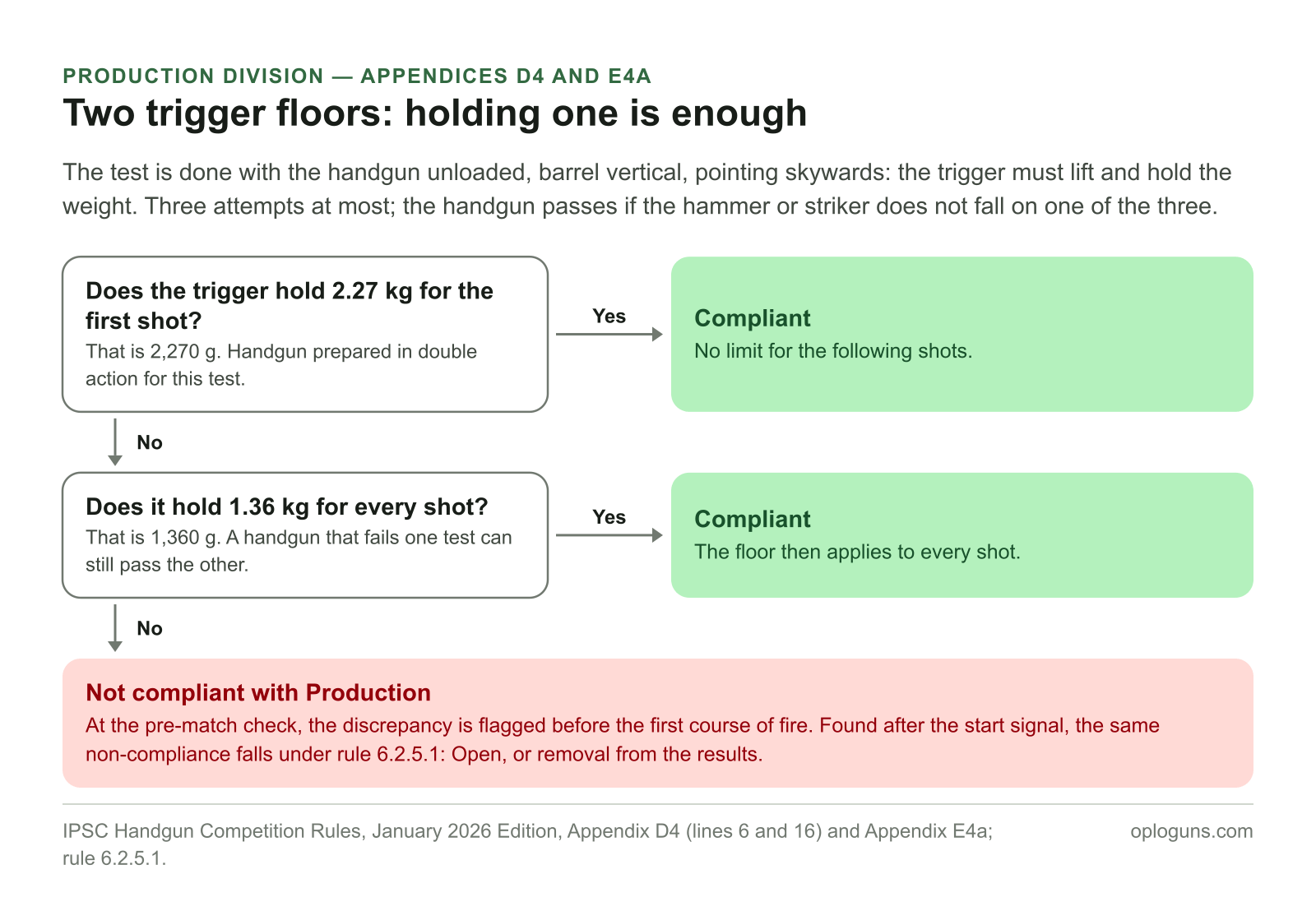
Two floors, depending on the pistol. The first: 2.27 kg for the first shot, that is 2,270 g, 5 lb or 22.3 N, with no limit for the following shots. The second: 1.36 kg for every shot, that is 1,360 g, 3 lb or 13.3 N111. 2,270 g is a little over two liters of water hanging from your index finger.
The check is described in Appendix E4a1:
- Prepare the unloaded handgun as if for firing, in double action for the first-shot test.
- Hook the weight or the gauge as close as possible to the center of the trigger.
- Raise the handgun gently, barrel vertical, pointing skywards: the trigger must lift and hold the weight. A gauge can replace it, following the procedure of the Range Master, the match's chief official.
- Repeat three times at most. The handgun passes if the hammer or striker does not fall on one of the three attempts.
A handgun that fails one of the two tests can still pass the other. If it fails both, it does not comply with Production. The pre-match check is a service to the shooter: it flags the discrepancy before the first course of fire. Found after the start signal, the same non-compliance falls under rule 6.2.5.1: Open, or removal from the results1.
A second rule targets handguns with an external hammer. At the start signal, the hammer is fully decocked, and the first shot is fired in double action. Thumb-cocking it after the signal, with a round chambered, costs one procedural penalty each time, or 10 points1. The only exception: a course of fire that starts with an empty chamber.
127 mm barrel and 15 rounds: what the official measures
Production knows only one dimension: barrel length. No maximum weight, no box, no magazine length1.
The measurement is made with the handgun assembled and unloaded, barrel pointing skywards. A rod marked at 127 mm is slid into the muzzle down to the breech face: if the mark is flush with or beyond the muzzle, the handgun complies1. 127 mm is 5 inches.
The 15-cartridge ceiling applies to the contents, not to the magazine. Any magazine accessible to the shooter during the course of fire holds 15 cartridges at most at the start signal1. A 17- or 19-round magazine remains allowed: it simply starts less full.
A shooter whose handgun no longer complies with their division after the start signal is moved to Open, if it is available, otherwise their scores leave the results1. The mechanism is described in our article on Open Division.
Choosing a Production pistol: two families
The trigger rule splits the pistols on the list into two families. The models themselves are compared in our guide to which pistol for TSV, division by division.
Double then single action
External hammer, a long and heavy first shot, short following shots. The CZ Shadow 2 lists 46 N in double action, or 4,691 g, then 15 N, or 1,530 g511.
Pros
Striker-fired
No hammer: the striker is cocked by the slide, and the trigger weighs the same on every shot. Glock lists 26 N for the 17 Gen5, or 2,651 g611.
Pros
- A single trigger pull to learn, from the first shot to the last.
- A floor of 1,360 g for every shot, with no decocking to do1.
Three other rules of the appendix rule out pistols:
- Single action only: single-action 1911s and 2011s are excluded, as is the SA version of an approved range1.
- A barrel over 127 mm: the Glock 34 and its 135 mm fall outside the division62.
- The optic: a red dot moves the pistol to Production Optics, same pistol, different ranking1.
Weight, for its part, stays unrestricted. A Glock 17 Gen5 of 708 g and a CZ Shadow 2 of 1,330 g, with an empty magazine, shoot in the same division56.
Entry budget for Production: €986 to €2,549
Assumption: a new pistol from the list, two magazines on top of those supplied, a belt, a holster and three magazine pouches. Prices recorded on 15 November 2026.
| Item | First year | Following years |
|---|---|---|
| New pistol, from the Glock 17 Gen5 to the CZ Shadow 2 | €689 to €1,8707 | — |
| Two more magazines | €70 to €1408 | — |
| Belt, holster, three magazine pouches | €227 to €5399 | — |
| Total specific to the division | €986 to €2,549 | — |
| 2,400 cartridges of 9 mm, by the case of 1,000 | €624 to €66210 | €624 to €662 |
Between the two ends, the Tanfoglio Stock costs €1,160 to €1,1997. A Glock 17 magazine comes to €35 to €43, a Shadow 2 magazine to €65 to €708.
The division adds nothing else: no optic, no magwell, no compensator to buy. In the following years, only the ammunition remains, at 200 rounds a month11. The license, the medical certificate and the gun safe are costed in our guide to IPSC in France.
Four common mistakes in Production Division
- "A model on the list is allowed in all its versions." The list rules out variants within a range, and Appendix D4 any single-action-only handgun12.
- "You need 15-round magazines." The ceiling applies to the cartridges present at the start signal; no magazine length is set1.
- "An aftermarket trigger is prohibited." Aftermarket trigger assemblies and hammers are allowed, at the division's minimum pull1.
- "Cocking the hammer after the signal saves time." With a round chambered, it costs 10 points each time1.
Production Division by goal
What you gain, what you give up
To shoot a factory pistol, Production accepts a pistol from the list as it comes out of its case, in 9 mm. In return, 15 cartridges at the start, and a first shot in double action on a hammer-fired pistol.
To prepare your pistol, the division leaves you open sights, springs, the trigger, the hammer and the grip panels. In return, no magwell and no thumb rest: Standard and Open, for their part, do not prohibit them.
To shoot with a red dot, the same pistol moves to Production Optics. In return, a sight and a plate to buy, and a different ranking.
Sources 11 references
The rules come from the IPSC Handgun rulebook in its January 2026 edition and from the IPSC Production list, the French framework from the FFTir's rules, specifications from manufacturers' sheets, prices from surveys dated 15 November 2026 at French gun shops. Click a note marker in the text to highlight the matching source.
- IPSC — IPSC Handgun Competition Rules, January 2026 Edition (PDF, final version of 29 December 2025, linked from the IPSC "Rule Books" page), reread on 15 November 2026: Appendix D4, Production Division, pp. 58-59 — lines 1 to 14, including "Minimum power factor for Major : Not applicable", "Minimum power factor for Minor : 125", "Minimum trigger pull : 2.27kg (5lbs.) for first shot or 1.36kg (3lbs.) for every shot", "Maximum handgun size : Maximum barrel length 127 mm", "Maximum magazine length : No", "Optical/electronic sights : No", "Compensators, ports, sound and/or flash suppressors : No"; 15, "Only handguns listed as approved in the Production Division List on the IPSC website may be used in Production Division. Note that handguns deemed by IPSC to be single-action-only are expressly prohibited"; 16, trigger of 2.27 kg for the first shot "and no restriction for subsequent shots fired", or of 1.36 kg "for every shot fired"; 17, "Handguns with external hammers must be fully decocked […] First shot attempted must be double action", "one procedural penalty per occurrence" if the hammer is cocked after the signal on a loaded chamber, except for an empty-chamber start; 18, the manufacturer's original parts "as standard equipment, or as an option"; 18.1, modifications prohibited "other than minor detailing", including "grip panels, racking or cocking handles, flared, enlarged and/or add-on magwells", "Weak hand thumb rests", "Extended slide lock levers are prohibited", color, finish, serrations and stippling allowed; 18.2, "Magazines accessible to a competitor during a COF must not contain more than 15 rounds at the Start Signal", base pads, internal limiters and witness holes allowed if they add or remove negligible weight; 18.3, sights trimmed, adjusted, colored or fiber-optic; 19, "Aftermarket parts, components and accessories are prohibited, except as follows"; 19.1 to 19.6, magazines, open sights "provided their installation and/or adjustment requires no alteration to the handgun", grip panels "which do not protrude beyond the bottom of the frame", tape, "rubber sleeves are prohibited", springs "in the same configuration as original", trigger assemblies with the trigger safety retained, hammers. Appendix E3a, tape in one layer, never on the slide, the trigger, the trigger guard, a lever or a button. Appendix E4a, trigger check: weight lifted with the barrel "pointed vertically skywards" or a gauge, "a maximum of 3 times", a pass if the hammer or striker does not fall on one of the three attempts. Appendix E4b, rod marked at 127 mm down to the breech face. Rules 5.1.2, minimum caliber 9x19; 6.2.3 and 6.2.3.1, compliance check before the match, "the onus is upon him […] to provide evidence"; 6.2.5.1, reclassification to Open or removal from the results; 8.1.2.5, hammer lowered with the decocking lever, otherwise by hand; 10.1.2, procedural penalty of 10 points; glossary, "Aftermarket : Items not manufactured by the OFM", "OFM : Original firearm manufacturer". ⚠️ The IPSC also publishes interpretations during the year on its Rule Books page: to be checked before a match.
- IPSC — Production Division List, "Updated: 2026-03-09", read on ipsc.org on 24 September 2026, then in its archived copy of 13 October 2026, read on 9 November 2026: IPSC "reserves the right to modify this list at any time"; BERETTA "92 Series full size frame […] 92X Performance"; CZ "CZ75 SP-01 Shadow […] Shadow 2, Shadow 2 Urban Grey, Shadow 2 OR (Optical Ready), Shadow 2 Orange, Shadow 2 Compact", "NOT APPROVED: CZ-USA and CZ Custom Shop variants"; GLOCK "17, 17M, 19, 19M, 19X […]", "Also approved: Gen 5 versions of above models. Also approved: MOS […] versions", "Gen 6 of models approved in current list", "provided the barrel length does not exceed 127mm", "NOT APPROVED: 17TB, 18, 24, 25, 28, 34, 35, 41, 42, Pro, L, C models"; SMITH & WESSON "M&P M2.0 (but not the M&P M2.0 Competitor) […] PC M&P9 M2.0 COMPETITOR, Tungsten Finish (without Jet-Funnel)"; TANFOGLIO "Stock, Stock II, Stock III, Stock III Special, […] Stock I, […] Stock III Pro, Stock Master", "NOT APPROVED: Stock Custom model"; WALTHER "PDP (all variants Full Size and Compact, all barrel lengths up to 5 inch including Steel Frame models without detachable Mag Funnel)". ⚠️ The IPSC website refused automated reading on 15 November 2026: the list could not be reread that day, and may have changed since 13 October.
- FFTir — Règlement administratif du Tir Sportif de Vitesse, saison 2019/2020 [administrative rules for TSV, 2019/2020 season] (4-page PDF hosted by the federation, in French), reread on 15 November 2026: article I, a discipline « régie au niveau international par l'IPSC » [governed internationally by the IPSC]; article VII, « seul le règlement officiel de l'IPSC en anglais est valable sur les compétitions de Niveau III et plus » [only the official IPSC rulebook in English is valid at Level III competitions and above]. ⚠️ 2019-2020 edition, the latest version published by the federation.
- FFTir — Règlement de Gestion Sportive 2026-2027, Vie Nationale [sports management rules 2026-2027, national competitions] (PDF, V1, « Version du 29/09/2026 », in French), reread on 15 November 2026: B.10.1.1, events "HANDGUN : Open, Standard, Classic, Production, Optic, Production Optic, PCC Optic, PCC Iron".
- CZ — CZ Shadow 2, manufacturer specification sheet, reread on 15 November 2026: "DA 46 N / SA 15 N"; consulted on 20 August 2026 for the weight of 1,330 g with an empty magazine and the 120 mm barrel.
- GLOCK — manufacturer specification sheets, reread on 9 November 2026: G17 Gen5, 114 mm barrel, 708 g with an empty magazine, 26 N, 17 rounds; G34 Gen5 MOS FS, 135 mm barrel.
- New pistols, prices recorded on 15 November 2026 (pages in French). Glock 17 Gen5: GunMarket, product page, €689.00; Le Pistolier, Glock 17 Gen5 FS, €715.00; Armurerie de la Bourse, Glock 17 Gen5 FS, €745.00. Tanfoglio Stock: Armurerie de la Bourse, product page, €1,160.00; Le Pistolier, product page, €1,199.00; Armurerie Auxerre, product page, €1,199.00. CZ Shadow 2: Armurerie FMR, product page, €1,830.00; Armurerie Auxerre, product page, €1,866.75; Le Pistolier, product page, €1,869.00; Deville Armory, product page, €1,870.00. ⚠️ Commercial data.
- Factory magazines, prices recorded on 15 November 2026 (pages in French). Glock 17, 17 rounds: Armurerie Auxerre, product page, €35.20; Armurerie de la Bourse, product page, €37.00; Armurerie Douillet, product page, €43.00. CZ Shadow 2: Le Pistolier, product page, €64.99; Armurerie Auxerre, 18-round magazine, €69.90; Armurerie de la Bourse, product page, €70.00. ⚠️ Commercial data.
- Equipment, prices recorded on 15 November 2026 (pages in French). Armurerie de la Bourse: Ghost IPSC belt and inner belt, €55.00; DAA Racer magazine pouch, €31.00. Armurerie Douillet: Ghost Stinger holster, €79.00; Ghost double-magnet magazine pouch, €61.00. Deville Armory: DAA Competition belt, €83.95; CR Speed Ultra 2 holster for CZ Shadow 2, €272.02. ⚠️ Commercial data.
- 9 mm ammunition by the case of 1,000, prices recorded on 15 November 2026 (pages in French): Armurerie Centrale, munitions 9x19, 1,000 STV Scorpio 9 mm Luger 124 gr FMJ cartridges at €259.00 instead of €299.00; Armurerie Lavaux, MFS cal. 9x19 Para FMJ, lot of 1,000, €275.95. ⚠️ Commercial data; the STV case was shown as out of stock that day.
- Calculations and conversions: 1 kgf = 9.807 N, so 2.27 kg = 22.3 N and 1.36 kg = 13.3 N; a liter of water weighs 1 kg; 46 N = 4,691 g, 15 N = 1,530 g, 26 N = 2,651 g; 127 mm = 5 inches; two magazines: 2 × 35.20 = €70.40 to 2 × 70.00 = €140.00; equipment: 55 + 79 + 3 × 31 = €227 to 83.95 + 272.02 + 3 × 61 = €538.97; total: 689 + 70.40 + 227 = €986.40 to 1,870 + 140 + 538.97 = €2,548.97; ammunition at 200 rounds a month: 2,400 cartridges, at €0.26 a round (€259.00 per 1,000) or €624, at €0.28 (€275.95 per 1,000) or €662.
The rules and the list in force prevail. This article describes the IPSC Handgun rulebook of January 2026 and the Production list as it read until 13 October 2026; the prices are those of 15 November 2026. IPSC can modify the list at any time: a pistol's admission, and that of its exact version, is to be checked on the IPSC website before buying and before every match.
Frequently asked questions
Which pistols are allowed in IPSC Production Division?
Only those named in the Production Division List published by IPSC, and which comply with Appendix D4 of the rulebook: a barrel of 127 mm at most, no optic, no compensator. Single-action-only handguns are expressly excluded. In its version of 9 March 2026, read on ipsc.org on 24 September 2026 and then in an archived copy of 13 October 2026, the list named, among others, the Glock 17 and 19, the CZ Shadow 2 models, the Tanfoglio Stock models, the Beretta 92X Performance and the Walther PDP models.
Where do you find the IPSC Production list?
On the IPSC website, on the "Production Division List" page. The rulebook reproduces none of its models: its Appendix D4 refers to that page, which IPSC reserves the right to modify at any time. It is sorted by manufacturer, carries its update date and specifies, for some brands, the variants that are approved and those that are not.
Which modifications are prohibited in Production?
Any modification of an original part beyond minor detailing, flared, enlarged or add-on magwells, the weak-hand thumb rest, the extended slide lock lever, rubber sleeves, the optic and the compensator. Aftermarket parts are prohibited, except six families: magazines, open sights, grip panels, springs, trigger assemblies and hammers.
How many cartridges in a magazine in Production?
15 at most at the start signal, in each of the magazines the shooter carries. The rulebook sets neither a capacity nor a maximum length for the magazine itself: a 17- or 19-round magazine is allowed if it holds only 15 at the start.
What trigger pull in IPSC Production?
2.27 kg (2,270 g) for the first shot, with no limit for the following ones, or 1.36 kg (1,360 g) for every shot. The official checks it with a weight hung from the trigger, muzzle skywards, or with a trigger pull gauge, three attempts at most. A handgun with an external hammer starts hammer down: the first shot is fired in double action.
How much does it cost to enter Production Division?
At the prices recorded on 15 November 2026 at several French gun shops: €689 to €1,870 for the pistol, from the Glock 17 Gen5 to the CZ Shadow 2, €70 to €140 for two more magazines, €227 to €539 for the belt, the holster and three magazine pouches. That is €986 to €2,549 before ammunition, license and gun safe.
Spotted an error, or a rule that has changed since we checked? Report an error