Shot timer: how it works, par time and splits, which one to choose
Published on · 12 min read · Anthony Baillon
A shot timer sounds a signal, then its microphone timestamps each gunshot to the hundredth of a second: first shot, split between two shots, total time at the last. The par time adds a second signal, at a chosen duration. In an IPSC match, only the Range Officer's timer counts. The models recorded cost €147 to €360.
At a glance
| What the timer gives | What it is |
|---|---|
| Start delay | The time between the button press and the signal: none, fixed or random |
| First shot | The time from the signal to the first gunshot |
| Split | The time between two shots |
| Total time | The time from the signal to the last shot detected |
| Par time | A second signal, at a programmed duration |
- In a match: the official time is that of the Range Officer's timer, written to the hundredth.
- In dry fire: the par time always works; detecting the click depends on the model.
- Prices recorded: €147 to €200 for a pocket timer, €245 to €360 above that.
Shot timer: a signal, a microphone, a stopwatch
A shot timer has only three components: a buzzer, a stopwatch and a microphone. Pressing the start button launches a countdown; at the signal, the stopwatch starts, and each gunshot picked up by the microphone is timestamped34.
The device sees nothing. It knows neither where the bullet goes nor which gun is firing: it counts noises. All its settings follow from that, and all its limits too.
A string runs in five steps3:
- Set the start delay and the microphone sensitivity.
- Press the start button: the countdown begins.
- Shoot at the audible signal.
- Review the string on the screen: time of each shot, splits, total time.
- Write down the times, on a sheet or in a spreadsheet, before the next string.
The signal itself is adjustable. Double-Alpha lists up to 125 dB for its EDGE, more than 110 dB for the CED7000 Gen-2; AMG Lab lists 105 dB for its Commander, with adjustable volume347. AMG Lab wants it loud enough to get through double hearing protection7.
Timer start delay: instant, fixed or random
The start delay separates the button press from the signal. Fixed, it leaves time to take the start position; random, it reduces anticipation of the beep4.
| Timer | Start delay settings |
|---|---|
| PACT Club Timer III | Instant, or 2 to 3.5 seconds5 |
| CED7000 Gen-2 | Instant, fixed at 3 seconds, random from 2 to 5 seconds, or custom from 0.1 to 9.9 seconds4 |
| DAA EDGE | From 0.0 to 99.9 seconds in steps of 0.1, with a random part within a chosen range3 |
These ranges overlap the one used in a match. In IPSC, the Range Officer says "Standby", and the start signal follows within 1 to 4 seconds1. A random delay of 2 to 4 seconds, the example the EDGE manual gives, therefore comes close to that wait in training3.
Timer sensitivity: between a counted echo and a missed shot
The microphone is the device's weak point, and the manufacturers say so. PACT sums up the problem in its manual: too sensitive, the timer picks up shot echoes, or even its own buzzer; not sensitive enough, it misses shots, especially with low-power rounds5.
Each generation of device answers in its own way:
- PACT Club Timer III: an adjustment in the battery compartment, which the manufacturer advises against touching5.
- CED7000 Gen-2: 8 levels in the menu, the factory level 4 being intended for outdoor use. A filter counts two shots only if they are at least 0.09 second apart4.
- DAA EDGE: 16 levels, a test that suggests the range suited to the venue, and five presets to recall, for example dry fire, indoor range, outdoor range3.
Echo is therefore handled through time. The EDGE manual places the echoes of an indoor range 0.05 to 0.08 second after the shot, and suggests a window of 0.10 second during which no new shot is counted; for splits shorter than that tenth, the window is reduced accordingly3. The CED7000 Gen-2's filter, for its part, goes down to 0.02 second, at the risk of counting echoes, its manual warns4.
Where the device sits matters too. The CED7000 Gen-2 manual asks you to face its front panel toward the shooter, within six feet, or 1.83 m, unobstructed, and out of the path of ejected brass410.
Two false shots come up in the EDGE manual. At very high sensitivity, a knock on the housing or a quick button press can be counted as a shot. At the end of a stage, so can the noises of unloading: a button then mutes the microphone3.
Once the microphone is set, what remains is reading what it counted.
First shot, splits and total time
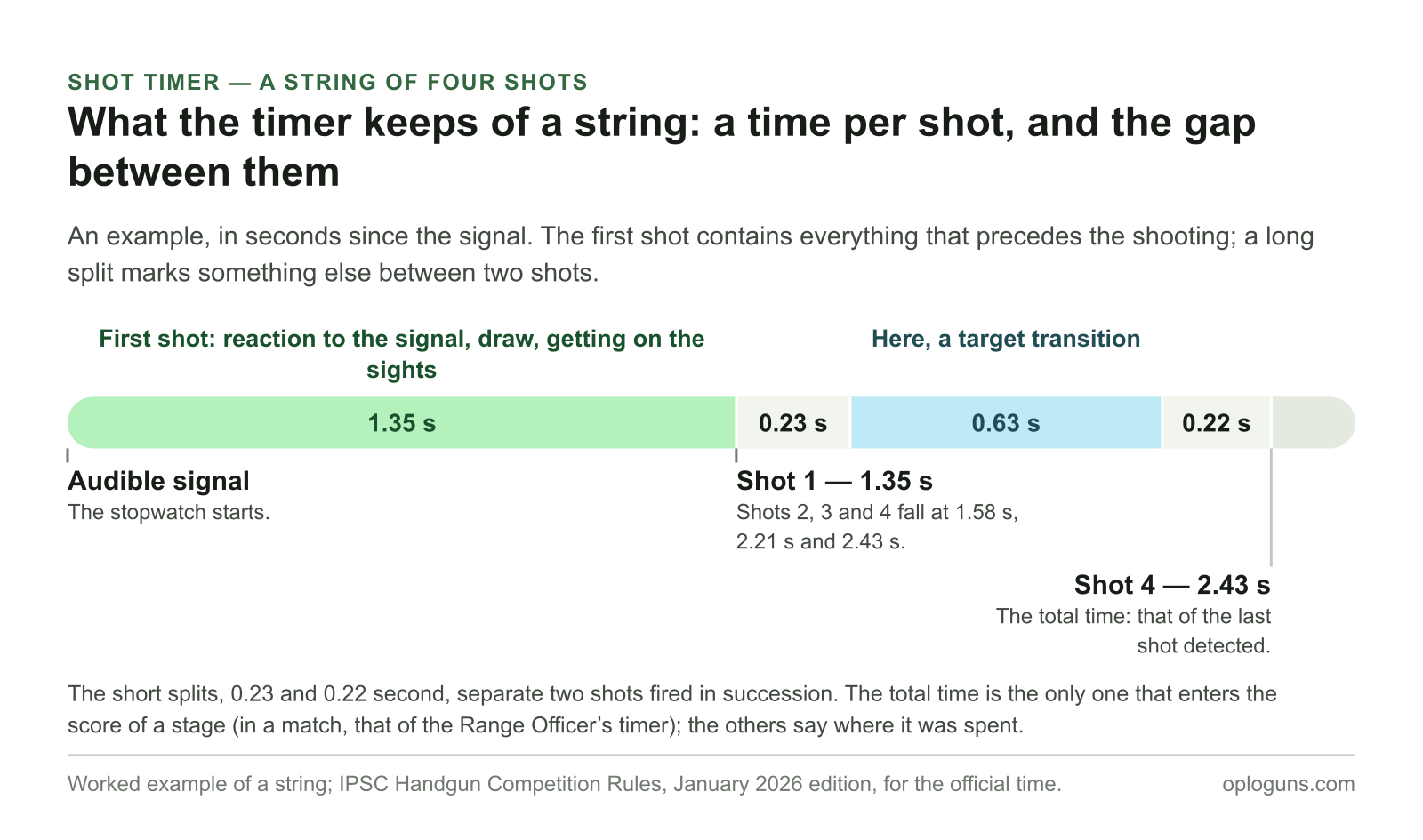
For each shot, the timer keeps two numbers: the time elapsed since the signal, and the split, which separates it from the previous shot3. The total time is that of the last shot detected3.
An example, on a string of four shots10:
| Shot | Time since the signal | Split |
|---|---|---|
| 1 | 1.35 s | — |
| 2 | 1.58 s | 0.23 s |
| 3 | 2.21 s | 0.63 s |
| 4 | 2.43 s | 0.22 s |
This table can be read three ways. The first shot, 1.35 seconds, contains everything that precedes the shooting: the reaction to the signal, the draw, getting on the sights. The short splits, 0.23 and 0.22 second, separate two shots fired in succession. The longest, 0.63 second, marks something else between two shots: here, a target transition.
The total time, 2.43 seconds, is the only one that enters the score of a stage1; the others say where it was spent.
Memory sets what can be reviewed afterward: 10 strings of 100 shots on a CED7000 Gen-2, 30 strings of 250 shots on a DAA EDGE, 3 strings on an AMG Lab Commander437. Beyond that, the sheet of paper takes over.
Par time: a second signal, at a chosen duration
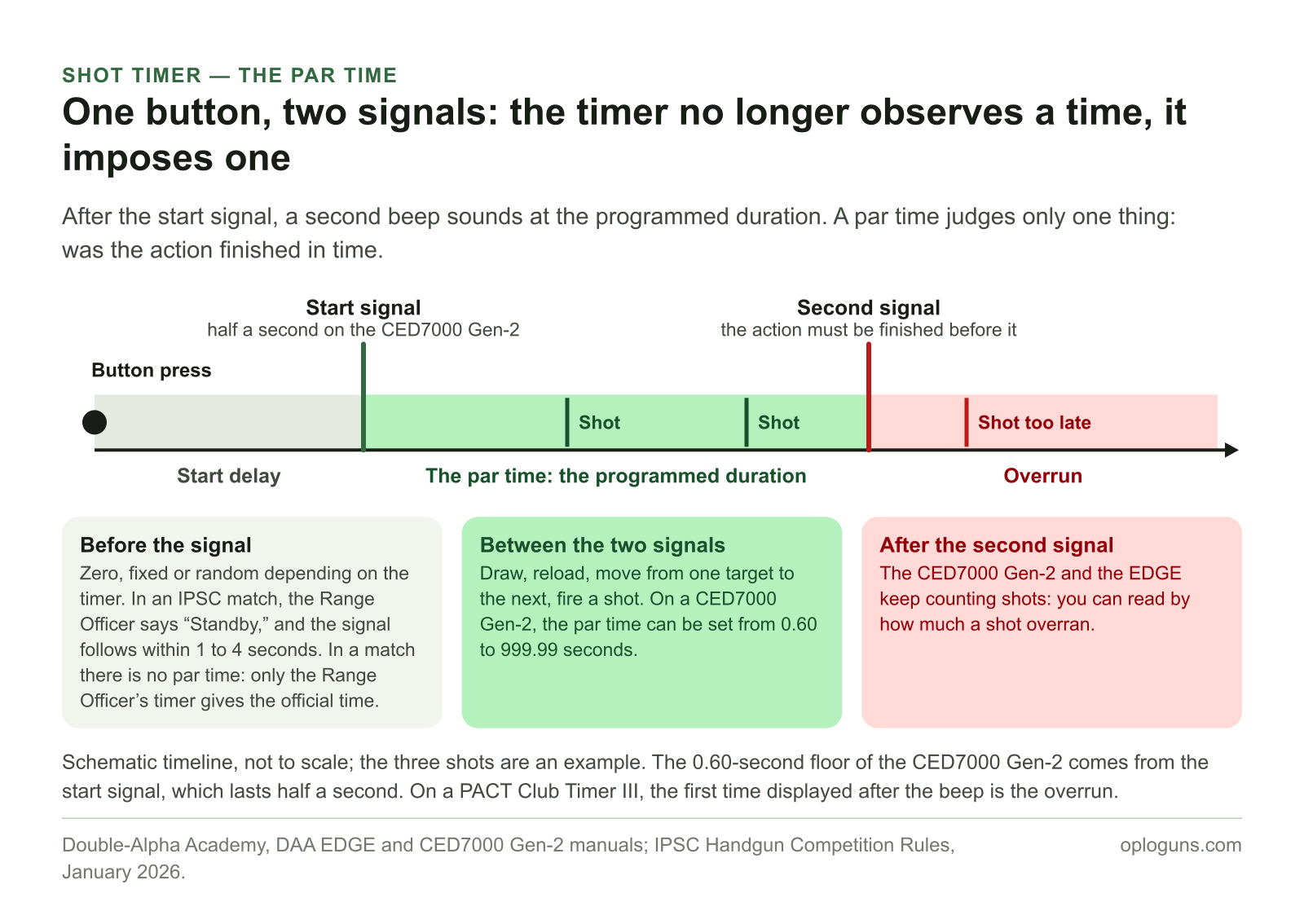
The par time turns the measurement around. The timer no longer observes a time: it imposes one. After the start signal, a second beep sounds at the programmed duration, and the action must be finished before it3.
The EDGE manual lists its uses: drawing, reloading, moving from one target to another, executing a shot3. On a CED7000 Gen-2, the par time is set from 0.60 to 999.99 seconds, to the hundredth. The 0.60-second floor comes from the start signal, which lasts half a second4.
Three operating details change the reading:
- Shots are still counted after the beep. The CED7000 Gen-2 and the EDGE keep recording, which shows by how much a shot overran43.
- On a PACT Club Timer III, the par time disables the first-shot display. The first time displayed after the beep is then the overrun, not a time between two shots5.
- Par times can be chained. Up to five on a single start for the CED7000 Gen-2, the EDGE and the ProTimer BT; three extra beeps for the Commander4367. On the EDGE, each par time is counted from the previous one, not from the start3.
A par time judges only one thing: was the action finished in time. It says nothing about the quality of the shot.
Timer in dry fire: the par time, not always the click
In dry fire, there is no gunshot. The par time works all the same, since it waits for no noise: it is the basic tool of the exercise.
Detecting the click, for its part, depends on the model. AMG Lab writes that its Commander is "sensitive enough to pick up dry fire"7; Competition Electronics advertises for its ProTimer BT a sensitivity that picks up dry-fire drills6; the EDGE provides a preset for this use3. These are manufacturers' claims, and the sensitivity they assume is the one at which a knock on the housing can pass for a shot3.
The drills, the success rule to write down and the number of repetitions that gives the measurement a meaning are in our dry-fire protocol.
Timer in an IPSC match: only the Range Officer's counts
In a match, the shooter does not hold the timer. The IPSC rulebook is clear: "Only the timing device operated by a Range Officer must be used to record the official elapsed time"1. In France, tir sportif de vitesse (TSV, the French name for IPSC shooting) follows this rulebook2.
Four rules frame this official time1:
- The start: the signal follows the Range Officer's "Standby" within 1 to 4 seconds.
- The finish: in Comstock scoring, the time stops on the last shot fired.
- The record: the time is written on the score sheet to two decimal places.
- The failure: if the Range Officer judges the device faulty, the shooter whose time is not reliable reshoots the stage.
A shooter who reacts to the signal but gives up without any time being recorded receives a zero time and a zero score for the stage1. The signal can also be paired with a visual signal or a physical contact for a hearing-impaired shooter, with the approval of the Range Master, the chief official1; the EDGE and the ProTimer BT have a light start designed for this36.
This time then divides the points: that is the hit factor, explained in our guide to IPSC in France. How a match day unfolds, from registration to the last stage, is in our article on the first IPSC match.
Another rulebook gives the timer the whole score: that of Steel Challenge, ranked on time alone, which provides for sound-actuated timers11.
Which shot timer to choose: eight models, €147 to €360
Prices recorded on 15 November 2026 at one manufacturer and two French gun shops3489:
| Family | Models recorded | Price |
|---|---|---|
| Pocket timer | CED7000 Gen-2, Special Pie M1A2+, PACT Club Timer III, SG Timer GO | €147 to €200 |
| High-end timer | Pocket Pro Timer Bluetooth, DAA EDGE, ProTimer BT | €245 to €283 |
| Large-display timer | SG Shot Timer 2 | €360 |
On the EDGE, a wireless link controls target activators and reads a chronograph of the same brand3.
A pocket timer, under €200
The CED7000 Gen-2 is the documented example: €147 to €169 depending on the seller489.
Pros
A high-end timer, €245 to €283
The DAA EDGE is the documented example: €250 to €27039.
Pros
A used shot timer
The generation matters. Double-Alpha distinguishes the CED7000 Gen-2 from the original device by rubber buttons instead of plastic, a glass screen protector and a USB-C port instead of a round jack; the accessories remain shared4. Compare a used price with a new one only for the same generation.
The timer measures a movement that starts at the holster: how to choose one is in our article which IPSC holster for which pistol, and choosing the gun in which pistol for IPSC.
Three misconceptions about the shot timer
- "My timer is the one that counts in a match." Only the device held by the Range Officer records the official time1.
- "The more sensitive the microphone, the better it counts." Too sensitive, it counts echoes, or even its own buzzer5.
- "The time stops when you lower the gun." It stops at the last shot detected31.
Which shot timer for which use
What each family brings, and what it costs
To train at the range, outdoors, a pocket timer brings the signal, the random delay, the splits and the par time, for €147 to €200. In return, a short memory: times are written on a sheet.
For an indoor range, the echo setting weighs more than the price: the CED7000 Gen-2 has a time filter, the EDGE adds a frequency filter and a microphone test. In return, settings to redo from one range to the next.
For dry fire, the par time is enough, and every model described here has one. In return, it measures whether a limit was met, not the click; the models advertised as hearing it require a high sensitivity.
For the match, no purchase changes the official time: it comes from the Range Officer's timer.
Sources 11 references
The rules on official time come from the January 2026 IPSC Handgun rulebook. How the devices work is as described by their manufacturers' manuals and pages, flagged ⚠️: they present their own products. Prices were recorded on 15 November 2026. Click a reference number in the text to highlight the matching source.
- IPSC — IPSC Handgun Competition Rules, January 2026 Edition (PDF, final version of 29 December 2025, linked from the IPSC "Rule Books" page), reread 15 November 2026: 8.3.3, "'Standby' – This command should be followed by the Start Signal within 1 to 4 seconds"; 8.3.4.2, competitor who reacts to the signal without continuing and without an official time recorded: "a zero time and zero score for that stage"; 8.3.9, visual or physical signals for a hearing-impaired competitor, with the prior approval of the Range Master; 9.2.1, "'Comstock' – Unlimited time stops on the last shot"; 9.2.1.1, hit factor: points divided by the total time "(recorded to two decimal places)"; 9.7.1, "The elapsed time taken by the competitor to complete the course of fire must be recorded to 2 decimal places"; 9.10.1, "Only the timing device operated by a Range Officer must be used to record the official elapsed time of a competitor's attempt at a course of fire", device judged faulty: the competitor "will be required to reshoot the course of fire". ⚠️ IPSC also publishes interpretations during the year on its Rule Books page: to be checked before a match.
- FFTir — Règlement administratif du Tir Sportif de Vitesse, saison 2019/2020 [administrative rules of tir sportif de vitesse, 2019/2020 season] (4-page PDF hosted by the federation, in French), reread 15 November 2026: article I, discipline « régie au niveau international par l'IPSC » [governed at international level by IPSC]; article VII, « seul le règlement officiel de l'IPSC en anglais est valable sur les compétitions de Niveau III et plus » [only the official IPSC rulebook in English is valid at Level III competitions and above]. ⚠️ 2019-2020 edition, the last version published by the federation.
- Double-Alpha Academy — DAA EDGE Shot Timer, manuel d'utilisation [user manual] (PDF in French, version 1.0, January 2026) and product page, consulted 15 November 2026: six-step quick-start guide; for each shot, « Temps du tir (depuis le signal de départ) » [shot time (since the start signal)] and « Split (temps entre ce tir et le tir précédent) » [split (time between this shot and the previous one)]; total time, « temps écoulé jusqu'au dernier tir détecté » [time elapsed up to the last shot detected]; « Jusqu'à 30 séries peuvent être stockées, avec un maximum de 250 tirs par série » [up to 30 strings can be stored, with a maximum of 250 shots per string]; microphone sensitivity from MIN to MAX, 16 levels, default setting L9; « avec une sensibilité très élevée, des pressions rapides sur les boutons ou des chocs sur le boîtier peuvent être enregistrés comme des tirs » [at very high sensitivity, quick button presses or knocks on the housing can be recorded as shots]; echo window: « ceux-ci se produisent souvent 0,05 à 0,08 seconde après le tir. Régler la fenêtre d'écho sur 0,10 seconde permet d'éviter les fausses détections » [these often occur 0.05 to 0.08 second after the shot; setting the echo window to 0.10 second avoids false detections], to be reduced for splits under 0.10 second; echo filter; start delay from 0.0 to 99.9 s in steps of 0.1 s, random start, « Exemple : pour un départ aléatoire entre 2,0 et 4,0 s » [example: for a random start between 2.0 and 4.0 s]; MUTE button, « couramment utilisée à la fin d'un stage afin d'éviter l'enregistrement de bruits indésirables pendant le déchargement » [commonly used at the end of a stage to avoid recording unwanted noises during unloading]; PAR mode, « jusqu'à cinq signaux sonores chronométrés à partir d'un seul signal de départ » [up to five timed audible signals from a single start signal], « lorsqu'une action doit être terminée avant chaque bip (par exemple : dégainer, recharger, transitionner ou exécuter un tir) » [when an action must be finished before each beep (for example: drawing, reloading, transitioning or executing a shot)], « Chaque temps PAR est relatif au PAR précédent » [each PAR time is relative to the previous PAR], shots recorded throughout the string; five presets, « Exemple : Préréglage 1 : tir à sec ; Préréglage 2 : stand intérieur ; Préréglage 3 : stand extérieur » [example: preset 1, dry fire; preset 2, indoor range; preset 3, outdoor range]; microphone test indicating the recommended sensitivity range; start by lamp, « utile pour les tireurs malentendants » [useful for hearing-impaired shooters]; wireless link with the brand's target activators and chronograph. Product page: "High-output buzzer (up to 125 dB)", two CR123A batteries "(not included)", 25 to 50 hours, €249.95. ⚠️ Commercial source, manufacturer's description.
- Double-Alpha Academy — CED7000 GEN-2 User Manual (PDF) and product page, consulted 15 November 2026: after START is pressed, a beep sounds and the stopwatch starts; screen: first shot, number of shots, split and total time, up to 999.99 seconds; "The timer can hold up to 10 strings, with each string storing up to 100 shots"; start delays "Fixed (F): A 3-second delay", "Random (R): A 2–5 second randomized delay", "Instant (I)", "Custom (C): Set your own delay, anywhere from 0.1 to 9.9 seconds"; "PAR times can be set from 0.60 to 999.99 seconds, accurate to 1/100th of a second. (Note: Minimum is 0.60 sec due to the 0.50 sec buzzer duration.)"; "The timer continues tracking shots even after the beep"; "Multiple Par – Up to 5 PAR times from a single activation"; "8 digital sensitivity levels", "factory-set to Level 4, ideal for most outdoor use"; delays "Fixed", "ideal for getting into position", and "Random", "to reduce anticipation"; software filter factory-set at 0.08 second, "the timer will only register shots spaced at least 0.09 seconds apart", adjustable down to 0.02 second, "may risk detecting echo noise"; "Always face the timer's front panel toward the shooter", "position the timer within six feet of the shooter", "Avoid blocking the microphone or allowing ejected brass to strike the timer". Product page: rubber buttons instead of plastic, glass screen protector, USB-C charging port instead of a round jack, accessories of the original CED7000 compatible, "Loud start beep exceeding 110 dB", €146.95. ⚠️ Commercial source, distributor's description.
- PACT — Club Timer III, Instruction Manual (3-page PDF, linked from the manufacturer's manuals page), consulted 15 November 2026: "a delay of 2 to 3.5 seconds after you release the GO button for the buzzer to sound, or […] instantly"; "Each time a shot is fired the shot # will increment, the shot time (last shot fired) and split time will be displayed"; "When a PAR time is used the FIRST SHOT feature is disabled. The SPLIT time of the first shot after the PAR is the time from the PAR buzzer to the shot. It is the amount overtime, not the time between shots"; "Set too sensitive, the timer will pick up shot echoes or even its own buzzer. Not sensitive enough and it can miss shots, a real problem with the low power rounds"; adjustment in the battery compartment, "we strongly recommend that you do NOT mess with it". ⚠️ Commercial source, manufacturer's manual.
- Competition Electronics — ProTimer BT, manufacturer's page, consulted 15 November 2026: "Stack up to five beeper alerts at the intervals you choose"; "Increased sensitivity picks up rimfire, airsoft and dry-fire drills"; start signal by white LED "for hearing-impaired shooters or private reps". ⚠️ Commercial source, manufacturer's claims.
- AMG Lab — Commander timer page, consulted 15 November 2026: "Commander is sensitive enough to pick up dry fire"; "You've got up to 3 extra beeps on demand"; "Loud beep: 105dB, 1.5kHz", "Adjustable beep volume so that it can be loud enough to pierce through double hearing protection"; "3 strings memory". ⚠️ Commercial source, manufacturer's claims.
- Armurerie de la Bourse — prices recorded 15 November 2026 (pages in French): timer CED 7000 DAA Gen 2 €149.00; Competition Electronics Pocket Pro Timer Bluetooth €245.00. ⚠️ Commercial data.
- Deville Armory — prices recorded 15 November 2026 (pages in French): CED7000 Gen-2 €169.11; Special Pie M1A2+ €169.11; PACT Club Timer III €185.00; Shooters Global SG Timer GO €189.95, €199.95 with pocket clip; DAA EDGE €270.00; Competition Electronics ProTimer BT €282.51; Shooters Global SG Shot Timer 2 €359.95, presented with a large front display. ⚠️ Commercial data; items to order, the Club Timer III shown as unavailable that day.
- Calculations: 6 feet × 0.3048 = 1.83 m; example string, 1.58 − 1.35 = 0.23 s; 2.21 − 1.58 = 0.63 s; 2.43 − 2.21 = 0.22 s; the times in the example are chosen for illustration, not measured. Price gap between a DAA EDGE and a CED7000 Gen-2: 249.95 − 146.95 = €103.00 at their distributor, 270.00 − 169.11 = €100.89 at the same gun shop.
- Steel Challenge Shooting Association — Steel Challenge Rules, 2026-09 edition, published by USPSA, in force on 1 September 2026, consulted 15 November 2026: 9.1, "Steel Challenge scoring is simple: your time is your score; lowest time wins"; 9.5, "Steel Challenge events will be timed with sound-actuated shot timers". ⚠️ Rulebook of another federation, a U.S. one.
The rules in force prevail. This article describes the January 2026 IPSC Handgun rulebook and manufacturers' manuals read on 15 November 2026; the prices are those of that day. A device's settings are read in its own manual, and the time of a match is the one the Range Officer records.
Frequently asked questions
How do you use a shot timer?
In five steps: set the start delay and the microphone sensitivity, press the start button, shoot at the audible signal, review the string on the screen, then write down the times. The screen gives the time of each shot from the signal, the split between two shots and the total time, stopped at the last shot detected.
What is a par time?
A second audible signal, sounded by the timer at a programmed duration after the start signal. The action, a draw or a magazine change for example, must be finished before that second beep. On a CED7000 Gen-2, it is set from 0.60 to 999.99 seconds, to the hundredth; several timers chain up to five par times on a single start.
What is a split time, or split?
The time that separates one shot from the previous one. The timer displays it next to the time of each shot, counted from the start signal. On a string of four shots fired at 1.35, 1.58, 2.21 and 2.43 seconds, the splits are 0.23, 0.63 and 0.22 second, and the total time 2.43 seconds.
Does a shot timer work in dry fire?
Its par time does: the second signal does not depend on any gunshot. Detecting the click depends on the model. AMG Lab and Competition Electronics advertise timers sensitive enough to hear it; at very high sensitivity, the DAA EDGE manual warns that a knock on the housing can be counted as a shot.
Can you use your own timer in an IPSC match?
To train, yes; for the score, no. The January 2026 IPSC rulebook recognizes only the timer held by the Range Officer to record the official time, written to the hundredth of a second on the score sheet. If the Range Officer judges the device faulty, the shooter reshoots the stage.
How much does a shot timer cost?
From €147 to €360 for the eight models recorded on 15 November 2026. Four pocket timers stay under €200, including the CED7000 Gen-2, from €147 to €169. Three models cost €245 to €283, including the DAA EDGE, from €250 to €270. One large-display timer was recorded at €360.
What should you look at on a used shot timer?
The generation of the device. Double-Alpha distinguishes the original CED7000 from its Gen-2 by three visible points: rubber buttons instead of plastic, a glass screen protector, and a USB-C charging port instead of a round jack. Compare a used price with a new one only for the same generation.
Spotted an error, or a rule that has changed since we checked? Report an error