Mounting a riflescope: 11 mm or Picatinny rail, base, rings and torque
Published on · 11 min read · Anthony Baillon
A scope mounts on the gun's rail: 11 mm dovetail, Weaver or Picatinny, each with its own rings. Their height follows from the objective, and they are tightened to the torque in the manual, 1.8 N·m at Hawke. And a reticle canted by 3° throws any elevation correction 31 cm off at 600 m.
At a glance
| Step | Benchmark | Why |
|---|---|---|
| Rail | 11 mm, Weaver or Picatinny | The rings depend on it |
| Canted base | 20 MOA, or 5.8 mrad | Adjustment gained upward |
| Height | Objective as close to the barrel as possible | Without ever touching it |
| Torque | 1.8 N·m on the caps at Hawke | Overtightened, the scope suffers |
| Reticle | Vertical, elevation turret on top | Otherwise, elevation drifts sideways |
- Recoil stop: pin on the 11 mm rail, cross slot on the Picatinny, rings pushed toward the muzzle before tightening.
- Mounting budget: €25 to €120 of rings, €49 to €155 of rail, €85 to €145 of torque wrench, recorded on 4 November 2026.
Scope rail: 11 mm dovetail, Weaver or Picatinny
Three rails share the rifle market. Hawke tells them apart by their grooves1:
| Rail | How to recognize it | Common guns |
|---|---|---|
| 9 to 11 mm dovetail | Two side grooves, no slots, often a recoil hole | Air rifles, some .22 LR and centerfire rifles |
| Weaver | Cross slots 4.57 mm wide, variable spacing | Hunting, heavy-recoil guns |
| Picatinny | Slots at a regular 10 mm (0.394") pitch | Hunting, precision, tactical rifles |
Some guns have their own dovetail: 17 mm on Tikka rifles, with a hole at the front of the rail that acts as a recoil stop13. The Picatinny, for its part, follows a US military standard, MIL-STD-191313. Its slots are slightly wider and deeper than the Weaver's, and their spacing is fixed15. Hence a one-way compatibility: Warne's Weaver-style rings fit both rails, but a Picatinny base with a wide key, or with several keys at the 10 mm pitch, finds no place on a Weaver5.
The 11 mm dovetail
Pros
The Picatinny rail
Pros
Hawke also makes adapters, which put a Weaver or Picatinny rail on a 9 to 11 mm dovetail4. That leaves the question of what rail height you need, and sometimes what cant.
20 MOA canted base: adjustment for shooting far
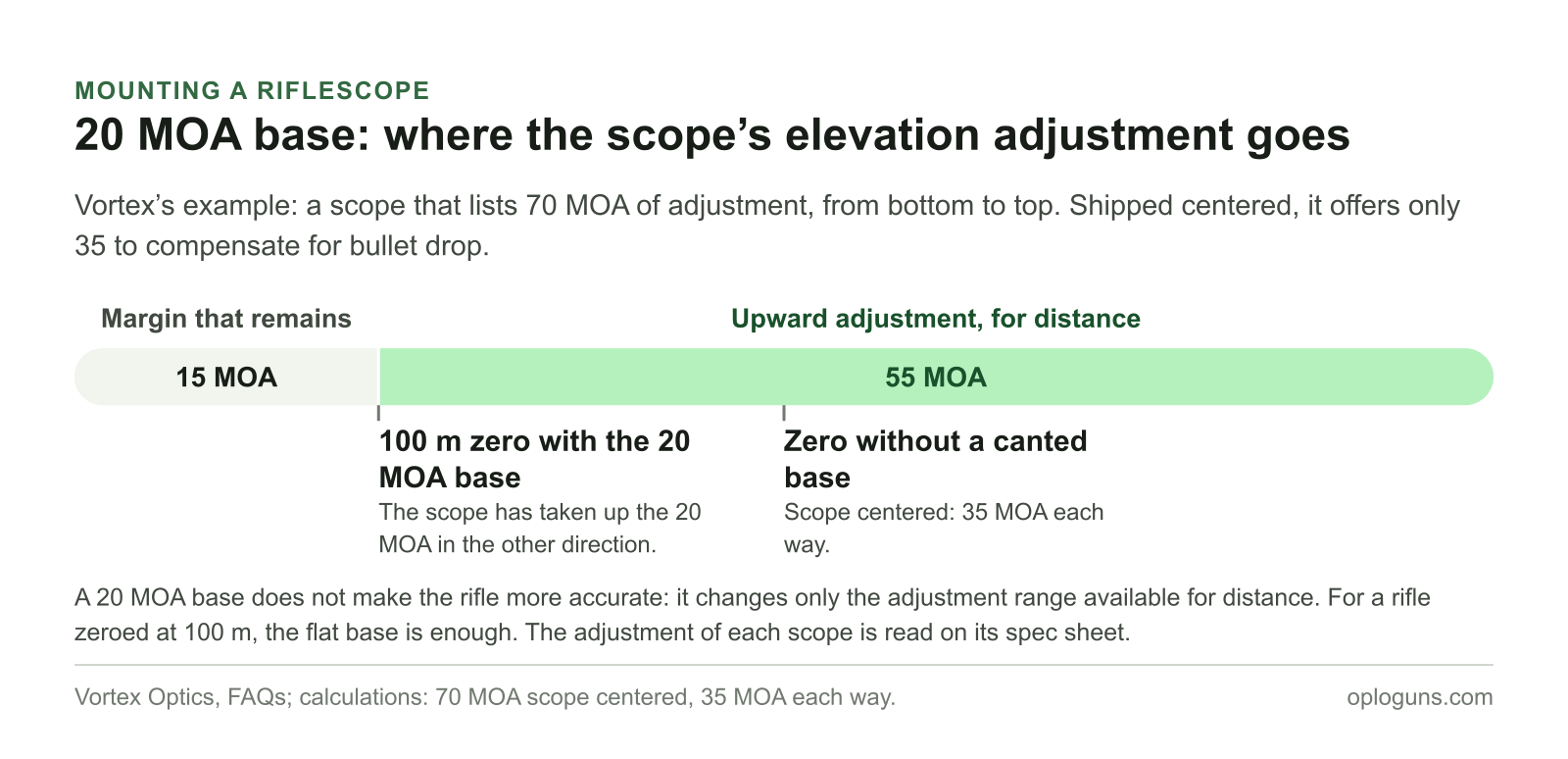
A scope lists a total adjustment, from bottom to top. Shipped centered, it offers only half of it to compensate for bullet drop: 35 MOA on a scope that lists 70, in Vortex's example6. For shooting far, that is sometimes not enough.
The canted base tilts the scope slightly downward. The zero is then made further along the adjustment range, and more adjustment remains for distance6. 20 MOA bases are common, according to Vortex6. Twenty minutes of angle equal 5.8 mrad, or 58 cm at 100 m16.
The gain has a condition. To make a 100 m zero, the scope must be able to take up those 20 MOA in the other direction. On Vortex's 70 MOA scope, 15 would remain as margin, and 55 upward instead of 3516. The adjustment of each scope is read on its spec sheet: our guide to choosing a riflescope compares four models.
The cant can sit in three places:
- In the rail: 20 MOA Picatinny rails, €69 to €155 depending on the gun14.
- In a canted one-piece mount: €151 to €397, from 20 to 30 MOA1415.
- In the rings: Hawke offers 25 MOA inserts for its Match rings7.
The distances that call for this adjustment are those of shooting at 1,000 m and of Precision Rifle. For a rifle zeroed at 100 m, the flat base is enough.
Height of the rings: the objective close to the barrel
The aim is written by Leupold: the objective of the scope as close as possible to the barrel, without touching8. Warne gives the reason: a barrel vibrates when the shot goes off, and an objective that touches it can shift the zero and damage the scope9. Hawke also points out that the scope must touch neither the barrel, nor the rear sight, nor the receiver10.
The Leupold guide, for bolt-action and semi-automatic hunting rifles8:
| Objective | Rings | Exception |
|---|---|---|
| 56 mm | Super high | High on some bolt-action rifles |
| 50 mm | High | Super high for a heavy barrel |
| 42 to 45 mm | Medium | High possible in 45 mm |
| 40 mm | Low | Medium for a heavy barrel |
| 28 to 36 mm | Low | Medium for a heavy barrel |
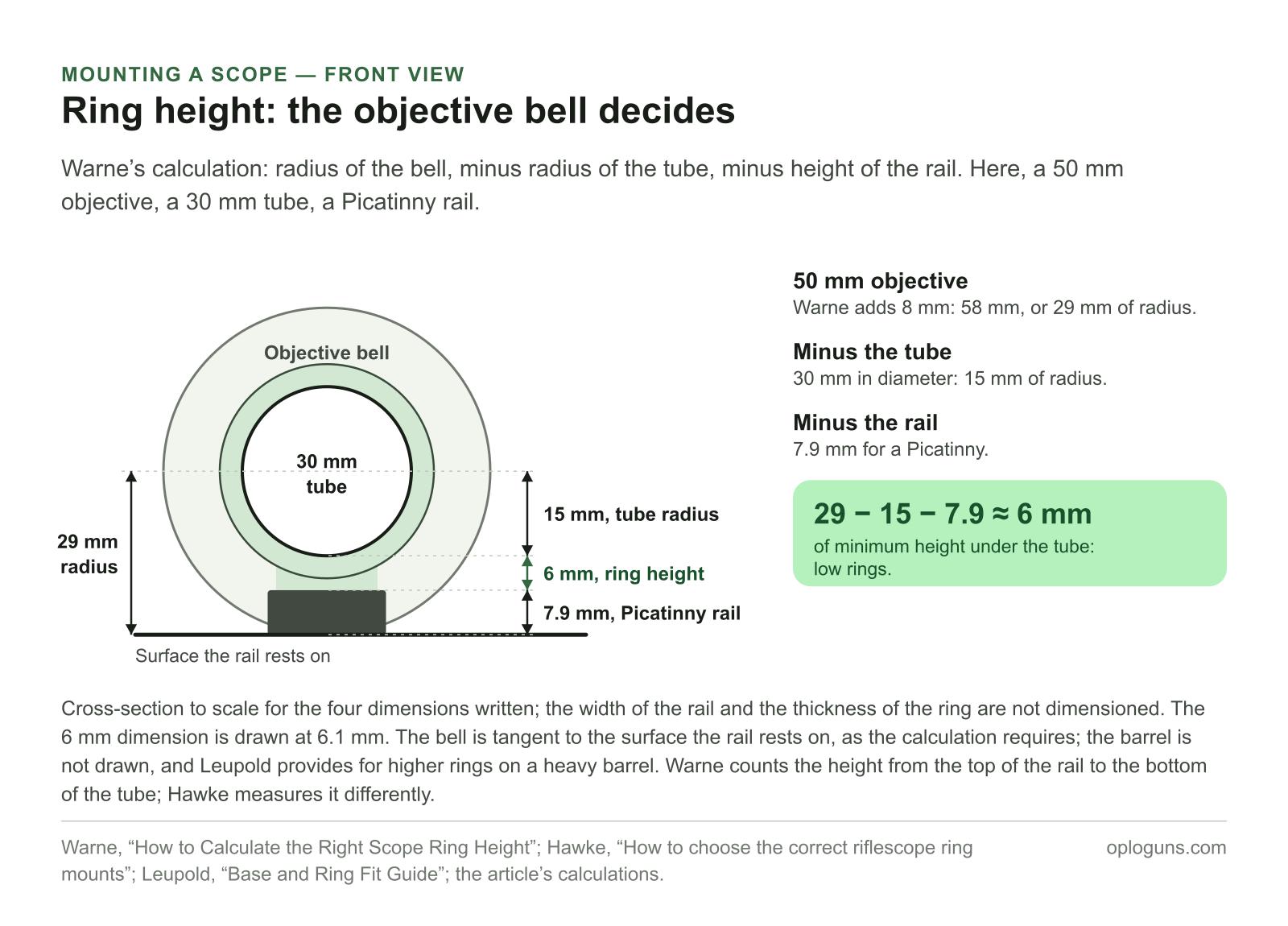
Warne offers a calculation: radius of the objective bell, minus radius of the tube, minus height of the rail. Lacking an exact dimension, it adds 8 mm to the listed diameter of the objective9. A 50 mm objective therefore counts as 58 mm, or 29 mm of radius. On a 30 mm tube and a 7.9 mm Picatinny rail, 6 mm of minimum height remain under the tube: low rings, in Warne's example916.
Manufacturers do not measure height at the same place. Warne counts it from the top of the rail to the bottom of the tube; Hawke, from the base of the ring to the center of the ring, and takes a little over half the diameter of the objective: at least 28 mm for a 56 mm bell19. Two "medium" rings from two brands are therefore not necessarily the same height.
Mounting a riflescope: the steps in the manual
The Hawke manual and the Warne guide describe the same order1011:
- Check that the gun is unloaded, bolt open or removed13.
- Fix the rail or the base: Warne advises a removable threadlocker on these screws, tightened with a torque wrench11.
- Fit the rings without tightening them fully10, then push them toward the muzzle to seat their recoil key against the front of the slot511.
- Set the scope as low as possible, with no contact with the barrel, the rear sight or the receiver10.
- Set the fore-and-aft position in the shooting position: Hawke looks for the most forward point that gives a full field of view, for maximum eye relief10. Warne sets it at the magnification the shooter uses11.
- Make the reticle vertical, elevation turret on top10, with a bubble level or a plumb line11.
- Tighten evenly, in a crisscross pattern, to the torque in the manual1011.
Hawke adds a warning for heavy-recoil guns: sufficient eye relief avoids injuring the eye10. That leaves the torque figure, which changes from one manufacturer to the next.
Torque values for scope rings: the manuals' figures
Each manual gives its own torque. Those that are published1061213:
| Manufacturer | Screws | Torque |
|---|---|---|
| Hawke | Ring caps | 1.8 N·m (16 in-lb) |
| Hawke | Ring bases | 3.4 N·m (30 in-lb) |
| Vortex | Rings, "most" | 15 to 18 in-lb, or 1.7 to 2 N·m |
| Leupold, Open Range rings | Ring screws | 28 in-lb, or 3.2 N·m |
| Leupold, Open Range rings | Clamp on the rail | 45 in-lb, or 5.1 N·m |
| Tikka T1x and T3x | Action screws | 7 N·m, 5 N·m at most with a plastic trigger guard |
The differences come down to the parts: 1.8 N·m on Hawke caps, 3.2 N·m on Leupold rings. A ring's torque holds for that ring alone. Hawke warns that overtightening can damage the scope10, and Vortex lists over-tightened rings among the causes of a zero that cannot be found or of a "wandering zero"6. To picture 1.8 N·m: the weight of a one-and-a-half-liter bottle at the end of a 12 cm wrench16.
The thread counts too. Warne gives its cap torques dry, without threadlocker, and those of the base with threadlocker; at equal torque, a lubricated screw clamps harder11. The other causes of an adjustment that moves are in our guide to zeroing a riflescope.
Leveling the reticle: 31 cm at 600 m for 3°
A canted reticle does not show at the zero. It shows at the first elevation correction: the turret then moves the impact along a tilted axis, and so to the side as well16.
Canted reticle: the sideways error of a 10 mrad correction
10 mrad elevation correction dialed with a canted reticle, error to the side at 600 m, in centimeters
Sideways error = correction × sine of the angle × distance16. The loss in elevation stays under 1 cm at 600 m for these angles.
View the data
| Reticle canted by | Sideways error | At 300 m | At 600 m |
|---|---|---|---|
| 1° | 0.17 mrad | 5.2 cm | 10.5 cm |
| 2° | 0.35 mrad | 10.5 cm | 20.9 cm |
| 3° | 0.52 mrad | 15.7 cm | 31.4 cm |
For a 10 mrad correction, 3° of cant is enough to move the impact 31 cm at 600 m. Hawke makes bubble levels for the 11 mm rail and for the Weaver rail7; Warne also cites the leveling tool and the plumb line11. The levels recorded cost €12 to €541415.
Recoil stop: pin, slot and receiver lug
When the shot goes off, the gun recoils under the scope, which tends to stay where it is. The ring therefore has to bear on something. Three parts take care of it:
- The pin on 11 mm rings: Hawke fits it to its 9-11 mm rings, and the manual considers it sometimes necessary on heavy-recoil rifles210. It sits in the rail's recoil hole1. The Weaver rings in the same range have none3.
- The key on Picatinny rings: it bears on the front face of the slot. Pushed toward the muzzle before tightening, it stays there, and the play in the slot no longer matters, according to Warne5.
- The receiver's recoil lug: at Tikka, the barrel is pulled rearward before the action screws are tightened, to remove the slack from that lug, then tightened to 7 N·m13.
Mounting budget: rings, rail, wrench and level
Prices recorded on 4 November 2026 at two gun shops1415:
| Item | Prices recorded |
|---|---|
| 30 mm rings, two-piece | €25 to €120 |
| Picatinny rail, flat or 20 MOA | €49 to €155 |
| Canted one-piece mount, 20 to 30 MOA | €151 to €397 |
| Torque wrench or screwdriver | €85 to €145 |
| Bubble level | €12 to €54 |
In the first year, a complete mount on a Picatinny rail comes to €171 to €474: two-piece rings, rail, torque wrench and bubble level. In the following years, nothing more, unless the scope changes: the wrench and the level are used again16.
Three misconceptions about mounting a scope
- "Any Picatinny ring fits a Weaver rail." Not always: a key that is too wide, or several keys at the Picatinny pitch, will not go into a Weaver5.
- "The tighter, the better it holds." Hawke warns that overtightening can damage the scope, and Vortex cites over-tightened rings among the causes of an unstable zero106.
- "A 20 MOA base makes the rifle more accurate." It changes only the adjustment range available for distance6.
Which mount for your rifle
Air rifle or .22 LR with a dovetail
9-11 mm rings with a recoil stop pin, low or medium depending on the objective, are enough. In return, the pin has to find the hole in the rail, and clamping remains the only other hold against recoil. How France classifies an air rifle by its power is in our guide to air rifles and 20 joules, the choice of optic in the air rifle scope or the .22 LR rifle scope.
Hunting or precision rifle, zeroed at 100 m
A flat Picatinny rail and two-piece rings, pushed toward the muzzle, tightened to the torque in the manual. In return, a rail to fit if the gun has none, and a torque wrench to buy.
Long range and Precision Rifle
A canted base, 20 MOA most often, or a canted one-piece mount, and a reticle leveled with a bubble. In return, €151 to €397 for a one-piece mount, and a scope that must keep enough downward adjustment to make its zero.
Sources 16 references
Rails, heights, procedure and torque values taken from the guides and manuals of optics, ring and firearm manufacturers; prices recorded on 4 November 2026 at two French gun shops; errors and conversions calculated. Click a reference number in the text to highlight the matching source.
- Hawke Optics — How to choose the correct riflescope ring mounts, 8 May 2017, reread on 4 November 2026: "9-11mm Dovetail" rail without cross slots, often drilled with recoil holes, on air rifles and some rimfire and centerfire rifles; "Weaver/Picatinny" rail whose repeated slots act as recoil stops; Picatinny slots at a regular "10mm (.394")" center-to-center spacing, Weaver slots ".180" (4.57mm)" wide at a spacing that is not constant; height chosen "just over half of your riflescopes widest point", measured from the base of the ring to the middle of the ring; example of a 56 mm bell, 28 mm at least.
- Hawke Optics — Match Mount 30mm 2 Piece 9-11mm Medium, sheet reread on 4 November 2026: "9-11mm models are fitted with a recoil stop pin"; "Retractable Recoil Stop Pin: Yes"; M4 screws. ⚠️ Manufacturer's technical data.
- Hawke Optics — Match Mount 30mm 2 Piece Weaver Medium, sheet reread on 4 November 2026: "Rail: Weaver", "Retractable Recoil Stop Pin: No". ⚠️ Manufacturer's technical data.
- Hawke Optics — Adaptor Base 2 Piece 9-11mm / 3/8" Dovetail to Weaver/Picatinny, sheet reread on 4 November 2026: adapter putting a Weaver or Picatinny rail on a 9 to 11 mm dovetail. ⚠️ Manufacturer's technical data.
- Warne Scope Mounts — Weaver vs. Picatinny Style Bases, reread on 4 November 2026: Picatinny slot "slightly wider, and slightly deeper" than the Weaver slot, and "standardized spacing of the slots"; Warne Maxima and Tactical rings "a weaver style ring that will work on both weaver and picatinny style bases"; some Picatinny bases unsuited to Weaver, key too wide or multiple keys at the Picatinny pitch; "When you push the rings forward, you seat the recoil key against the front of the slot"; "the amount of play in the slot is a moot point".
- Vortex Optics — FAQs, reread on 4 November 2026: causes of a zero that cannot be found, including "Over-tightened rings. We recommend 15-18in. pounds on most ring sets" and the zero that moves ("wandering zero"); adjustment listed "from the absolute bottom to absolute top", scope shipped centered, half the adjustment available, example of "70 MOA of total elevation adjustment" giving 35 MOA; "20 MOA canted mounts and bases are quite common" and allow the zero to be made higher in the adjustment range, to keep adjustment for long distances.
- Hawke Optics — Mounts, mounts page reread on 4 November 2026: "Mount Inserts 25 MOA Elevation" in 1" and 30 mm for Match rings; "Bubble Level 1.8" / 46mm 9-11mm Dovetail" and "Bubble Level 2.2" / 56mm Weaver".
- Leupold — Base and Ring Fit Guide (PDF, 2021), reread on 4 November 2026: "The goal is to have the objective of the scope as close as possible to the barrel without touching"; table "Ring height (for bolt-action semi-auto hunting rifles)": 56 mm super high (high on some bolt-action rifles), 50 mm high (super high for a heavy barrel), 42-45 mm medium (45 mm possibly requiring high), 40 mm low, 28-36 mm low (medium for a heavy barrel).
- Warne Scope Mounts — How to Calculate the Right Scope Ring Height, reread on 4 November 2026: "Or minus Tr minus Bh = Mrh" (objective radius, tube radius, height of the base or rail); example of a 30 mm tube on a Picatinny rail, 1.14 − 0.59 − 0.312 = 0.238 inch, low 30 mm rings; "it's safe to add 8mm to the manufactures' 'glass' dimension"; mounting as close to the barrel as possible, an objective that touches the barrel being liable to shift the zero and damage the scope.
- Hawke Optics — Endurance riflescope instructions (PDF, French text included), reread on 4 November 2026: « Sur les carabines à recul important, il peut être nécessaire d'installer une goupille butée de recul sur les bagues » [on heavy-recoil rifles, it may be necessary to fit a recoil stop pin to the rings]; « Fixez les bagues sur la base de la carabine. Ne serrez pas à fond » [fix the rings to the rifle's base; do not tighten fully]; scope mounted « le plus bas possible sans toucher le tube, le viseur arrière ou le récepteur » [as low as possible without touching the barrel, the rear sight or the receiver]; most forward position « pour assurer le dégagement oculaire maximum » [to ensure maximum eye relief]; « Faites tourner la lunette dans les bagues jusqu'à ce que le motif du réticule soit vertical et que la tourelle d'élévation soit en haut » [rotate the scope in the rings until the reticle pattern is vertical and the elevation turret is on top]; even tightening; « Ne serrez pas trop les bagues. Ceci peut endommager la lunette » [do not overtighten the rings; this can damage the scope], "(1,8 Nm) (16 in/lbs)" for the cap screws and "(3,4 Nm) (30 in/lbs)" for the base screws; sufficient eye relief on heavy-recoil guns, « Ceci évitera les blessures des yeux » [this will avoid eye injuries]. ⚠️ Manufacturer's document hosted by a retailer.
- Warne Scope Mounts — How to Mount a Riflescope, reread on 4 November 2026: blue threadlocker on the base screws, tightened with a torque wrench; "To seat the recoil key, apply pressure on the ring forward toward the muzzle, then tighten"; eye relief "at your preferred magnification"; reticle leveled "by using a scope leveling tool or by referencing a plumb line"; caps tightened "incrementally in a crisscross pattern" to the optic manufacturer's torque; cap torques "dry thread", base torques "wet"; "at an equal torque value, lubricated or wet thread screws will apply more pressure".
- Leupold — Open Range Cross-Slot Rings 30mm Medium Matte, sheet reread on 4 November 2026: "Keeper Clamp Torque: 45 in-lbs", "Ring Top Screw Torque: 28 in-lbs"; rings for Picatinny and Weaver rails. ⚠️ Manufacturer's technical data.
- Sako — Tikka T1x and T3x manual, version 5.3 (PDF, 2023), reread on 4 November 2026: mounts fixed on "the 17mm rail on the top of the receiver", of which "A circular hole on the front of the rail will act as a recoilstop"; some models with a "Picatinny-rail (MIL-STD-1913)", of which "the base screw grooves on the rail will act as recoil stops"; gun unloaded, bolt and magazine removed before disassembly; action screws "to a torque of 7 Nm (62 in-lbs) in metallic trigger guards and max. 5 Nm (44 in-lbs) in plastic trigger guards", barrel pulled rearward before tightening "in order to remove the slack from the recoil lug"; Picatinny rail to be removed by a "qualified gunsmith"; mounts fitted according to their manufacturer's instructions.
- Armurerie Auxerre — prices recorded on 4 November 2026 (pages in French): UTG Accushot 30 mm rings €25.00; Sig Sauer Alpha 1 30 mm rings €119.90; Sabatti Rover 20 MOA Picatinny rail €68.90; Warne M673 20 MOA rail, Remington 700 €154.90; Warne Maxima LR-Skel 20 MOA one-piece mount €150.90; PGM D30 30 MOA one-piece mount €396.60; torque wrench for rings €85.00; Hawke bubble level for Weaver rail €19.00; Sportsmatch SP3 level €53.50. ⚠️ Commercial data.
- Armurerie Douillet — prices recorded on 4 November 2026 (pages in French): Force 30 mm Picatinny rings €39.00; Vortex Pro 30 mm extra-high rings €116.00; steel Picatinny rail, Remington 700 SA / Bergara B14 €49.00; Tier One Unimount 30 mm 20 MOA one-piece mount €329.00; Lyman torque screwdriver €129.00; Wheeler Fat Wrench, electronic €145.00; Vector Optics bubble level for Weaver rail €12.00. ⚠️ Commercial data.
- Calculations: 1 MOA = 0.2909 mrad, so 20 MOA = 5.82 mrad, or 58.2 cm at 100 m; 70 MOA scope centered: 35 MOA each way, 55 upward and 15 of margin downward with a 20 MOA base; conversions 1 inch = 25.4 mm (1.14 in = 29 mm, 0.59 in = 15 mm, 0.312 in = 7.9 mm, 0.238 in = 6 mm) and 1 in-lb = 0.113 N·m (15, 18, 28 and 45 in-lb = 1.7, 2.0, 3.2 and 5.1 N·m); sideways error of a correction dialed with a canted reticle = correction × sin(angle), or 10 mrad × sin 3° = 0.52 mrad, 31.4 cm at 600 m, and a loss in elevation of 10 × (1 − cos 3°) = 0.014 mrad, or 8 mm at 600 m; 1.8 N·m is equivalent to about 1.5 kilograms (14.7 N) at the end of a 12 cm arm; first-year budget: 25 + 49 + 85 + 12 = €171 at the lowest, 120 + 155 + 145 + 54 = €474 at the highest.
The manual for your parts prevails. The torque values cited are those of the manuals and sheets of Hawke, Vortex, Leupold and Tikka: they hold only for those parts. A rail, a base or rings from another brand are tightened to the torque in their own manual, and removing a factory-fitted rail is sometimes a gunsmith's job.
Frequently asked questions
11 mm rail or Picatinny: what is the difference?
The 11 mm rail is a dovetail: two side grooves, with no cross slots, often drilled with a recoil hole, found on air rifles and some .22 LR rifles. It takes "9-11 mm" rings, fitted with a recoil stop pin at Hawke. The Picatinny rail has cross slots spaced 10 mm apart, which themselves act as recoil stops. The rings for one do not fit the other without an adapter.
Do Weaver rings fit a Picatinny rail?
In general, yes: Warne states that its Weaver-style rings fit both rails. The reverse is not always true. A base designed for Picatinny may have a recoil key too wide for the Weaver slot, or several keys spaced at the Picatinny pitch, which the irregular spacing of the Weaver does not follow.
What torque for scope rings?
The torque in the manual for the rings and the scope. Hawke gives 1.8 N·m for the cap screws and 3.4 N·m for the base screws; Vortex recommends 15 to 18 in-lb, or 1.7 to 2 N·m, on most rings; Leupold lists 28 in-lb, or 3.2 N·m, for the screws of its Open Range rings. Overtightening can damage the scope, according to Hawke.
What is a 20 MOA base for?
Gaining elevation adjustment for long-range shooting. A scope shipped centered offers only half its adjustment to compensate for bullet drop. The canted base shifts the zero within the adjustment range, which frees up to 20 MOA more upward, or 5.8 mrad, provided the scope has that adjustment available downward to make the zero.
What ring height for a 50 mm objective?
Leupold's guide puts a 50 mm objective on high rings, and a 56 mm one on super-high rings, with exceptions depending on the barrel. Warne offers a calculation: radius of the objective bell, minus radius of the tube, minus height of the rail. The aim is the same for both: the objective as close to the barrel as possible, without touching it.
Spotted an error, or a rule that has changed since we checked? Report an error