Red dot or scope, red or green, with or without a battery, "parallax-free": understand before you choose
Published on · 9 min read · Anthony Baillon
A red dot does not magnify: you aim with both eyes open, the eye at least 10 cm back on a recoiling gun. A scope magnifies and shows the impact, but pins the eye at about 10 cm and narrows the field. Green looks brighter, solar still keeps a battery, and "parallax-free" comes with a distance.
At a glance
| Sight | What it does | What it asks |
|---|---|---|
| Red dot | A dot at ×1, whole target in the field | A battery, at least 10 cm of eye distance on a recoiling gun |
| Scope | Magnifies ×3 to ×12, fine reticle | An eye at 9 to 10 cm, a reduced field |
- "Parallax-free": at Hawke, beyond 9.14 m for a red dot; a scope with no adjustment is set for 91 m only.
- Laser: above class 2, buying and holding are punished in France outside the professional uses set by decree.
Red dot or scope: seeing wide or seeing far
A red dot projects a point of light onto a tilted pane of glass, with no magnification. Aimpoint designs its own for "two eyes open" aiming: the dot follows the movement of the eye while staying fixed on the target, with no need to center it1. The sheet gives "Magnification 1X" and unlimited eye relief1.
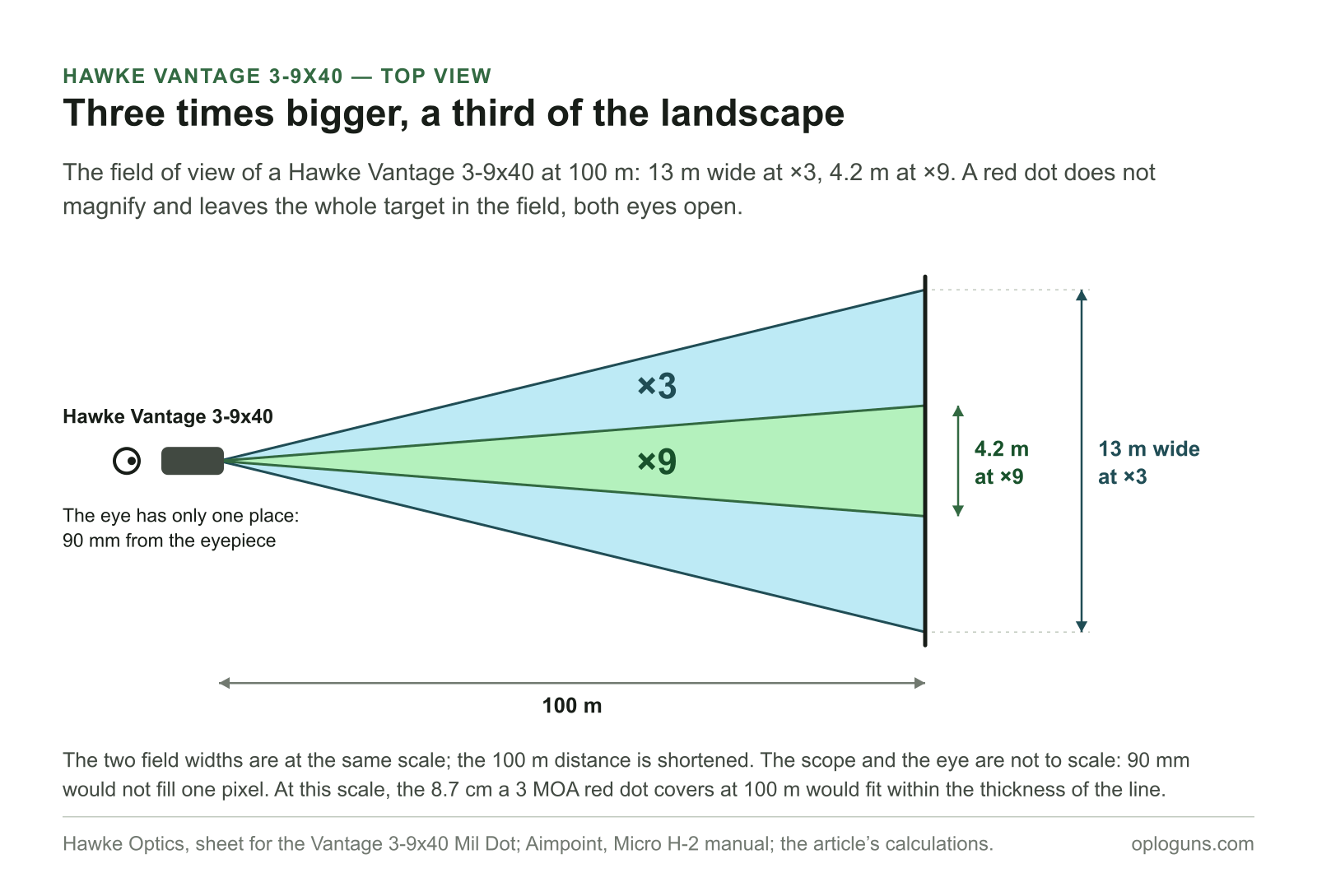
A scope magnifies. It places a fine reticle on an enlarged image, and that is what lets you see where the bullet struck. In return, your eye has only one place: 90 mm behind the eyepiece of a Hawke Vantage 3-9x40, 102 mm on an Endurance 30 WA3. The field tightens with magnification: 13 m at 100 m at ×3 on the Vantage, 4.2 m at ×93. Three times bigger, a third of the landscape.
The red dot
Pros
The scope
Pros
Choosing a scope, focal plane and reticle included, is set out in choosing a riflescope; the red dot on a handgun in the pistol red dot.
Parallax-free red dot: what the spec sheets say
Parallax is the apparent shift of an object when you look at it from another place4. On a sight, it shows when you move your head: if the dot leaves the target, the sight is not free of it at that distance4.
"Parallax free" appears on almost every sheet. Holosun writes it for its HS510C, Vortex for its Crossfire56. Hawke, for its part, gives a figure: "Parallax error free from 10 yards/9 meters", or 9.14 m, on its Endurance, Wide View and Vantage red dots2. Short of that, nothing is promised.
On a scope, the same manufacturer sets parallax at 100 yards, or 91 m, when there is no adjustment3. Same phenomenon, two distances: the red dot is free of it from ten meters or so, the fixed scope is right at one distance only.
Three clarifications spare you a wrong diagnosis:
- A dot that moves in the window is not parallax: as long as it stays on the target, the sight is free of it4.
- The tilted glass is deliberate: it reflects the diode's light back to the eye45.
- The test is done on a distant target: at least 25 yards, 22.86 m, according to Primary Arms, sight still, head moving4.
Primary Arms adds that parallax remains possible on entry-level or older sights4. That leaves the dot's color, another promise of the spec sheets.
Red or green dot: the eye's sensitivity
The human eye sees best around 555 nm, in the green: at equal power, a green dot looks brighter7. Red keeps two arguments at the same manufacturer. It contrasts better against a background of forest or grass. Its diode generally draws a little less for the same brightness7.
That "generally" matters. Vortex lists 50,000 hours at setting 5 for its Crossfire, in red as in green6. As for astigmatism, Vector Optics reports that some shooters see green more sharply, without guaranteeing it7.
Red dot without a battery: solar supplements the battery
The electronic red dots compared all have a battery. The Holosun HS510C has a solar panel, but Holosun describes it as a dual power supply, solar and CR2032 battery: the panel "supplements battery power" and adjusts brightness58.
Sleep mode also extends battery life. The sight switches off when there is no movement, after 5 minutes at Hawke, 10 minutes by default at Holosun, and comes back on at the first movement25. Listed battery lives are always read with their setting:
- Aimpoint Micro H-2: more than five years at setting 8, at room temperature; extreme cold shortens them1.
- Holosun HS510C: 50,000 hours with the dot alone, 20,000 with the circle, at setting 65.
- Vortex Crossfire: 50,000 hours at setting 5, left on day and night; 100,000 hours if it is on only twelve hours a day6.
The battery-free red dot therefore does not exist in these ranges; the scope without illumination does.
Red dot or laser: two objects, two sets of rules
A red dot is not made to light up the target. For its Micro H-2, Aimpoint writes it: "No forward optical signature from the dot beyond 10 meters"1. A laser, for its part, projects a beam, and the law treats it separately.
In France, above class 2, the law is clear-cut. Article 68 of the law of 14 March 2011 punishes buying, holding and using a laser device « d'une classe supérieure à 2 » [of a class higher than 2] not intended for a specific authorized use. The penalty: six months' imprisonment and a €7,500 fine9. Those uses are set by article 4 bis of the decree of 2 May 2007: nine professional headings, from industry to stage shows. The defense heading covers uses « mises en œuvre par les forces de l'ordre et les forces militaires françaises ou par toute entité agissant sous leur ordre ou pour leur compte » [carried out by French law-enforcement and military forces or by any entity acting under their orders or on their behalf]10. Sport shooting is not among them.
For hunting, among electronic aids, the arrêté (ministerial order) of 1 August 1986 accepts a red dot sight only « sans convertisseur ou amplificateur d'image, et sans rayon laser » [without an image converter or intensifier, and without a laser beam]; it also accepts scopes with an illuminated reticle mounted on the firearm. Version in force since 10 July 202611. The code de l'environnement (environmental code) prohibits any electronic aid that an arrêté does not authorize12.
Red dot and scope at the range: what the rulebook allows
On an ISSF competition gun, you will mount neither, except in running target. The rifle accepts no attached optical system, the pistol no projected-dot sight. In running target, rule 10.4.3.1 accepts any type of sight at 50 m, and 10.4.3.2 a fixed optic of 4× at most at 10 m15. The spotting scope, not attached to the gun, remains allowed for locating your shots at 50 and 300 m with a rifle, at 25 and 50 m with a pistol15. It has its own guide, the spotting scope for sport shooting.
Outside ISSF, each discipline's rulebook decides: optics divisions in IPSC shooting, unrestricted optics in Precision Rifle, as the two guides cited above set out. The rulebook in force prevails.
Three misconceptions about the red dot and the scope
- "Parallax-free means at any distance." Hawke guarantees it from 10 yards, 9.14 m2.
- "A solar red dot has no battery." The HS510C keeps a CR2032, which the panel supplements58.
- "Green always drains the battery more." Vortex lists the same battery life for both colors of the Crossfire6.
Red dot or scope for your use
Fast shooting, close or moving target
The red dot keeps the whole target in the field, with no precise place for the eye beyond the 10 cm of safety. A Hawke Endurance 1x30 costs €175 at two French gun shops checked on 15 November 2026, promotion included at one of them1314. In return, no detail at distance, and a battery to replace. Choosing a model for a long gun is set out in our guide to the red dot for rifle and shotgun.
Precision shooting beyond 50 m
The scope shows the impact and offers a fine reticle. A Hawke Vantage 3-9x40 costs €99 to €114 depending on the version (Vantage or Vantage HD, promotions included)1314. In return, an eye to place at 9 cm and a field of 4.2 m at 100 m at the highest magnification. What you lose at entry level is in the budget riflescope.
Both at once
A scope that starts at ×1, of the 1-6x type, is aimed almost like a red dot at the low end and magnifies at the high end. On a Hawke Frontier 30 1-6x24, the field goes from 37.6 m at 100 m at ×1 to 6.3 m at ×63. In return, 514 g on the gun, more than any red dot.
Sources 16 references
The specifications come from the manufacturers' manuals and sheets, reread on 15 November 2026; the legal texts, from Légifrance in their version in force that day; the prices, from dated checks at two French gun shops, flagged ⚠️ as commercial data. Click a reference number in the text to highlight the matching source.
- Aimpoint — Micro H-2 and Micro T-2, user manual (PDF, French text included), reread 15 November 2026: "two eyes open" aiming; "The red dot follows the movement of the user's eye while remaining fixed on target, eliminating any need for centering"; "Magnification 1X unlimited eye relief"; "Optical signature" given for the Micro H-2; "Optical signature No forward optical signature from the dot beyond 10 meters"; CR2032 battery, "More than 5 years of use at pos. 8", figures "valid at room temperature for a quality battery", "Extreme cold might shorten battery life".
- Hawke Optics — sheets for the Endurance Red Dot 1x30 Weaver, Reflex Sight Wide View and Vantage Red Dot 1x30, reread 15 November 2026: "Parallax error free from 10 yards/9 meters"; sleep mode "when no movement is detected for 5 minutes"; Wide View: 57 g without a base, 85 g with one. ⚠️ Manufacturer's technical data.
- Hawke Optics — sheets for the Vantage 3-9x40 Mil Dot, Endurance 30 WA 2.5-10x50 and Frontier 30 1-6x24, reread 15 November 2026: Vantage, eye relief 90 mm, field of view from 13 to 4.2 m at 100 m, fixed parallax "PX/Focus (m) 91", ¼ MOA clicks, no illumination, 402 g; Endurance, eye relief 102 mm, 612 g; Frontier, field of view from 37.6 to 6.3 m at 100 m, 514 g. ⚠️ Manufacturer's technical data.
- Primary Arms — Understanding Parallax: The Science Behind Slanted Red Dot Lenses, reread 15 November 2026: "Parallax is the perceived shift in the location of an object that occurs when you view it from different locations"; a parallax-free sight reduces or eliminates it "at reasonable distances"; test on an object "at least 25 yards away", optic still, head moving; a dot that moves in the window "as long as it stays on the target" is not parallax; it remains possible "particularly with budget or older optics"; lens slanted "by design". ⚠️ Specialist commercial source.
- Holosun — HS510C / HE510C-GR manual (PDF), reread 15 November 2026: front lens "positioned off axis" to reflect the diode's light; "Parallax free with unlimited eye relief"; "Fail Safe operation with a dual power supply (solar component and battery)", CR2032 battery; "up to 20000 hours (dot with circle) or 50000 hours (dot) at setting 6"; sleep after 10 minutes without movement by default.
- Vortex Optics — Crossfire Red Dot manual (PDF), reread 15 November 2026: "Bright Red" and "Bright Green" versions, "BATTERY RUN TIME (@ SETTING 5) 50,000 hrs." for both; 100,000 hours at setting 5 "12 hours a day"; "EYE RELIEF Unlimited"; "PARALLAX SETTING Parallax Free"; "In order to prevent recoil injury, position the dot so you have at least four inches of eye relief".
- Vector Optics — Green Dot Sight vs Red Dot Sight, 18 June 2026, reread 15 November 2026: "Green light is near the peak of human photopic vision sensitivity (around 555nm)"; "green LEDs require slightly more power than red LEDs to achieve the same brightness level"; "In green backgrounds such as forests and grass, red dots usually provide better contrast"; for astigmatism, an effect that "varies individually and is not guaranteed". ⚠️ Manufacturer.
- Holosun — HS510C page, reread 15 November 2026: "Solar panel supplements battery power and automatically adjusts brightness in changing light"; 650 nm red emitter, "up to 50,000 hours of battery life".
- Légifrance — loi n° 2011-267 du 14 mars 2011, article 68 (in French), in force since 16 March 2011, reread 15 November 2026: « Le fait d'acheter, de détenir ou d'utiliser un appareil à laser non destiné à un usage spécifique autorisé d'une classe supérieure à 2 est puni de six mois d'emprisonnement et de 7 500 € d'amende. » [Buying, holding or using a laser device of a class higher than 2 not intended for a specific authorized use is punished by six months' imprisonment and a €7,500 fine.]
- Légifrance — décret n° 2007-665 du 2 mai 2007, article 4 bis (in French), created by decree no. 2012-1303 of 26 November 2012, reread 15 November 2026: « Les usages spécifiques autorisés pour les appareils à laser sortant d'une classe supérieure à 2 sont les usages professionnels suivants » [the specific uses authorized for laser devices of an output class higher than 2 are the following professional uses] (nine headings), the defense and security heading covering uses « mises en œuvre par les forces de l'ordre et les forces militaires françaises ou par toute entité agissant sous leur ordre ou pour leur compte » [carried out by French law-enforcement and military forces or by any entity acting under their orders or on their behalf].
- Légifrance — arrêté du 1er août 1986 relatif à divers procédés de chasse, article 7 (in French), amended by the arrêté of 25 June 2026, in force since 10 July 2026, reread 15 November 2026: the only means authorized « pour la chasse et la destruction des espèces d'animaux classées susceptibles d'occasionner des dégâts » [for hunting and for the destruction of animal species classed as liable to cause damage] are the electronic aids it lists, among them « les viseurs à point rouge, sans convertisseur ou amplificateur d'image, et sans rayon laser » [red dot sights, without an image converter or intensifier, and without a laser beam] and « les lunettes à réticule lumineux fixées sur les armes à feu » [scopes with an illuminated reticle mounted on firearms].
- Légifrance — article L424-4 du code de l'environnement (in French), in force since 9 March 2012, reread 15 November 2026: « Tous les moyens d'assistance électronique à l'exercice de la chasse, autres que ceux autorisés par arrêté ministériel sont prohibés. » [All electronic aids to hunting, other than those authorized by ministerial order, are prohibited.]
- Armurerie Auxerre — checks of 15 November 2026 (in French): viseurs point rouge, page 2, Hawke Endurance Red Dot 1x30 3 MOA €174.90; lunettes, page 8, Hawke Vantage 3-9x40 30/30 Duplex €101.15, 3-9x40 AO Mil Dot €109.65, 3-9x40 AO 30/30 Duplex €113.90. ⚠️ Commercial data.
- Armurerie Beau Repaire — checks of 15 November 2026 (in French): points rouges, page 4, Hawke Endurance Red Dot 1x30 Weaver €175.00 (promotional price, struck-through €289.00); lunettes, page 11, Hawke Vantage HD 3-9x40 Mil Dot €99.00 and 3-9x40 AO 30/30 €108.90 (promotional prices). ⚠️ Commercial data.
- ISSF — Rule Book, 2025 edition, third print 10/2026, in force since 19 October 2026: 7.4.1.6, no optical system attached to the rifle; 8.4.1.2, "Optical, mirror, telescope, laser beam, electronically projected dot sights etc. are prohibited" on the pistol; running target, 10.4.3.1 "50m Rifles. Any types of sights are permitted." and 10.4.3.2 "10m Rifles. Any type of sights are permitted except that optical sights must be non-variable with a maximum of four power (4X) magnification"; 7.5.8.1 and 8.6.1, spotting scope not attached to the gun allowed at 50 and 300 m with a rifle, at 25 and 50 m with a pistol.
- Calculations: one minute of angle covers 29.09 mm at 100 m; a 3 MOA dot covers 3 × 29.09 = 87 mm at 100 m; a ¼ MOA click is worth 7.3 mm at 100 m; 10 yards equal 9.144 m, 25 yards 22.86 m, 100 yards 91.44 m.
The text in force prevails. This article cites France's law of 14 March 2011, decree of 2 May 2007, arrêté of 1 August 1986 and code de l'environnement in their version of 15 November 2026, and the ISSF rulebook in its 2025 edition, third print. The specifications are those the manufacturers list for the models cited.
Frequently asked questions
Red dot or scope: which to choose?
A red dot does not magnify: you aim with both eyes open, with optically unlimited eye relief; on a recoiling gun, though, Vortex asks for at least 4 inches, 10 cm, between the eye and the sight to avoid injury. The whole target stays in the field of view. A scope magnifies, up to twelve times on the models compared: it shows detail and the impact, but needs the eye placed about 9 to 10 cm from the eyepiece and reduces the field. The choice depends on the distance and on what you need to see.
Red or green dot: what is the difference?
The human eye is more sensitive to green, around 555 nm: at equal intensity, a green dot looks brighter. Vector Optics notes that a green diode generally draws a little more, and that a red dot contrasts better against vegetation. Yet Vortex lists the same battery life, 50,000 hours, for both colors of its Crossfire.
What does "parallax-free red dot" mean?
That the dot stays on the target when the eye moves behind the glass, beyond a certain distance. Hawke puts it in figures: "parallax error free from 10 yards", or 9.14 m. The dot can move within the window without that being parallax: only its position on the target counts.
Is there a red dot without a battery?
The solar-panel models compared keep a CR2032 battery: at Holosun, solar supplements the battery and adjusts brightness, it does not replace it. Listed battery life reaches 50,000 hours at a given setting, and automatic sleep when there is no movement saves it.
Red dot or laser: are they the same thing?
No. A red dot is not made to light up the target: for its Micro H-2, Aimpoint lists no forward light signature beyond 10 m. A laser projects a beam. In France, the law of 14 March 2011 punishes buying, holding and using a laser of a class higher than 2 outside the professional uses set by decree, and the 1986 arrêté (ministerial order) accepts a red dot sight for hunting only « sans rayon laser » [without a laser beam].
Spotted an error, or a rule that has changed since we checked? Report an error