Spotting scope for sport shooting: which one for 25, 50, 100 or 300 m, or a target camera
Published on · 8 min read · Anthony Baillon
A 20 to 60 power spotting scope reads hits to the millimeter out to 50 m, and at 100 m at the top of its zoom. At 300 m, it would take ×87 and more: American makers offer a target camera, which the range's rules may or may not allow. The objective, 60 to 85 mm, decides the brightness.
At a glance
| Distance | Reading 1 mm takes | Optic |
|---|---|---|
| 25 m | ×7.3 to ×14.5 | Any zoom spotting scope |
| 50 m | ×14.5 to ×29 | 20-60x spotting scope |
| 100 m | ×29 to ×58 | Top of the zoom, wide objective |
| 300 m | ×87 to ×175 | Beyond the spotting scopes recorded |
First figure for 20/20 vision, second for 20/40.
- Prices recorded: €220 to €250 for a Hawke Vantage 24-72x70, €893 to €898 for an Endurance ED 25-75x85.
- ISSF rulebook: a spotting scope not attached to the gun is permitted at 50 and 300 m for rifle, 25 and 50 m for pistol.
Spotting scope for shooting: reading magnification
Seeing the hole is not enough to count the points: you have to see whether the hole touches the line, to within a millimeter. That reading magnification is worked out, distance by distance, in our guide to what magnification you need to see your hits. The table in the box comes out of it. Set against the range of spotting scopes:
- At 25 and 50 m, a 20-60x works at a third of its range9.
- At 100 m, it works at the top of its range, or beyond it with 20/40 vision9.
- At 300 m, no spotting scope recorded gets there: the most powerful, a Hawke 25-75x85, stops at ×751.
The ISSF rulebook in force since 19 October 2026 allows a spotting scope not attached to the gun to locate your shots and judge the wind, in rifle events at 50 and 300 m and pistol events at 25 and 50 m4. If you are starting 50 m rifle three positions, that is your case.
Spotting scope objective: 60 to 85 mm
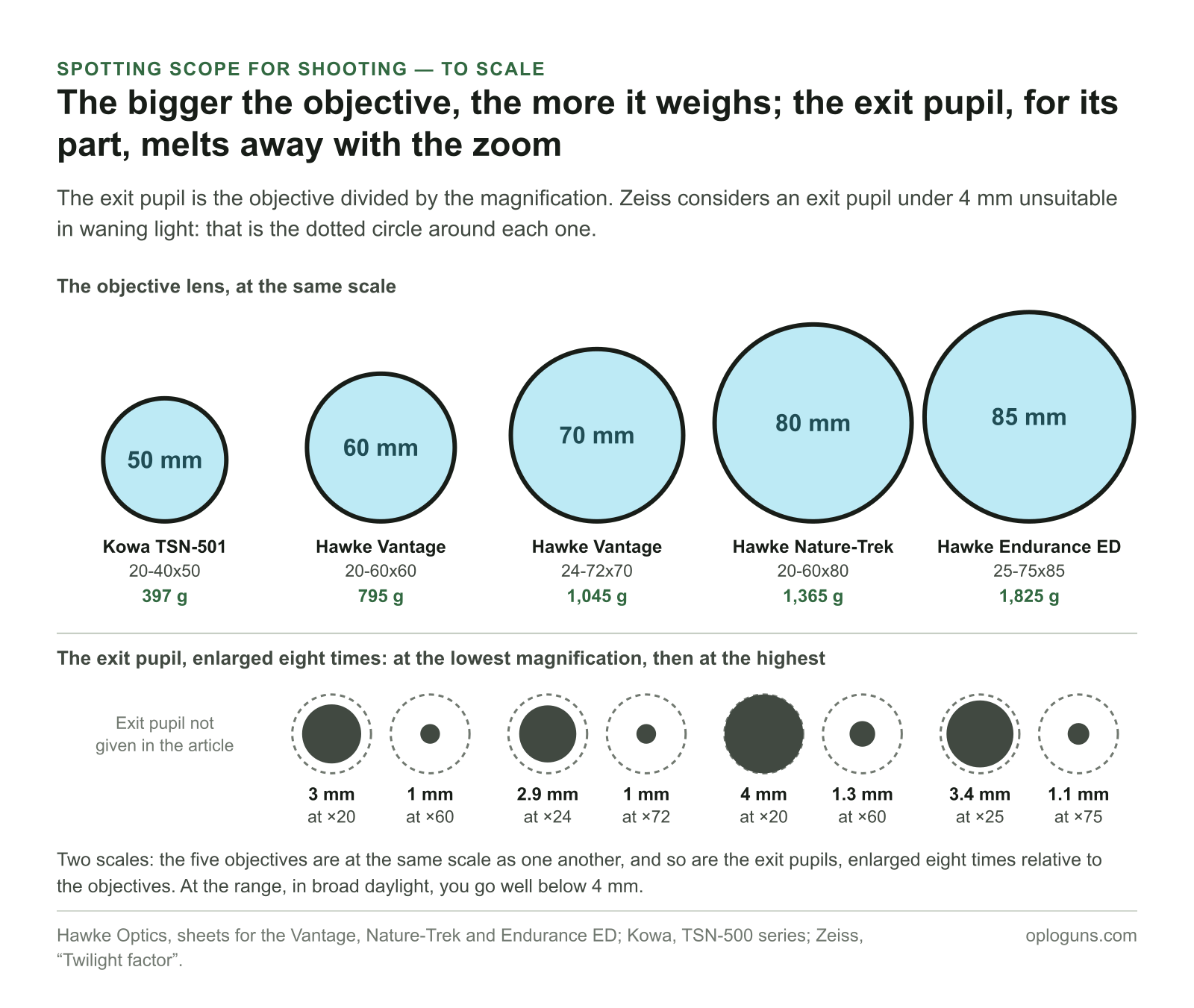
The higher the magnification climbs, the darker the image gets. The exit pupil, the objective divided by the magnification, measures it9. Zeiss considers an exit pupil under 4 mm unsuitable in waning light5; at the range, in broad daylight, you go well below that, but the objective sets how far.
| Spotting scope | Objective | Pupil at the lowest | Pupil at the highest | Weight |
|---|---|---|---|---|
| Hawke Vantage 20-60x60 | 60 mm | 3 mm at ×20 | 1 mm at ×60 | 795 g |
| Hawke Vantage 24-72x70 | 70 mm | 2.9 mm at ×24 | 1 mm at ×72 | 1,045 g |
| Hawke Nature-Trek 20-60x80 | 80 mm | 4 mm at ×20 | 1.3 mm at ×60 | 1,365 g |
| Hawke Endurance ED 25-75x85 | 85 mm | 3.4 mm at ×25 | 1.1 mm at ×75 | 1,825 g |
The price of the objective is paid in weight: more than a kilo between the 60 mm and the 85 mm1, the weight of one more one-liter water bottle in the bag. A compact spotting scope like the Kowa TSN-501 goes down to 50 mm and 397 g, with a zoom limited to 20-40x3: enough for 25 and 50 m, short for 100 m.
ED glass
Hawke presents low-dispersion glass, known as ED, as the most effective way to improve the image: it reduces color fringing, or chromatic aberration, and makes the image sharper and higher in contrast2. On the Endurance ED 25-75x85, Hawke states it at all magnifications; the sheets of the Vantages and the Nature-Trek do not mention it1. The price gap between a Vantage and an Endurance ED exceeds €60078.
Straight or angled eyepiece, and the tripod
The same spotting scope sometimes exists in a straight and an angled version: the Kowa TSN-501 is angled, the TSN-502 straight, both in 20-40x503. The shooting position and the height of the support decide; trying both at the range, in the position you hold, settles it better than a spec sheet.
The support counts as much as the optic. Hawke spotting scopes screw onto a standard 1/4-20 UNC thread, and some have a rotating collar that turns the body12. A 24 cm tabletop tripod is in the catalog of one of the gun shops recorded7. One last figure to read on the sheet, the close focus: 5.5 m on the Nature-Trek 20-60x80, 7 m on the Vantage 20-60x60, 9 m on the Vantage 24-72x70, 8 m on the Endurance ED 25-75x851.
Pros
Cons
- An exit pupil of 1 to 1.3 mm at the top of the zoom, on the spotting scopes in the table9.
- Eyes that leave the gun between two shots.
- No help beyond 100 m for reading to the millimeter.
Target camera: when the spotting scope is no longer enough
At 300 m, the spotting scope shows the target but no longer reads the millimeter. The target camera turns the problem around: placed near the target, it films it up close and transmits the image to the shooter. The Longshot LR-3 illustrates it:
- Its own radio link, from the camera to the receiver, with no Wi-Fi and no mobile network6.
- A transmission listed at up to 2 miles, 3.2 km6.
- 9 hours of battery life per charge, and several cameras possible on a single receiver6.
The image is displayed on a phone or a tablet6.
The camera has its own constraints. The maker places it near the target, offset to the side, out of the line of fire; it contradicts itself on the same page, sometimes in front of the target, sometimes behind it6. It also sells a warranty against shots that hit it6. Its placement is therefore decided with the manual and the person in charge of the range, the sole judge of the location. The device is set up and collected only on that person's order, with the firing line closed and firearms unloaded; no one goes to the targets during shooting. These cameras come from American makers, and their use depends on the rules of each range. Shooting at these distances is presented in getting started in long-range shooting.
Pros
- A reading at 300 m, without extreme magnification6.
- The target seen without leaving your position.
Cons
- A device to place near the targets, firing line closed, on the order of the person in charge of the range.
- A 9-hour battery6.
Spotting scope prices for shooting: €220 to €1,197
Prices recorded on 15 November 2026 at two French gun shops, promotions included78:
| Spotting scope | Objective | Prices recorded |
|---|---|---|
| Hawke Vantage 24-72x70 | 70 mm | €220 to €250 |
| Hawke Endurance ED 25-75x85 | 85 mm, ED glass | €893 to €898 |
| Kite Optics SP82 20-60x, depending on version | 82 mm | €1,005 to €1,197 |
The tripod is extra.
Three misconceptions about the shooting spotting scope
- "You need ×60 to read at 50 m." ×14.5 to ×29 are enough, depending on eyesight9.
- "The highest magnification is the best setting." At the top of the zoom, the exit pupil falls to around 1 mm9: the image darkens.
- "A spotting scope is banned in competition." The ISSF permits it, not attached to the gun, at 50 and 300 m for rifle, at 25 and 50 m for pistol4.
Which spotting scope for your distance
Pistol at 25 m, rifle at 50 m
A 20-60x of 60 to 70 mm, like the Hawke Vantage 24-72x70 at €220 to €250, reads the millimeter at a third of its zoom. In return, an exit pupil of 1 mm if you go up to the maximum.
Rifle at 100 m
An objective of 80 mm or more and ED glass keep a bright image higher up the zoom: €893 to €898 for the Endurance ED 25-75x85. In return, 1.8 kg to carry and set down.
Shooting at 300 m
The target camera, if the range allows it. In return, a device to place near the targets, firing line closed, and a battery to recharge. The choice of the scope for the rifle itself is in the long-range scope.
Sources 9 references
The specifications come from the makers' sheets, reread on 15 November 2026; the competition rule, from the ISSF rulebook in the edition stated; the prices, from dated records at two French gun shops, flagged ⚠️ as commercial data. Click a reference number in the text to highlight the matching source.
- Hawke Optics — sheets for the Vantage 20-60x60, Vantage 24-72x70, Nature-Trek 20-60x80 and Endurance ED 25-75x85, reread on 15 November 2026: weights of 795 g, 1,045 g, 1,365 g and 1,825 g; close focus of 7 m (Vantage 20-60x60), 9 m (Vantage 24-72x70), 5.5 m (Nature-Trek) and 8 m (Endurance ED); Nature-Trek, exit pupil from 4 to 1.3 mm, "Body rotation for viewing in virtually any position", tripod thread; Endurance ED, "All magnifications are constructed with ED glass reducing the potential for chromatic aberration". ⚠️ Maker's technical data.
- Hawke Optics — Spotting Scope Optical System, 13 June 2017, and How to use your spotting scope, 11 May 2017, reread on 15 November 2026: "Extra-low dispersion (ED) lenses are the most effective way to improve image quality", for an image "significantly sharper" with the best contrast; "A rotating tripod band is available on some models to allow body rotation and alternative scope orientation"; "1/4-20 UNC" thread.
- Kowa — TSN-500 Series data sheet (PDF), reread on 15 November 2026: "KOWA TSN-501 ANGLED MODEL", "KOWA TSN-502 STRAIGHT MODEL" (same optical specifications); 50 mm objective; "Fixed 20-40x zoom eyepiece"; "Weight (501/502) 14oz".
- ISSF — Rule Book, Edition 2025, Third Print 10/2026, in force since 19 October 2026: 7.5.8.1, "The use of telescopes not attached to the rifle to locate shots and judge wind is permitted for 50m and 300m events only"; 8.6.1, same rule "in 25m and 50m events only" for pistol.
- Zeiss — Twilight factor, Zeiss Hunting blog, reread on 15 November 2026: "Anything with an exit pupil smaller than 4 mm is, therefore, unsuitable in the waning light right from the start".
- Longshot Target Cameras — LR-3 2-Mile Target Camera, reread on 15 November 2026: "wireless video transmission up to 2 Miles"; "No Wi-Fi or Cell Service Required"; "Direct connection between the camera and receiver"; "up to 9 hours of battery life on a single charge"; "supports multiple cameras connected to a single receiver"; image transmitted "to your mobile device"; placement "approximately 10–15 feet in front of and offset slightly to the side of the target" then, in the frequently asked questions, "roughly 10–15 feet behind and offset slightly to the side of the target"; "Bulletproof Warranty" covering the camera "if it's accidentally struck by gunfire while in use". ⚠️ Maker; no price recorded at two sellers in euros.
- Armurerie Auxerre — longues-vues (in French), prices recorded on 15 November 2026: Hawke Vantage 24-72x70 €219.90; Hawke Endurance ED 25-75x85 €893.00; Kite Optics SSC SP82 20-60x82 €1,196.90 (special price); Hawke CF2 tabletop tripod, « hauteur 24 cm » [height 24 cm]. ⚠️ Commercial data.
- Armurerie Beau Repaire — longues-vues et monoculaires (in French; pages 1 and 2), prices recorded on 15 November 2026, promotions under way: Hawke Vantage 24-72x70 €249.50; Hawke Endurance ED 25-75x85 €898.00; Kite Optic SP 82 20-60x €1,005.00. ⚠️ Commercial data.
- Calculations, following the method of our magnification guide: one minute of angle covers 7.27 mm at 25 m, 14.54 mm at 50 m, 29.09 mm at 100 m and 87.27 mm at 300 m; reading 1 mm takes 1 minute (20/20 vision) or 2 minutes (20/40) divided by the apparent size of 1 mm, or ×7.3 and ×14.5 at 25 m, ×14.5 and ×29 at 50 m, ×29 and ×58 at 100 m, ×87 and ×175 at 300 m; exit pupil = objective ÷ magnification (60 ÷ 20 = 3; 60 ÷ 60 = 1; 70 ÷ 24 = 2.9; 70 ÷ 72 = 0.97; 80 ÷ 20 = 4; 80 ÷ 30 = 2.7; 85 ÷ 25 = 3.4; 85 ÷ 75 = 1.1; 60 ÷ 30 = 2 mm); 1 oz = 28.35 g (Kowa: 14 oz = 397 g); 2 miles = 3.2 km; 898 − 249.50 = €648.50.
The rulebook in force prevails. This article cites the ISSF rulebook in its 2025 edition, third print in force on 19 October 2026. The use of a spotting scope or a camera in federation competition, and the placing of a device near the targets, are confirmed with the range officer and the person in charge of the range.
Frequently asked questions
Which spotting scope for sport shooting?
A zoom spotting scope of the 20-60x type, on a 60 to 85 mm objective, covers distances from 25 to 100 m: reading a hit to the millimeter takes ×7.3 to ×14.5 at 25 m, ×14.5 to ×29 at 50 m, ×29 to ×58 at 100 m, depending on eyesight. On 15 November 2026, a Hawke Vantage 24-72x70 cost €220 to €250, a Hawke Endurance ED 25-75x85 €893 to €898.
Which spotting scope for sport shooting at 50 m?
Reading a hit to the millimeter at 50 m takes ×14.5 with 20/20 vision, ×29 with 20/40: any spotting scope of 20 to 60 power is enough there. The objective decides the brightness: at ×30, a 60 mm objective leaves 2 mm of exit pupil, an 80 mm objective 2.7 mm. The ISSF rulebook allows a spotting scope not attached to the gun in 50 m rifle.
Which spotting scope for shooting at 100 m?
At 100 m, reading the millimeter takes ×29 to ×58. A 20-60x or a 25-75x gets there at the top of its range, where the exit pupil falls to around 1 mm: on a Hawke Endurance ED 25-75x85, 3.4 mm at ×25, 1.1 mm at ×75. A wide objective and ED glass keep a usable image higher up the zoom.
Wireless long-range target camera: how does it work?
A camera placed near the target films it and transmits the image over its own radio link, with no Wi-Fi and no mobile network. Longshot lists a transmission range of up to 2 miles, 3.2 km, and 9 hours of battery life for its LR-3. The maker places it near the target, to the side, out of the line of fire; it is set up and collected with the firing line closed, on the order of the person in charge of the range, with no one at the targets during shooting.
Does a target camera replace the spotting scope?
At 300 m, reading a 1 mm hit would take ×87 to ×175: no spotting scope recorded goes that high, the most powerful stops at ×75. The camera, placed near the target, does not need to magnify that much. In return, it depends on a battery, on a radio link, and on the agreement of the range, which decides how it is set up and collected, firing line closed.
Spotted an error, or a rule that has changed since we checked? Report an error