Choosing precision .22 LR ammo: a protocol rather than a ranking
Published on · 9 min read · Anthony Baillon
The most accurate .22 LR ammunition is the one your barrel prefers: Eley and Lapua themselves test their lots gun by gun to find it. A simple protocol does the same job at the range. To separate two close loads, five shots mislead one time in three; fifty shots, barely one time in sixteen.
At a glance
| Step | What the protocol sets |
|---|---|
| Distance | 50 m with a rifle, 25 m with a pistol |
| Fouling shots | 10 uncounted shots before measuring |
| Measured shots | 40 to 50 per load, in groups of 5 or 10 |
| Order | loads alternated, group after group |
| Measurement | average of the groups, center to center |
| Record | brand, product, lot, conditions |
- The lot counts: two boxes of the same product can come from different lots.
- The cost: one box of 50 per load, or €40 to €115 for five loads.
The most accurate .22 LR ammo: your barrel's choice
The manufacturers say it before the shooters do. Eley: "What performs flawlessly in one barrel may not deliver the same results in another"1. And of Tenex, its competition ammunition: because each barrel vibrates in its own way, no single lot performs identically in every gun2.
Hence test ranges run by the manufacturers themselves. Eley has up to 20 lots fired there through the customer's barrel1. Lapua runs them in Germany, Finland, Sweden and the United States6. At the Arizona one, some rifles show a clear preference for a given ammunition5.
A published ranking compares ammunition in guns that are not yours. It does not replace the test. For the gun itself, our guide to the .22 LR target pistol reviews the families and the events. For choosing a bolt-action .22 LR rifle, the barrel, the magazine, the trigger and the muzzle thread separate the models.
.22 LR ammunition lot: two boxes, two results
The brand and the product name are not enough: the lot counts too. Eley prints on each box a code that gives the product line, the year, the loading machine, the batch number and the mean velocity measured in four test barrels2. Lapua's range hands the customer the product and the precise lot that grouped best5.
Two practical consequences:
- Write down the lot of every box tested, not just the brand.
- Buy the chosen lot again, while it is available: a new lot of the same product is tested afresh.
Manufacturers also rank their product lines by the consistency they guarantee. Eley makes its Tenex to a radial standard deviation of 3.75 mm at most, its Club to 5.50 mm23. The gap between lines exists; it does not say which one your barrel prefers. Shooting at 10 m follows the same logic, with head diameter added: the same test for 4.5 mm pellets is done with the gun on a rest.
How many shots per ammo: 40 to 50, not 5
A five-shot group is a lottery. Two five-shot groups fired with the same ammunition, in the same gun, differ by a median of 30%; two three-shot groups, by 44%14. A 20% difference between two loads is lost in that noise.
Ranking two loads correctly: the odds by number of shots
Two loads whose true dispersion differs by 20%, compared by the average extreme spread of 5-shot groups; simulation, circular normal dispersion
Simulation of 12,000 comparisons per point14. A coin toss would give 50%. A dispersion gap smaller than 20% takes more shots for the same result.
View the data
| Shots per load | Correct, by extreme spread | Correct, by mean radius |
|---|---|---|
| 5 | 67% | 69% |
| 10 | 75% | 75% |
| 20 | 83% | 84% |
| 30 | 88% | 88% |
| 40 | 91% | 92% |
| 50 | 94% | 94% |
| 80 | 97% | 98% |
| 100 | 98% | 98.5% |
The calculation starts from two loads whose true dispersion differs by 20%. With five shots each, you pick the right one two times out of three: barely better than a coin toss. It takes twenty to be right five times out of six, fifty to be right 94 times out of 10014.
The manufacturers' ranges work on that scale:
- Eley fires 10 shots per lot, shortlists the best, then tops up to a 40-shot group per lot1.
- Lapua, in Arizona, fires 10 fouling shots, then about eight 10-shot groups per load, measured at 50 and 100 m5.
Conversely, Sako guarantees the accuracy of its Tikka rifles in .22 LR on a three-shot group at 50 m8: a manufacturing benchmark, not a comparison protocol.
Measuring a .22 LR group: center to center, averaged
Two measurements are almost as good as each other. The extreme spread, first: the distance between the centers of the two hits farthest apart. It is measured from outside edge to outside edge, minus the bullet diameter, 5.6 mm914.
The mean radius, next: the average distance from each hit to the center of the group. It uses every shot, where the extreme spread keeps only two. On ten-shot groups, it varies a little less from one group to the next: its relative variation is 17%, against 20% for the extreme spread14. Eley, for that matter, expresses the consistency of its lines as a radial standard deviation, a measurement of the same family2.
The choice counts less than the number of shots. The chart's table shows it: for an equal number of shots, the two measurements pick the right load almost as often14. On paper, the extreme spread is measured with a steel rule; the mean radius needs the coordinates of the hits, which an electronic target supplies. Reading those hits from the firing point takes magnification: our guide what magnification to see your hits calculates it distance by distance.
The protocol at the range, step by step
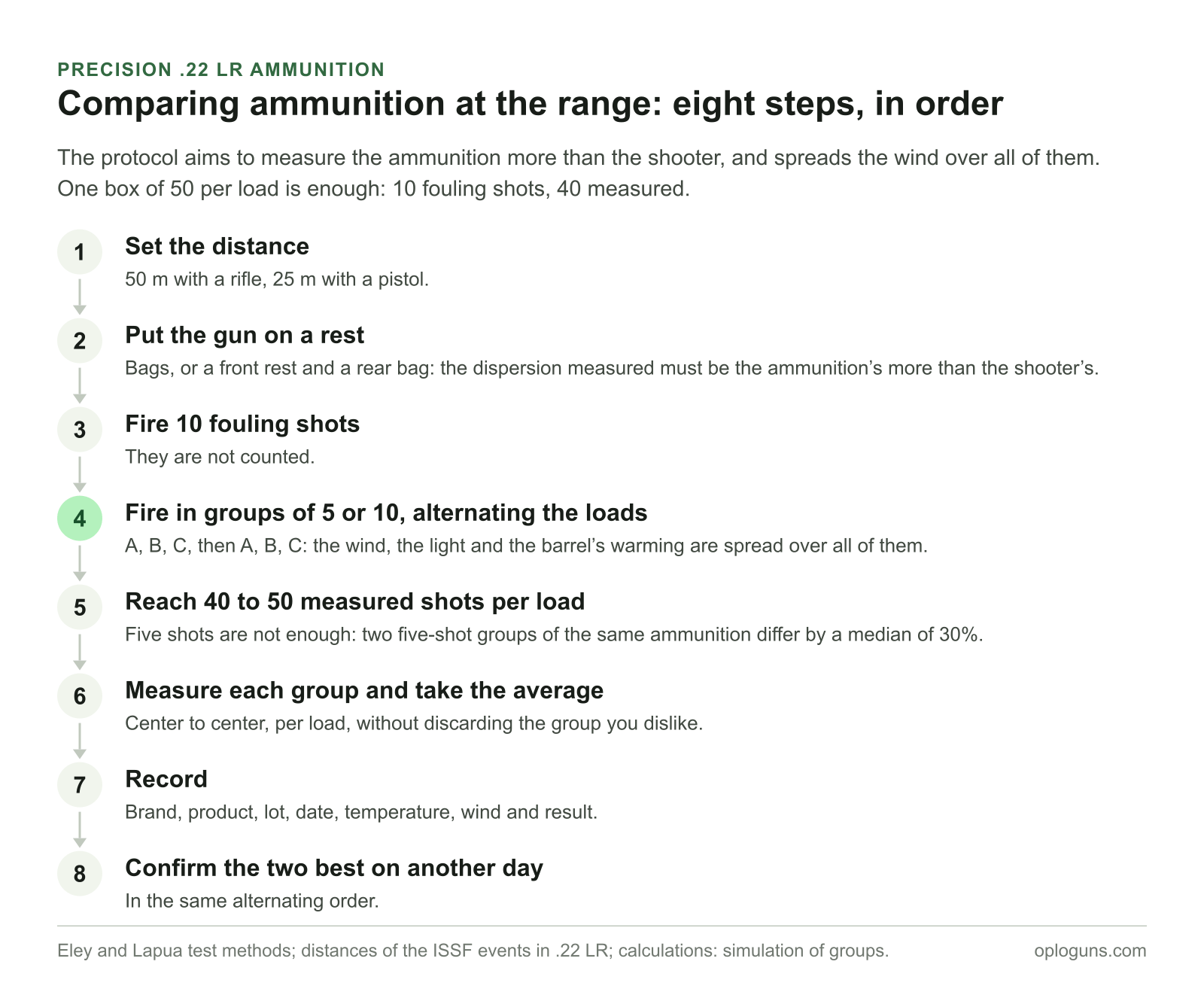
- Set the distance: 50 m with a rifle, 25 m with a pistol, the distances of the ISSF events in .22 LR9. The wind soon weighs in: in a 4 m/s crosswind, a Center-X drifts 24 mm at 50 m and 98 mm at 100 m7.
- Put the gun on a rest: bags, or a front rest and a rear bag, so that the dispersion measured is the ammunition's more than the shooter's. Lapua goes as far as clamping the receiver in a vise5.
- Fire 10 fouling shots, uncounted, as Lapua's range does before each test5.
- Fire in groups of 5 or 10, alternating the loads: A, B, C, then A, B, C. The wind, the light and the barrel's warming are thus spread over all of them.
- Reach 40 to 50 measured shots per load14.
- Measure each group and take the average per load, without discarding the group you dislike.
- Record brand, product, lot, date, temperature, wind and result, in a paper notebook or a spreadsheet.
- Confirm the two best on another day, in the same alternating order.
A group spoiled by the shooter stays in the average. Discarding it amounts to choosing the result before measuring it. The method that separates what comes from the shooter from what comes from the gun is detailed in our plan for improving at sport shooting.
Test budget: €40 to €115 for five .22 LR loads
One box of 50 per load is enough for the protocol: 10 fouling shots, 40 measured. Prices recorded on 1 November 2026 at two French gun shops, per box of 501213:
| Ammunition, box of 50 | Armurerie Loisir | Armurerie de la Bourse |
|---|---|---|
| RWS Target Rifle | €8.90 | €8.00 |
| RWS Pistol Match | €9.50 | €10.00 |
| SK Rifle Match | €8.90 | €12.00 |
| Eley Match | €19.90 | €18.00 |
| Eley Tenex Pistol | €24.90 | €18.00 |
| Eley Tenex | €22.90 | — |
Testing five training loads costs about €40; five match loads, about €115. That is €0.16 to €0.50 a shot, when training .22 LR bought by the case runs at around €0.13, as our comparison .22 LR, .22 Magnum or .17 HMR shows. Confirming the two best adds two boxes.
.22 LR pistol: ammo that also cycles the gun
With a semi-automatic pistol, accuracy is not enough. The ammunition must also drive the slide back and recock. CZ ships the .22 LR adapter for its Shadow 2 with two springs, one for less powerful ammunition such as subsonic rounds, the other for more powerful loads11.
Manufacturers do in fact load their pistol ammunition slower than their rifle ammunition. Eley lists 276 to 287 m/s for Tenex Pistol, against 317 to 330 m/s for Tenex24. RWS gives 275 m/s for its Pistol Match, in a 130 mm test barrel10.
In 25 m rapid fire pistol, the ISSF adds a threshold: a bullet of at least 2.53 g, at an average of at least 250 m/s, measured 3 m from the muzzle9. RWS lists 260 m/s for its P25 Rapid Fire, in its 130 mm barrel10: the margin comes down to 10 m/s. The pistol protocol therefore also counts each load's malfunctions, cause by cause, as in our guide to pistol malfunctions.
Three misconceptions about precision .22 LR ammo
- "The most expensive groups best everywhere." Eley writes that no lot of its Tenex performs identically in every barrel2.
- "A five-shot group is enough to judge." Two five-shot groups of the same ammunition differ by a median of 30%; to separate two close loads, five shots get it wrong one time in three14.
- "At 50 m, the wind does not count." In a 4 m/s crosswind, a match .22 LR drifts 24 mm at 50 m7, more than the width of the 10 ring of the ISSF target, 10.4 mm9.
Which testing protocol for your gun
.22 LR rifle at 50 m
The full protocol applies: rest, 10 fouling shots, 40 to 50 measured shots per load, loads alternated. In return, it takes a whole session and a windless day, or flags to read the wind.
.22 LR pistol at 25 m
Same protocol, also counting each load's malfunctions. In return, the shooter's dispersion weighs more than with a rifle: the rest makes the difference between measuring the ammunition and measuring your own fatigue.
Shooting .22 LR at 100 m and beyond
The ammunition must also hold its velocity and resist the wind, which our guide to subsonic, standard or high-velocity .22 LR covers. In return, every shot costs more in wind than at 50 m: four times more drift at 100 m, according to Lapua's table.
Sources 14 references
Test methods and specifications taken from the manufacturers; ISSF rules; prices recorded at two French gun shops; probabilities calculated by simulation. Click a reference number in the text to highlight the matching source.
- Eley — Test Ranges, page reread 1 November 2026: "What performs flawlessly in one barrel may not deliver the same results in another, which is why batch testing is critical"; "you can test your barrel with up to 20 batches"; "10 shots from each batch are fired through each barrel and the best performing batches are then shortlisted. A further 30 shots from those selections are fired until an overall 40 shot group size and consolidated score is recorded for each".
- Eley — Eley Tenex, page reread 1 November 2026: "maximum radial standard deviation of 3.75mm and a velocity range of 317–330 m/s"; "Because barrel harmonics differ from rifle to rifle, no single lot performs identically in every barrel"; lot code: "10 = Loaded product 26 = Year of manufacture 04 = Loader number 244 = Batch number for loader 1045 = Mean velocity across four barrels". ⚠️ Manufacturer's technical data; distance at which the radial standard deviation is measured not specified.
- Eley — Eley Club, page reread 1 November 2026: 2.59 g, 317 to 330 m/s, maximum radial standard deviation of 5.50 mm. ⚠️ Manufacturer's technical data.
- Eley — Eley Tenex Pistol, page reread 1 November 2026: 2.59 g, 276 to 287 m/s, maximum radial standard deviation of 4.40 mm; pistol testing at ranges that "both have 25m and 50m lanes". ⚠️ Manufacturer's technical data.
- Art Merrill, NRA Shooting Sports USA — Lapua's Arizona Test Center For Smallbore Competitors, 15 July 2019, reread 1 November 2026: the receiver is locked in an aluminum block clamped in a vise; 100 m air-conditioned tunnel, hits recorded at 50 and 100 m; "the first 10 shots are typically needed as bore-fouling shots before the actual testing begins"; "perhaps eight 10-shot groups"; some rifles "may show a dramatic preference for a specific Lapua ammunition"; the customer receives the recommendation, "including the specific case lot of the ammo tested and recommended".
- Lapua — Rimfire Test Shooting, page reread 1 November 2026: test ranges in Schönebeck (Germany), Lapua and Konnevesi (Finland), Skogås (Sweden), Mesa (Arizona) and Marengo (Ohio).
- Lapua — .22 LR Center-X, table reread 1 November 2026: 327 m/s at the muzzle, 660 mm test barrel; drift in a 4 m/s crosswind: 24 mm at 50 m, 98 mm at 100 m. ⚠️ Manufacturer's technical data.
- Sako — Tikka T1x and T3x manual, version 5.3 (PDF, 2023), reread 1 November 2026: "guarantees this rifle to have a minimum performance of 1 M.O.A. or better, at 100 meters (Rimfire at 50m) with 3 cartridges".
- ISSF — Rule Book, Edition 2025, Third Print 10/2026, in force since 19 October 2026: 7.4.6, 50 m rifle in 5.6 mm (.22") Long Rifle; 8.4.4, 25 m pistol in .22 Long Rifle, and for rapid fire pistol "minimum bullet weight 2.53g = 39gr; minimum average velocity 250m/sec., measured 3.0m from the muzzle"; 6.3.4.2, 10 ring of the 50 m rifle target of 10.4 mm.
- RWS — sheets reread 1 November 2026: Pistol Match, 2.6 g, 275 m/s, 130 mm test barrel; P25 Rapid Fire, 2.6 g, 260 m/s, 130 mm test barrel. ⚠️ Manufacturer's technical data.
- CZ — CZ Shadow instruction manual (PDF, edition 02/2025, French text included), .22 LR adapter: « L'arme est fournie avec deux ressorts de rappel de couleurs différentes. Le ressort bleu est destiné aux munitions .22LR moins puissantes (comme les cartouches subsoniques par exemple). Le ressort rouge est, quant à lui, destiné aux munitions plus puissantes » [the gun is supplied with two recoil springs of different colors; the blue spring is for less powerful .22 LR ammunition, such as subsonic cartridges; the red spring is for more powerful ammunition].
- Armurerie Loisir (in French) — balles .22 LR, recorded 1 November 2026, boxes of 50: RWS Target Rifle €8.90, RWS Pistol Match €9.50, SK Rifle Match €8.90 (out of stock that day), Eley Match €19.90, Eley Tenex €22.90, Eley Tenex Pistol €24.90. ⚠️ Commercial data.
- Armurerie de la Bourse (in French) — munitions de catégorie C, recorded 1 November 2026, boxes of 50: RWS Target Rifle €8.00, RWS Pistol Match €10.00, SK Rifle Match €12.00, Eley Match €18.00 (out of stock that day), Eley Tenex Pistol €18.00. ⚠️ Commercial data.
- Calculations: simulation of groups with circular normal dispersion (same standard deviation on both axes), seed 20261101; 60,000 groups per size for the variability (extreme spread of 5 shots: coefficient of variation 27%; of 10 shots: 20%; mean radius of 10 shots: 17%; median ratio between two groups of the same ammunition: 1.30 for 5 shots, 1.44 for 3 shots); 12,000 comparisons per point for the probability of correctly ranking two loads whose standard deviation differs by 20% (uncertainty of the order of one point). Budget: five boxes of 50 at €8.00 (RWS Target Rifle) or at €22.90 (Eley Tenex); price per shot of €0.16 and of €0.46 to €0.50.
Manufacturers' specifications are not a test. The velocities and consistency figures cited are measured in the manufacturers' test barrels; your gun will give other values. Which ammunition is allowed, and for rapid fire pistol its minimum velocity, is a matter for the rules of your discipline and the range officer's check.
Frequently asked questions
Which .22 LR ammunition is the most accurate?
The one your gun prefers, and it changes from one barrel to the next. Eley writes it itself: no single lot performs identically in every barrel. Eley and Lapua in fact run test ranges where the shooter tries several lots in their own gun. A general ranking therefore says nothing about your rifle or your pistol: only a comparative test does.
How many shots does it take to test a .22 LR load?
Forty to fifty shots per load, in groups of five or ten. For two loads whose dispersion differs by 20%, five shots pick the right one only two times out of three; fifty shots, 94 times out of 100. Eley fires 40 shots per shortlisted lot, and Lapua's test range in Arizona eight ten-shot groups, after ten fouling shots.
At what distance should you test .22 LR ammo?
At the distance you shoot: 50 m for the rifle, 25 m for the pistol, the distances of the ISSF events in .22 LR. Lapua's test range measures at 50 and 100 m; Eley's for pistols have 25 and 50 m lanes. Farther out, the wind weighs more: 24 mm of drift at 50 m in a 4 m/s crosswind, according to Lapua.
What does the lot number on a box of Eley .22 LR mean?
On each box, Eley codes the product line, the year of manufacture, the loading machine, the batch number and the mean velocity measured in four test barrels. Two boxes of the same product can therefore come from different lots. The lot that groups best in your gun is written down, so that you can buy it again.
Do you need different ammo for a .22 LR pistol?
Often, yes. Manufacturers load their pistol ammunition slower: 276 to 287 m/s for Eley Tenex Pistol, against 317 to 330 m/s for the rifle Tenex. A semi-automatic pistol must also cycle with the ammunition chosen: CZ ships the .22 LR adapter for its Shadow 2 with two springs, one of them for less powerful ammunition.
Spotted an error, or a rule that has changed since we checked? Report an error