Recreational air rifle caliber and pellet: 4.5 or 5.5 mm, round, flat or pointed head
Published on · 10 min read · Anthony Baillon
Between 4.5 mm (.177) and 5.5 mm (.22), French law does not choose: it classifies by energy. At equal energy, the 4.5 mm pellet leaves faster, 240 m/s against 175 at Weihrauch, and drops less. The 5.5 mm gives more shots per fill and costs more. The head: flat at 10 m, round out to 50 m.
At a glance
| Caliber | Velocity at 19.9 joules | Price per pellet |
|---|---|---|
| 4.5 mm, 0.56 g pellet | 267 m/s | €0.010 to €0.022 |
| 5.5 mm, 0.95 g pellet | 205 m/s | €0.016 to €0.036 |
| 6.35 mm, 1.30 g pellet | 176 m/s | €0.030 to €0.100 |
- Drop at 50 m, rifle zeroed at 30 m: 10 cm in 4.5 mm, 17 cm in 5.5 mm, 22 cm in 6.35 mm.
- Events: 4.5 mm is the only caliber allowed in 10 m shooting and in air silhouette.
- The pellet's head: H&N rates its flat heads for 10 m, pointed for 30 m, round for 50 m.
4.5 or 5.5 mm: same energy, not the same velocity
One rifle, two calibers, a single energy. Weihrauch ships its HW 100 X in a 16.3-joule version1:
| HW 100 X-S, 16.3 joules | Velocity | Shots per fill |
|---|---|---|
| 4.5 mm | 240 m/s | 210 |
| 5.0 mm | 185 m/s | 240 |
| 5.5 mm | 175 m/s | 240 |
Source: Weihrauch, HW 100 X technical data 20261.
The 5.5 mm pellet leaves 65 m/s slower, because it is heavier: 1.06 g against 0.57 g, from these figures15. Almost double, for a head barely a millimeter wider.
The same gap can be read on a spring-piston rifle. The HW 97 K is listed at 280 m/s in 4.5 mm, 215 in 5.0 mm, 205 in 5.5 mm and 165 in 6.3 mm2. The calculation linking energy, mass and velocity is set out in 20 joules: velocity, range and useful distance.
Drop at 50 m: 10 cm in 4.5 mm, 17 cm in 5.5 mm
A slower pellet takes longer to arrive, and drops more. H&N calculates it for its round-head Field Target Trophy pellets, at 19.9 joules with the rifle zeroed at 30 m6:
- 4.5 mm, 0.56 g: 267 m/s at the muzzle, 10 cm below the line of sight at 50 m.
- 5.5 mm, 0.95 g: 205 m/s, 17 cm.
- 6.35 mm, 1.30 g: 176 m/s, 22 cm.
The tool counts these offsets from a line of sight taken at the muzzle. With a scope, the real offset depends on its height above the barrel6.
Seven centimeters between the first two: roughly the diameter of a tennis ball. On a recreational target at 50 m, that is a hit or a miss. Inside 30 m, the offset from the line of sight hardly exceeds four centimeters, in all three calibers6. The full table, pellet by pellet, is in the article on the 20 joules.
Caliber does not tell you the air rifle's category
France's code de la sécurité intérieure, the internal security code, knows nothing of the caliber of air guns. It classifies by muzzle energy: between 2 and 20 joules in category D, at 20 joules and more in category C3.
The Référentiel général des armes, France's official register of firearm models, confirms it by the numbers. In the export of 11 September 2026, it holds 788 air rifles classed in category C 4°4:
- 5.5 mm: 323 entries.
- 4.5 mm: 259 entries.
- 6.35 mm: 123 entries.
Conversely, rifles in 5.5, 6.35, 7.62 and even 9 mm are listed for sale at 19.9 joules1113. So the caliber engraved on the barrel says nothing about legal status. The energy is read in the manual; thresholds, age and transport are in air rifles and the 20 joules.
10 m and silhouette: 4.5 mm, the only caliber allowed
A shooter aiming at competition has no choice. In 10 m air rifle, the ISSF rulebook sets the caliber at 4.5 mm, in a rifle of 7.5 joules at most8. The metallic silhouette rulebook provides for air gun events, which it does not require to be held at continental and world championships, shot with « plombs de 4,5mm » [4.5 mm pellets]9.
Neither of these two rulebooks allows 5.5 mm. The Olympic event is described in getting started in 10 m air rifle, silhouette in getting started in metallic silhouette.
Pellet prices: 5.5 mm costs 1.2 to 2.3 times more
The tin is misleading: it holds 500 pellets in 4.5 mm, often 250 in 5.5 mm. Per pellet, the prices recorded on 15 November 2026 at two gun shops1112:
| Same reference | 4.5 mm | 5.5 mm |
|---|---|---|
| H&N Sport, flat head | €0.018 | €0.028 |
| RWS Hobby, flat head | €0.016 | €0.028 |
| RWS Superpoint Extra, pointed head | €0.022 | €0.036 |
| Gamo Pro Magnum, pointed head | €0.016 | €0.036 |
| Norica Domed FT, round head | €0.016 | €0.020 |
In 6.35 mm, a pellet comes to €0.030 to €0.1001112. Over a year at 200 pellets a month:
- In 4.5 mm: €24 to €53 a year.
- In 5.5 mm: €37 to €86 a year.
These ranges cover recreational pellets. Match pellets in 4.5 mm, at €0.03 to €0.05 apiece, have their own article: choosing and testing 4.5 mm pellets.
Shots per fill and noise: what caliber changes
In a PCP, a rifle with an air reservoir, 5.5 mm gives more shots per fill. At 16.3 joules, the HW 100 X shoots 240 pellets of 5.5 mm per fill, against 210 in 4.5 mm. At 7.5 joules, 650 against 6001. At 16.3 joules, the short version gives 135 against 1001.
Noise changes too. Gamo says so in discussing its sound moderators: a lighter, faster, smaller-caliber pellet makes more noise than a heavier, slower, larger-caliber one10. The subject has its own article: the quiet air rifle and the sound moderator.
Heavy or light pellet: H&N's minimum energy
Every pellet has its energy. H&N writes a minimum muzzle energy on each sheet5:
| H&N pellet | Mass | Minimum energy |
|---|---|---|
| Field Target Trophy 4.5 mm | 0.56 g | 7.5 joules |
| Baracuda 4.5 mm | 0.69 g | 16.3 joules |
| Field Target Trophy 5.5 mm | 0.95 g | 16.3 joules |
| Baracuda 5.5 mm | 1.37 g | 25 joules |
| Field Target Trophy 6.35 mm | 1.30 g | 25 joules |
| Baracuda 6.35 mm | 2.00 g | 25 joules |
Energies converted from 5.5, 12 and 18.5 foot-pounds15.
The criterion is decisive for a category D rifle. Under 20 joules, every 4.5 mm pellet in this table gets its minimum. In 5.5 mm, only the lightest. In 6.35 mm, none: H&N rates both for 25 joules and more, a category C energy3.
Yet 6.35 mm rifles are listed at 19.9 joules, at €259 to €2661113. The 1.30 g pellet leaves them at 176 m/s, according to H&N's calculator6.
Flat, round or pointed head: 10, 30 or 50 m
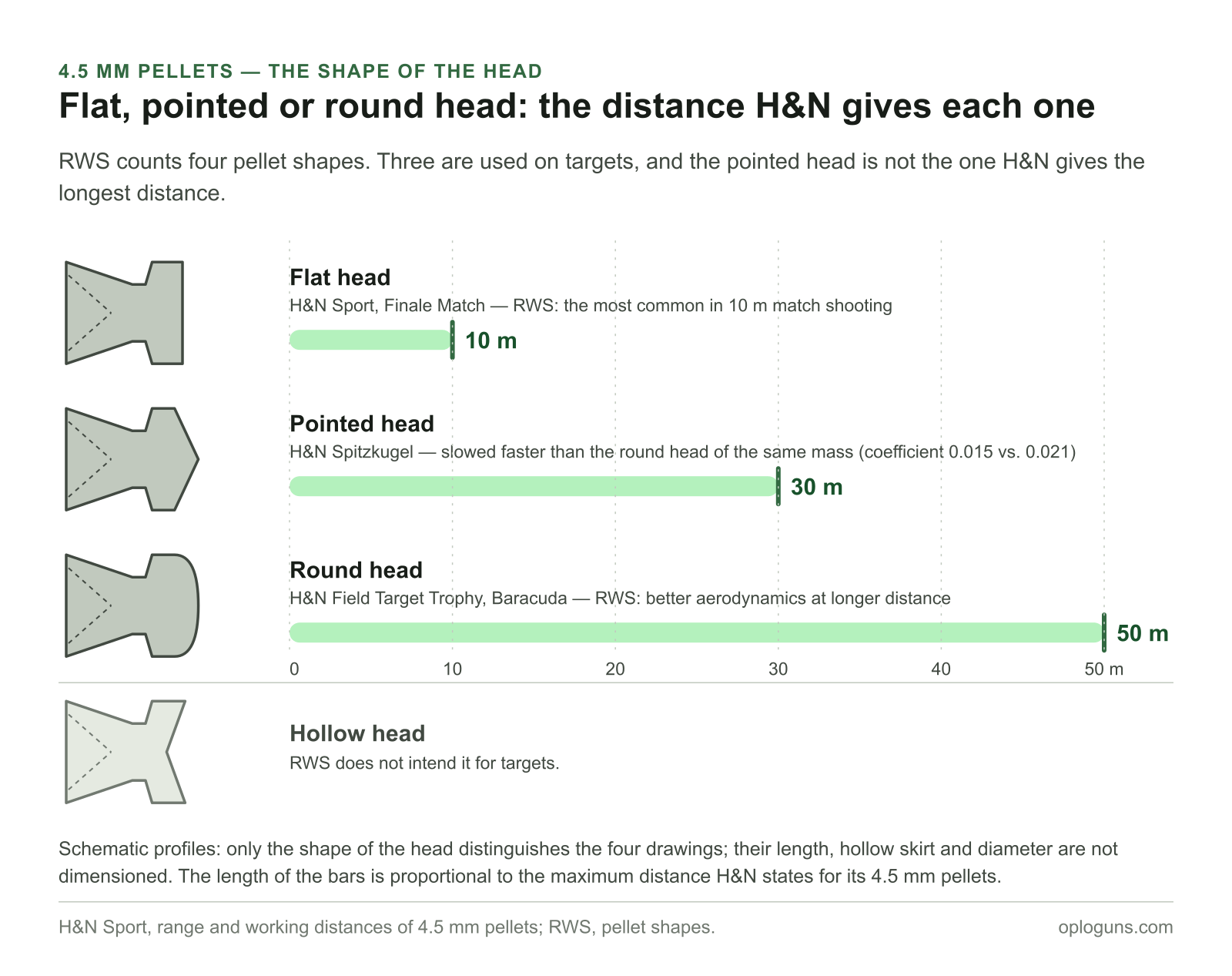
RWS counts four pellet shapes: flat head, the wadcutter; round head, the domed pellet; pointed head; hollow head7. The first three are used on targets, and H&N gives each of them a maximum distance5:
| Head | H&N pellet, 4.5 mm | Maximum distance |
|---|---|---|
| Flat | Sport, Finale Match | 10 m |
| Pointed | Spitzkugel | 30 m |
| Round | Field Target Trophy, Baracuda | 50 m |
The flat head is the one for 10 m shooting: RWS calls it the most common in match shooting7. The round head has, according to the same manufacturer, better aerodynamics for accurate shots at longer distance7.
The pointed head is a surprise. H&N presents its own as aerodynamic, and yet gives it a ballistic coefficient of 0.015, against 0.021 for its round head of the same mass5. That coefficient describes how the air slows the pellet. At 50 m, the pointed pellet is flying at only 165 m/s, the round head at 1896.
RWS intends the pointed head for plinking, a practice described in plinking: definition, guns and targets. The hollow head, which the manufacturer does not intend for targets, falls outside the subject7.
That leaves the barrel. Weihrauch says so in its manual: each gun has its own characteristics, and several kinds of pellets are worth trying14. Rested testing is described step by step in the article on 4.5 mm pellets.
4.5 or 5.5 mm: pros and cons
4.5 mm
Pros
5.5 mm
Pros
Three misconceptions about air rifle caliber
- "5.5 mm is more powerful." No: French law classifies by energy3, and Weihrauch ships the same rifle at 16.3 joules in both calibers1.
- "A 4.5 mm rifle is always in category D." No: 259 air rifles in 4.5 mm are classed in category C 4° in the Référentiel général des armes4.
- "The pointed head flies better." No, at H&N: a ballistic coefficient of 0.015 for the pointed pellet, 0.021 for the round head of the same mass5.
4.5 or 5.5 mm: the caliber for your shooting
10 m shooting, at a club or in competition
4.5 mm, the only caliber allowed, with a flat head, the shape rated for 10 m. In return, a rifle of 7.5 joules at most to compete.
Recreational shooting from 25 to 50 m
4.5 mm, with a round head: 10 cm of drop at 50 m, and the cheapest pellet. In return, fewer shots per fill than in 5.5 mm on a PCP.
Long sessions with a PCP
5.5 mm: 240 shots per fill instead of 210 at 16.3 joules. In return, 17 cm of drop at 50 m, and a pellet up to 2.3 times more expensive.
6.35 mm
A caliber whose Field Target Trophy and Baracuda pellets H&N rates for 25 joules and more. In return, at that energy, the rifle falls under French category C: a license and a declaration, described in air rifles and the 20 joules.
Caliber is only one of the criteria. The mechanism is compared in spring, gas ram, CO2 or PCP, and the model, by budget, in which air rifle to choose.
The text and the rulebook in force prevail. Article R311-2 of France's internal security code in force on 15 November 2026; ISSF rules, 2025 edition; prices of 15 November 2026. The category of a specific rifle is checked with the gun shop, and the day's price with the seller.
Sources 15 references
Velocities and shot counts taken from Weihrauch's sheets; masses, minimum energies, distances and trajectories, from H&N's sheets and calculator; rules read in the rulebooks translated by the Fédération française de tir; classification counted on the official export of the Référentiel général des armes; prices recorded at three gun shops and flagged ⚠️ as commercial data. Everything was re-read on 15 November 2026. Click a note marker in the text to highlight the matching source.
- Weihrauch — HW 100 X, Technische Daten / Technical data (PDF of 5 February 2026), re-read 15 November 2026: HW 100 X-S, 16.3 J version, 4,5 mm/.177" at 240 m/s and 210 shots, 5,0 mm/.20" at 185 m/s and 240 shots, 5,5 mm/.22" at 175 m/s and 240 shots ("Schusskapazität/Shot capacity"); 7.5 J F version, 170 m/s and 600 shots in 4.5 mm, 125 m/s and 650 shots in 5.5 mm; short HW 100 X-SK version at 16.3 J, 100 shots in 4.5 mm and 135 in 5.5 mm.
- Weihrauch — HW 97 K (sheet in German), consulted 15 November 2026: "Antrieb Federkolben" [power source: spring piston], "Kaliber 4,5 mm – 280 m/s", "5,0 mm – 215 m/s", "5,5 mm – 205 m/s", "6,3 mm – 165 m/s". The energy of these versions is not written on the sheet.
- Légifrance — article R311-2 du code de la sécurité intérieure (in French), version in force since 7 September 2025 (decree no. 2025-894 of 5 September 2025, art. 2), consulted 15 November 2026: category C, 4°, « Armes et lanceurs dont le projectile est propulsé de manière non pyrotechnique » [weapons and launchers whose projectile is propelled non-pyrotechnically] « avec une énergie à la bouche supérieure ou égale à 20 joules » [with a muzzle energy of 20 joules or more]; category D, h), same wording « avec une énergie à la bouche comprise entre 2 et 20 joules » [with a muzzle energy between 2 and 20 joules].
- Ministère de l'Intérieur, Service central des armes et explosifs — Référentiel général des armes (in French), export of 11 September 2026, counted 15 November 2026: 808 entries classed "C 4°", of which 788 of the type « Carabine à air » [air rifle]; among them, 323 in "5,5 MM AIR COMPRIME", 259 in "4,5 MM AIR COMPRIME", 123 in "6,35 MM AIR COMPRIME". The register does not list category D weapons.
- H&N Sport — pellet sheets, consulted 15 November 2026: Field Target Trophy .177, "Weight 8.64 gr", "Min. muzzle energy 5.5 ft.lbs", "Max. distance 50 m", "Bc 0.021"; .22, 14.66 gr, 12 ft.lbs, 50 m; .25, 20.06 gr, 18.5 ft.lbs, 50 m; Baracuda .177, 10.65 gr, 12 ft.lbs, 50 m; Baracuda .22, 21.14 gr, 18.5 ft.lbs, 50 m; Baracuda .25, 30.86 gr, 18.5 ft.lbs, 50 m; Spitzkugel .177, "Air gun pellet with aerodynamic design for flat trajectories", 8.64 gr, "Max. distance 30 m", "Bc 0.015"; Sport .177 and Finale Match Heavy .177, "Max. distance 10 m". On each sheet: "The ballistic coefficient (BC) describes the drag deceleration of the air gun pellet." ⚠️ Manufacturer's technical data.
- H&N Sport — ballistic calculator ("Ballistics Calculator") on the sheets for Field Target Trophy .177, .22 and .25 and Spitzkugel .177, queried 15 November 2026 in metric units, at 19.9 J, zero at 30 m, sight height "Skip", which gives a nil offset at 0 m in the tool's answer: Field Target Trophy .177, 266.6 m/s at the muzzle, 189.4 m/s and −9.65 cm at 50 m; .22, 204.7 m/s, −17.06 cm; .25, 175.6 m/s, −22.22 cm; offsets at 10 and 20 m of +1.7 to +4.1 cm; Spitzkugel .177, 165.2 m/s at 50 m. ⚠️ Manufacturer's calculation, read on the curves rendered by the tool.
- RWS — Airgun pellets, page re-read 15 November 2026: "there are now four basic shapes of 'airgun pellet'. The FLAT NOSE type is the most common form for match and sport shooting at the 10 m distance"; round head, "This shape exhibits improved aerodynamics, especially for accurate shots at longer distances"; pointed heads cited for "plinking"; hollow heads cited for a use other than targets.
- Fédération française de tir, CNS Arbitrage — Règles Carabine ISSF, édition 2025, 2e impression en vigueur au 1er juillet 2026, mise à jour du 04/07/2026 [ISSF rifle rules, 2025 edition, second print in force on 1 July 2026, update of 04/07/2026] (PDF, in French), re-read 15 November 2026: 7.4.6, 10 m rifle, caliber 4,5 mm (.177"); 7.4.4, c), « Toute carabine à air comprimé ne doit pas dépasser 7,5 joules » [no air rifle may exceed 7.5 joules].
- IMSSU, translation by the Fédération française de tir — Règlement IMSSU 2025, règlement air comprimé [IMSSU rulebook 2025, air gun rules] (PDF, in French, pp. 46-47), re-read 15 November 2026: « Munitions : Plombs de 4,5mm (177"). » [ammunition: 4.5 mm (.177) pellets]; « L'organisation de matchs air comprimé n'est pas obligatoire lors des Championnats Continentaux et Mondiaux. » [holding air gun matches is not compulsory at continental and world championships].
- Gamo — Gamo technology, page consulted 15 November 2026: "A lighter, faster and smaller caliber pellet, for instance, will produce a louder sound than a heavier, slower and higher caliber pellet." ⚠️ Manufacturer's data, with no published measurement.
- Armurerie Loisir (in French) — prices recorded 15 November 2026, sections 4.5 mm pellets, 5.5 mm pellets and PCP rifles under 20 J: H&N Sport 4.5 mm, €8.90 per 500, and 5.5 mm, €6.90 per 250; Gamo Pro Magnum 4.5 mm, €7.99 per 500, and 5.5 mm, €8.99 per 250; Swiss Arms flat head 4.5 mm, €4.90 per 500, and 5.5 mm, €3.90 per 250; Norma S-Target Match 4.5 mm, €11.10 per 500; Benjamin .25, €19.90 per 200; Snowpeak Mercury AP1000 rifles in 5.5 and in 6.35 mm "(19.9 joules)", €259.00 each; Snowpeak M25 in 7.62 mm and in 9 mm "(19.9 joules)". ⚠️ Commercial data.
- Toro Distribution — billes et plombs [BBs and pellets] (in French), prices recorded 15 November 2026: RWS Hobby 4.5 mm 0.45 g, €7.90 per 500, and 5.5 mm 0.77 g, €13.90 per 500; RWS Superpoint Extra 4.5 mm, €10.90 per 500, and 5.5 mm, €17.90 per 500; Norica Domed FT 4.5 mm, €7.90 per 500, 5.5 mm, €4.90 per 250, and 6.35 mm, €5.90 per 200; Powair flat heads 4.5 mm, €4.90 per 500, and 5.5 mm, €4.90 per 250; Gamo Match Classic 5.5 mm, €7.50 per 250. ⚠️ Commercial data.
- Armurerie Beau Repaire — PCP rifles (in French), prices recorded 15 November 2026: Snowpeak Mercury AP1000 "cal.6.35 19.9 joules" and "cal.5.5mm", €266.00 each; Snowpeak T-Rex "cal.5.5 19.9J", €243.00. ⚠️ Commercial data.
- Weihrauch — HW 100 X manual, French text (PDF, edition 10-25), re-read 15 November 2026: « Chaque arme possède ses propres caractéristiques. Afin d'obtenir les meilleurs résultats, vous devriez essayez différentes sortes de balles de forme diabolo. » [each gun has its own characteristics; to get the best results, you should try different kinds of diabolo-shaped pellets].
- Calculations: energy = mass × velocity² ÷ 2, so mass = 2 × energy ÷ velocity²: 2 × 16.3 ÷ 240² = 0.57 g; 2 × 16.3 ÷ 175² = 1.06 g; 240 − 175 = 65 m/s. 1 grain = 0.064799 g (8.64 gr = 0.56 g; 10.65 gr = 0.69 g; 14.66 gr = 0.95 g; 20.06 gr = 1.30 g; 21.14 gr = 1.37 g; 30.86 gr = 2.00 g). 1 foot-pound = 1.3558 J (5.5 ft.lbs = 7.5 J; 12 = 16.3 J; 18.5 = 25.1 J). Price per pellet: price of the tin ÷ contents; ratio of 5.5 to 4.5 mm from 1.24 (Norica Domed FT) to 2.25 (Gamo Pro Magnum); ranges of €0.010 to €0.022 in 4.5 mm, €0.016 to €0.036 in 5.5 mm, €0.030 to €0.100 in 6.35 mm; 2,400 pellets a year: €24 to €53 and €37 to €86 (€3.90 per 250, or €0.0156 × 2,400 = €37). 17.06 − 9.65 = 7.4 cm.
Frequently asked questions
PCP air rifle in 4.5 or 5.5 mm: which one should you choose?
At equal energy, 4.5 mm (.177) goes faster and drops less: Weihrauch lists 240 m/s in 4.5 mm and 175 m/s in 5.5 mm (.22) for its 16.3-joule HW 100 X. The 5.5 mm gives more shots per fill, 240 against 210 on the same rifle. A 5.5 mm pellet costs 1.2 to 2.3 times more, and 4.5 mm is the only caliber allowed in 10 m shooting.
Which caliber should you choose for an air rifle?
4.5 mm for 10 m shooting, the only caliber the ISSF rulebook allows, and for the flattest trajectory: 10 cm of drop at 50 m at 19.9 joules, against 17 cm in 5.5 mm. 5.5 mm for the number of shots per fill of a PCP. In 6.35 mm, H&N rates its Field Target Trophy and Baracuda pellets for at least 25 joules, above the French category D threshold.
Is a 5.5 mm air rifle more powerful than a 4.5 mm one?
Not as a matter of principle. French law classifies an air gun by its muzzle energy, not its caliber: from 2 to under 20 joules in category D, at 20 joules and more in category C. Both calibers are sold at 19.9 joules, and Weihrauch ships its HW 100 X at 16.3 joules in either. At equal energy, the 5.5 mm pellet leaves the muzzle slower.
Which pellet for a 20-joule air rifle?
It depends on the distance. H&N rates its flat heads for 10 m, its pointed head for 30 m, its round-head Field Target Trophy and Baracuda for 50 m. Weihrauch advises in its manual trying several kinds of pellets, each gun having its own characteristics. Some heavy pellets need more energy: at least 25 joules for the 5.5 mm Baracuda.
Which pellet for an air pistol?
In 10 m shooting, a 4.5 mm flat-head pellet, the shape H&N rates for that distance and that RWS calls the most common in match shooting. Weights, head diameters and rested testing are detailed in the article on 4.5 mm match pellets; the choice of gun, in the one on air pistols.
Are there 5.5 mm air rifles in category D in France?
Yes: 5.5 mm rifles are listed for sale at 19.9 joules, under the category C threshold. Caliber does not tell you the category: the Référentiel général des armes, France's official register of firearm models, holds 323 air rifles in 5.5 mm and 259 in 4.5 mm classed in category C 4°, in the export of 11 September 2026. The energy of a given rifle is read in its manual.
Spotted an error, or a rule that has changed since we checked? Report an error