Air rifles: spring, gas ram, CO2 or PCP?
Published on · Updated on · 12 min read · Anthony Baillon
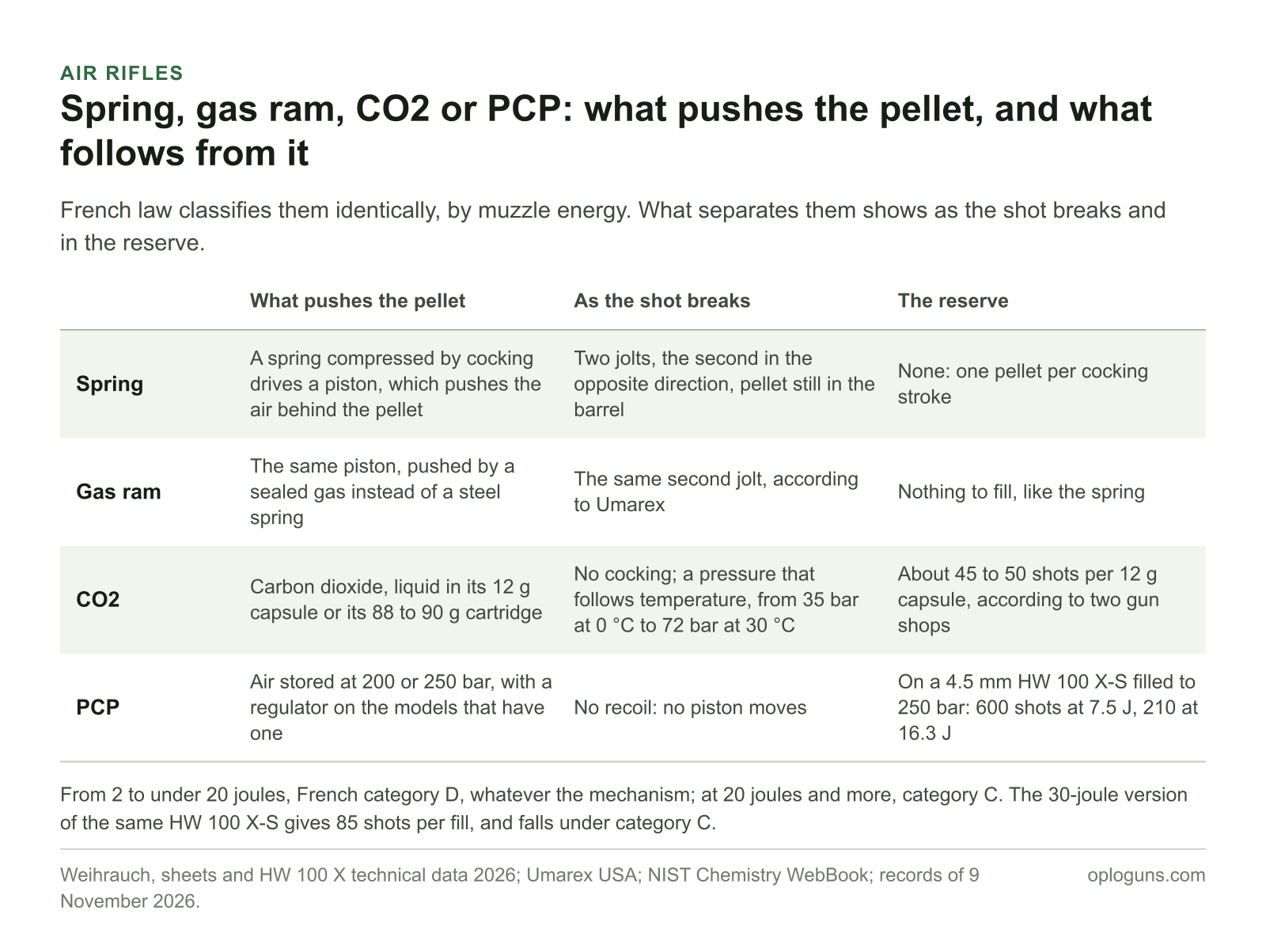
An air rifle is powered in four ways: a spring, a gas ram, a CO2 capsule or a reservoir of pre-charged air, the PCP. French law treats them identically, to the joule. What separates them: recoil, shot count, cold, and what has to be bought around the gun.
At a glance
| Mechanism | Energy source | Strength and limit |
|---|---|---|
| Spring | the shooter, at each cocking stroke | ✓ Nothing to fill ✗ A double jolt as the shot breaks |
| Gas ram | a gas sealed in the piston | ✓ No steel spring ✗ The same double jolt |
| CO2 | a capsule or a cartridge | ✓ Repeat shots without cocking ✗ Pressure tied to temperature |
| PCP | an air reservoir at 200 or 250 bar | ✓ No recoil, several hundred shots depending on power ✗ A pump or a tank on top |
- Same category: from 2 to under 20 joules, French category D, whatever the mechanism.
- Prices recorded on 9 November 2026: €99 to €129 for a spring rifle of 19 to 19.9 joules, €245 to €299 for a 19.9-joule PCP, without a pump.
Four air rifle mechanisms, and a fifth
A single manufacturer, Weihrauch, makes three of them1. Spring-piston rifles, break barrel or underlever. A gas ram rifle, the HW 90. And PCPs, the HW 100 X and HW 110.
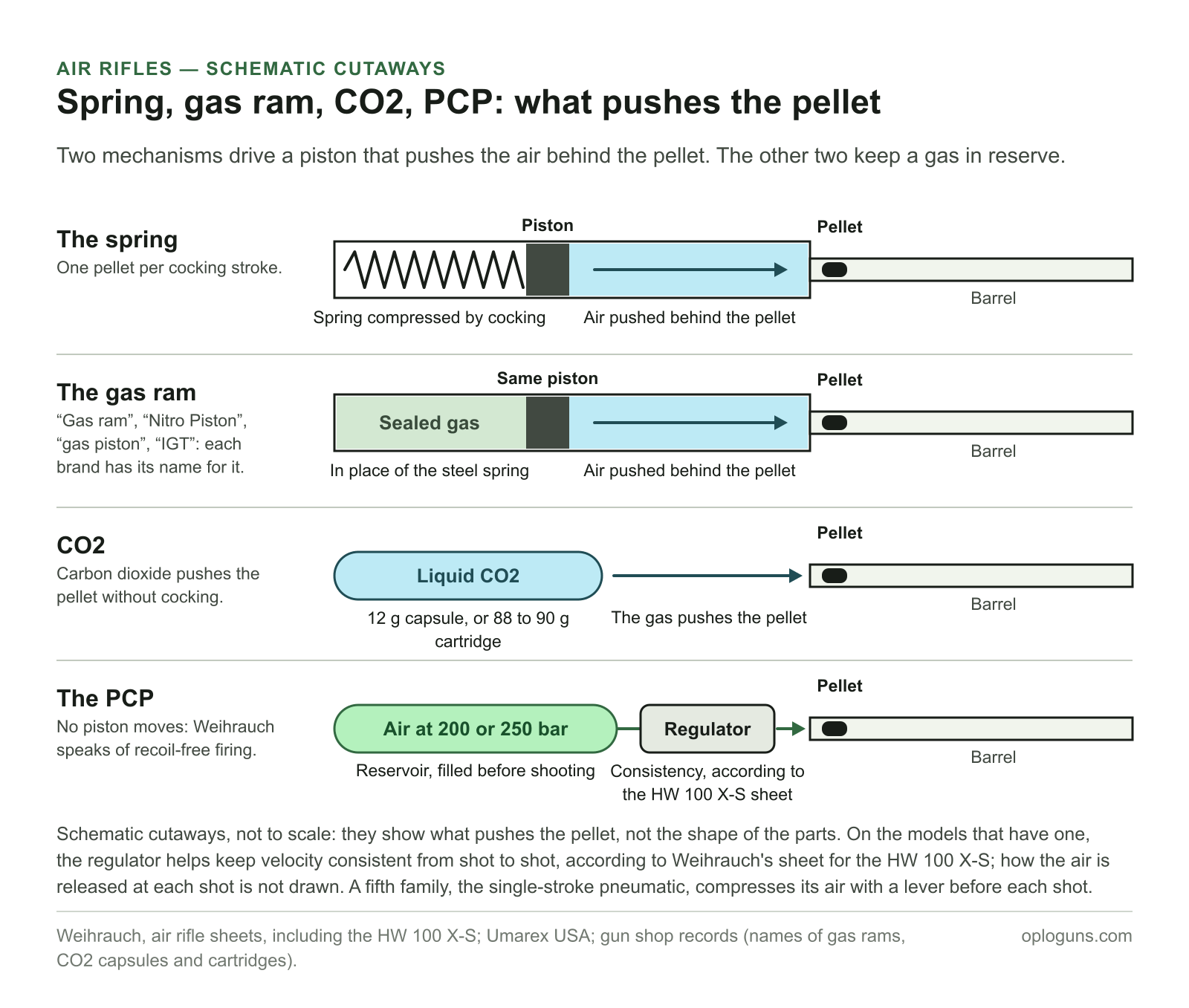
- The spring. Cocking compresses a spring; as the shot breaks, it drives a piston that pushes the air behind the pellet. One pellet per cocking stroke.
- The gas ram. The same piston, pushed by a sealed gas instead of a steel spring. Each brand has its name for it: "gas ram" at Weihrauch, "Nitro Piston" at Crosman, "gas piston" at Umarex, "IGT" at Gamo19.
- CO2. Liquid in its 12 g capsule or its 88 to 90 g cartridge, carbon dioxide pushes the pellet without cocking.
- The PCP. Air is stored in a reservoir, at 200 bar on the HW 110, at 250 bar on the HW 100 X. Both have a regulator, which Weihrauch presents, on the HW 100 X-S, as a guarantee of consistency12.
A fifth family, the single-stroke pneumatic, compresses its air with a lever before each shot. It is described, for pistols, in air pistol or air rifle for 10 m. The same mechanisms in recreational pistols are compared in air pistols: CO2, spring or PCP.
Recoil: the double jolt of the spring and the gas ram
A spring-piston rifle moves before the pellet leaves. Umarex describes two impulses. The first comes from the release of the spring and piston; the second, when the piston stops at the end of the cylinder, "in the opposite direction"3. The pellet is still in the barrel at that moment4.
Two consequences, according to the same manufacturer:
- The scope: the second impulse "can cause damage" to an ordinary optic. Scopes for spring-piston rifles brace their lenses on both sides3.
- The hold: a firm grip or a hard rest degrades accuracy. The rifle must be free to move back and forth: this is the so-called "artillery hold"4.
The gas ram does not escape it: Umarex has "spring or gas piston" rifles in mind in both cases3. Weihrauch lists for its HW 90 an integrated recoil-reduction system, and recommends a scope mount with damping elements1.
The PCP, for its part, drives no piston. Weihrauch describes the firing of its HW 100 X and HW 110 as "rückstoßfrei", recoil-free1. How many shots does a fill allow? That depends on the power.
Shot count: one per cocking, hundreds per fill
The spring-piston rifle fires one pellet per cocking stroke, with no reserve to watch. The PCP shoots for as long as its pressure allows, and Weihrauch puts figures on the effect of power on a single gun2:
| HW 100 X-S, 4.5 mm, 250 bar | Velocity | Energy | Shots per fill |
|---|---|---|---|
| F version | 170 m/s | 7.5 J | 600 |
| 16.3 J version | 240 m/s | 16.3 J | 210 |
| FAC version | 320 m/s | 30 J | 85 |
Source: Weihrauch, HW 100 X technical data 20262.
Twice the energy, a third of the shots. The 16.3-joule version is in French category D; the 30-joule one, in category C7. What caliber changes is in 4.5 or 5.5 mm.
CO2 is counted in capsules. Two gun shops list about 45 to 50 shots per 12 g capsule, without always naming the gun. One of them also lists around fifty shots for the 90 g cartridge of a Sig Sauer MCX rifle1012.
Consistency: a springer and a PCP on the chronograph
Consistency does not depend on the mechanism alone. Two British press reviews, by the same reviewer and at similar power, measured it1415:
| Gun Mart review, 4.5 mm | Measurement | Velocity spread |
|---|---|---|
| HW 97 K, spring, 15.5 J | 10 shots, 238 m/s on average | 1.8 m/s (6 fps) |
| HW 100 FSB KT, PCP, 15.6 J | 57 shots from 200 bar, 233 m/s | 4.6 m/s (15 fps) |
British versions, under 12 ft-lb; one gun, one reviewer, different pellets.
Over ten shots, the spring-piston rifle stayed within 1.8 m/s; the PCP, within 4.6 m/s over fifty-seven shots in a row on a single fill. An American filmed test points the same way, in 5.5 mm and at American power. In 2019, the Shooting Gear Reviews channel chronographed five shots from a spring-piston Sig ASP20 between 872 and 879 ft/s (266 to 268 m/s). Five shots from a regulated Umarex Gauntlet PCP, lightly modified, came in between 921 and 937 ft/s (281 to 286 m/s), after a faster first shot, the gun having warmed up in the sun17. The HW 97 K grouped its pellets into about 10 mm at 30 yards, or 27 m14. That leaves the question of carbon dioxide, which cannot be set by a pressure regulator.
CO2 and temperature: pressure doubles from 0 to 30 °C
The CO2 in a capsule is liquid. As long as some remains, its pressure depends on temperature, not on quantity. It is 35 bar at 0 °C, 45 bar at 10 °C, 57 bar at 20 °C, 72 bar at 30 °C5. Between a winter morning and a summer afternoon, the force pushing the pellet more than doubles. What counts as a fault, and what does not, is in an air rifle that no longer shoots.
These pressures remain far from the 200 to 250 bar of a PCP reservoir1. The CO2 pellet rifles recorded on sale develop 4.9 to 7.8 joules; the spring-piston and PCP rifles in the same sections go up to 19.9 joules1112.
CO2 therefore lends itself to recreational shooting in strings. Its repeat shots without cocking have a price per shot, which can be calculated.
Air rifle cost per shot: from gas to the pump
Pellets aside, each mechanism has its running cost.
| Mechanism | To buy on top | Price recorded |
|---|---|---|
| Spring, gas ram | nothing | — |
| CO2, 12 g capsule | one capsule every 45 to 50 shots | €0.49 to €1.09 per capsule |
| PCP | a hand pump, once | €50 to €340 |
Prices recorded on 9 November 2026101213.
At 45 to 50 shots per capsule, the gas comes to 1 to 2.4 cents a shot. The PCP shifts the expense: the pump is bought once, then every fill costs pump strokes. The presenter of Shooting Gear Reviews counts about 150 of them to bring his Gauntlet back up to pressure after some 70 shots17. The tank and the compressor, their price and their upkeep are compared in filling a PCP: pump, tank or compressor. The price of match pellets is in choosing 4.5 mm pellets.
Weight: from 2,500 to 4,000 g at a single manufacturer
The mechanism weighs in the balance. At Weihrauch12:
- HW 30 S, spring and break barrel: 2,500 g, 985 mm.
- HW 97 K, spring and underlever: 4,000 g, 300 mm fixed barrel.
- HW 90, gas ram: 4,000 g.
- HW 100 X-S, PCP, 16.3 J version: 3,300 g with a wooden stock.
Between the two spring-piston rifles, a gap of 1,500 g: the weight of a one-and-a-half-liter bottle of water. So the mechanism alone does not set the weight; the 16.3-joule PCP sits between the two.
Air rifles at 10 m: what the ISSF allows
The ISSF rulebook imposes no mechanism. In 10 m air rifle, it allows "any type of compressed air or gas rifle", with three limits6:
- 7.5 joules at most, with the F mark in a pentagon.
- 850 mm at most for the system, from the rear of the mechanism to the muzzle.
- No optics on the rifle.
A recreational rifle at 19.9 joules therefore exceeds that cap by more than double. In competition, any air or CO2 cylinder must stay within the manufacturer's validity date, ten years at most6. The choice of match rifles is detailed in air pistol or air rifle for 10 m, and the event in getting started in 10 m air rifle.
Spring, gas ram, CO2 or PCP: pros and cons
New prices recorded on 9 November 2026 at two French gun shops, rifle alone.
The spring-piston rifle
| Model | Energy | New price recorded |
|---|---|---|
| Umarex R-Force One, 4.5 mm | 19.9 J | €99 to €1001112 |
| Umarex R-Force Wood, 4.5 mm | 19 to 19.9 J | €126 to €1291112 |
Pros
- Nothing to fill: no pump, no capsule.
- The lowest entry price at 19.9 joules.
- Power that does not depend on the weather.
The gas ram rifle
| Model | Energy | New price recorded |
|---|---|---|
| Crosman Shockwave NP, 4.5 mm, with 4x32 scope | 19.9 J | €169 to €1891112 |
Pros
- Nothing to fill, like the spring.
- A shorter lock time and reduced recoil, according to Weihrauch for its HW 901.
Cons
- The same second impulse as the spring, according to Umarex3.
- More expensive than a spring of the same energy in the records.
The CO2 rifle
| Model | Energy | New price recorded |
|---|---|---|
| Sig Sauer MCX CO2, 4.5 mm, 30-round magazine | about 7 J | €295 to €3391112 |
Lever-action rifles and Western replicas are covered in the lever-action air rifle.
Pros
The PCP rifle
| Model | Energy | New price recorded |
|---|---|---|
| Snowpeak T-Rex, 4.5 mm | 19.9 J | €245 to €2461112 |
| Stoeger XM1, 4.5 mm | 19.9 J | €295 to €2991112 |
Pros
- No recoil: no piston moves1.
- Hundreds of shots per fill at low power: 210 at 16.3 joules on the HW 100 X2.
- The mechanism of 10 m match rifles, compared in the article on 10 m.
Same category for every air rifle mechanism
France's code de la sécurité intérieure, the internal security code, names neither the spring, nor CO2, nor air. It covers weapons whose projectile is propelled « de manière non pyrotechnique » [non-pyrotechnically]: from 2 to under 20 joules, category D; at 20 joules and more, category C7. A 19.9-joule spring-piston rifle and a 19.9-joule PCP have the same status.
Hunting is closed to all of them. For any game, and for the destruction of animal species classed as liable to cause damage, the arrêté (ministerial order) of 1 August 1986 prohibits « l'emploi des armes à air ou gaz comprimé dénommées aussi armes à vent » [the use of air or compressed-gas guns, also called wind guns]8. Age, transport and the thresholds at 2 and 20 joules are detailed in air rifles and the 20 joules.
Three misconceptions about air rifles
- "A PCP is more powerful than a spring-piston rifle." Not in category D: both are sold up to 19.9 joules1112, and French law classifies them at the same threshold7.
- "CO2 is compressed air like any other." It is liquid in its capsule, and its pressure follows temperature, from 35 bar at 0 °C to 72 bar at 30 °C5.
- "The gas ram does away with the spring's recoil." Umarex puts the spring and the gas ram in the same case: a second impulse, in the opposite direction3.
Air rifles: the mechanism for your use
The choice of model, by budget and by distance, is in which air rifle to choose.
Shooting at the club, with no accessories
The spring-piston rifle, from €99 at 19.9 joules, or the gas ram. In return, a loose hold to learn and a scope made for this two-way movement. Where to shoot is in recreational shooting.
Shooting strings, for fun
CO2 gives repeat shots without cocking, at 1 to 2.4 cents a shot in gas. In return, an energy of 4.9 to 7.8 joules in the records, and a pressure that drops with the cold. Magazine-fed rifles are compared in the magazine-fed air rifle.
Accuracy at 19.9 joules
The PCP, at €245 to €299 in the records, without recoil. In return, a pump at €50 to €340, and a pressurized reservoir.
Competition at 10 m
A match rifle under 7.5 joules, running on pre-charged air in the models compared separately. In return, a cylinder valid for ten years at most, and a license to compete.
The text in force prevails. France's internal security code and the arrêté of 1 August 1986 as they stood on 9 November 2026; ISSF rules in force since 19 October 2026. Specifications are the manufacturers'; the energy of a specific gun is read in its manual, and the day's price is checked with the gun shop.
Sources 17 references
The guns' specifications come from the manufacturers' sheets; the pressure of CO2, from a reference table; rules, from the ISSF rulebook and from the texts re-read on Légifrance in their version in force. The prices and energies listed on sale were recorded on 9 November 2026 and are flagged ⚠️ as commercial data. Click a note marker in the text to highlight the matching source.
- Weihrauch — air rifle sheets (German text), consulted 9 November 2026: HW 30 S, "Gewicht 2,50 kg", "Gesamtlänge 985 mm", "Lauflänge 395 mm", "4,5 mm – 190 m/s"; HW 97 K, cocking lever under the barrel, "Starrlauf-System", "Antrieb Federkolben", "Gewicht 4,00 kg", "Lauflänge 300 mm", "4,5 mm – 280 m/s"; HW 90, "High-Tech-Luftgewehr mit Gaskolbenprinzip (Theoben gas ram)", "Die äußerst kurze Schussentwicklungszeit, das integrierte System zur Rückstoßreduzierung", "Dampa Mount" scope mount recommended, "Gewicht 4,00 kg"; HW 100 X-S, "Pressluft – 250 bar", "mit Regulator", "rückstoßfreie Schussabgabe", re-read 16 November 2026: "Neugestalteter Regulator mit besserer Konstanz"; HW 110 S, "Pressluft – 200 bar", "mit Regulator", "rückstoßfreie Schussabgabe"; accessories, "Dampa Mount", "Zielfernrohr-Montage einteilig: mit Dämpfungselementen - speziell auch für das Luftgewehr HW 90".
- Weihrauch — HW 100 X, Technische Daten / Technical data (PDF, 2026), re-read 9 November 2026: HW 100 X-S, FAC, 16.3 J and F versions; weight with wooden stock 3.6, 3.3 and 3.3 kg; in 4.5 mm, 320 m/s and 30 J for 85 shots, 240 m/s and 16.3 J for 210 shots, 170 m/s and 7.5 J for 600 shots ("Shot capacity").
- Umarex USA — "What Kind of Scope Can I Put on my Spring or Gas Piston Air Rifle?", 28 March 2024, re-read 9 November 2026: "The first impulse comes from the release of the spring and piston assembly"; "The second impulse occurs when the piston assembly comes to a stop at the end of the cylinder"; "the second impulse is going in the opposite direction of the first recoil impulse"; "It is this impulse that can cause damage to your optic"; scopes designed for these rifles, with glass elements braced on both sides.
- Umarex USA — "Are Spring and Gas Piston Air Rifles Inaccurate?", 3 April 2024, re-read 9 November 2026: inaccuracy among those who shoot "from a hard rest or by gripping the stock and handguard too firmly"; "While the pellet is still in the barrel, the piston assembly comes to a very sudden and abrupt halt"; the so-called "artillery hold", which "lets the rifle move backward and forward as the impulse forces dictate".
- NIST Chemistry WebBook — saturation properties of carbon dioxide, table consulted 9 November 2026: saturated vapor pressure of 34.85 bar at 0 °C, 45.02 bar at 10 °C, 57.29 bar at 20 °C and 72.14 bar at 30 °C.
- ISSF — ISSF Rule Book, Edition 2025, Third Print 10/2026 (PDF), in force since 19 October 2026, re-read 9 November 2026: 7.4.4, "Any type of compressed air or gas rifle that conforms to the specifications in the Rifle Measurements Table"; a) system of "850mm" at most; c) "Any Air Rifle must not exceed 7.5 joule and must bear this mark"; 7.4.1.6 a, no optics on the rifle; 6.7.6.2 h, "any air or CO2 cylinder is within manufacturer's validity date (maximum of ten (10) years)".
- Légifrance — article R311-2 du code de la sécurité intérieure (in French), version in force on 9 November 2026, re-read that day: category C, 4°, « Armes et lanceurs dont le projectile est propulsé de manière non pyrotechnique avec une énergie à la bouche supérieure ou égale à 20 joules » [weapons and launchers whose projectile is propelled non-pyrotechnically with a muzzle energy of 20 joules or more]; category D, h), same wording « avec une énergie à la bouche comprise entre 2 et 20 joules » [with a muzzle energy between 2 and 20 joules].
- Légifrance — arrêté du 1er août 1986 relatif à divers procédés de chasse (in French), version in force on 15 November 2026, re-read 15 November 2026: article 1, « Sont interdits pour la chasse de tout gibier et pour la destruction des espèces d'animaux classées susceptibles d'occasionner des dégâts » [the following are prohibited for hunting any game and for destroying animal species classed as liable to cause damage] […] « l'emploi des armes à air ou gaz comprimé dénommées aussi armes à vent » [the use of air or compressed-gas guns, also called wind guns].
- Armurerie Beau Repaire — air rifles from 10 to 20 joules (in French), recorded 9 November 2026: product names "Umarex R-force target gas piston", "Umarex R-force xtrem gas piston", "Crosman SHOCKWAVE NITRO PISTON", "GAMO swarm maxxim igt". ⚠️ Commercial data.
- ABC Shootings — plombs [pellets] (in French), recorded 9 November 2026: « Capsule de CO² 12gr. Autonomie avec 1 capsule environ 45 plombs » [12 g CO2 capsule; about 45 pellets per capsule], €1.09. ⚠️ Commercial data; shot count stated by the seller, with no gun specified.
- Armurerie Beau Repaire (in French) — prices recorded 9 November 2026, sections under 10 joules, 10 to 20 joules and PCP: Umarex R-Force One 19 J €99.00; Umarex R-Force Wood 19 J €126.00; Crosman Shockwave Nitro Piston with 4x32 scope €169.00; Sig Sauer MCX CO2 4.5 mm €295.00; Snowpeak T-Rex PCP 4.5 mm 19.9 J €245.00; Stoeger XM1 4.5 mm 19.9 J PCP €299.00; spring-piston and PCP rifles sold at 19.9 J (Artemis SR1000S, Crosman Vital Shot, Crosman Discovery, Gamo Arrow…); Sig MPX 4.5 mm CO2 pellet rifle at 4.9 J. ⚠️ Commercial data.
- Armurerie Loisir (in French) — prices recorded 9 November 2026, sections air rifles, CO2 rifles, PCPs under 20 J, CO2 cartridges and PCP pumps: Umarex R-Force One 19.9 J, « piston-ressort » [spring-piston], €99.90; R-Force Wood 19.9 J, « mécanisme à ressort » [spring mechanism], €129.00; Crosman Shockwave NP 19.9 J, with Center Point 4x32 scope, €189.00; Sig Sauer MCX CO2 7.3 J, 90 g cartridge « opérationnelle pour une cinquantaine de coups » [good for around fifty shots], about 7 joules, €339.00; Crosman 1077 CO2, 7.8 J, « chaque cartouche CO2 a une capacité d'environ 50 coups » [each CO2 cartridge has a capacity of about 50 shots] (12 g); CO2 pellet rifles in the section from 6.7 to 7.8 J (Sig Sauer MPX 6.7 J, MCX 7.3 J, Crosman 1077 7.8 J); Snowpeak T-Rex PCP 4.5 mm 19.9 J €246.00; Stoeger XM1 PCP 4.5 mm 19.9 J €294.90; 12 g CO2 capsules from €7.40 per 10 to €49.00 per 100, « une cinquantaine de coups » [around fifty shots] per capsule according to the section; PCP pumps from €49.90 (multi-brand 310 bar, on promotion, struck-through price €89.90) to €339.90 (Gamo 200 bar). ⚠️ Commercial data.
- Armurerie de Strasbourg (Recht) — cartouches à air [air cartridges] (in French), recorded 9 November 2026: 12 g CO2 capsule from €0.99; same day, Armurerie Auxerre, high-pressure pumps (in French), from €119.00 (Powair, 3-stage 200 bar pump) to €324.45. ⚠️ Commercial data.
- Gun Mart — Mark Camoccio, Weihrauch HW97K Blue Laminate review, 15 March 2018, re-read 9 November 2026: .177 caliber, 10-shot string over the chronograph, average of 781 fps, spread of 6 fps, Air Arms Diabolo Field, 11.4 ft-lb; groups at 30 yards of "3/8” with the Diabolos, and JSB Exacts", about 1/4 inch with Webley Accupells. British version. ⚠️ Specialist press: one gun, one reviewer.
- Gun Mart — Mark Camoccio, Weihrauch HW100 FSB KT review, 27 January 2017, re-read 9 November 2026: .177 caliber, filled to 200 bar, "Spread – 15 fps (over 57 shots)", average of 765 fps (770 at most, 755 at least), Weihrauch F&T pellets, 11.5 ft-lb. British version. ⚠️ Specialist press: one gun, one reviewer.
- RWS — .22 l.r. R-50 sheet, consulted 9 November 2026: "V0 330 m/s", "E0 142 J", 2.6 g bullet, 650 mm barrel. Bottle calculation: 2 kg × 9.81 m/s² × 1 m = 19.6 J.
- Shooting Gear Reviews, YouTube — "PCP VS Break Barrel - Which AIRGUN Should You BUY?", 22 October 2019, transcript re-read 9 November 2026: break-barrel Sig ASP20 and regulated Umarex Gauntlet PCP, "modded just a little bit", both in .22 (0:47); Gauntlet, first shot at 949 ft/s, gun warmed by the sun, then "923 937 930 921 923" (9:14, 9:41); ASP20 with RWS Hobby pellets, "875 875 872 879", then 878 (10:55); "about 150 pumps to top it back off" after "70 shots or so" (16:22). American versions, energy not given. ⚠️ Filmed test: one gun, one shooter.
Frequently asked questions
Spring-piston or PCP air rifle: which one should you choose?
It depends on the use. The spring-piston rifle is self-sufficient, one shot per cocking stroke, from around a hundred euros at 19.9 joules. The PCP fires several shots per fill with no noticeable recoil, but needs a pump, a tank or a compressor. French law classifies them the same way: category D from 2 to under 20 joules.
CO2 or PCP: what is the difference?
CO2 is liquid in its capsule, and its pressure follows temperature: about 35 bar at 0 °C, 57 bar at 20 °C, 72 bar at 30 °C. The air in a PCP is stored at 200 or 250 bar; on the models that have one, the regulator helps keep velocity consistent from shot to shot. The CO2 pellet rifles recorded on sale develop 4.9 to 7.8 joules; PCPs go up to 19.9 joules.
How many shots from a PCP air rifle?
It depends on the power. Weihrauch lists for its HW 100 X in 4.5 mm, filled to 250 bar: 600 shots at 7.5 joules, 210 at 16.3 joules, 85 at 30 joules. A spring-piston rifle, for its part, fires one shot per cocking stroke, with no reserve to run out.
Does a spring-piston air rifle damage a scope?
It can, according to Umarex: the piston, stopping at the end of the cylinder, creates a second impulse in the opposite direction to the first, and that is the one that can damage the optic. Gas ram rifles are subject to it too. Some scopes and mounts are designed for this two-way movement.
Is 20 joules a lot?
For an air gun, it is the threshold of French category C. It is roughly the energy of a two-liter bottle dropped from one meter, about a seventh of an RWS R-50 .22 LR cartridge at the muzzle (142 J), and nearly three times the 7.5-joule cap of the 10 m air rifle in competition.
What is the best air rifle brand?
None is as a matter of principle: most brands cover several mechanisms, and Weihrauch makes three, spring, gas ram and PCP. The mechanism and the power separate rifles more than the name does: recoil, shot count, sensitivity to cold and filling equipment change from one family to the next.
At what distance do you shoot an air rifle?
In ISSF competition, at 10 m. For recreation, British press reviews shoot groups at 30 yards, or 27 m: about 10 mm for a 15.5-joule spring-piston Weihrauch HW 97 K, tested by Gun Mart in 2018 with two brands of pellets.
Which air rifle for 10 m shooting?
The ISSF rulebook allows any compressed air or gas rifle, up to 7.5 joules, 5.5 kg and 850 mm of system length, without optics. The match rifles on sale run on pre-charged air; a recreational rifle at 19.9 joules exceeds the 7.5-joule cap.
Spotted an error, or a rule that has changed since we checked? Report an error