Filling a PCP rifle or pistol: pump, tank or compressor
Published on · 10 min read · Anthony Baillon
A PCP (pre-charged pneumatic) rifle or pistol is filled in three ways: with a hand pump, from a scuba or carbon-fiber tank, or with a compressor. The working pressure decides the equipment: 200 bar at Feinwerkbau and Steyr, 300 bar for the Hämmerli AR20. A pump costs €79 to €340, a compressor €399 and up.
At a glance
| Solution | Purchase | Limit |
|---|---|---|
| Hand pump | €79 to €340 | Effort, heat, moisture |
| Tank | Fill station from €79 to €249, plus the tank | Refills and periodic inspections |
| Compressor | €399 to €1,099 | Dry, oil-free air to guarantee |
- The rule that never moves: never exceed the cylinder's maximum pressure, engraved on it and written in the manual.
- The cylinder itself: ten years at most, at most manufacturers.
Fill pressure: 200 or 300 bar depending on the gun
A misread figure costs a cylinder, or worse. Feinwerkbau forbids using or storing its reservoirs above 200 bar1. Steyr sets the same limit and warns: its cylinders are tested at 300 bar, which is why the gauge is graduated up to 300, but the working pressure remains 200 bar23.
Other guns go higher:
- Hämmerli AR20: 300 bar at most, « en aucun cas » [under no circumstances] beyond4.
- Walther rifle cylinders: sold for 300 bar5.
- Weihrauch: 200 bar for the HW 100, 101, 110 and HW 44, 250 bar for the HW 100 X6.
Two hundred bar is two hundred times atmospheric pressure, in a cylinder that fits in the hand. Filling equipment is therefore chosen by the highest pressure to be reached. A pump or compressor limited to 200 bar will never fill an AR20 to 300. Choosing the gun by its pressure is covered in choosing an air pistol or air rifle.
Pump, tank or compressor: three ways to fill
The cylinder connects to the air source through an adapter specific to each brand, €26 to €69 at French gun shops578. Steyr lists the three possible sources: tank, hand pump or compressor2.
The hand pump
A pump you work standing up, braced on your legs. The Hill MK5 manual advises keeping the back straight and flexing the knees, for long, steady strokes. It also warns that the force required rises with the pressure, and that the pump body heats up: the manual then asks you to stop and let it cool9.
Pros
Steyr gives one piece of practical advice: do not wait until the cylinder is empty to fill it, since pumping is then shorter and less tiring3.
The scuba or carbon-fiber tank
A large tank, filled by a compressor, serves as a reserve. You screw the cylinder onto it through an adapter and open the valve: Walther states about five seconds for the AR20, then the valve is closed again4. The tank empties as it goes, and its pressure drops: it fills to 200 bar only as long as it stays above that.
Steyr puts figures on what a 10-liter tank filled to 300 bar gives3:
| Steyr cylinder | From empty | From a reserve |
|---|---|---|
| Pistol | 75 fills | 113, from 70 to 200 bar |
| Rifle, short cylinder | 25 fills | 62, from 140 to 200 bar |
| Rifle, long cylinder | 18 fills | 45, from 140 to 200 bar |
The compressor
An electric compressor brings the cylinder up to pressure on its own. The models sold for PCP airguns run from 200 to 320 bar, from €399 to €1,0991011. Above that, Bauer compressors, at 330 bar, cost €3,289 to €7,79010.
Pros
- Self-sufficient and effortless, once the machine is bought.
- Models at 300 bar and above, for the guns that need it10.
Scuba tank: inspection and requalification
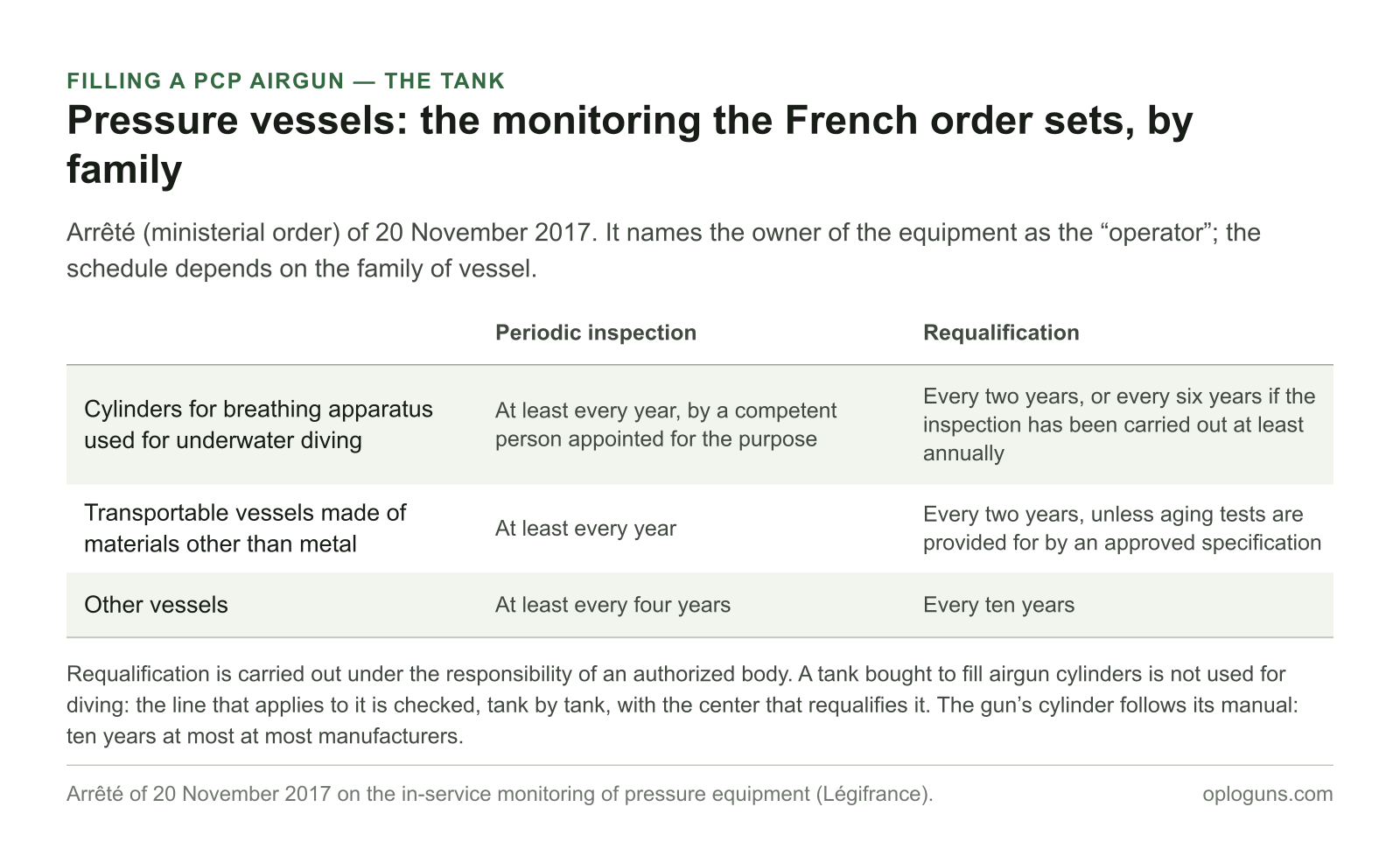
A scuba tank is pressure equipment. In France, the arrêté (ministerial order) of 20 November 2017 sets how it is monitored, and names as « exploitant » [operator] the owner of the equipment12.
For « bouteilles pour appareils respiratoires utilisées pour la plongée subaquatique » [cylinders for breathing apparatus used for underwater diving], the text provides for12:
- A periodic inspection at least every year, by a competent person appointed for the purpose.
- A requalification every two years, or every six years if the periodic inspection has been carried out at least annually.
- An authorized body, under whose responsibility the requalification is carried out.
Transportable vessels « en matériaux autres que métalliques » [made of materials other than metal] follow the same one-year and two-year rhythm, unless aging tests are provided for by an approved specification12. For other vessels, the inspection takes place at least every four years and the requalification every ten years12.
A tank bought to fill airgun cylinders is not used for diving. The line that applies to it is therefore checked, tank by tank, with the center that requalifies it.
Moisture in compressed air: the filter and the bleed
Water damages a cylinder from the inside. Feinwerkbau accepts only air « exempt d'huile et d'eau » [free of oil and water], compliant with the DIN EN 12021 standard for breathing air1. For the AR20, Walther asks for air compliant with the DIN 3188 standard, also the one for breathing air4.
Three steps reduce moisture:
- A filter or dry kit on the pump. It costs about thirty euros: €259 for the Hill pump without filter, €289 with7; €267 for the AHG 8300, €298 for the 8301 with its dehumidifier kit5.
- The bleed. After filling, Steyr has you unscrew the cylinder three quarters of a turn, no more. The bleed screw is then opened to drain the water from the pump3.
- The drying cartridge changed on time: every three to four months in use, and at once if moisture shows at the bleed9.
Steyr in fact ranks the pump among the back-up solutions, because of that little moisture it always lets in3.
PCP filling safety: seven steps
- Read the maximum pressure on the cylinder and in the manual, and never exceed it12.
- Check the cylinder's date: ten years after manufacture, Feinwerkbau and Steyr have it emptied and withdrawn, and Walther has it checked or replaced124.
- Examine the cylinder before each use: at the slightest crack, empty it and never fill it again61.
- Screw the cylinder in by hand, without tools, the gun pointed in a safe direction24.
- Read the gauge with the gun unloaded and uncocked, never during filling1.
- Release the pump's pressure through its bleed screw before disconnecting9. An unscrewed cylinder, for its part, stays under pressure4.
- Store the cylinder with a little air, below 50 °C, and hand it to an airline or the post office only when empty341.
No one but the manufacturer repairs a cylinder, its valve or its gauge16. Transporting the gun itself follows its own rules, recalled in the pellet rifle and the 20 joules. The other failures of an airgun, a stuck pellet or a leak, are in a pellet rifle that no longer shoots.
What each PCP filling solution costs
Prices recorded on 4 November 2026:
| Solution | First year | Following years |
|---|---|---|
| Hand pump | €79 to €340107511 | Grease, seals, drying cartridge |
| Tank and fill station | Fill station from €79 to €24910, plus the tank | Refills, annual inspection and requalification of a scuba tank |
| Compressor for PCP airguns | €399 to €1,0991011 | Filters and oil depending on the model |
| Bauer compressor, 330 bar | €3,289 to €7,79010 | €34.90 per filter cartridge, €49.90 per liter of oil10 |
Two items come on top of every solution. The fill adapter, €26 to €69 depending on the brand578. And the gun's cylinder, to be replaced after ten years: €159 to €375 depending on the brand85.
How often you fill depends on the cylinder. Feinwerkbau lists 160 shots at 200 bar with the long cylinder of its P 8X pistol, 100 with the short cylinder13: enough to shoot a 60-shot match and its sighters before filling. The season's other items, license and club included, are costed in getting started in 10 m air pistol and getting started in 10 m air rifle.
Three misconceptions about PCP filling
- "If the pump goes to 300 bar, so does the cylinder." No: Feinwerkbau and Steyr stop their cylinders at 200 bar and forbid going beyond, even though the Steyr gauge is graduated up to 30013.
- "Nitrogen or helium will do just as well." No, Steyr answers: clean, dry compressed air, nothing else3.
- "A cylinder is stored empty." No: Steyr advises storing it with a little air, otherwise condensation can form3.
Pump, tank or compressor, depending on how you shoot
One shooter, one pistol or rifle at 200 bar
A hand pump is enough to fill a cylinder that gives a match between two fills, for €79 to €340. In return, the effort at every fill, and a little moisture that a bleed and a filter limit without removing it.
A rifle at 300 bar
A pump rated for 300 bar and above, such as the Hill MK5 at 315 bar, or a 300-bar compressor. In return, the hardest effort at the end of the stroke with the pump, and €399 at least for the compressor.
Several shooters, or a club
A tank and its fill station, or a 330-bar compressor. In return, the periodic inspections of a scuba tank, or €3,289 and more for a Bauer compressor.
The pellet that will leave that cylinder is chosen, for its part, by a test at 10 m: see choosing and testing 4.5 mm pellets. And if the choice of PCP is not yet made, it is compared with spring and CO2 in pellet rifle: spring, gas ram, CO2 or PCP, and the PCP rifle itself, regulator and bullpup included, in choosing a PCP rifle.
Sources 13 references
Pressures and instructions taken from the manufacturers' manuals and pages; tank monitoring rules read on Légifrance in the version in force; prices recorded at several gun shops, flagged ⚠️ as commercial data. Click a reference number in the text to highlight the matching source.
- Feinwerkbau — Informations du fabricant sur la manipulation des réservoirs d'air comprimé [manufacturer's information on handling compressed-air reservoirs] (PDF, French text included), reread 4 November 2026: reservoirs « pas » to be used « plus de 10 ans » [not for more than 10 years]; filling with « de l'air comprimé exempt d'huile et d'eau » [compressed air free of oil and water] at « une pression maximale de 200 bars (DIN EN 12021 - air respirable) » [a maximum pressure of 200 bar (DIN EN 12021 - breathing air)], « en aucun cas » [under no circumstances] used or stored beyond; surface not to be engraved; repairs, valves and gauges reserved for the manufacturer; reservoirs that leak, are damaged or are more than 10 years old « vidés sans danger » [emptied safely]; fill indicator checked « uniquement lorsque l'arme est déchargée et est détendu - en aucun cas pendant que le réservoir d'air comprimé est rempli » [only when the gun is unloaded and uncocked - under no circumstances while the compressed-air reservoir is being filled]; « Seuls les réservoirs d'air comprimé non remplis peuvent être transportés dans les avions, lors d'envois postaux » [only unfilled compressed-air reservoirs may be carried on aircraft or sent by post].
- Steyr Sport — EVO 10 E and EVO 10 E Compact manual (PDF, English), reread 4 November 2026: "Maximum filling pressure 200 bar"; "The compressed-air cylinders must be emptied and safely disposed of 10 years after production date"; "the compressed air cylinder must by screwed fully into place by hand only. No tools may be used"; recharging "on a recharging bottle", "on a hand pump" or "on a compressor". ⚠️ Manual hosted by a retailer, not by the manufacturer.
- Steyr Sport — FAQ General, reread 4 November 2026: filling "with a filling cylinder", "with a compressor", "with a hand pump"; "We would suggest the pump as an addition to the above-mentioned filling methods, because there can always be a little humidity in the cylinder. Even if you handle everything with care and pump with a dry kit"; "Do not fire the weapon until the air cylinder is totally empty. In this way, pumping does not take as long or require as much effort"; after filling, cylinder unscrewed "just a ¾" turn, then bleed screw opened "to allow water to drain out of the pump"; "All STEYR compressed air cylinders are checked with 300 bars. That´s why the manometer goes up to 300 bars. The working pressure is 200 bars!"; from a 10-liter tank at 300 bar: pistol cylinder 113 times from 70 to 200 bar and 75 times from 0 to 200 bar, long rifle cylinder 45 and 18 times, short cylinder 62 and 25 times; "Can I use helium or nitrogen to fill up my air cylinder? No, please use clean and dry compressed air only"; "store it with a little air remaining, otherwise condensed water could arise".
- Walther, for Hämmerli — mode d'emploi AR20 [AR20 operating instructions] (PDF, French text included), reread 4 November 2026: « La pression de remplissage maximale s'élève à 300 bar et ne doit en aucun cas être dépassée » [the maximum fill pressure is 300 bar and must under no circumstances be exceeded]; « ouvrez la soupape de la bouteille pendant env. 5 secondes puis refermez-la » [open the tank valve for about 5 seconds, then close it again]; « Le réservoir reste sous pression même une fois qu'il a été dévissé de la carabine ! » [the reservoir stays under pressure even once it has been unscrewed from the rifle]; gun « pointée dans une direction sûre » [pointed in a safe direction] to screw in the cartridge; a cartridge more than ten years old « vérifiée / remplacée par le fabricant aux frais de l'utilisateur » [checked / replaced by the manufacturer at the user's expense]; « L'air utilisé doit satisfaire à la norme DIN 3188 (air pouvant être respiré) » [the air used must meet the DIN 3188 standard (breathable air)]; « Ne stockez pas la cartouche d'air comprimé à des températures dépassant 50 °C » [do not store the compressed-air cartridge at temperatures above 50 °C]. ⚠️ Operating instructions hosted by a retailer, not by the manufacturer.
- Fontaine (Sedan) — compression (in French), prices recorded 4 November 2026: AHG 8300 hand pump €267.00, AHG 8301 with dehumidifier kit €298.00; Walther "300 Bar" air cartridges €278.00 and €288.00; Anschütz cartridges from €290.00 to €375.00; Walther fill adapter €26.00, Anschütz €52.00. ⚠️ Commercial data.
- Weihrauch — Important notes for air cartridges, page reread 4 November 2026: service life limited to 10 years; steel cylinders of the HW 100, HW 101, HW 110 and HW 44 able to undergo "a one-time requalification inspection performed by the manufacturer", for "a maximum total service life of 20 years"; no extension for the aluminum cylinder of the HW 100 X; "Before each use, the compressed air cylinder must be inspected for cracks"; "Maximum 200 bar for models HW 100, HW 101, HW 110 and HW 44 and maximum 250 bar for the HW 100 X"; repairs reserved for the manufacturer.
- ABC Shootings — accessoires de compétition (in French), prices recorded 4 November 2026: Hill manual air pump without filter €259.00, with filter €289.00; Feinwerkbau fill adapter €44.00; Steyr fill probe €40.00. ⚠️ Commercial data.
- Armurerie de Strasbourg (Recht) — cartouches à air (in French), prices recorded 4 November 2026: Steyr and Feinwerkbau air adapters €59.00, Walther €69.00; cartridges from €159.00 (Hämmerli AP20) to €345.00 (Morini). ⚠️ Commercial data.
- Hill — MK5, models 5128-005 and 5128-555, operating instructions (PDF, English), reread 4 November 2026: "Keep back straight and flex knees to apply long steady strokes"; "During prolonged usage the body of the pump will become very warm. Stop pumping and allow pump to cool down before continuing"; "As the pressure increases the pump will require more force (this is normal). The maximum working pressure of the pump is 315 bar"; "Unscrew the bleed screw to release pump pressure"; inner tube greased "every 3 months"; "The Dry-Pac material should be replaced every 3-4 months when the pump is in use", and immediately "If there is any evidence of moisture when releasing the bleed screw". ⚠️ Operating instructions hosted by a retailer, not by the manufacturer; no number of shots per fill is published in them.
- Toro Distribution (Darnétal) — compresseurs, pompes et stations pour armes PCP and compresseurs (in French), prices recorded 4 November 2026: hand pumps from €79.00 (Borner fixed, 300 bar) to €339.00 (Crosman, 300 bar); fill stations for buffer tanks from €79.00 (Gamo) to €249.00 (Ninja EZ); compressors for PCP airguns from €399.00 (Powair, 300 bar) to €1,099.00 (Umarex PAC 1400, 300 bar), including the Walther PCP Performance Eco Silent 200 bar at €429.00 and the Gamo 320 bar at €881.50; Bauer 330 bar compressors from €3,289.00 (PE 100 three-phase) to €7,790.00 (Oceanus); Coltri intake filter cartridge €34.90, Coltri synthetic oil 1 liter €49.90. ⚠️ Commercial data.
- Armurerie Loisir — pompes PCP (in French), prices recorded 4 November 2026: Kral 200 bar hand pump €249.00, Hill MK4 300 bar pump €339.90, Umarex Ready Air compressor €839.90. ⚠️ Commercial data.
- Légifrance — arrêté du 20 novembre 2017 relatif au suivi en service des équipements sous pression et des récipients à pression simples [order of 20 November 2017 on the in-service monitoring of pressure equipment and simple pressure vessels], version in force on 4 November 2026, reread by WebFetch on 4 November 2026: article 2, « Exploitant : au sens du présent arrêté on entend par exploitant le propriétaire de l'équipement » [operator: within the meaning of this order, the operator is the owner of the equipment]; article 15, I, maximum period between two periodic inspections of « 1 an pour les bouteilles pour appareils respiratoires utilisées pour la plongée subaquatique ainsi que les récipients mobiles en matériaux autres que métalliques » [1 year for cylinders for breathing apparatus used for underwater diving and for transportable vessels made of materials other than metal], and of 4 years for other equipment excluding piping; article 17, I, inspection under the operator's responsibility « par une personne compétente désignée à cet effet » [by a competent person appointed for the purpose]; article 18, I, periodic requalification every « deux ans pour les bouteilles pour appareils respiratoires utilisées pour la plongée subaquatique » [two years for cylinders for breathing apparatus used for underwater diving] and transportable vessels made of materials other than metal, « six ans pour les bouteilles de plongée dont l'inspection périodique a été effectuée au moins annuellement » [six years for scuba tanks whose periodic inspection has been carried out at least annually], six years for non-metallic vessels that have undergone aging-control tests under an approved specification, « dix ans pour les autres récipients » [ten years for other vessels]; article 23, « Les opérations de requalification périodique sont effectuées sous la responsabilité d'un organisme habilité » [periodic requalification operations are carried out under the responsibility of an authorized body].
- Feinwerkbau — P 8X operating instructions (PDF), reread 4 November 2026: "Quantity of shots / cylinder approx. 160 at 200 bar" with the long cylinder, "100 at 200 bar" with the short cylinder. ⚠️ Operating instructions hosted by a retailer, not by the manufacturer.
The text in force prevails. Arrêté of 20 November 2017 in the version in force on 4 November 2026; manufacturers' instructions and prices recorded the same day. The pressure and date of each cylinder are read on the cylinder itself and in its manual; the monitoring of a tank is checked with the center that requalifies it.
Frequently asked questions
What pressure should a PCP rifle be filled to?
To the maximum pressure stated by the manufacturer, never beyond. Feinwerkbau and Steyr stop their cylinders at 200 bar; Steyr adds that its cylinders are tested at 300 bar, which is why the gauge is graduated up to 300, but that the working pressure remains 200 bar. The Hämmerli AR20 is filled to 300 bar at most. Weihrauch sets 200 bar for most of its PCP rifles and 250 bar for the HW 100 X.
Pump or tank to fill a PCP airgun?
A pump costs €79 to €340 and leaves you self-sufficient, but it takes an effort that rises with the pressure and lets in a little moisture. A tank fills fast and often: from a 10-liter tank at 300 bar, Steyr counts 75 fills of an empty pistol cylinder, 18 of an empty long rifle cylinder. In return, the tank has to be refilled, and a scuba tank follows a legal schedule of inspections.
Does a scuba tank have to be inspected?
Yes, in France. The arrêté (ministerial order) of 20 November 2017 sets, for cylinders for breathing apparatus used for underwater diving, a periodic inspection at least every year and a requalification every two years, or every six years if the inspection has been carried out at least annually. The requalification is done under the responsibility of an authorized body, and the owner is the operator within the meaning of the text.
Can a PCP rifle be filled with nitrogen?
Steyr says no: neither helium nor nitrogen, only clean, dry compressed air. Feinwerkbau requires air free of oil and water, compliant with the DIN EN 12021 standard for breathing air.
How long does the air cylinder of a PCP airgun last?
Ten years from its date of manufacture, at Feinwerkbau, Steyr and Walther. Weihrauch allows a single requalification of its steel cylinders, at the factory, which brings their service life to twenty years at most; not for its aluminum cylinders.
Spotted an error, or a rule that has changed since we checked? Report an error