Shooting far with an air rifle: PCP, pellets, 50 m and field target
Published on · 11 min read · Anthony Baillon
With an air rifle, shooting far means 50 m: that is the maximum distance in field target, capped at 16.3 joules, and the one H&N gives its precision pellets. Field target is not among the twelve disciplines of the Fédération française de tir, the French shooting federation. Beyond 50 m, you need another projectile.
At a glance
| Benchmark | Value | Source |
|---|---|---|
| Maximum distance in field target | 50 m | WFTF, 2.5.1 |
| Maximum energy in field target | 16.3 joules | WFTF, 1.1.1 |
| Hit zone | 40 mm, reduced to 25 or 15 mm | WFTF, 2.3 |
| Grouping required of a field target pellet | 12 mm over 5 shots at 50 m | H&N |
| Drop at 50 m, sights zeroed at 30 m | 12 to 14 cm at 16.3 joules, scope height not counted | H&N |
- At 16.3 joules, French category D: the rifle stays under the 20-joule threshold.
- The pellet matters as much as the rifle: heavy, round-nose, 3 to 4 euro cents each for the two products recorded.
Long-range air rifle shooting: 50 m
The Rifle discipline of the Fédération française de tir shoots air only at 10 m, with a 4.5 mm pellet3. The metallic silhouette rulebook, which the federation publishes in French in its 2025 edition, goes further: optional air events, with a rifle, on silhouettes placed at 18, 27, 33 and 41 m15. Pellet manufacturers go out to 50 m. At H&N, every product page carries a maximum distance4:
| H&N 4.5 mm pellet | Weight | Minimum energy | Maximum distance |
|---|---|---|---|
| Finale Match Heavy, flat nose | 0.53 g | 7.5 J | 10 m |
| Field Target Trophy Green, lead-free | 0.37 g | 7.5 J | 30 m |
| Field Target Trophy | 0.56 g | 7.5 J | 50 m |
| Baracuda FT | 0.62 g | 16 J | 50 m |
| Baracuda Match | 0.69 g | 16 J | 50 m |
| Slug HP 10 gr | 0.65 g | 16 J | 100 m |
Source: H&N Sport, product pages4.
Fifty meters: five times the distance of match shooting. It is also the limit of field target, whose rulebook places targets between 9 and 50 meters1. Long-range shooting in the federation's sense, the firearm kind, is described in long-range shooting.
At 50 m, the accuracy of a good pellet remains measurable. H&N requires each lot of its Baracuda FT to group within 12 mm at most over five shots, within 20 mm over twenty shots4. The difficulty lies elsewhere: the pellet drops.
Pellet drop at 50 m: 12 to 14 cm, zeroed at 30 m
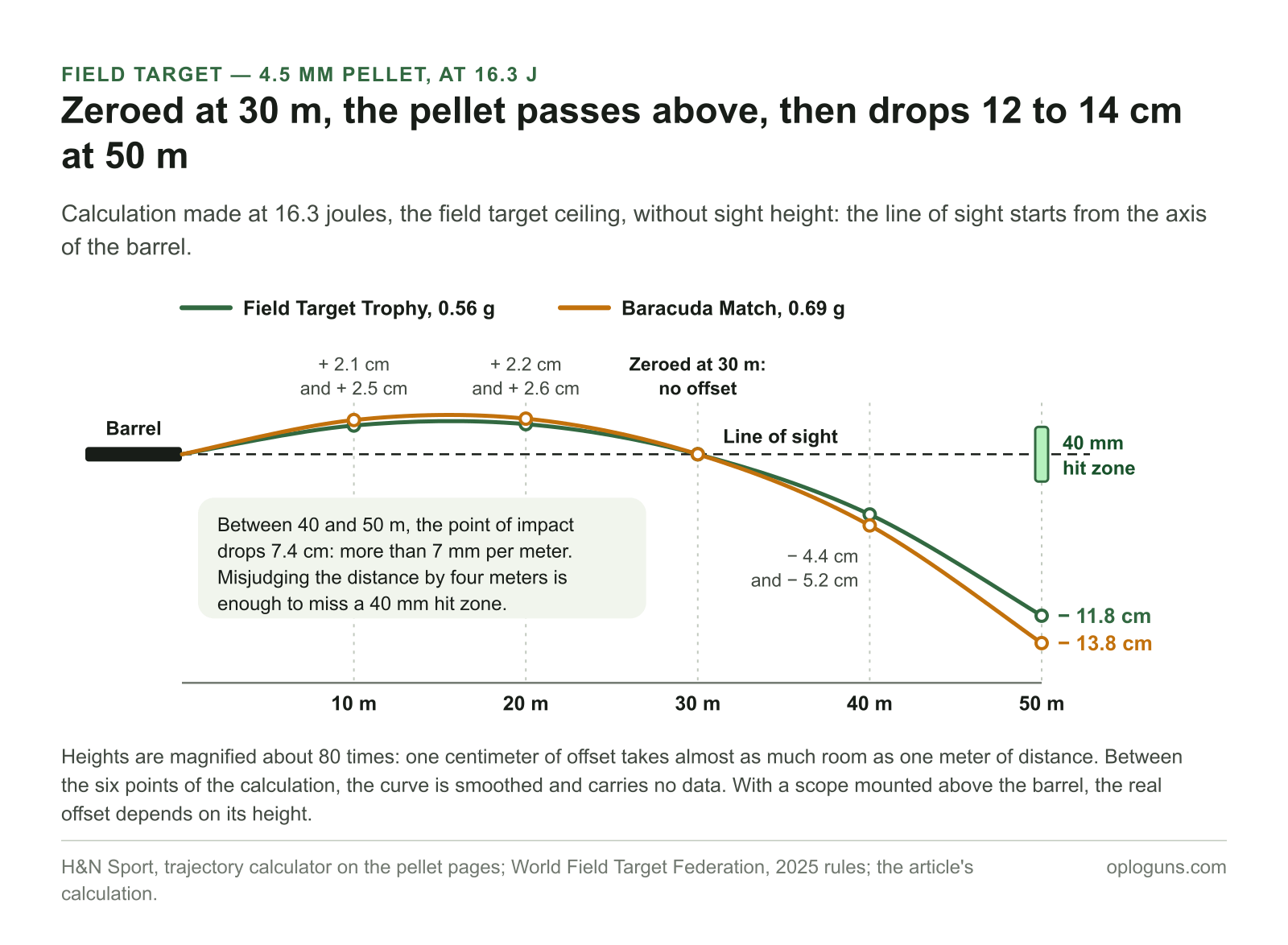
A field target pellet leaves slowly. The rulebook sets its maximum velocity according to its weight, so that energy does not exceed 16.3 joules: 242 m/s for a 0.56 g pellet1. H&N publishes a trajectory calculator on its product pages13.
The calculation here is made without sight height, the tool's "Skip" option: the line of sight starts from the axis of the barrel. A scope is mounted above it, and the real offset depends on its height. At 16.3 joules, sights zeroed at 30 m:
| Distance | Field Target Trophy, 0.56 g | Baracuda Match, 0.69 g |
|---|---|---|
| 10 m | + 2.1 cm | + 2.5 cm |
| 20 m | + 2.2 cm | + 2.6 cm |
| 40 m | − 4.4 cm | − 5.2 cm |
| 50 m | − 11.8 cm | − 13.8 cm |
Offset from the line of sight, scope height not counted13. The heavier pellet leaves more slowly and drops more.
Twelve centimeters at 50 m: three times the diameter of the hit zone. And the slope is steep at the end of the flight. Between 40 and 50 m, the impact falls by 7.4 cm in this calculation, more than 7 mm per meter. Four meters of error on the distance are enough to leave a 40 mm zone, whether the scope height is counted or not12.
Then there is wind. A pellet is light and more easily pushed around than most firearm projectiles, Umarex recalls8. The field target rulebook in fact allows a wind indicator attached to the rifle, provided it is not electronic1. The same trajectory at 19.9 joules, and in the other calibers, is in 20 joules: pellet velocity and range.
Which pellet for long range: heavy, round nose
The flat-nose match pellet is made for 10 m. RWS reserves the round nose for accurate shots at longer distances, and makes it the first choice for field target14. H&N adds weight. Choosing a pellet for 10 m is covered in choosing your 4.5 mm pellets.
Three benchmarks can be read on H&N's product pages4:
- Weight. The three pellets rated for 50 m weigh 0.56, 0.62 and 0.69 g, against 0.53 g for the match pellet.
- The rifle's minimum energy. The two heaviest require 16 joules; the Baracuda FT gives its best results at "16 joules / 12 ft.lbs", the 12 ft·lb that the field target rulebook converts to 16.3 joules1.
- The ballistic coefficient, written BC: the higher it is, the better the projectile keeps its velocity. It is 0.018 to 0.024 for these pellets.
A very light pellet does not go farther. The Field Target Trophy Green weighs only 0.37 g, and H&N associates it with the speed of sound; yet its product page stops at 30 m4. Weihrauch, for its part, recommends pellets « de qualité et plus lourds » [of quality and heavier], and trying several: every gun has its preferences6.
Two products, one heavy, the other close to the match pellet, were recorded on 15 November 2026 at two French gun shops1011:
| 4.5 mm pellet | Tin | Price recorded | Per pellet |
|---|---|---|---|
| H&N Baracuda, 0.69 g | 400 | €12 to €14 | 3 to 3.5 cents |
| JSB Exact, 0.54 g | 500 | €16 to €21 | 3 to 4 cents |
4.5 mm slugs: beyond 50 m, another power level
The slug no longer has the shape of a diabolo. H&N describes it as a projectile « en forme de balle » [bullet-shaped], designed « pour les armes puissantes » [for powerful guns], to shoot at targets at 50, 100 or even 200 m4. Its ballistic coefficient is 0.08 in 4.5 mm: more than three times that of the best diabolo from the same brand412.
It comes with three trade-offs:
- Power. H&N recommends it from 16 joules, and lists an optimal result at 30 joules4. Yet in France an airgun of 20 joules and above is in category C9.
- The gun. Umarex advises against slugs in a break-barrel or gas-piston rifle: they can get stuck in the barrel. Some lower-velocity PCPs also struggle to shoot them7.
- The discipline. Slugs are seen neither in field target nor in benchrest, the same manufacturer writes7.
What to do when a projectile stays in the barrel is in an air rifle that no longer shoots. What moving to 20 joules changes, purchase entitlement and declaration included, is in the air rifle and the 20 joules. Under that threshold, the diabolo and 50 m remain the rule. That leaves choosing what fires it.
Which air rifle for shooting far: the regulated PCP
The field target rulebook knows only two families: PCP and "springer", meaning spring or gas ram. Both are limited to 16.3 joules1. Power therefore gives no one an edge, and it is checked: every rifle goes over the chronograph each day1.
Weihrauch sells its HW 100 X PCP in a 16.3-joule version5. Its spec sheet gives what matters at 50 m:
- 240 m/s in 4.5 mm, just under the rulebook's maximum velocity for a 0.56 g pellet.
- 210 shots per fill, at 250 bar.
- A pressure regulator.
- A recoilless shot, "rückstoßfrei".
The spring rifle is not out of the game: it has its own class. It asks for a different hold. Weihrauch warns that a spring rifle held too firmly shoots inaccurately, and that any change in shouldering moves the impact6. The four mechanisms are compared in spring, gas ram, CO2 or PCP, filling in filling a PCP airgun.
The scope completes the set. The rulebook accepts any sighting system, except the laser, and forbids any rangefinder1: distance is estimated through the scope. Rail, recoil and parallax are covered in the scope for an air rifle.
Field target: metal silhouettes from 9 to 50 m
Field target was born on 7 September 1980, in Sussex, behind a pub. The first targets were simple metal silhouettes; fall-when-hit targets arrived in the mid-1980s2. The rulebook of the World Field Target Federation, the WFTF, now sets its specifications1.
The target is a metal silhouette pierced by a round zone. When the pellet passes through the hole, a paddle placed behind it drops the target, which the shooter resets from the firing point1. The smaller the zone, the closer the target:
| Hit zone | Maximum distance | Standing or kneeling target |
|---|---|---|
| 40 mm | 50 m | 40 m |
| 25 mm | 35 m | 20 m |
| 15 mm | 20 m | Not allowed |
Source: WFTF, rule 2.5.11.
The rest of the rulebook fits in five points1:
- Fifty targets per course at the world championship: 25 lanes of two targets.
- Three minutes per lane: one for preparation, two for the two targets.
- No rangefinder. The shooter estimates the distance alone, through the scope, within the allotted time.
- Imposed positions on one fifth of the targets at most: standing or kneeling.
- Reduced zones on one quarter of the targets at most.
The sound moderator is allowed there, subject to the law of the host country1. What it changes to the noise of an airgun is measured in the quiet air rifle.
Field target in France: outside the federation's disciplines
The Disciplines page of the Fédération française de tir displays twelve, from crossbow to tir sportif de vitesse, the French name for IPSC shooting. Field target is not one of them3. The federation's rifle events are shot at 10 m with air, at 50 m in .22 LR; benchrest, at 50, 100 or 200 m, with firearms3. Only air metallic silhouette goes beyond 10 m: 41 m at most with a rifle15, which getting started in metallic silhouette presents.
The discipline nevertheless has a French representative. The WFTF counts France among its member countries, through the Association française de field target2. It listed 45 member countries in 20242.
For the shooter, that makes two contacts:
- The association, for everything to do with field target.
- The shooting club, to find out whether its 50 m range accepts an air rifle: the federation's page does not settle it.
In every case, the shooting is done at a target, in a place provided for it, described in recreational shooting: license and places. The age, transport and energy thresholds of an airgun are in the air rifle and the 20 joules.
Three misconceptions about long-range air shooting
- "You need maximum power." Field target caps everyone at 16.3 joules1, and H&N gets its best results at 16 joules with its field target pellet4.
- "A light pellet shoots farther." H&N's 0.37 g pellet is rated for 30 m; its 0.56 to 0.69 g pellets, for 50 m4.
- "A slug goes in any rifle." It requires 16 joules at least, 30 for an optimal result4, and Umarex advises against it in a break-barrel rifle7.
Shooting far with an air rifle: by your goal
Shooting at 50 m at a target, at a club
A regulated PCP under 20 joules, a heavy round-nose pellet, an adjustable-parallax scope. In return, the pellet passes 12 to 14 cm below the line of sight at 50 m, zeroed at 30 m and scope height not counted, and access to the range depends on the club: see recreational shooting: license and places.
Discovering field target
A rifle of 16.3 joules at most, PCP or spring, and distances to estimate yourself. In return, the discipline is not one of the French shooting federation's: it has its own association.
Going beyond 50 m
A slug, from 16 joules, rated for 100 m in 4.5 mm. In return, its optimal performance is at 30 joules: in France, a category C gun, with purchase entitlement and declaration.
The rules in force prevail. WFTF rules in their 2025 edition, France's internal security code in its version of 15 November 2026. The distances, groupings and trajectories are the manufacturers' own for their products; the trajectory of a given gun is checked on target. Shooting is done at a target, in an authorized place.
Sources 15 references
The field target rules come from the World Field Target Federation rulebook; the specifications of pellets and rifles, from the manufacturers' pages; the law, from Légifrance. Everything was read on 15 November 2026. The prices, recorded the same day, are flagged ⚠️ as commercial data; the trajectory is that of the manufacturer's calculator. Click a reference number in the text to highlight the matching source.
- World Field Target Federation — Competition Rules (2025 Edition) (PDF, 43 pages), reread 15 November 2026: 1.1.1, "Air rifles (PCP or Springer) with a muzzle energy not exceeding 12 ft. lbs (16.3 Joules)"; 1.3, "Any form of sighting system may be used with the exception of laser sights. No built-in or separate range finding device may be used"; 1.4 o, "Silencers/Muzzle breaks are permitted. Provided the use of these items comply with the laws of the country hosting a WFTC"; 1.6.1 and 8.11, non-electronic wind indicator, attached to the rifle; 2.1.2, "three courses of 25 lanes each with 2 targets per lane (total of 50 targets per course)"; 2.3.1, "Metal silhouette “fall when hit” targets with a face plate with hole and paddle behind that are resettable from the firing point"; 2.3.4, "Standard hit zones shall be 40 mm in diameter"; 2.3.5, reduced zones of 15 or 25 mm; 2.5.1, "Targets shall be placed at distances of between 9 metres and 50 metres from the firing line", 15 mm zones out to 20 m, 25 mm out to 35 m, 40 mm out to 50 m, positional targets of 25 mm out to 20 m and of 40 mm out to 40 m; 2.6.1, reduced zones on 25% of targets at most; 2.7.1, standing or kneeling targets on 20% at most; 4.2.1, classes "PCP and Springer (both limited to 12 ft. lbs or 16.3 joules)"; 8.5, "SPRINGER – air rifle in which power is generated by a large spring/gas ram and piston"; 5.5.3, "All rifles shall be chronographed daily"; 5.8.1, "Shooters are allowed 3 minutes in each lane. 1 minute for preparation plus 2 minutes for 2 targets"; 5.8.4, "Looking through the scope, Range finding, loading of rifle, checking of the wind are all part of the timing process"; appendix A, maximum velocity by weight: 0.557 g, 241.7 m/s; 0.616 g, 229.8 m/s; 0.687 g, 217.6 m/s; for an intermediate weight, the line of the lower weight applies.
- World Field Target Federation — Members and History pages, reread 15 November 2026: "Forty-five Member Countries as of 2024", including "FRANCE"; "31) Association Francaise de Field Target (AFFT)"; "Field Target (FT) first started on the 7th September 1980, the first event being held on land behind a pub called the Red Lion in Magham Down in Sussex"; first targets as simple metal silhouettes, fall-when-hit targets introduced in the mid-1980s.
- Fédération française de tir — Disciplines and Benchrest pages (in French), consulted 15 November 2026, with no update date displayed: twelve disciplines, Arbalète match et field, Armes anciennes, Benchrest, Carabine, Cible mobile, Écoles de tir, Pistolet, Para-tir, Plateau, Silhouettes métalliques, Tir aux armes réglementaires, Tir sportif de vitesse; the term "field target" does not appear there; Carabine: « à 10 mètres (air comprimé et plomb de 4,5 millimètres), à 50 mètres » [at 10 meters (compressed air and 4.5-millimeter pellet), at 50 meters] in .22 Long Rifle; Benchrest: targets at « 100 ou 200 mètres » [100 or 200 meters], Rimfire event « à 50 mètres » [at 50 meters] with a .22 Long Rifle rifle, no air event on the page.
- H&N Sport — product pages in French, reread 15 November 2026: Baracuda FT 4,5 mm, « Les meilleurs résultats sont obtenus dans les carabines à air de précision avec une énergie initiale de 16 joules / 12 ft.lbs. Après 5 tirs à 50m, chaque lot de production doit atteindre un groupement d'un diamètre (C-T-C) maximum de 12 mm et après 20 tirs de 20 mm » [the best results are obtained in precision air rifles with a muzzle energy of 16 joules / 12 ft.lbs; after 5 shots at 50 m, each production lot must reach a grouping with a maximum center-to-center diameter of 12 mm, and after 20 shots of 20 mm], 0.62 g, minimum energy 16 J, maximum distance 50 m, BC 0.018; Baracuda Match, « Balles lourdes très précises pour des grandes distances » [very accurate heavy pellets for long distances], 0.69 g, 16 J, 50 m, BC 0.024; Field Target Trophy, 0.56 g, 7.5 J, 50 m, BC 0.021; Field Target Trophy Green, tin alloy, « Vitesse du son et trajectoire plane pour des distances moyennes » [speed of sound and flat trajectory for medium distances], 0.37 g, 7.5 J, 30 m; Finale Match Heavy, 0.53 g, 7.5 J, 10 m; Slug HP 10 gr, « se distingue considérablement des plombs traditionnels, en raison de sa forme de balle. Il est conçu pour les armes puissantes, pour tirer avec précision sur des cibles à 50, 100 ou même 200 mètres de distance. Un coefficient balistique (BC) extrêmement favorable assure une trajectoire tendue » [differs considerably from traditional pellets because of its bullet shape; it is designed for powerful guns, to shoot accurately at targets 50, 100 or even 200 meters away; an extremely favorable ballistic coefficient (BC) ensures a flat trajectory], « Recommandé pour les armes d'une puissance en bouche de canon d'au moins 16 joules. Résultat optimal avec les armes de puissance de 30 joules » [recommended for guns with a muzzle energy of at least 16 joules; optimal result with 30-joule guns], 0.65 g, maximum distance 100 m, BC 0.08. ⚠️ Manufacturer's technical data.
- Weihrauch — 2026 catalog (PDF, in German), reread 15 November 2026: HW 100 series, "rückstoßfreie Schussabgabe", regulator, 250 bar cartridge; HW 100 X table in 4.5 mm: 320 m/s and 30 J for 85 shots, 240 m/s and 16.3 J for 210 shots, 170 m/s and 7.5 J for 600 shots. ⚠️ Manufacturer's technical data.
- Weihrauch — manual for the HW 30 S to HW 99 spring rifles (PDF, 06/2026, French text included), reread 15 November 2026: « Les carabines à air comprimé à ressort de piston réagissent par des tirs imprécis si elles sont tenues trop fermement » [spring-piston air rifles respond with inaccurate shots if they are held too firmly]; « Si vous épaulez différemment ou modifiez la position des mains, l'emplacement d'impact se modifie également » [if you shoulder differently or change the position of your hands, the point of impact changes too]; « vous devriez essayez différentes sortes de balles de forme diabolo » [you should try different kinds of diabolo-shaped pellets]; « Nous recommandons d'utiliser des balles diabolo / plombs de qualité et plus lourdes » [we recommend using quality, heavier diabolo pellets].
- Umarex USA — "Did you Know Some Airguns Can Shoot Slugs?", reread 15 November 2026: "Do not try to use airgun slugs in a break barrel or gas piston style air rifle. This may result in getting a slug stuck in the gun's barrel"; "some lower velocity PCP air rifles might struggle to shoot an airgun slug"; "You won't see airgun slugs used on the benchrest or in a field target competition".
- Umarex USA — "What Affects Air Rifle Accuracy: Power, Pellets, Technique", reread 15 November 2026: "Wind matters because pellets are relatively light and more easily pushed around than many firearm projectiles".
- Légifrance — article R311-2 du code de la sécurité intérieure (in French), version in force since 7 September 2025 (decree no. 2025-894 of 5 September 2025, art. 2), consulted 15 November 2026: category C, 4°, « Armes et lanceurs dont le projectile est propulsé de manière non pyrotechnique avec une énergie à la bouche supérieure ou égale à 20 joules » [guns and launchers whose projectile is propelled non-pyrotechnically with a muzzle energy of 20 joules or more]; category D, h), same wording « comprise entre 2 et 20 joules » [between 2 and 20 joules].
- Armurerie Loisir — plombs de 4,5 mm (in French), prices recorded 15 November 2026: 400 H&N Baracuda 4.5 mm pellets (0.69 g) at €13.90; 500 JSB Exact 4.5 mm pellets (0.54 g) at €20.99. ⚠️ Commercial data.
- Armurerie Auxerre — plombs et billes d'acier (in French), prices recorded 15 November 2026: 400 H&N Baracuda 4.5 mm pellets at €12.25; 500 JSB Exact Diabolo 4.5 mm pellets at €16.40. ⚠️ Commercial data.
- Calculations: between 40 and 50 m, the offset from the line of sight goes from − 4.37 to − 11.78 cm, or 7.41 cm over 10 m and 7.4 mm per meter, without sight height; 4 m of error then make 30 mm, more than the zone's 20 mm radius; the calculator, queried again with its sight heights of 38.1 and 50.8 mm, gives between 40 and 50 m a fall of 6.14 and 5.71 cm, or 25 and 23 mm for 4 m of error; 11.78 cm ÷ 4 cm = 2.9; 12 ft·lb × 1.356 = 16.3 J; ratio of ballistic coefficients: 0.08 ÷ 0.024 = 3.3; price per pellet: 12.25 ÷ 400 = €0.031 and 13.90 ÷ 400 = €0.035; 16.40 ÷ 500 = €0.033 and 20.99 ÷ 500 = €0.042.
- H&N Sport — ballistics calculator ("Ballistics Calculator") on the Field Target Trophy .177 and Baracuda Match .177 pages, queried 15 November 2026 in metric units, at 16.3 J, zero at 30 m, sight height "Skip": the tool then gives a zero offset at the muzzle, the line of sight starting from the axis of the barrel. Field Target Trophy, 0.56 g: 241.3 m/s at the muzzle; offset from the line of sight + 2.05 cm at 10 m, + 2.19 at 20 m, − 4.37 at 40 m, − 11.78 at 50 m. Baracuda Match, 0.69 g: + 2.46 cm at 10 m, + 2.62 at 20 m, − 5.16 at 40 m, − 13.82 at 50 m. ⚠️ Manufacturer's calculation, without scope height: the real offset depends on the height of the mount; the Baracuda FT page carries no calculator.
- RWS — Airgun pellets, page reread 15 November 2026: "The FLAT NOSE type is the most common form for match and sport shooting at the 10 m distance"; "ROUND NOSE pellets […] This shape exhibits improved aerodynamics, especially for accurate shots at longer distances. It is therefore the first choice for field target shooting".
- IMSSU, translation by the Fédération française de tir — Règlement sportif officiel IMSSU 2025 [official IMSSU sporting rules 2025] (PDF, in French, « Mise à jour par la CNS Arbitrage en mars 2025 » [updated by the national officiating commission in March 2025]), air rules, pp. 46-47, reread 15 November 2026: « Tout pistolet ou carabine de calibre 4,5mm (177”) conforme aux critères et spécifications du règlement ISSF » [any pistol or rifle of 4.5 mm (.177) caliber meeting the criteria and specifications of the ISSF rulebook]; « Plombs de 4,5mm (177") » [4.5 mm (.177) pellets]; « Carabines : Poulets : 18 m. Cochons : 27 m. Dindons : 33 m. Béliers : 41 m. » [rifles: chickens, 18 m; pigs, 27 m; turkeys, 33 m; rams, 41 m]; « L'organisation de matchs air comprimé n'est pas obligatoire lors des Championnats Continentaux et Mondiaux » [organizing air matches is not compulsory at Continental and World Championships].
Frequently asked questions
How far can you shoot accurately with an air rifle?
Out to 50 m with a diabolo pellet: that is the maximum distance H&N gives its field target pellets, and that of the farthest targets in the World Field Target Federation rulebook. The manufacturer requires each lot of its Baracuda FT to group within 12 mm at most, over five shots at 50 m.
Which pellet for long-range shooting?
A heavy round-nose pellet. At H&N, the three 4.5 mm pellets rated for 50 m weigh 0.56 to 0.69 g, against 0.53 g for a 10 m match pellet. The two heaviest require 16 joules at least. Two products recorded on 15 November 2026 cost 3 to 4 euro cents per pellet.
Which air rifle for long-range shooting?
The field target rulebook accepts two families, PCP and spring-piston or gas-ram rifles, all limited to 16.3 joules. Weihrauch sells a 16.3-joule version of its HW 100 X PCP: 240 m/s in 4.5 mm, 210 shots per fill, recoilless. In France, such a rifle stays in category D, under the 20-joule threshold.
What is field target?
Air rifle shooting at metal silhouettes that fall when the pellet passes through a round 40 mm zone, sometimes reduced to 25 or 15 mm. The targets are placed between 9 and 50 m, at distances the shooter estimates without a rangefinder. Energy is limited to 16.3 joules. The discipline was born in England in 1980.
Is field target shot in France?
France is among the member countries of the World Field Target Federation, where it is represented by the Association française de field target. Field target is not one of the twelve disciplines displayed by the Fédération française de tir, the French shooting federation, whose Rifle discipline shoots air only at 10 m, and whose metallic silhouette rulebook places air targets at 41 m at most.
Can you shoot at 100 m with a PCP rifle?
Not with a diabolo pellet, which H&N limits to 50 m. The manufacturer gives 100 m to its 4.5 mm Slug HP, a bullet-shaped projectile, from 16 joules, with an optimal result at 30 joules. In France, at 20 joules and above, an airgun is in category C. Umarex advises against slugs in a break-barrel rifle.
Spotted an error, or a rule that has changed since we checked? Report an error