Lead-free ammunition: what Europe bans, and from when
Published on · 9 min read · Anthony Baillon
Lead ammunition is not banned in Europe: only shot is, and only in wetlands, since 15 February 2023. A second regulation, approved by the member states in June 2026, will ban it everywhere seven years after it enters into force, with a derogation for sport shooting. Bullets remain excluded.
At a glance
| Text | What it covers | Since or from |
|---|---|---|
| Regulation 2021/57 | lead shot in wetlands and within 100 m of them | 15 February 2023 |
| Draft D105447/07 | lead shot for hunting and outdoor sport shooting | seven years after entry into force |
| The draft's derogation | shot of 1.9 to 2.6 mm, compliant range, federation member | no time limit |
Status on 4 November 2026: the draft has cleared the member states' vote and the scrutiny of Parliament and the Council; it awaits publication in the Official Journal.
- Out of scope: bullets, .22 LR included, airgun pellets, indoor shooting and muzzle-loading firearms.
- At the shooting range, only outdoor clay target shooting is affected.
Lead ammunition: banned in wetlands
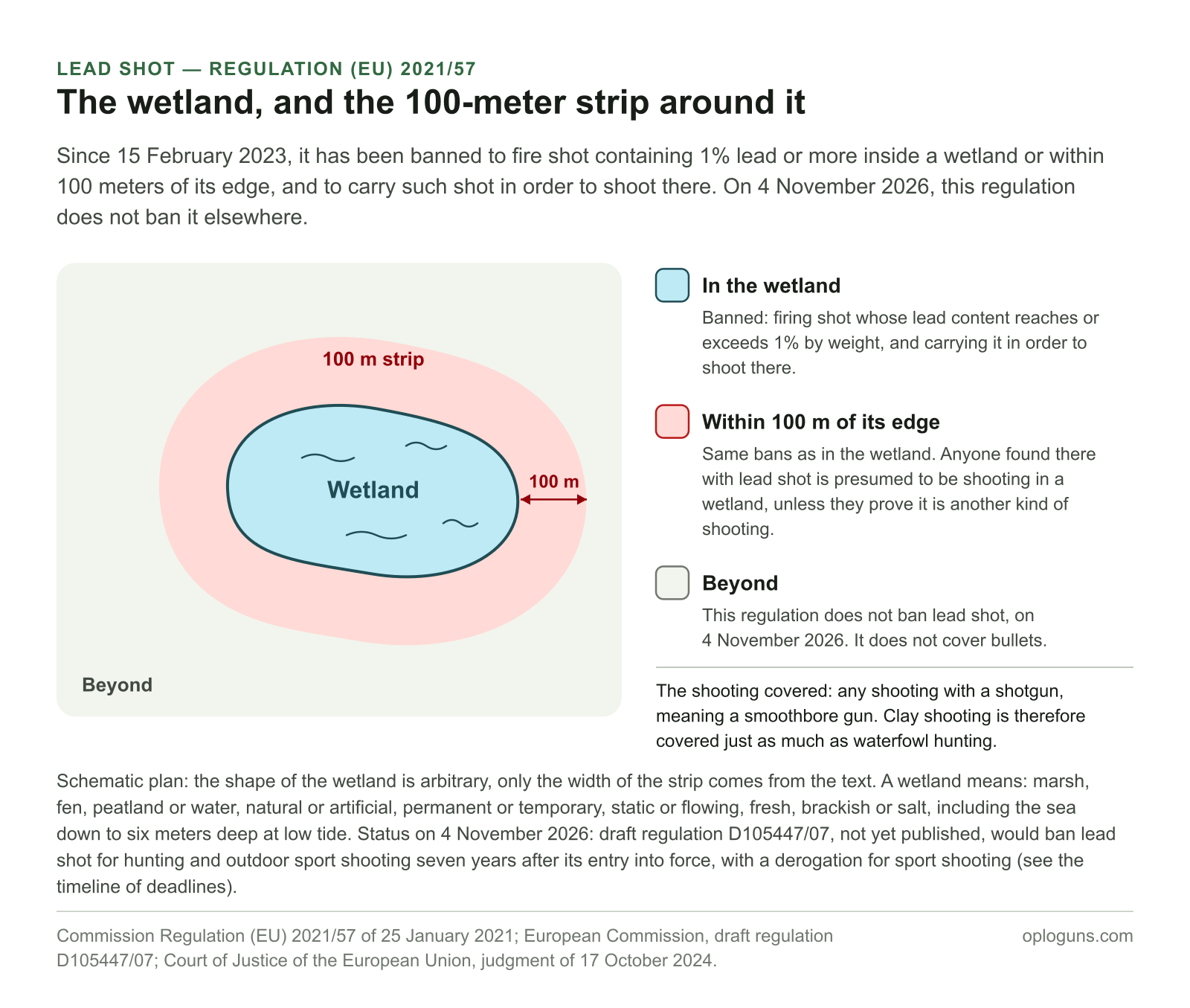
Regulation (EU) 2021/57 dates from 25 January 2021. It amends Annex XVII to the REACH regulation, which governs chemical substances in the Union1. After 15 February 2023, it bans, inside a wetland or within 100 meters of its edge1:
- Firing shot whose lead concentration reaches 1% by weight.
- Carrying it in order to shoot in a wetland.
The text defines "shooting" as « tout tir pratiqué avec un fusil de chasse » [any shooting with a shotgun], meaning a smoothbore gun1. Clay shooting is therefore covered just as much as waterfowl hunting. A person found with lead shot in that strip is presumed to be shooting in a wetland, unless they prove it is another kind of shooting1.
The "wetland" is broad: marsh, fen, peatland, natural or artificial water, permanent or temporary, fresh, brackish or salt, including the sea down to six meters deep at low tide1. Challenged before the European courts, the text stands: the Court of Justice dismissed the appeal against it on 17 October 20244.
Outside these areas, lead shot remains permitted. That is what the second text changes.
Lead restriction: seven years in the making
| Date | Step |
|---|---|
| 16 July 2019 | the Commission asks the European Chemicals Agency, ECHA, for a restriction dossier2 |
| 24 March 2021 | ECHA publishes its dossier: shot, bullets and fishing tackle2 |
| 2 December 2022 | opinions of its committees for risk assessment and socio-economic analysis2 |
| 27 February 2023 | the opinions are forwarded to the Commission2 |
| 25 June 2026 | the REACH committee, where the member states sit, gives a favorable opinion on draft D105447/073 |
| 10 October 2026 | end of scrutiny: neither the European Parliament nor the Council objects2 |
The vote of 25 June 2026 gathers 17 member states in favor, representing 68.26% of the Union's population, 5 against and 5 abstentions3. The text comes under the regulatory procedure with scrutiny: Parliament and the Council had a right to object, which they did not exercise23.
On 4 November 2026, the document still bears its draft title, « Règlement (UE) …/… de la Commission du XXX » [Commission Regulation (EU) …/… of XXX]2. It will enter into force twenty days after its publication in the Official Journal2. All its deadlines run from that date, which is not yet known.
Lead shot: a seven-year transition
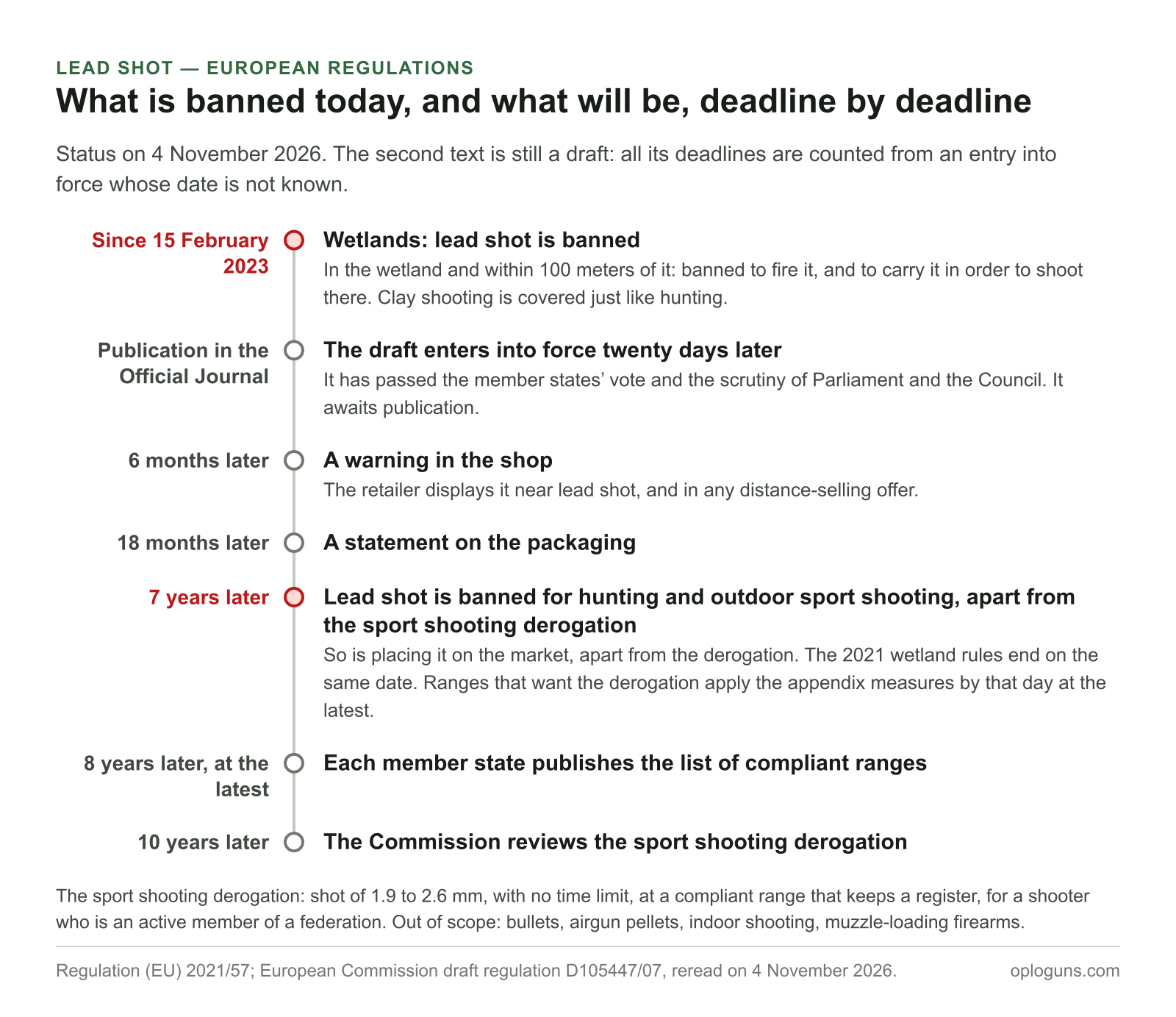
The draft now covers only gunshot, above 1% lead by weight. Seven years after entry into force, it bans2:
- For hunting, carrying or firing lead shot, travel to the hunting ground included.
- In outdoor sport shooting, firing lead shot.
- On the market, placing lead shot on sale, apart from the derogation.
ECHA proposed a five-year transition for hunting. The Commission settles on seven, for want of certainty about the volumes of replacement ammunition that industry will be able to produce2. The same period applies to sport shooting. Two obligations arrive sooner.
- Six months after entry into force, the retailer displays a warning near lead shot, and in any distance-selling offer2.
- Eighteen months after, the packaging carries the statement: « ATTENTION: Ce produit contient du plomb, une substance très toxique pour l'environnement et qui peut nuire à la fertilité ou au fœtus. » [WARNING: This product contains lead, a substance that is very toxic to the environment and may damage fertility or the unborn child.]2
The 2021 wetland rules apply until the same seven-year deadline, when the general ban takes over2. Sport shooting, for its part, keeps a door open.
Sport shooting: 1.9 to 2.6 mm lead shot retained
The Commission does not want to prevent member states from hosting the Olympic Games and international competitions, where lead is the rule, or shooters from training for them2. The ISSF, the international federation, sets the rule. Its pellets are made of lead, lead alloy or another material it approves, and measure 2.6 mm at most5.
The draft therefore keeps, with no time limit, shot of 1.9 to 2.6 mm, « les seuls calibres utilisés dans les compétitions » [the only sizes used in competitions] according to the text, on four conditions2:
- The outdoor range applies the appendix measures no later than seven years after entry into force.
- The shooter is an active member of a federation for sport shooting, meaning the holder of a current membership.
- The range keeps a register: estimated weight of shot fired by members, the people who fire it, weight of shot recovered.
- That register is shown to the authorities at their request.
The appendix requires of the range2:
- At least two containment measures among walls, berms or banks, nets or curtains, and surfacing of the impact areas.
- Recovery of the lead at least every three years, and when the range closes.
- Impact-area soil kept between pH 6.5 and 8.5, checked at least every six months, to slow the migration of lead.
- Control of runoff water, and a ban on any crop or livestock farming on the site.
Each member state publishes, eight years after entry into force at the latest, the list of ranges that meet these conditions; the Commission reviews the derogation after ten years2. The ISSF already provides, for its new clay target ranges, a level shotfall zone of at least 90 meters, made for recovering the pellets mechanically5.
Bullets and airgun pellets: outside the ban
The .22 LR, the 9 mm and rifle bullets fall out of scope. ECHA's committees judged a restriction on bullets proportionate. The Commission removes them all the same: bullets, lead included, are the main defense ammunition, and the Union wants to build up stocks of them2.
The gap in effect is quantified in the text. Banning lead bullets for hunting and outdoor shooting would have avoided 8,232 metric tons of lead in twenty years; shot, 558,000 metric tons, nearly sixty-eight times more2.
Also remaining out of scope2:
- Airgun pellets, whose substitutes are rare, less accurate and up to four times more expensive.
- Indoor shooting, in an enclosed building that releases no shot into the environment.
- Muzzle-loading and historical firearms, made before 1 January 1900, and their replicas.
- Primers and wads.
The lead that exposes the shooter at the range comes partly from primers and from the ground: that health side is covered in lead at the shooting range.
At the range: what changes, discipline by discipline
| Activity | On 4 November 2026 | Seven years after entry into force |
|---|---|---|
| Pistol, rifle, service-firearm shooting, with bullets | nothing | nothing: bullets excluded |
| Air gun, 10 m | nothing | nothing: pellets excluded |
| Outdoor clay targets, outside wetlands | lead shot permitted | lead of 1.9 to 2.6 mm at a compliant range, federation member |
| Clay targets within 100 m of a wetland | lead shot banned | end of the 2021 rules, the draft's general regime |
| Historical firearms, muzzle-loading | nothing | nothing: exempt |
The fourth row calls for a cautious reading. The draft ends the wetland paragraphs at the seven-year deadline and provides no specific rule for them2; only the published version will prevail. The choice of clay target cartridges, and their regulation load, are detailed in clay shooting cartridges; shooting historical firearms, in historical firearms shooting.
Lead substitutes: steel, bismuth, copper bullets
For hunting, ECHA concluded that steel and bismuth shot, like copper and brass bullets, are widely used, technically feasible and comparable in price to lead2.
For sport shooting with shot, steel could replace lead with comparable performance, provided the international federations accept it2. Steel sporting cartridges already exist in 24 and 28 grams from one French manufacturer, in shot size no. 76. For sport shooting bullets and airgun pellets, the substitutes proved less effective. The .22 LR, small centerfire calibers and open-tip match bullets remain hard to replace2.
Which leaves one question: does the shotgun accept steel? The answer is stamped on its barrel.
Steel shot: the shotgun's steel shot proof mark
Proof testing checks a gun's strength by firing overpressure cartridges, before it is stamped. It has been compulsory in France for every civilian firearm since 19607. The countries of the C.I.P., the Permanent International Commission for the Proof of Small Arms, mutually recognize their proof marks7.
The Banc national d'épreuve de Saint-Étienne, the French national proof house, distinguishes several C.I.P. marks8:
- N for ordinary proof, S for superior proof.
- PN for black powder.
- A fleur-de-lys for the « billes d'acier » [steel shot] proof.
The proof marks on the barrel, the shotgun manufacturer's manual and the cartridge's instructions say which steel shot a gun accepts. The choke counts too: steel patterns tighter than lead. The relationship between choke and steel shot is read in each shotgun's manual. For an old shotgun or one with no manual, the gunsmith or the proof house decides. The proof house tests a gun in case of doubt, and advises a reproof after thirty years7.
Three misconceptions about lead-free ammunition
- "Europe has postponed the lead ban by seven years." No general ban existed outside wetlands. The seven years are the new text's transition, counted from its entry into force12.
- ".22 LR bullets will be banned." The Commission has removed bullets from the scope of the restriction2.
- "Clay shooting escapes the wetland rule." The 2021 regulation covers « tout tir pratiqué avec un fusil de chasse » [any shooting with a shotgun], clay targets included1.
Sources 8 references
Union texts read in their official French version: regulation published in the Official Journal, draft regulation and voting result published in the European Commission's comitology register, judgment of the Court of Justice. ISSF rules in their edition in force on 19 October 2026. The quotations are in French unless noted; the glosses in brackets are ours, not the official English wording. Click a note marker in the text to highlight the matching source.
- EUR-Lex — règlement (UE) 2021/57 de la Commission du 25 janvier 2021, « en ce qui concerne le plomb dans la grenaille de chasse utilisée à l'intérieur ou autour de zones humides » [as regards lead in gunshot used in or around wetlands], OJ L 24 of 26 January 2021, p. 19, in force on 15 February 2021, text reread on 4 November 2026: entry 63, paragraph 11, « Après le 15 février 2023, il est interdit d'effectuer l'un ou l'autre des actes suivants à l'intérieur ou à moins de 100 mètres de zones humides: a) décharger de la grenaille de chasse contenant une concentration en plomb (exprimé en tant que métal) égale ou supérieure à 1 % en poids; b) porter de la grenaille de ce type lors de la pratique du tir en zones humides » [after 15 February 2023, it is banned to do either of the following in or within 100 meters of wetlands: a) fire gunshot containing a concentration of lead (expressed as metal) of 1% or more by weight; b) carry such gunshot while wetland shooting]; presumption of wetland shooting « à moins que la personne puisse démontrer qu'il s'agit d'un autre type de tir » [unless the person can show that it is another type of shooting]; paragraph 13, "wetlands": « des étendues de marais, de fagnes, de tourbières ou d'eaux naturelles ou artificielles, permanentes ou temporaires, où l'eau est stagnante ou courante, douce, saumâtre ou salée, y compris des étendues d'eau marine dont la profondeur à marée basse n'excède pas six mètres » [areas of marsh, fen, peatland or water, natural or artificial, permanent or temporary, with water that is static or flowing, fresh, brackish or salt, including areas of marine water whose depth at low tide does not exceed six meters]; "shotgun": « un fusil à canon lisse, à l'exclusion des fusils à air comprimé » [a smoothbore gun, excluding air guns]; "shooting": « tout tir pratiqué avec un fusil de chasse » [any shooting with a shotgun].
- European Commission, comitology register — projet de règlement D105447/07, « RÈGLEMENT (UE) …/... DE LA COMMISSION du XXX » amending Annex XVII to the REACH regulation « en ce qui concerne le plomb dans la grenaille de chasse » [as regards lead in gunshot], French version of the act and its annex (ref. Ares(2026)6605816 of 1 July 2026), record reread on 4 November 2026: procedure « Réglementation avec contrôle » [regulatory with scrutiny], step « Pas d'opposition du PE/Conseil » [no objection from the EP/Council] dated 10 October 2026. Recitals: mandate of 16 July 2019 (4), dossier published on 24 March 2021 (5), substitutes « grenaille d'acier et de bismuth, ainsi que les balles en cuivre et en laiton » [steel and bismuth shot, and copper and brass bullets] and steel possible in sport shooting with « l'accord des fédérations internationales » [the agreement of the international federations] (8), committee opinions of 2 December 2022 (note 10), opinions forwarded on 27 February 2023 (26), transition extended from five to seven years (29), bullets excluded, 8,232 metric tons against 558,000 metric tons over twenty years (31), airgun pellets excluded, substitutes « jusqu'à quatre fois plus cher » [up to four times more expensive] (32), Olympic Games and competitions « dans lesquelles l'utilisation du plomb est obligatoire » [in which the use of lead is mandatory] (33), derogation from 1.9 to 2.6 mm, « les seuls calibres utilisés dans les compétitions » [the only sizes used in competitions] (34). Annex: paragraph 14a (end of paragraphs 11 to 14 at seven years), paragraphs 28 to 39 (bans at seven years, derogation of paragraph 30 and its four conditions, display at six months, labeling at eighteen months, exemption of muzzle-loading and historical firearms, review at ten years, list of ranges at eight years, indoor shooting, primers and wads out of scope, definitions of "sport shooting", "active member", "indoor shooting", "historical firearms" predating 1 January 1900); appendix: at least two containment measures, recovery at least every three years, pH of 6.5 to 8.5 checked every six months, drainage water, « interdiction de toute utilisation agricole » [ban on any agricultural use]; article 2, entry into force « le vingtième jour suivant celui de sa publication » [on the twentieth day following that of its publication].
- European Commission, comitology register — formal voting result V117006/01 on draft D105447/07, REACH committee (C34200), meeting of 25 June 2026, reread on 4 November 2026 (in English): "Opinion of the committee: Positive"; 17 member states in favor, representing 68.26% of the population, 5 against (19.79%), 5 abstentions (11.95%); procedure "Regulatory with scrutiny (Art. 5a)".
- Court of Justice of the European Union — arrêt du 17 octobre 2024, Firearms United Network e.a. contre Commission, affaire C-105/23 P [judgment of 17 October 2024, Firearms United Network and Others v Commission, case C-105/23 P], appeal concerning Regulation (EU) 2021/57, reread on 4 November 2026: « 1) Le pourvoi est rejeté. » [1) The appeal is dismissed.]
- ISSF — Rule Book, Edition 2025, Third Print 10/2026 (in English), in force since 19 October 2026, reread on 4 November 2026: 9.4.3.1 c), "Pellets must be made of lead, lead alloy or of any other ISSF approved material"; d), "Pellets must not exceed 2.6mm in diameter"; 6.4.17.2, new clay target ranges provided with a level shotfall zone of at least 90 m "to permit mechanical salvage and the recovery of lead pellets".
- Tunet (Nobel Sport) — product sheets reread on 4 November 2026: Universelle 24 Steel, 12 gauge, length 70, load 24 g, shot size 7, « Matière plomb : Acier » [shot material: steel]; Confort Steel, 12 gauge, load 28 g, shot size 7, « Matière plomb : Acier ». ⚠️ Manufacturer's data.
- Banc national d'épreuve de Saint-Étienne — Éprouver une arme [proofing a firearm], page reread on 4 November 2026: « En 1960, l'épreuve est rendue obligatoire pour toutes les armes à feu civiles » [in 1960, proof was made compulsory for all civilian firearms]; the gun « est testée par le tir de cartouches de surpression » [is tested by firing overpressure cartridges], then « poinçonnée, certifiée et enregistrée » [stamped, certified and recorded]; « le Banc National d'Epreuve peut à tout moment tester votre arme; ce dernier conseille une ré-épreuve après 30 ans » [the national proof house can test your gun at any time; it advises a reproof after 30 years]; under the C.I.P. convention, the signatory countries « reconnaissent mutuellement la validité, sur leur territoire, des poinçons » [mutually recognize the validity of the proof marks on their territory].
- Banc national d'épreuve de Saint-Étienne — Poinçons d'épreuve au 1er janvier 2014 [proof marks on 1 January 2014] (PDF), reread on 4 November 2026: C.I.P. marks for ordinary proof (N), superior proof (S), black powder proof (PN), the « billes d'acier » [steel shot] proof (fleur-de-lys), type proof (T) and ammunition inspection (M).
The regulation in force prevails. This article describes the state of the texts on 4 November 2026: the 2021 regulation in force, and a draft regulation that the Commission still has to adopt and publish. Its deadlines will be calculated from its date of entry into force; only the version published in the Official Journal of the European Union applies.
Frequently asked questions
Is lead ammunition banned in France?
Not in general. Since 15 February 2023, European regulation 2021/57 has banned firing shot containing 1% lead or more in a wetland or within 100 meters of one, and carrying it in order to shoot there. Elsewhere, lead shot remains permitted on 4 November 2026, as do lead bullets everywhere.
Will lead shot be banned in clay shooting?
The draft regulation approved by the member states on 25 June 2026 bans, seven years after its entry into force, firing lead shot in outdoor sport shooting. A derogation with no time limit keeps shot of 1.9 to 2.6 mm for members of a sport shooting federation, at ranges that apply containment measures and keep a register.
Are .22 LR lead bullets going to be banned?
No, according to the text being adopted: the Commission has removed bullets from the scope of the restriction, which now covers only shot. Airgun pellets are also excluded, as are indoor shooting and muzzle-loading firearms.
When will the lead shot ban apply?
Seven years after the regulation enters into force, which comes twenty days after its publication in the Official Journal. On 4 November 2026, the European Parliament and the Council have not objected, at the end of a scrutiny period closed on 10 October 2026, but the regulation is not yet published: the exact date is therefore not set.
Can you fire steel shot in any shotgun?
Not without checking: a shotgun that has passed the steel shot proof at a C.I.P. proof house bears a fleur-de-lys mark. The proof marks on the barrel, the gun manufacturer's manual and the cartridge's instructions say which steel shot it accepts; the gunsmith decides in case of doubt.
Spotted an error, or a rule that has changed since we checked? Report an error