Hunting scope: driven hunt, stand, stalking or all-round
Published on · 8 min read · Anthony Baillon
A hunting scope is chosen by its magnification range, its objective and its reticle. For stand hunting and stalking: 2 to 12 power, on a 40 to 56 mm objective. In France, an illuminated reticle mounted on the firearm is allowed; graduations beyond 300 m are not. Prices found: €415 to €1,755.
At a glance
| Use | What counts | Example found |
|---|---|---|
| Stand | 50 to 56 mm objective, illuminated reticle | Hawke Endurance 30 WA 3-12x56, €445 to €558 |
| Stalking | Weight, variable magnification | Hawke Endurance 30 WA 2.5-10x50, €415 to €419 |
| All-round | A range that starts low | Kite B6 2-12x50, €599 |
- French law: illuminated reticle allowed, built-in rangefinder accepted without automatic correction, graduations beyond 300 m forbidden.
- Driven hunt: the 1-4x or 1-6x scope has its own guide, the driven-hunt rifle one.
Hunting scope: the magnification range first
The ANCGG (Association nationale des chasseurs de grand gibier, France's national big-game hunters' association) summed it up in 2011: « Préférez un grossissement variable car les distances varient en permanence » [Prefer variable magnification, because distances change all the time]1. In the 1980s, covering both the driven hunt (the French battue, where beaters push game toward a line of posted hunters) and stalking led to the 1.5-6x. In the same article on the stalking rifle, the association also named 1.7-10x, 2.5-10x or 3-9x as « choix judicieux » [sound choices]1.
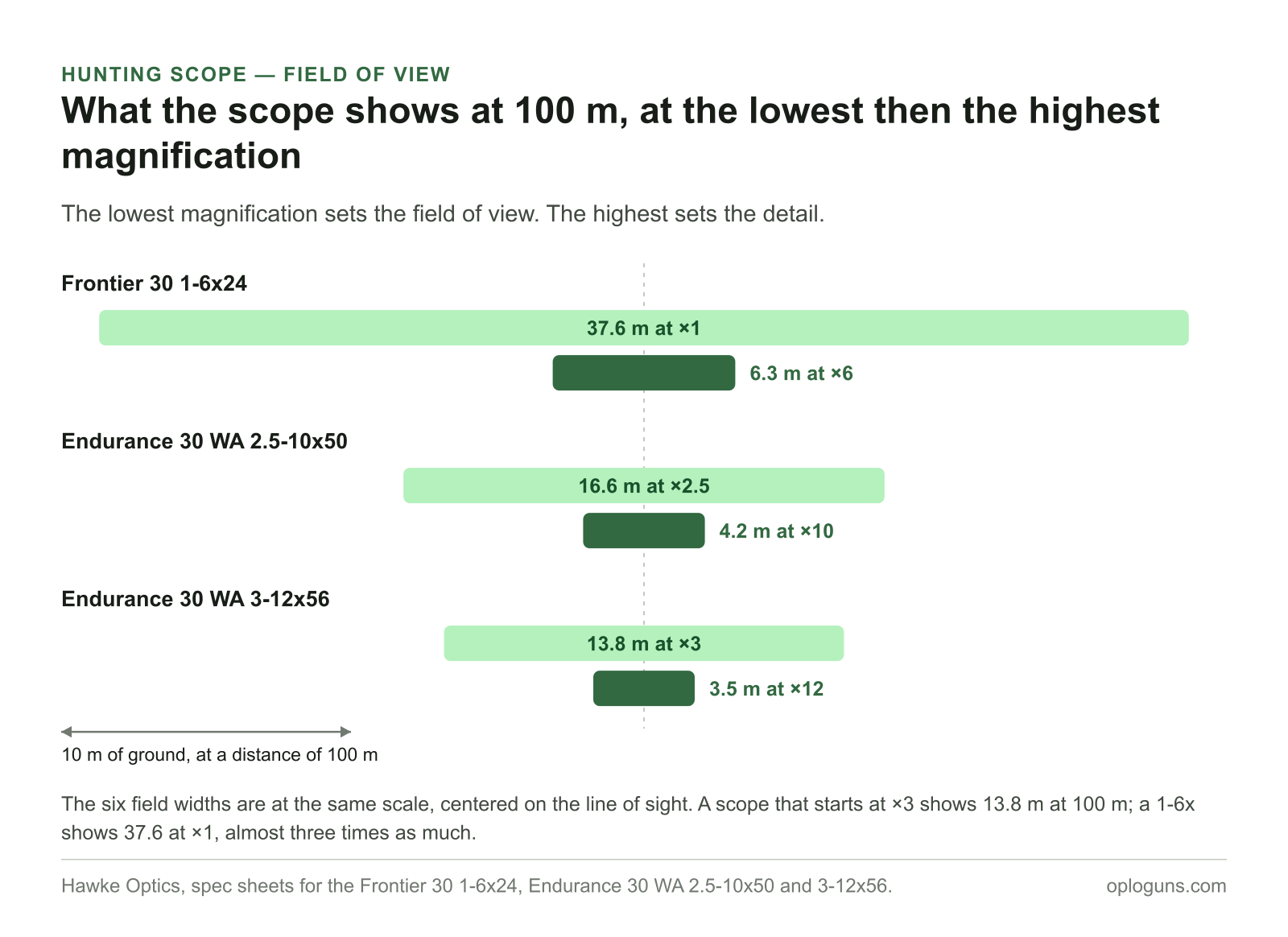
The lowest magnification sets the field of view. The highest sets the detail. On Hawke's spec sheets, at 100 m:
| Scope | Field at the lowest | Field at the highest | Weight |
|---|---|---|---|
| Frontier 30 1-6x24 | 37.6 m at ×1 | 6.3 m at ×6 | 514 g |
| Endurance 30 WA 2.5-10x50 | 16.6 m at ×2.5 | 4.2 m at ×10 | 612 g |
| Endurance 30 WA 3-12x56 | 13.8 m at ×3 | 3.5 m at ×12 | 635 g |
A scope that starts at ×3 shows 13.8 m at 100 m; a 1-6x shows 37.6 at ×1, almost three times as much29. For the driven hunt, where field of view comes first, the 1-4x or 1-6x scope and the red dot are compared in the driven-hunt rifle and the red dot for rifle and shotgun.
Scope objective: 40 to 56 mm, and the weight
A wider objective keeps a brighter image as you zoom in. The measure that says so is the exit pupil, the objective divided by the magnification29:
- Hawke Endurance 30 WA 2.5-10x50: 20 mm at ×2.5, 5 mm at ×102.
- Hawke Endurance 30 WA 3-12x56: 18.7 mm at ×3, 4.7 mm at ×122.
- A 3-9x40: 4.4 mm at ×99.
Zeiss considers an exit pupil smaller than 4 mm unsuitable "in the waning light", and would "ideally" have it at least as large as the user's own pupil3. The twilight factor, the square root of the objective multiplied by the magnification, compares optics: 22.4 for the 2.5-10x50 at ×10, 25.9 for the 3-12x56 at ×129. Zeiss points out that it remains "a mere mathematical parameter": glass quality and light transmission are not in it3.
A wide objective is paid for in weight and in ring height. The ANCGG warned against excess: « 40, 42 mm vous apporteront sans doute satisfaction » [40 or 42 mm will no doubt serve you well] on a stalking rifle, and a combination of about 4 kg is no burden1. Between Hawke's Vantage 3-9x40, 402 g, and its Endurance 3-12x56, 635 g, the gap is 233 g2. That leaves the reticle, which is read in the same half-light.
Illuminated reticle: allowed in France, at low intensity
An illuminated reticle is an electronic aid. France's code de l'environnement (environmental code) prohibits every such aid that an arrêté (ministerial order) does not authorize6. The arrêté of 1 August 1986, in its version in force since 10 July 2026, authorizes « les lunettes à réticule lumineux fixées sur les armes à feu » [scopes with an illuminated reticle mounted on firearms]4. For thermal devices, see what French law says about thermal scopes.
On the spec sheet, two figures count: the number of levels and the off positions. The Endurance 30 WA offers six, in red, with an off position between each2. The ANCGG insisted on a « très faible » [very low] intensity in half-light: a reticle that is too bright dazzles and makes the pupil contract1.
An unlit reticle can also be read in low light: the association noted that « les barres épaisses permettent une meilleure visée lorsque la luminosité est faible » [thick posts allow better aiming when light is low]1. The choice between first and second focal plane is set out in choosing a riflescope.
Turrets and rangefinder: what the 1986 arrêté says
Two articles of the same arrêté govern hunting scopes.
- Graduations beyond 300 m: article 2 forbids, for the hunting of all game, « l'emploi de toute arme munie d'un dispositif fixe ou amovible comportant des graduations ou des repères de réglage de tir pour les distances supérieures à 300 mètres » [the use of any firearm fitted with a fixed or removable device bearing graduations or aiming-adjustment marks for distances over 300 meters]5. The text targets those graduations or adjustment marks for more than 300 m; whether a given turret or reticle carries them is checked with the hunters' federation or the gunsmith.
- Built-in rangefinder: article 7 accepts rangefinders, « qui peuvent être intégrés dans les lunettes de visée fixées sur les armes à feu à la condition que ces dernières ne soient pas équipées d'un système de correction automatique de la visée » [which may be built into scopes mounted on firearms provided the scopes are not fitted with an automatic aim-correction system]4.
- Red dot: it is accepted « sans convertisseur ou amplificateur d'image, et sans rayon laser » [without an image converter or intensifier, and without a laser beam]4.
The text in force prevails: a 2011 guide still calls the built-in rangefinder forbidden.
Mounting a hunting scope: fixed or detachable
The ANCGG recommended a detachable mount for stalking in rough terrain, so the scope can go in the pack on difficult stretches. On one condition: « vérifier au stand de tir que son montage-démontage ne modifie pas le point d'impact » [check at the range that fitting and removing it does not change the point of impact]1. Rails, rings and torque values are in mounting a riflescope, zeroing at the range in zeroing a riflescope.
Hunting scope prices: €415 to €1,755
Prices recorded on 15 November 2026 at two French gun shops, promotions included78:
| Scope | Objective | Prices found |
|---|---|---|
| Hawke Endurance 30 WA 2.5-10x50 | 50 mm | €415 to €419 |
| Hawke Endurance 30 WA 3-12x56, listed under different names (IR at one shop) | 56 mm | €445 to €558 |
| Kite B6 2-12x50 | 50 mm | €599 |
| Zeiss Conquest V4 3-12x56, depending on reticle | 56 mm | €1,169 to €1,227 |
| Kahles Helia 2.4-12x56i, 4-Dot reticle | 56 mm | €1,435 to €1,549 |
| Kahles Helia 2-10x50i, 4-Dot reticle | 50 mm | €1,500 to €1,755 |
The same scope can vary by more than €250 from one shop to the next: €1,500 or €1,755 for the Kahles Helia 2-10x50i with the 4-Dot reticle, on the same day78. The mount comes on top. For an entry-level scope, what you lose below these prices is in the budget riflescope.
Three misconceptions about the hunting scope
- "A built-in rangefinder is forbidden for hunting." That was the ANCGG's view in 20111. Article 7 of the 1986 arrêté accepts it without automatic aim correction, and already did in its version in force from 29 December 2018 to 31 December 20234.
- "The twilight factor tells you the brightness." Zeiss calls it a mere mathematical parameter3.
- "The bigger the objective, the better." The ANCGG judged 40 or 42 mm enough for stalking, without weighing down the rifle1.
Which scope for your kind of hunting
Stand hunting, on a steady rest
A 50 to 56 mm objective and an illuminated reticle at low intensity, like the Endurance 30 WA 3-12x56, at €445 to €558. The ANCGG judged weight less important on the stand, where the rifle is carried little. In return, 635 g and taller rings.
Stalking, rifle on the sling
Variable magnification on a 40 to 50 mm objective, to stay light: the Hawke 2.5-10x50 weighs 612 g. In return, an exit pupil of 5 mm at the highest power, against 4.7 mm on the 3-12x56.
A single scope for the driven hunt and stalking
A range that starts at ×1.5 or ×2 and climbs to ×10 or ×12, like the Kite B6 2-12x50 at €599. In return, a narrower field at the low end than a 1-6x: you gain in detail what you lose in width.
Sources 9 references
The legal texts were reread on Légifrance in their version of 15 November 2026; the specifications come from the manufacturers' sheets; the recommendations on use, from a hunters' association, with no regulatory force; the prices, from dated checks at two French gun shops, flagged ⚠️ as commercial data. Click a reference number in the text to highlight the matching source.
- ANCGG, Association nationale des chasseurs de grand gibier — Jean-Marie Blum, « S'équiper d'une carabine pour l'approche » [equipping yourself with a rifle for stalking], Grande Faune no. 131, 2011 (PDF, in French), reread 15 November 2026: « Préférez un grossissement variable car les distances varient en permanence » [prefer variable magnification, because distances change all the time]; driven-hunt and stalking versatility in the eighties pointing to « un grossissement variable de 1,5 à 6 fois » [a variable magnification of 1.5 to 6 power]; « 1,7 à 10 fois, 2,5 à 10 fois, 3 à 9 fois, sont des choix judicieux » [1.7 to 10, 2.5 to 10 and 3 to 9 power are sound choices]; « 40, 42 mm vous apporteront sans doute satisfaction » [40 or 42 mm will no doubt serve you well]; « Jusqu'à environ 4 kg, l'ensemble avec sa lunette ne devrait pas vous gêner » [up to about 4 kg, the rifle with its scope should not bother you]; weight less important « lorsque l'arme ne doit servir qu'à l'affût » [when the rifle is only to be used on the stand]; « les barres épaisses permettent une meilleure visée lorsque la luminosité est faible » [thick posts allow better aiming when light is low]; illuminated reticle set to give off « une lumière très faible » [a very faint light], or it will « diminuer le diamètre de votre pupille » [reduce the diameter of your pupil]; detachable mount, checking « au stand de tir que son montage-démontage ne modifie pas le point d'impact » [at the range that fitting and removing it does not change the point of impact]; a rangefinder built into the scope described as forbidden (2011 text, earlier than the version of article 7 in force from 29 December 2018 to 31 December 2023, which already accepted it without automatic correction). An association's recommendations, with no regulatory force.
- Hawke Optics — spec sheets for the Endurance 30 WA 2.5-10x50 LR Dot, Endurance 30 WA 3-12x56 LR Dot, Frontier 30 1-6x24 and Vantage 3-9x40, reread 15 November 2026: field of view at 100 m from 16.6 to 4.2 m (2.5-10x50), 13.8 to 3.5 m (3-12x56), 37.6 to 6.3 m (1-6x24); exit pupil from 20 to 5 mm and from 18.7 to 4.7 mm; "Illumination 6 Levels (Red)", "Stepped Rheostat with Off Positions In-between"; weight 612 g, 635 g, 514 g and 402 g. ⚠️ Manufacturer's technical data.
- Zeiss — Twilight factor, Zeiss Hunting blog, reread 15 November 2026: twilight factor, the square root of the objective diameter multiplied by the magnification; "this twilight factor is a mere mathematical parameter"; exit pupil "at least as large as the pupil of the user"; "Anything with an exit pupil smaller than 4 mm is, therefore, unsuitable in the waning light right from the start".
- Légifrance — arrêté du 1er août 1986 relatif à divers procédés de chasse, article 7 (in French), amended by the arrêté of 25 June 2026, in force since 10 July 2026, reread 15 November 2026: the only means authorized « pour la chasse et la destruction des espèces d'animaux classées susceptibles d'occasionner des dégâts » [for hunting and for the destruction of animal species classed as liable to cause damage] are those it lists, among them « les viseurs à point rouge, sans convertisseur ou amplificateur d'image, et sans rayon laser » [red dot sights, without an image converter or intensifier, and without a laser beam], « les lunettes à réticule lumineux fixées sur les armes à feu » [scopes with an illuminated reticle mounted on firearms] and « les télémètres, qui peuvent être intégrés dans les lunettes de visée fixées sur les armes à feu à la condition que ces dernières ne soient pas équipées d'un système de correction automatique de la visée » [rangefinders, which may be built into scopes mounted on firearms provided the scopes are not fitted with an automatic aim-correction system]. The indent on rangefinders already appears in the version in force from 29 December 2018 to 31 December 2023 (amended by the arrêté of 12 December 2018), reread 15 November 2026.
- Légifrance — arrêté du 1er août 1986, article 2 (in French), amended by the arrêté of 28 December 2023, in force since 31 December 2023, reread 15 November 2026: forbidden for the hunting of all game is « l'emploi de toute arme munie d'un dispositif fixe ou amovible comportant des graduations ou des repères de réglage de tir pour les distances supérieures à 300 mètres » [the use of any firearm fitted with a fixed or removable device bearing graduations or aiming-adjustment marks for distances over 300 meters].
- Légifrance — article L424-4 du code de l'environnement (in French), in force since 9 March 2012, reread 15 November 2026: « Tous les moyens d'assistance électronique à l'exercice de la chasse, autres que ceux autorisés par arrêté ministériel sont prohibés. » [All electronic aids to hunting, other than those authorized by ministerial order, are prohibited.]
- Armurerie Auxerre — lunettes de tir et de visée (in French; pages 2, 3 and 5), prices recorded 15 November 2026: Hawke Endurance 30 WA 2.5-10x50 LR Dot €415.00; Endurance 30 WA 3-12x56 LR Dot IR, presented as « Lunette d'affût et de TMD, réticule lumineux » [scope for stand hunting and long-range shooting, illuminated reticle], €557.90 (special price, regular €619.00); Kite B6 X61 2-12x50 €599.00; Zeiss Conquest V4 3-12x56 L4A Dot €1,225.00; Kahles Helia 2.4-12x56i SFP Abs.4-Dot €1,434.90 (special price); Kahles Helia 2-10x50i SFP Abs.4-Dot €1,500.00. ⚠️ Commercial data.
- Armurerie Beau Repaire — lunettes (in French; pages 8, 10, 12, 13, 16 and 20), prices recorded 15 November 2026: Hawke Endurance 30 WA 2.5-10x50 LR Dot €419.00 and 3-12x56 LR Dot €445.00 (promotions); Kite Optics B6 2-12x50 €599.00 (promotion); Zeiss Conquest V4 3-12x56 €1,168.50 to €1,227.00 depending on reticle (promotions); Kahles Helia 2-10x50i illuminated 4-dot reticle €1,755.00; Kahles Helia 2.4-12x56i 4 Dot reticle €1,549.00 (promotion). ⚠️ Commercial data.
- Calculations: exit pupil = objective ÷ magnification (40 ÷ 9 = 4.4 mm; 50 ÷ 10 = 5 mm; 56 ÷ 12 = 4.7 mm); twilight factor = √(objective × magnification): √500 = 22.4; √672 = 25.9; field of 37.6 m at ×1 against 13.8 m at ×3: a ratio of 2.7; 635 − 402 = 233 g; 1,755 − 1,500 = €255.
The text in force prevails. This article cites the arrêté of 1 August 1986 and the code de l'environnement in their version of 15 November 2026. It deals only with optics: using a firearm for hunting falls under the French hunting license, the arrêtés and the departmental hunting plan in force.
Frequently asked questions
What is the best all-round hunting scope?
An all-round scope is a variable-power scope whose range starts low enough for the driven hunt and climbs high enough for stalking. The ANCGG, France's national big-game hunters' association, recalled in 2011 that driven-hunt and stalking versatility once led to the 1.5-6x, and also named 1.7-10x, 2.5-10x and 3-9x as « choix judicieux » [sound choices] in its article on the stalking rifle, with a 40 or 42 mm objective so as not to weigh it down.
Which scope for stand hunting?
One gun shop presents the Hawke Endurance 30 WA 3-12x56, with a 56 mm objective and an illuminated reticle, as a stand scope. On this model the exit pupil is still 4.7 mm at the highest magnification, above the 4 mm under which Zeiss considers an optic unsuited to fading light. In return, 635 g on the rifle.
Which scope for stalking?
A scope you carry for a long time: weight counts. The ANCGG judged in 2011 that a 40 or 42 mm objective is enough, and that rifle and scope together are no burden up to about 4 kg. It advised variable magnification and a detachable mount, checked at the range so that it does not shift the point of impact.
Is an illuminated reticle allowed for hunting in France?
Yes. The arrêté (ministerial order) of 1 August 1986, in its version in force since 10 July 2026, lists « les lunettes à réticule lumineux fixées sur les armes à feu » [scopes with an illuminated reticle mounted on firearms] among the authorized electronic aids. The same text, on the other hand, forbids for the hunting of all game any firearm fitted with graduations or aiming-adjustment marks for beyond 300 meters.
Is a scope with a built-in rangefinder allowed for hunting in France?
Yes, on one condition. Article 7 of the arrêté of 1 August 1986, in force on 15 November 2026, accepts rangefinders built into scopes mounted on firearms, provided the scope has no automatic aim-correction system. The same provision already appeared in the version in force from 29 December 2018 to 31 December 2023. The ANCGG, which called them forbidden in 2011, was writing before those versions.
Spotted an error, or a rule that has changed since we checked? Report an error