9mm pistol compensator: what it changes in muzzle rise, and where it is allowed
Published on · 11 min read · Anthony Baillon
A compensator is a part fitted to the muzzle of the barrel: it diverts gas upward to counter muzzle rise. On a 9mm pistol, a machine-rest test measured 36% less muzzle rise, and a slowed slide. In practical shooting, the IPSC rules allow it only in Open division.
At a glance
| Question | Answer | Text or measurement |
|---|---|---|
| What it does | Diverts gas at the muzzle, against muzzle rise | IPSC rules, glossary |
| Effect measured in 9mm | 36% less muzzle rise, on a rest | Shooting Times, 2015 |
| On a handgun in TSV (IPSC) | Open division only | Appendices D1 to D6 |
| ISSF 25 m, TAR 830 | Prohibited | ISSF 8.4.1.6; TAR, Annex A-830 |
| Sold on its own | €89 to €329 | Prices recorded on 15 November 2026 |
- The trade-off: the part slows the slide. With a light load, the pistol in the test no longer cycled.
- The French code: articles R311-1 and R311-2 name neither the compensator nor the muzzle brake. The barrel that takes it, on the other hand, is a firearm component.
Pistol compensator: gas diverted at the muzzle
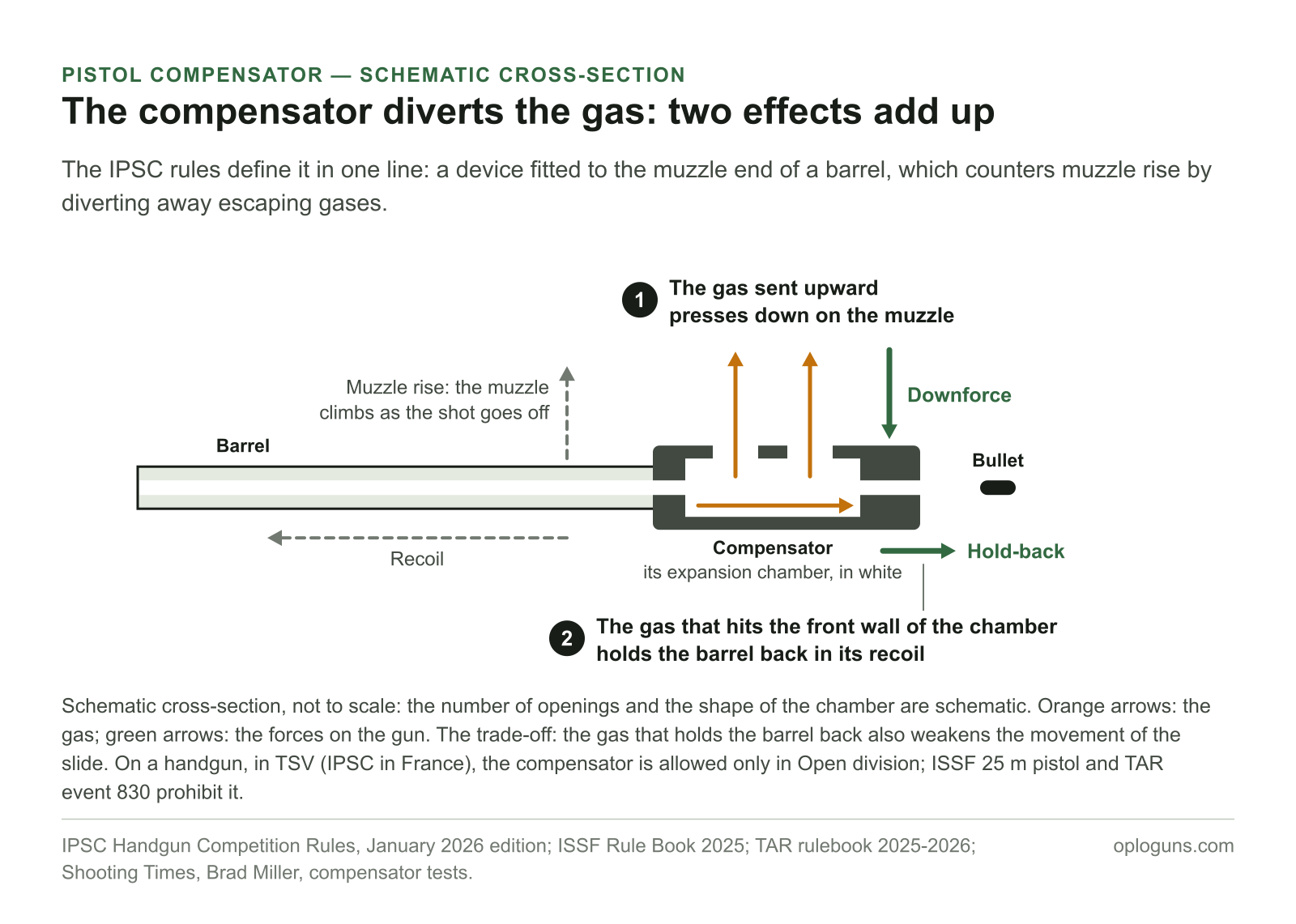
The IPSC rules define it in one line: a device fitted to the muzzle end of a barrel, which counters muzzle rise by diverting away escaping gases1. Muzzle rise is the upward movement of the muzzle as the shot goes off.
Two effects add up. The gas sent upward presses down on the muzzle3. And the gas that hits the front wall of the expansion chamber holds the barrel back in its recoil2.
Three setups exist on a pistol:
- The add-on compensator, screwed onto a threaded barrel. The sheets surveyed list two threads: 13.5 × 1 left-hand, or 1/2 inch with 28 threads per inch5.
- The model-specific compensator, fitted « sans aucune modification » [without any modification] according to the sheet for the Canik Rival's5.
- The compensator integral with the barrel: Staccato describes the barrel of its XC as a single, compensated piece4.
The ported barrel is a cousin. Its openings are cut into the barrel itself, ahead of the muzzle, and release gas while the bullet is still in it2. French gun shops sell these parts under two names, compensator and muzzle brake, sometimes side by side5. The ISSF rulebook, for its part, cites the two next to each other7.
Muzzle rise of a 9mm pistol: 36% less on a rest
One published measurement comes from the American magazine Shooting Times. In 2015, Brad Miller compared three 9mm barrels there on a Ransom Rest, a mechanical fixture that holds the gun and lets its travel be measured as the shot goes off2.
The protocol: a 124-grain bullet, or 8.04 g, the same powder in the quantified comparison, ten shots per load and per barrel2. The results are brought back to the same bullet velocity: 1,100 feet per second, or 335 m/s11. The power factor, bullet weight multiplied by velocity, comes to 136 there: Minor11.
| 9mm barrel | Muzzle rise | Bullet velocity |
|---|---|---|
| Factory, Glock 19 | Reference | Reference |
| Two ports, Glock 19C | 30% less | 20 m/s less |
| Single-chamber compensator | 36% less | Between the two |
So the compensator takes away a little more than a third of the travel, not the whole travel. Six points separate it from the ported barrel, which pays for its effect in velocity: 66 feet per second, 20 m/s, lost with the same ammunition211.
Compensator and ammunition: more gas, more effect
A compensator works with what it is given. In a second test on the same rest, in .45 ACP, the same author measured 46% less recoil with a traditional compensator, screwed onto the barrel3. Two models attached to the slide, in place of the barrel bushing, took away 30% and 14%3.
The highest figure comes from the .38 Super: 74% on average, with a 115-grain bullet and a powder charge close to that of the .45 ACP3. The author draws a rule from it: a lot of gas and a light bullet make the compensator more efficient3.
In Open division, Major requires a factor of 160 with a bullet of 120 grains at least, when the ammunition in the 2015 test gave 136111. The calculation and the velocities to hold are in our article on Open division. Common bullet weights are compared in our 9mm ammunition guide.
These measurements come from a rest, on two series of guns: they give a direction and an order of magnitude, not the figure for a given pistol held in two hands.
A slowed slide: the trade-off of the compensator
The part is paid for in function. The gas that holds the barrel back also weakens the movement of the slide2. In the 2015 test, the lightest load no longer cycled the gun once the compensator was fitted. In another series, four shots out of ten malfunctioned2.
A compensator manufacturer, Strike Industries, writes it in the description of its own model: a part mounted on the barrel adds moving mass, which can harm the cycling of a pistol5. The author of the test mentions a weaker recoil spring to get reliable cycling back with a range of ammunition2.
The add-on compensator on a 9mm pistol
Pros
Length also counts at the belt: the holster has to take the lengthened gun. Competition holsters and their inserts are in our article on the IPSC holster by pistol, malfunctions in pistol malfunctions. It remains to be seen where the part is allowed to shoot.
Compensator in TSV: Open division, and Open only
TSV, tir sportif de vitesse, is the French name for IPSC practical shooting. Each division appendix of the IPSC Handgun rules carries the same line 13, the one for compensators, ports, sound suppressors and flash suppressors. The answer, in the January 2026 edition1:
| Handgun division | Compensator | Detail in the rules |
|---|---|---|
| Open | Yes | Weights attached to the barrel also allowed |
| Standard | No | Only porting of the barrel is prohibited; the slide may be ported |
| Classic | No | — |
| Production | No | — |
| Production Optics | No | — |
| Revolver | No | — |
| Optics | No | Only porting of the barrel is prohibited; the slide may be ported |
Open is also the only division to allow a weight attached to the barrel and extending beyond the muzzle1. The rest of its appendix is detailed in our article on Open division, and the seven divisions are compared in which pistol for TSV.
A compensated pistol declared in another division does not stay there. After the start signal, non-compliant equipment sends the shooter to Open, if it is available at the match, with the same gun1. A model supplied compensated, like the Staccato XC, therefore shoots only in Open: see our guide to Staccato and 2011 pistols.
The pistol-caliber carbine follows a different rule. The IPSC PCC rules, in their April 2023 and January 2024 editions, allow compensators on it10. Neither is the edition in force; the April 2023 one is described in our article on the PCC. In shotgun and rifle, other divisions allow it too: they are described in our article on IPSC Shotgun and Rifle.
In France, the federation's rules add their own condition: TSV firearms comply with the IPSC rules, and are « en conformité avec la législation Française en vigueur » [in compliance with the French legislation in force]9.
ISSF 25 m, TAR 830: the compensator banned
Outside TSV, two rulebooks close the door to it on cartridge pistols, each for its own events78:
- ISSF 25 m pistol: compensators, muzzle brakes, perforated barrels and any device functioning in a similar manner are prohibited (rule 8.4.1.6).
- ISSF 10 m pistol, air: ported barrels and perforated barrel attachments are allowed, if the pistol fits in the measuring box (rule 8.4.1.5).
- Tir aux armes réglementaires (TAR), the French federation's service-arms discipline, event 830, « armes récentes » [recent arms] pistols and revolvers in calibers from 7.62 to 11.60 mm: its annex lists among non-authorized items « Tous systèmes de contrepoids rajoutés » [all added counterweight systems] and « Tous systèmes de compensation de recul » [all recoil compensation systems].
A .22 LR pistol with a threaded barrel is therefore shot at 25 m with nothing on the end of the barrel. The other thresholds for these events are in our article on pistol eligibility by discipline, and in 25 m pistol.
Buying a compensator: €89 to €329, and the code
Eight pistol compensators were on sale on their own, on 15 November 2026, at three French gun shops5:
| Type | Examples recorded | Price |
|---|---|---|
| Screw-on, for a threaded barrel | Toni System for Glock, Armanov, ZEV | €89 to €135 |
| For a specific model | Toni System for Domina, Strike Industries for Glock 19, Walther for PDP Pro SD | €110 to €160 |
| For Canik Rival, with rail | Canik | €315 to €329 |
The threaded barrel is not included. And the barrel is what the code names. Article R311-1 of the code de la sécurité intérieure, France's internal security code, draws up the list of firearm components: « le canon, la carcasse, la boîte de culasse » [the barrel, the frame, the receiver], the slide or bolt, the cylinder, the locking systems and the conversion6. Article R311-2 classifies in Category B, under item 5°, the components of the firearms of that category, including the handguns of item 1°6.
The compensator, for its part, does not appear there. Neither article R311-1 nor article R311-2 contains the words « compensateur » [compensator], « frein de bouche » [muzzle brake] or « cache-flamme » [flash hider]6. A single muzzle device is named there: the sound suppressor, which R311-1 places outside firearms if it does not alter the functioning of the firearm6. That point is covered in our article on the sound moderator.
So these two articles say nothing about a compensator sold on its own. The sheets surveyed indicate neither a category nor a document to supply for it5: the silence of a commercial sheet is not a rule. The question is put to the gunsmith before buying, as is the status of the threaded barrel itself.
Three misconceptions about pistol compensators
- "A compensator eliminates recoil." Measured on a rest in 9mm: 36% less muzzle rise, not all of it2.
- "A pistol with a ported slide is banned outside Open." In Standard and in Optics, only porting of the barrel is prohibited: the slide may be ported1.
- "Compensator and silencer are the same part as far as the texts go." The IPSC rules cite them side by side as distinct devices, and the code names only the sound suppressor16.
Pistol compensator according to your goal
What you gain, what you give up
To shoot in Open division, the compensator is part of the gun: it is the only handgun division that allows it, and the only one where a 9mm semi-automatic pistol can shoot Major. In return, a gun and ammunition specific to that division.
To shoot in another division, Production, Standard or Optics for example, the part is prohibited, and fitting it moves the shooter to Open if it is available at the match; otherwise, their scores do not count. In return for its absence, the gun stays allowed in its division, ported slide included in Standard and in Optics.
For 25 m or event 830, the part stays in the case: the ISSF rulebook prohibits it on 25 m pistols, the TAR rulebook in its recent-arms event. In return, a model sold compensated from the factory is not allowed there.
For practice at the range, a screw-on compensator takes away about a third of the muzzle rise measured on a rest. In return, a slowed slide, ammunition to choose accordingly, a holster to rethink.
Sources 11 references
The rules come from the IPSC Handgun rules of January 2026, the ISSF rulebook and the FFTir rulebooks; the measurements, from two machine-rest tests published by the magazine Shooting Times; the law, from the code de la sécurité intérieure; the prices, from surveys dated 15 November 2026 at three French gun shops. Click a note marker in the text to highlight the matching source.
- IPSC — IPSC Handgun Competition Rules, January 2026 Edition (PDF, final version of 29 December 2025, linked from the IPSC's "Rule Books" page), reread on 15 November 2026: glossary (12.5, p. 40), "Compensator : A device fitted to the muzzle end of a barrel to counter muzzle rise by diverting away escaping gasses"; line 13 of the division appendices, "Compensators, ports, sound and/or flash suppressors": "Yes" in Open (D1, p. 55), "No, see below" in Standard (D2, p. 56) and in Optics (D6, p. 63), "No" in Classic (D3), Production (D4), Production Optics (D4a) and Revolver (D5); D2, 17 and D6, 16, "Only porting of barrels is prohibited. Slides may be ported."; line 14, "Weight(s) attached to barrel that extend beyond the muzzle": "Yes" in Open, "No" elsewhere; D1, "Minimum power factor for Major : 160", "Minimum power factor for Minor : 125", "Minimum bullet weight : 120 grain for Major"; 6.2.5.1, a shooter whose equipment does not comply with their division is "placed in Open Division, if available, otherwise the competitor's scores will not be entered into match results"; 6.2.5.3, a reclassified shooter is "required to continue using the same firearm and sights"; 5.6.3.5, power factor, "The final result will ignore all decimal places". ⚠️ The IPSC also publishes interpretations during the year on its Rule Books page: to be checked before a match.
- Shooting Times — Brad Miller, "Pistol Recoil Reduction: Ports vs. Compensator", 26 May 2015, read on 15 November 2026: Glock 19C with a barrel cut with two ports, Rowland barrel with a single-chamber compensator, factory Glock 19 barrel; ammunition "loaded with Remington 124-grain JHP bullets and Accurate #7 gunpowder", two loads, ten shots per load and per barrel; "the Ransom Rest is an objective method to quantitatively measure muzzle rise"; comparison at equal velocity, "selected as 1,100 fps"; "The Glock ported barrel had 30 percent less muzzle rise", "the Rowland compensator reduced muzzle rise by 36 percent", velocity of the compensated barrel falling between those of the two Glock barrels; the compensator adds length and weight; "The ported barrel produced an average of 66 feet per second (fps) less velocity with the same ammunition"; "When gas hits the front wall of the compensator's expansion chamber, it pushes on that wall and slows the barrel's rearward movement"; the light load "failed to cycle the gun at all when the compensator was added to the Rowland barrel"; "the gun suffered four cycling malfunctions of the 10 shots fired due to weaker slide movement"; a compensator "might require a weaker recoil spring to function reliably with a wide range of ammunition". ⚠️ Press measurement on a rest, one gun and one load: an order of magnitude, not a value for every pistol.
- Shooting Times — Brad Miller, "Reducing Recoil: Traditional vs. Bushing Compensators", 10 February 2014, read on 15 November 2026: Para Ordnance pistols in .45 ACP, .40 S&W and 9mm, "The guns were fired from a Ransom Rest"; "Traditional compensators attach to the barrel, while bushing compensators replace the barrel bushing and attach to the slide"; "The EGW compensator reduced recoil by an average of 46-percent with the .45 ACP"; "The Wilson Combat Multi-Comp reduced recoil by an average of 30-percent in the .45 ACP"; "The Innovative Industries compensator produced an average of 14-percent less recoil"; .38 Super with a 115-grain bullet, "an average 74-percent reduction in recoil"; "compensators are all about gas"; "Similar gas volume with much lighter bullets might make compensator function more efficient". ⚠️ Press measurement on a rest; recoil is measured there by the travel of the gun.
- Staccato — Staccato XC, manufacturer's sheet, read on 15 November 2026: "Built with an integrated compensated barrel and a balanced trigger"; "One piece Island barrel for better balance and a lighter slide making it easier to track through recoil"; barrel "5.0" Island Comp". ⚠️ Manufacturer's claim.
- Pistol compensators sold on their own, sheets (in French) and prices recorded on 15 November 2026. Deville Armory: Toni System GLV6 for Glock, €89.00, « filetage M13.5x1LH » [M13.5x1LH thread]; « Frein de bouche compensateur Armanov PCOMP » [Armanov PCOMP muzzle brake compensator], €99.95, « Compatible avec canons filetés 1/2"-28 et M13,5 x 1 LH » [compatible with 1/2"-28 and M13.5 x 1 LH threaded barrels]; Canik compensator for Rival and Rival-S, €315.00. Armurerie de la Bourse: Toni System for Tanfoglio Domina, €110.00, « 4 évents supérieurs, 2 évents latéraux » [4 top ports, 2 side ports]; Strike Industries Mass Driver Comp for Glock 19 Gen4, €145.00, manufacturer's text as reproduced on the sheet: « Les compensateurs montés sur le canon ajoutent une masse alternative et augmentent le moment d'inertie du système d'exploitation, ce qui peut avoir un effet négatif sur le cycle fiable des armes de poing à recul » [barrel-mounted compensators add reciprocating mass and increase the moment of inertia of the operating system, which can have a negative effect on the reliable cycling of recoil-operated handguns]. Le Pistolier: ZEV 9mm compensator V2, €135.00, « Pour canon fileté en 13,5x1LH ou 1/2"x28 » [for a barrel threaded 13.5x1LH or 1/2"x28], « si ce compensateur est monté sur un Glock 19, alors celui-ci atteindra la longueur d'un Glock 34 » [if this compensator is fitted to a Glock 19, the pistol will reach the length of a Glock 34]; Walther, compensator for PDP Pro SD, €160.00; Canik, compensator for Rival, €329.00, « il se monte facilement et sans aucune modification » [it fits easily and without any modification], « Livré sans l'arme » [supplied without the gun]. ⚠️ Commercial data; three references displayed as to-order or out of stock that day; the page of the manufacturer Strike Industries could not be read. None of these sheets indicates a category or a document to supply for the compensator.
- Légifrance — article R311-1 and article R311-2 du code de la sécurité intérieure (in French), versions in force since 7 September 2025 (decree no. 2025-894 of 5 September 2025), consulted on 15 November 2026: R311-1, I, 19°, « Elément d'arme : partie d'une arme essentielle à son fonctionnement : le canon, la carcasse, la boîte de culasse, y compris le cas échéant ses parties supérieures et inférieures, la culasse, y compris le cas échéant son ensemble mobile additionnel, le barillet, les systèmes de fermetures et la conversion » [firearm component: a part of a firearm essential to its functioning: the barrel, the frame, the receiver, including where applicable its upper and lower parts, the slide or bolt, including where applicable its additional moving assembly, the cylinder, the locking systems and the conversion]; IV, 2°, not firearms: « Les réducteurs de son constituant des pièces additionnelles ne modifiant pas le fonctionnement de l'arme » [sound suppressors that are additional parts not altering the functioning of the firearm]; R311-2, Category B, 1°, « Armes à feu de poing et armes converties en armes de poing non comprises dans les autres catégories » [handguns and firearms converted into handguns not included in the other categories]; 5°, « Eléments des armes classées aux 1°, 2°, 3° et 4° de la présente catégorie » [components of the firearms classified in items 1°, 2°, 3° and 4° of this category]. The words « compensateur », « frein de bouche » and « cache-flamme » appear in neither article.
- ISSF — Rule Book, Edition 2025, Third Print 10/2026 (PDF, in force since 19 October 2026), read on 15 November 2026: 8.4.1.5, 10 m pistol, "Pistol with all accessories fitted must fit in measuring box", b) "Ported barrels and perforated barrel attachments are allowed"; 8.4.1.6, 25 m pistol, b) "Compensators, muzzle brakes, perforated barrels or any device(s) functioning in a similar manner are not allowed".
- FFTir, CNS TAR — Règlement TAR, saison 2025-2026 [TAR rulebook, 2025-2026 season] (78-page PDF, in French, « Diffusion 12 janvier 2026 » [released 12 January 2026]), reread on 15 November 2026: « ANNEXE A – discipline 830 », recent arms, pistols or revolvers, « Calibres réglementaires de 7,62 à 11,60 » [service calibers from 7.62 to 11.60], « ARMES et/ou ELEMENTS NON AUTORISES » [non-authorized firearms and/or items]: « Tous systèmes de contrepoids rajoutés » [all added counterweight systems], « Tous systèmes de compensation de recul » [all recoil compensation systems], « Tout allègement de l'arme d'origine ou non » [any lightening of the firearm, factory or otherwise].
- FFTir — Règlement administratif du Tir Sportif de Vitesse, saison 2019/2020 [TSV administrative rules, 2019/2020 season] (4-page PDF, in French), reread on 15 November 2026: article XIII, firearms « conformes à la réglementation FFTir et aux règlements sportifs de l'I.P.S.C. Elles doivent également se trouver en conformité avec la législation Française en vigueur » [compliant with FFTir regulations and the sporting rules of the I.P.S.C. They must also be in compliance with the French legislation in force]. ⚠️ 2019-2020 edition, the last version published by the federation.
- IPSC — IPSC Pistol Caliber Carbine Competition Rules, January 2024 Edition (annotated PDF, "Marked-Up Version Final 27 Dec 2023", hosted by the IPSC's Czech region), read on 15 November 2026: Appendix D, line 10, "Compensators, sound and/or flash suppressors permitted : Yes"; same line, same answer in the April 2023 edition (final version of 25 April 2023, copy from an unofficial site). ⚠️ April 2023 and January 2024 editions: the edition in force could not be read.
- Calculations and conversions: 1 grain = 0.0648 g, so 124 grains = 8.04 g; 1 foot per second = 0.3048 m/s, so 1,100 ft/s = 335.3 m/s and 66 ft/s = 20.1 m/s; power factor of the test ammunition: 124 × 1,100 ÷ 1,000 = 136.4, or 136, decimals ignored, above Minor (125) and below Open Major (160); 36 − 30 = 6 points; prices: €89.00 to €135.00 for the three screw-on compensators, €110.00 to €160.00 for the three gun-specific models, €315.00 to €329.00 for the Canik.
The rules and the law in force prevail. This article describes the IPSC Handgun rules of January 2026, the ISSF rulebook in force since 19 October 2026, the FFTir rulebooks and the code de la sécurité intérieure in the versions cited; the prices are those of 15 November 2026. The measurements come from machine-rest tests, on given guns and loads. Fitting a part to a barrel and choosing a spring are a gunsmith's job, as is the status of the part before buying.
Frequently asked questions
What is a compensator for on a 9mm pistol?
To counter muzzle rise. The IPSC rules define it as a device fitted to the muzzle end of the barrel, which diverts escaping gases. On a 9mm pistol held in a machine rest, the magazine Shooting Times measured 36% less muzzle rise than with the factory barrel, at equal bullet velocity.
Is a compensator allowed in IPSC?
On a handgun, in a single division: Open. The IPSC Handgun rules of January 2026 answer "Yes" on the compensator line of Appendix D1, and "No" in the six other appendices. In Standard and in Optics, only porting of the barrel is prohibited: the slide may be ported.
Can you fit a compensator to a .22 LR pistol in competition?
Not in ISSF 25 m events: rule 8.4.1.6 prohibits compensators, muzzle brakes, perforated barrels and any device functioning in a similar manner. In 10 m air pistol, rule 8.4.1.5 allows ported barrels and perforated barrel attachments.
Do you need a threaded barrel to fit a compensator?
Most often. Compensators sold on their own screw onto a threaded barrel, with a 13.5 × 1 left-hand thread or a 1/2-inch, 28-threads-per-inch one according to the sheets surveyed. Others are specific to one model and fit without modification, or are one piece with the barrel, as on the Staccato XC.
How much does a 9mm pistol compensator cost?
From €89 to €329 for eight references recorded on 15 November 2026 at three French gun shops: €89 to €160 for six screw-on or model-specific compensators, €315 to €329 for the one for the Canik Rival, which has a rail. The threaded barrel is not included in these prices.
What is the difference between a compensator and a ported barrel?
The location. Ports are cut into the barrel itself, and release gas while the bullet is still in it. A compensator extends the barrel: its chambers collect the gas after the muzzle. In the Shooting Times test, the ported barrel took away 30% of the muzzle rise, the compensator 36%, and the ported barrel lost 20 m/s.
Spotted an error, or a rule that has changed since we checked? Report an error