Cleaning a lever-action rifle or a .22 LR
Published on · 8 min read · Anthony Baillon
A lever-action rifle is cleaned with the action open and the gun unloaded, never disassembled beyond the manual. Henry cleans the barrel from breech to muzzle; Browning and Winchester run the rod in from the muzzle, with a muzzle guard. All three ask for little oil: in excess, it runs down to the stock's wood and damages it.
At a glance
| Manual | Direction of cleaning | Frequency |
|---|---|---|
| Henry H001, Big Boy | Breech to muzzle, preferably with a pull-through | Every time it is used |
| Browning BL-22 | From the muzzle, muzzle guard | After every day of shooting |
| Winchester Model 1873 | From the muzzle, muzzle guard | After every day of shooting |
- First: action open, gun unloaded and checked, ammunition out of the room.
- Never any disassembly beyond what the manual describes; the rest goes to a gunsmith.
Before cleaning a lever-action rifle: unload it
The three manuals start in the same place. Open the action, make certain the gun is completely unloaded, keep the muzzle pointed in a safe direction134. Ammunition stays away from the cleaning area, and no mechanical function is tested with a live cartridge13.
Unloading follows each model's magazine:
- Henry .22: withdraw the inner magazine tube completely, tip the gun to let the cartridges slide out into a container, replace the tube, then open the action carefully to eject the chambered round. Cycle the lever several times, then look into the chamber1.
- Browning BL-22: work the lever until the cartridges have been ejected one by one, then several times more. Check, holding the action open, that the chamber and the magazine are empty3.
The position of the hammer differs. Henry wants it down, in the fired position, before cleaning1; Browning, in the half-cock position3. Each instruction holds for the gun in its manual. Browning and Winchester add eye protection: springs and solvents can reach the eyes34.
Cleaning the barrel: from the breech or from the muzzle
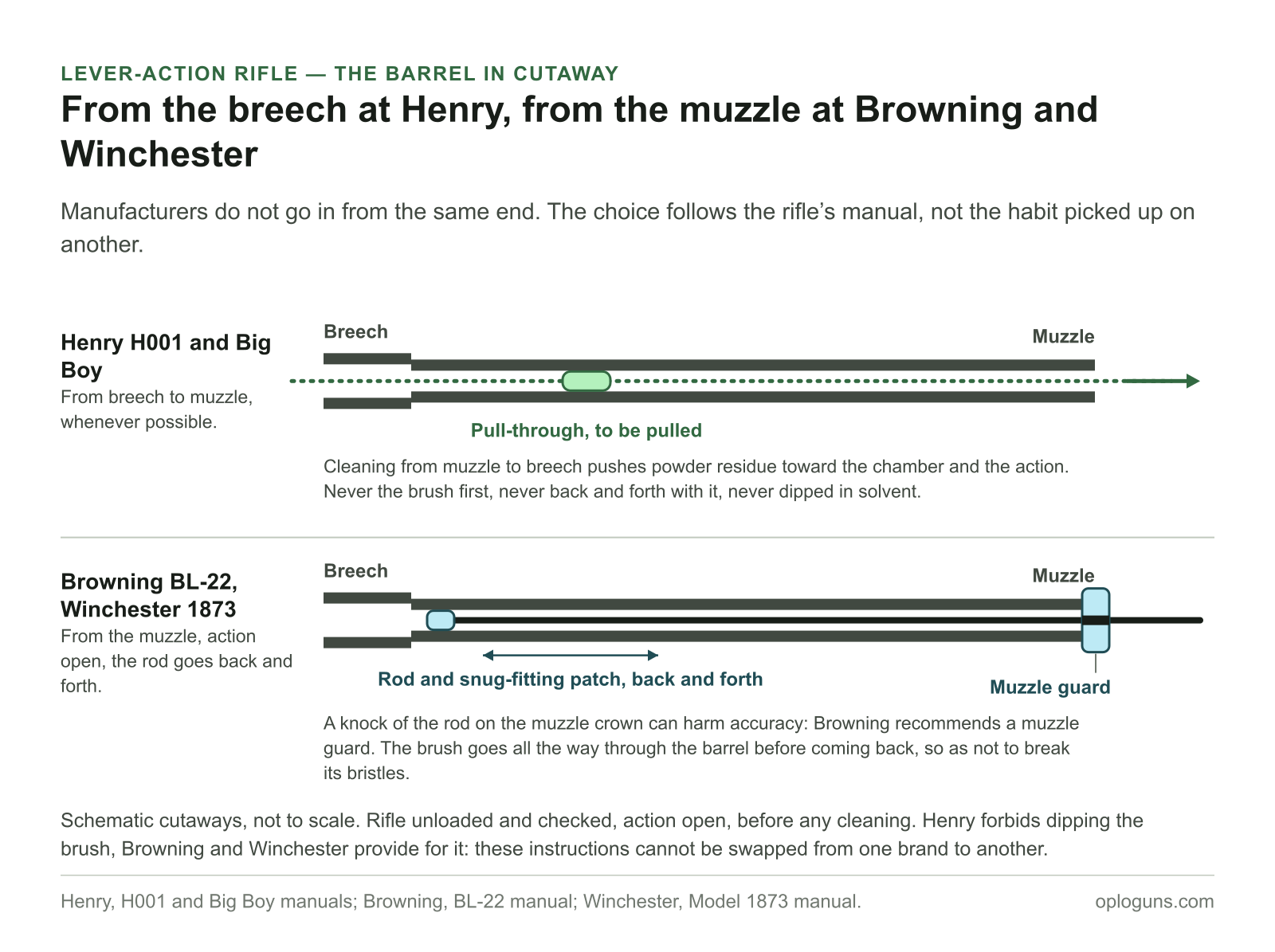
Manufacturers do not go in from the same end. The choice follows your rifle's manual, not the habit picked up on another gun.
Henry: in the direction of the bullet
Henry asks you to clean "in the direction of bullet travel", from breech to muzzle, whenever possible1. Its argument: cleaning from muzzle to breech carries the powder residue from the bore into the chamber and the action. It advises a pull-through cleaning kit. The rod remains allowed, provided you spare the muzzle crown and do not deposit fouling in the receiver1.
The instructions that follow are Henry's, for its H001 and Big Boy12:
- A mild solvent, never an aggressive one, and only a few drops.
- A clean patch on every pass.
- Never the brush first: it would pick up the dirt and deposit it in the chamber.
- Never back and forth with the brush, which bends its bristles.
- Never the brush dipped in solvent.
Browning and Winchester: from the muzzle, muzzle guard in place
For the BL-22, Browning has you raise the lever about five degrees, once the action is open, to lower the carrier below the chamber. The rod, with a slotted tip or a jag, enters from the muzzle with a snug-fitting patch, and goes back and forth several times3. Winchester describes the same passage from the muzzle for the Model 1873, with the action opened by lowering the lever completely4. Browning recommends a muzzle guard, and Winchester points to one sold separately: a knock of the rod on the crown can harm accuracy.
Normal fouling comes away with a patch soaked in solvent. If it is heavy, a brass brush, dipped in or sprayed with solvent, scrubs the chamber and the bore. It goes all the way through the barrel before coming back, so as not to break its bristles34. Winchester adds a copper or lead solvent for accuracy4. Then the barrel is wiped dry, and a lightly oiled patch protects it34.
Henry forbids dipping the brush; Browning and Winchester provide for it. These instructions cannot be swapped from one brand to another.
Oiling a lever-action rifle: a film, no more
Oil is the point on which the three manuals agree: little134.
- Henry: wipe down the action and oil the key parts; lightly oil the bolt. Too much oil runs toward the trigger, which becomes "gummy", or toward the stock, whose wood can fail.
- Browning BL-22: remove the dirt from the receiver with a small brush or a rag, then a very light film of fine oil on the moving parts.
- Winchester Model 1873: a few drops along the striker, on the sides of the hammer and at the lever pivot.
Browning and Winchester write it in capitals: do not pour oil into the receiver. It drains down to the wood, softens it and loosens the stock34. The metal surfaces are then wiped with a lightly oiled rag. Finger marks hold moisture, Browning writes3. Last, the chamber and the barrel are inspected: no patch must be left in them4.
Disassembling a lever action: not beyond the manual
"It is not necessary to take your Henry lever action apart to keep it clean," the manufacturer writes1. Henry, Browning and Winchester forbid any disassembly beyond what their manual describes. The mechanism is fitted with precision, and taking it apart can damage it permanently134. Beyond that, the gun goes to a qualified gunsmith.
Henry also advises, over time and depending on use, having your rifle inspected by a gunsmith, who can clean it more thoroughly1. Before going any further, Browning asks for a thorough cleaning when a malfunction occurs: it is sometimes enough to solve it3.
When to clean a .22 or lever-action rifle
| Moment | Henry | Browning BL-22 | Winchester 1873 |
|---|---|---|---|
| Before the first shot | Remove the factory compound | Remove the factory compound, without disassembly | Remove the factory compound, oil |
| After shooting | Every time it is used | After every day | After every day |
| After rain, sand, humidity | Clean and oil | Film of oil on the metal | Film of oil on the metal |
| After long storage | Clean before shooting | — | — |
Henry adds an instruction specific to the .22: do not leave fired cases in the chamber. The moisture in some cartridges can "sweat" out onto its walls and corrode it1. The same manufacturer advises against dry firing, which ends up marking the edge of the chamber of a rimfire gun1.
Storing a lever-action rifle after maintenance
Henry advises against storing the gun in anything that holds moisture, leather or heavy cloth, or with a plug in the barrel1. For long storage, it oils the bore, the chamber and the internal surfaces, and puts a rust-preventive oil on the outside. It cleans the gun before taking it out again1. Winchester stores the rifle in a cool, dry place, the ammunition separately4.
Cleaning gear is compared in the gun cleaning kit.
In France, the storage rules for a Category C firearm are in declaring a Category C firearm.
Three misconceptions about cleaning a lever-action rifle
- "A lever-action rifle has to be taken apart to be clean." Henry writes that it is not necessary1.
- "The rod always goes in from the breech." On the BL-22 and the Model 1873, it enters from the muzzle, with a muzzle guard34.
- "More oil protects better." The three manuals limit oil to a film: the excess reaches the trigger and the wood134.
Which procedure for your rifle
What your gun's manual says
For a Henry, the barrel in the direction of the bullet, with a pull-through, a mild solvent and a clean patch on every pass. In return, the brush is never dipped and never goes back and forth.
For a Browning BL-22 or a Winchester 1873, the rod from the muzzle with a muzzle guard, then a lightly oiled patch. In return, the brush goes all the way through the barrel before coming back.
For another model, its own manual. A bolt-action rifle or a .22 LR pistol follow theirs: pistol maintenance is in maintaining a sport pistol, lever-action rifles in the lever-action rifle.
The manufacturer's manual prevails. The instructions cited are those of the Henry, Browning and Winchester manuals consulted on 15 November 2026, written for the US versions. A gun that malfunctions goes to a gunsmith; where to shoot in France is set out in recreational shooting: license, where to shoot.
Sources 4 references
All the instructions come from the manufacturers' manuals, consulted on the day of the article in their online version; each holds only for the models of the manual that gives it. Click a reference number in the text to highlight the matching source.
- Henry Repeating Arms — H001 series manual (.22 lever-action rifles) (PDF), consulted on 15 November 2026: "BEFORE PERFORMING CLEANING PROCEDURES, MAKE SURE THE HAMMER IS IN THE FIRED-DOWN POSITION"; "OPEN THE ACTION AND MAKE CERTAIN YOUR FIREARM IS COMPLETELY UNLOADED. KEEP THE MUZZLE POINTED IN A SAFE DIRECTION"; "KEEP ALL AMMUNITION AWAY FROM THE CLEANING AREA. NEVER TEST THE MECHANICAL FUNCTION OF YOUR RIFLE WITH LIVE AMMUNITION"; unloading: "completely withdraw the inner magazine tube from the gun. Tip the rifle downward, allowing the cartridges to slide out into a suitable container. Replace the inner magazine tube. Very carefully, open the action to eject the chambered round", "Cycle the action multiple times", "Visually inspect the chamber"; "Do not leave discharged (empty) cases in the chambers for any length of time, as the chemical composition of many cartridges contain moisture which can “sweat” out"; "DO NOT ATTEMPT TO TAKE YOUR FIREARM APART FURTHER THAN EXPLAINED IN THIS MANUAL"; "IT IS NOT NECESSARY TO TAKE YOUR HENRY LEVER ACTION APART TO KEEP IT CLEAN"; "DO NOT USE AGGRESSIVE SOLVENTS"; "Your gun should be cleaned every time it is used. A minimum cleaning includes wiping down the action and oiling key parts"; "WHENEVER POSSIBLE, CLEAN THE BORE IN THE DIRECTION OF BULLET TRAVEL"; "Improperly cleaning from muzzle to breech will cause this powder residue to be carried from the bore into the chamber and action"; "use a pull-though cleaning kit"; "If desired, a cleaning rod and patches may be used, but care must be taken to avoid damaging the muzzle crown as well as depositing fouling into action"; "USE A CLEAN PATCH EACH TIME YOU GO DOWN THE BARREL"; "NEVER GO BACK AND FORTH REVERSING THE BRUSH"; "USE ONLY A FEW DROPS OF SOLVENT/LUBRICANT OIL"; "this will cause a gummy trigger"; "could cause premature failure of the wood"; "NEVER RUN A BRUSH IN THE BARREL FIRST"; "Never dip a brush in solvent"; "Lightly oil bolt"; "A gun brought out of prolonged storage should also be cleaned before shooting"; inspection by a gunsmith over time; storage: neither leather nor heavy cloth, no plug in the barrel, oil on bore, chamber and internal surfaces for long storage, rust-preventive oil on the outside; "It is suggested that you do NOT dry fire this rifle". US version.
- Henry Repeating Arms — H006 and H012 series manual (Big Boy) (PDF), consulted on 15 November 2026: same cleaning instructions as the H001 series, including "IT IS NOT NECESSARY TO TAKE YOUR HENRY LEVER ACTION APART TO KEEP IT CLEAN" and "WHENEVER POSSIBLE, CLEAN THE BORE IN THE DIRECTION OF BULLET TRAVEL". US version.
- Browning — BL-22 manual, consulted on 15 November 2026: "ALWAYS OPEN THE ACTION, MAKE CERTAIN YOUR RIFLE IS COMPLETELY UNLOADED, AND ENSURE THE HAMMER IS IN THE HALF-COCK POSITION"; "WEAR EYE PROTECTION WHEN DISASSEMBLING AND CLEANING YOUR RIFLE"; "KEEP ALL AMMUNITION AWAY FROM THE CLEANING AREA"; unloading with the lever "until all cartridges have been individually ejected", "ALWAYS WORK THE LEVER SEVERAL TIMES AFTER THE LAST UNFIRED CARTRIDGE HAS BEEN EJECTED", "VISUALLY CHECK, HOLDING THE ACTION OPEN"; "Clean your firearm after every day of shooting, and more often if it becomes excessively dirty"; "it may be necessary to raise the lever about five degrees to lower the carrier below the chamber"; "Use a cleaning rod with a slotted tip or cleaning jag and a patch large enough for a snug fit in the bore. Insert the rod and patch into the barrel at the muzzle and run it back and forth several times"; "We recommend purchasing a muzzle guard"; "a patch saturated with nitro solvent"; brass brush "Dip or spray the brush with nitro solvent", "pushed completely through the barrel before being withdrawn"; "pass a slightly oiled patch through it for preservation"; "Lightly lubricate all moving parts with a high-quality, light gun oil"; "DO NOT POUR LARGE QUANTITIES OF OIL INTO THE RECEIVER OR OTHER PARTS. IT CAN DRAIN DOWN TO THE WOOD AND SOFTEN IT"; "Finger marks provide a place where moisture can accumulate"; "NEVER ATTEMPT TO TAKE YOUR FIREARM APART FURTHER THAN EXPLAINED IN THIS OWNER'S MANUAL"; "The metal of the gun should receive a light film of oil any time the rifle has been exposed to weather or handling"; in case of a malfunction, "give your firearm a thorough cleaning to see if it solves the problem"; initial cleaning: remove the factory rust-preventive compound, "It is not necessary to disassemble your rifle to perform these operations". US version.
- Winchester Repeating Arms — Model 1873 manual, consulted on 15 November 2026: "BEFORE PERFORMING CLEANING PROCEDURES, OPEN THE ACTION AND MAKE CERTAIN YOUR RIFLE IS COMPLETELY UNLOADED"; eye protection; "Clean your firearm after each day of shooting"; before the first shot, remove the rust-preventive compound and oil "Along the surface of the striker assembly", "Along the sides of the hammer", "On the finger lever pivot point"; "Insert the rod and patch into the barrel at the muzzle end and run it back and forth several times"; "A muzzle guard can be purchased separately"; brass brush dipped in or sprayed with solvent, "pushed completely through the bore before being withdrawn"; "clean the bore with a copper or lead solvent"; "pass a lightly oiled patch through the barrel for preservation"; "The barrel and action should be inspected thoroughly to be certain no cleaning patches have been inadvertently left in them"; "DO NOT POUR LARGE QUANTITIES OF OIL INTO THE RECEIVER"; "Store your rifle in a cool, dry place to prevent corrosion. Store your rifle and ammunition separately"; "Open the action by completely lowering the lever"; "NEVER ATTEMPT TO TAKE YOUR FIREARM APART FURTHER THAN EXPLAINED IN THIS OWNER'S MANUAL"; film of oil on the metal "any time the rifle has been exposed to weather or handling". US version.
Frequently asked questions
How do you clean a lever-action rifle?
According to its manufacturer's manual. All of them start with the gun open and unloaded, ammunition out of the room. Henry has the barrel cleaned in the direction of the bullet, from breech to muzzle, with a pull-through; Browning and Winchester run the rod in from the muzzle, with a muzzle guard. All of them ask for little oil and forbid any disassembly beyond their manual.
Do you have to take a lever-action rifle apart to clean it?
No according to Henry, which writes that it is not necessary to take its lever action apart to keep it clean. Browning for the BL-22 and Henry forbid disassembly beyond what the manual describes, and refer the rest to a gunsmith.
Which end does the rod go in on a lever-action rifle?
It depends on the manufacturer. Henry asks you to clean "in the direction of bullet travel", from breech to muzzle, and prefers the pull-through to the rod. Browning for the BL-22 and Winchester for the Model 1873 have the rod enter from the muzzle, protecting the barrel crown with a muzzle guard.
How do you clean a .22 LR pistol?
A pistol is cleaned according to its own manual, after field stripping. The rules common to sport pistols, including frequency and lubrication, are in the pistol maintenance guide. A procedure written for a lever-action rifle does not hold for a pistol.
How often should you clean a lever-action .22 LR rifle?
Every time it is used according to Henry, after every day of shooting according to Browning for the BL-22, and more often if it is very dirty. Both also ask for a cleaning before the first shot, to remove the factory protective compound. Henry asks for cleaning and oiling after exposure to sand, dust, humidity or water; Browning and Winchester, for a film of oil on the metal after exposure to weather or handling.
Spotted an error, or a rule that has changed since we checked? Report an error