Rifle and handgun calibers: the conversion chart in mm and inches, with energies
Published on · 9 min read · Anthony Baillon
A caliber's name rounds things off: .308 Winchester fires a bullet of 7.85 mm at most, .38 Special a 9.12 mm bullet, like .357 Magnum. Muzzle energy depends on the cartridge and the barrel: 518 joules for a 124-grain 9 mm, 3,450 for a 147-grain .308.
At a glance
| Caliber | Bullet, at most | Published muzzle energy |
|---|---|---|
| .22 Long Rifle | 5.72 mm, .225 | 138 to 142 J |
| 9 mm Luger (9 × 19) | 9.03 mm, .356 | 518 J |
| .45 Auto (.45 ACP) | 11.48 mm, .452 | 504 to 508 J |
| .308 Winchester | 7.85 mm, .309 | 3,450 J |
- The diameter comes from the tables of the C.I.P., the body that sets cartridge dimensions.
- The energy comes from the makers, for a given cartridge, bullet weight and test barrel.
Caliber in mm and inches: the conversion chart
An inch is 25.4 mm. A caliber name in inches is therefore read in hundredths or thousandths of an inch: .22 equals 5.59 mm, .308 equals 7.82 mm, .45 equals 11.43 mm12. Yet the name does not give the diameter of the bullet.
The C.I.P., the international commission that publishes cartridge dimensions, gives the maximum bullet diameter for each one1:
| Common name | Other name | Bullet, at most | In inches |
|---|---|---|---|
| .22 Long Rifle | 5.6 mm, .22 LR | 5.72 mm | .225 |
| .223 Remington | 5.56 × 45 in the French reference list | 5.70 mm | .224 |
| 6.5 Creedmoor | — | 6.72 mm | .265 |
| .308 Winchester | 7.62 × 51 | 7.85 mm | .309 |
| .30-06 Springfield | 7.62 × 63 | 7.85 mm | .309 |
| 7.62 × 39 | — | 7.92 mm | .312 |
| .338 Lapua Magnum | — | 8.61 mm | .339 |
| 9 mm Luger | 9 mm Para, 9 × 19 | 9.03 mm | .356 |
| .38 Special | — | 9.12 mm | .359 |
| .357 Magnum | — | 9.12 mm | .359 |
| .45 Auto | .45 ACP | 11.48 mm | .452 |
Diameters from the C.I.P.1; other names from the référentiel général des armes, the French state's reference list of firearm models2; conversions calculated12.
The .38 Special shows it better than any other. Its name says 38 hundredths of an inch, or 9.65 mm. Its bullet measures 9.12 mm at most, the same as that of the .357 Magnum1. The two cases also have the same diameter at the head, 11.18 mm1. A .357 Magnum revolver does in fact fire .38 Special, as the guide to handgun calibers explains.
.308 or 7.62: two measurements of the same barrel
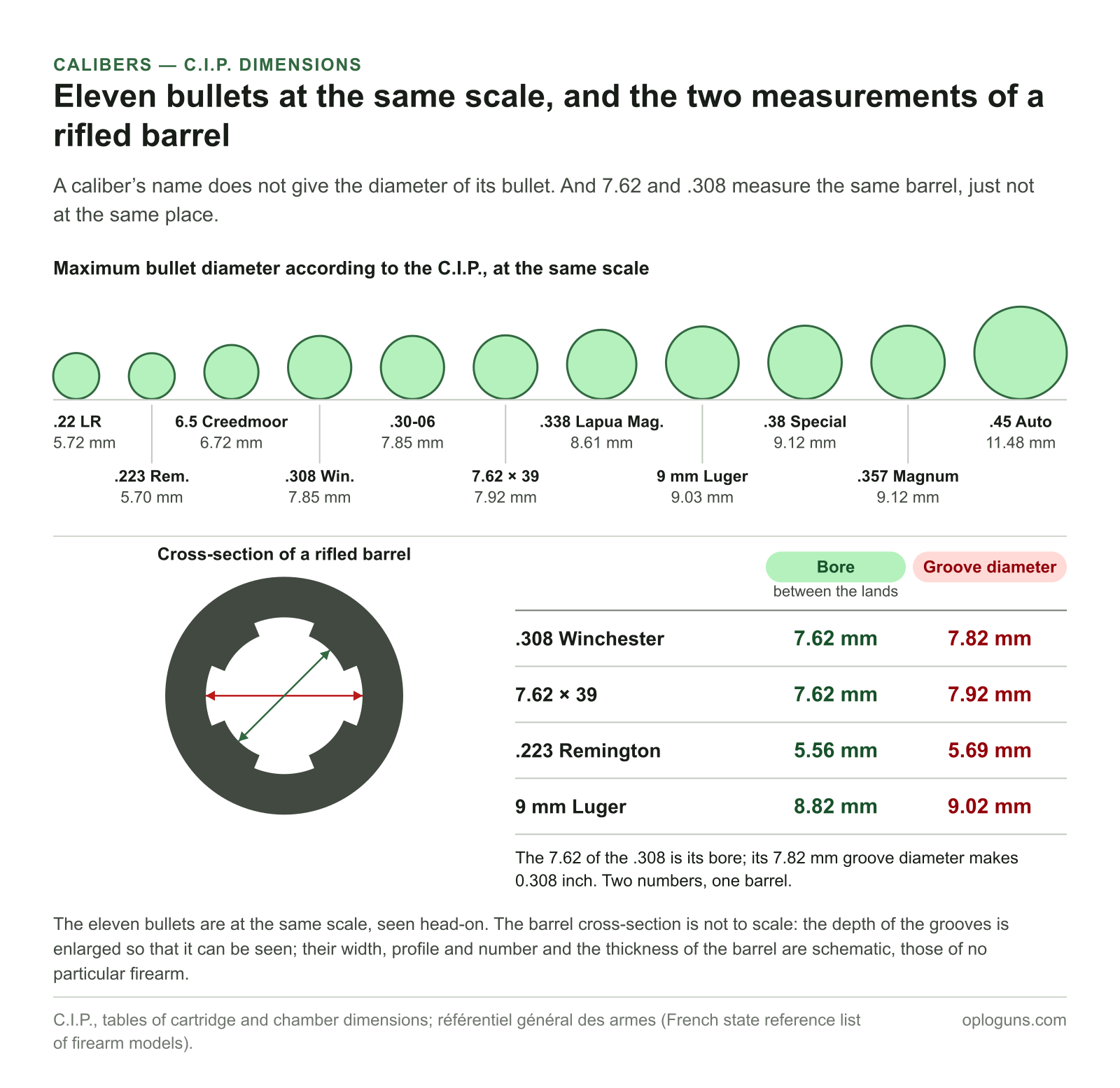
Two numbers for one cartridge: 7.62 and .308. They do not measure the same place. In a rifled barrel, the C.I.P. distinguishes the bore, measured between the lands of the rifling, from the groove diameter1:
- .308 Winchester: bore of 7.62 mm, groove diameter of 7.82 mm, or 0.308 inch.
- 7.62 × 39: bore of 7.62 mm, groove diameter of 7.92 mm.
- .223 Remington: bore of 5.56 mm, groove diameter of 5.69 mm.
- 9 mm Luger: bore of 8.82 mm, groove diameter of 9.02 mm.
For the three long-gun calibers, the metric number is that of the bore. The second figure in a metric name gives the case length: 19.15 mm at most for 9 × 19, 38.70 mm for 7.62 × 391.
The référentiel général des armes, which lists the firearms classified in France, files calibers under a double label: "9 X 19 (9MM LUGER)", "308 WIN (7,62 X 51MM)", "45 AUTO (45 ACP)", or "5,56 X 45 (223 REM)(223 WYLDE)" for .223 Remington2. Each firearm's entry carries that label next to its category.
Muzzle energy: what the makers publish
Muzzle energy equals the mass of the bullet multiplied by the square of its velocity, divided by two; what a joule represents is explained in the "most powerful" pellet rifle. Each maker publishes it for a specific cartridge and test barrel. The table follows the order of the families, then of the diameters:
| Caliber | Cartridge | Velocity | Energy | Test barrel |
|---|---|---|---|---|
| Handgun | ||||
| 9 mm Luger | FMJ 124 grains, 8.00 g | 360 m/s | 518 J | 150 mm |
| .38 Special | FMJ 158 grains, 10.25 g | 271 m/s | 376 J | 190 mm |
| .357 Magnum | FMJ 158 grains, 10.25 g | 385 m/s | 760 J | 150 mm |
| .45 Auto | FMJ 230 grains, 14.90 g | 260 m/s | 504 J | 127 mm |
| Rimfire | ||||
| .17 HMR | 17 grains | 777 m/s | 332 J | 610 mm |
| .22 Win. Magnum | 40 grains | 571 m/s | 423 J | not given |
| .22 Long Rifle | Match, 2.59 to 2.6 g | 327 to 330 m/s | 138 to 142 J | 650 to 660 mm |
| Long gun | ||||
| .223 Remington | FMJ 55 grains, 3.60 g | 1,006 m/s | 1,822 J | 600 mm |
| 6.5 Creedmoor | FMJBT 140 grains, 9.10 g | 810 m/s | 2,985 J | 550 mm |
| .308 Winchester | FMJ 147 grains, 9.55 g | 850 m/s | 3,450 J | 600 mm |
| .30-06 Springfield | FMJ 147 grains | 890 m/s | 3,782 J | 600 mm |
| 7.62 × 39 | FMJ 124 grains, 8.00 g | 738 m/s | 2,179 J | 520 mm |
| .338 Lapua Magnum | Scenar 250 grains, 16.2 g | 890 m/s | 6,416 J | 680 mm |
Sellier & Bellot for the handguns3 and for the long guns up to .30-064; Lapua and RWS for .22 LR7; CCI and Hornady for .22 Magnum and .17 HMR8; Lapua for .338, energy calculated612.
A match .22 LR bullet carries about 140 joules; a 147-grain .308, nearly twenty-five times more12. The energy of the bullet is not the recoil of the firearm, which is calculated separately: the 7x64, .30-06 or .308 comparison puts figures on it for those three calibers.
Same caliber, different energy: cartridge and barrel
The table gives one cartridge per caliber. Another cartridge of the same caliber gives another figure:
- Bullet weight: at Sellier & Bellot, the 115-grain 9 mm Luger leaves at 390 m/s and 570 joules, the 124-grain at 360 m/s and 518 joules, from the same 150 mm barrel3.
- The maker: in 158-grain .357 Magnum, from a 150 mm barrel, Sellier & Bellot publishes 760 joules, GECO 79635.
- The test barrel: it runs from 125 to 190 mm for handguns, from 520 to 680 mm for long guns346. GECO publishes 518 joules for its 124-grain 9 mm from a 125 mm barrel5.
A maker can also publish two figures. For its 250-grain .338 Lapua Magnum, Lapua lists 890 m/s on the sheet, and 905 m/s with 6,634 joules in the first row of its table6. The energy in the table above is calculated from the velocity on the sheet.
The figure to read on a box of cartridges
Energy means something only with the bullet weight and the length of the test barrel. A ranking of calibers by power in fact compares cartridges, each from its own barrel.
Caliber and sport shooting: the event sets the caliber
The rulebook of each event says which caliber it allows. That caliber is a threshold, not a ranking:
| Event | Caliber allowed | Rule |
|---|---|---|
| 10 m rifle | 4.5 mm (.177), compressed air, 7.5 J at most | ISSF, rifle 7.4.4 and 7.4.6 |
| 25 m rimfire pistol, ISSF | 5.6 mm (.22") Long Rifle | ISSF, pistol 8.4.3.2 |
| 25 m centerfire pistol, ISSF | 7.62 to 9.65 mm (.30 to .38) | ISSF, pistol 8.4.3.3 |
| 50 m pistol, ISSF | 5.6 mm (.22") Long Rifle | ISSF, pistol 8.4.3.4 |
| Practical shooting | 9 × 19 at least | IPSC, January 2026, 5.1.2 |
| Precision Rifle | .30 at most, 975 m/s (3,200 feet per second) at most | IPRF, French version 1.3, 4.1.1 |
ISSF rules as translated by the Fédération française de tir, the French shooting federation910; IPSC and IPRF rulebooks11.
Practical shooting adds one measurement. Its cartridge is judged not on its joules but on its power factor, bullet weight multiplied by velocity, which places it in Minor or Major: the scale is set out in IPSC in France.
The choice of a caliber is therefore made inside these bounds. It is covered family by family: 9 mm or .22 LR to start, .22 LR, .22 Magnum or .17 HMR, and the caliber to shoot at 1,000 m.
Category of the firearm: caliber alone does not set it
French law classifies a firearm first by its form and its action. The « armes à feu de poing » [handguns] fall under Category B, in 1°, « non comprises dans les autres catégories » [not included in the other categories]13: a .22 LR pistol like a 9 mm pistol. Long guns are classified by their repeating mechanism and their capacity, described in the French firearm categories A, B, C and D.
One provision covers named calibers. B, 4°, covers the « armes chambrant les calibres suivants, quel que soit leur type ou le système de fonctionnement » [firearms chambering the following calibers, whatever their type or action], including 7.62 × 39 and 5.56 × 4513. The référentiel général des armes files .223 Remington with 5.56 × 45, under the label "5,56 X 45 (223 REM)(223 WYLDE)"2. The category of a given model is read on its entry in the reference list, and checked at the gun shop.
Compressed air follows its own rule: Category D from 2 to under 20 joules, Category C from 20, whatever the caliber, 4.5 or 5.5 mm13. The detail is in the pellet rifle and the 20 joules.
Three misconceptions about calibers
- "The name gives the diameter of the bullet." No: .38 Special fires a bullet of 9.12 mm at most, not 9.65 mm1.
- ".308 and 7.62 are two sizes." No: the 7.62 measures the bore of the barrel, the .308 is close to the groove diameter, 7.82 mm1.
- "The caliber gives the energy." No: the same 9 mm Luger publishes 518 or 570 joules depending on the bullet, from the same barrel3.
Which caliber for your event
Precision shooting at 10, 25 and 50 m
4.5 mm compressed air for 10 m rifle; for pistol, .22 Long Rifle at 25 m rimfire and at 50 m, from 7.62 to 9.65 mm at 25 m centerfire: the calibers of the ISSF rulebooks. In return, one gun per distance, and a .22 LR pistol in Category B like a 9 mm.
Practical shooting
9 × 19 at least, the minimum of the IPSC rulebook. In return, a Category B pistol, on authorization. Choosing the pistol is in IPSC in France.
Long-range shooting
A caliber of .30 at most in Precision Rifle, from 6.5 Creedmoor to .308 in the Open division; the Limited division allows only 7.62 × 51 NATO or .308 Winchester. In return, 300 m firing lines are rare; they are counted in the caliber to shoot at 1,000 m.
The diameters are those of the C.I.P. tables; the energies, those the makers publish for a given cartridge and test barrel. The texts are cited in their version in force on 15 November 2026, and the text in force prevails. The category of a given firearm is checked in the référentiel général des armes and at the gun shop.
Sources 13 references
Dimensions come from the C.I.P. tables; the labels, from the référentiel général des armes; the energies, from the makers' catalogs; the rules, from the federations' rulebooks and from Légifrance. Everything was reread on 15 November 2026, unless stated otherwise. Click a reference number in the text to highlight the matching source.
- C.I.P. — tables of cartridge and chamber dimensions, sheets in French: bullet G1 (maximum cartridge), bore F and groove diameter Z of the barrel, case length L3. 22 Long Rifle (revision of 14 May 2024), G1 5.72 mm; 223 Rem. (17 May 2017), G1 5.70, F 5.56, Z 5.69; 6,5 Creedmoor (21 April 2020), G1 6.72; 308 Win. (23 September 2008), G1 7.85, F 7.62, Z 7.82; 30-06 Spring. (23 September 2008), G1 7.85; 7,62 x 39 (22 May 2013), G1 7.92, F 7.62, Z 7.92, L3 38.70; 338 Lapua Mag. (18 October 2016), G1 8.61; 9 mm Luger (23 September 2008), "9 mm Para(bellum), 9 x 19 (mm)", G1 9.03, F 8.82, Z 9.02, L3 19.15; 38 Special (7 June 2000), G1 9.12, case head R1 11.18; 357 Magnum (14 June 2006), G1 9.12, R1 11.18; 45 Auto (21 April 2020), "45 ACP", G1 11.48. All dimensions in millimeters.
- Ministère de l'Intérieur (SCAE) — référentiel général des armes (in French), export of 11 September 2026, downloaded on 1 November 2026 (repository copy, read on 15 November 2026): caliber labels "22 LONG RIFLE", "9 X 19 (9MM LUGER)", "308 WIN (7,62 X 51MM)", "30-06 SPRING (7,62 X 63MM)", "45 AUTO (45 ACP)", "5,56 X 45 (223 REM)(223 WYLDE)", "7,62 X 39", "6,5 CREEDMOOR", "338 LAPUA MAG", "38 SPECIAL", "357 MAGNUM". The reference list covers only firearms of Categories A to C.
- Sellier & Bellot — ballistic table, pistol and revolver cartridges: 9 mm Luger FMJ 124 grains, 8.00 g, 360 m/s, 518 J, test barrel 150 mm; FMJ 115 grains, 7.50 g, 390 m/s, 570 J, 150 mm; .38 Special FMJ 158 grains, 10.25 g, 271 m/s, 376 J, 190 mm; .357 Magnum FMJ 158 grains, 10.25 g, 385 m/s, 760 J, 150 mm; .45 Auto FMJ 230 grains, 14.90 g, 260 m/s, 504 J, 127 mm. ⚠️ Manufacturer technical data.
- Sellier & Bellot — FMJ rifle ammunition: .223 Rem 55 grains, 3.60 g, 1,006 m/s, 1,822 J, 600 mm barrel; 7.62 × 39 124 grains, 8.00 g, 738 m/s, 2,179 J, 520 mm; .308 Win 147 grains, 9.55 g, 850 m/s, 3,450 J, 600 mm; 6.5 Creedmoor FMJBT 140 grains, 9.10 g, 810 m/s, 2,985 J, 550 mm; .30-06 Spring. 147 grains, 890 m/s, 3,782 J, 600 mm. ⚠️ Manufacturer technical data.
- GECO — product sheets, reread on 30 July 2026: 9 mm Luger Full Metal Jacket 8.0 g, 124 grains, 360 m/s, 518 J, 125 mm barrel; .357 Magnum FMJ Flat Nose 10.2 g, 158 grains, 395 m/s, 796 J, 150 mm barrel; .45 Auto Lead Round Nose copper-plated 14.9 g, 230 grains, 261 m/s, 508 J, 150 mm barrel. ⚠️ Manufacturer technical data.
- Lapua — .338 Lapua Mag. Scenar 250 gr sheet (4318017): 16.2 g, "890 m/s" on the sheet, 680 mm test barrel; first row of the metric ballistic table: 905 m/s and 6,634 J. ⚠️ Manufacturer technical data; two velocities on the same page.
- Lapua and RWS — sheets reread on 30 July 2026: Lapua Center-X .22 LR, 2.59 g, 327 m/s and 138 J at the muzzle, 660 mm test barrel; RWS Target Rifle .22 LR, 2.6 g, 330 m/s and 142 J, 650 mm test barrel. ⚠️ Manufacturer technical data.
- CCI and Hornady — CCI 2023 catalog, ballistics pages: Maxi-Mag .22 WMR 40 grains, 1,875 ft/s and 312 foot-pounds at the muzzle, "Performance data derived from industry test barrels"; Hornady, 17 HMR 17 grains V-MAX, "Test barrel length: 24 inches", 2,550 ft/s and 245 foot-pounds. Reread on 30 July 2026. ⚠️ Manufacturer technical data.
- Fédération française de tir — Règles Pistolet ISSF, mise à jour 08/2026 (in French, translation of the 2025 edition, second print in force on 1 July 2026), reread on 15 November 2026: 8.4.3.2, 25 m rimfire pistol, « Tout pistolet de calibre 5,6 mm (.22'') à percussion annulaire, chambré pour les cartouches Long Rifle » [any 5.6 mm (.22") rimfire pistol chambered for Long Rifle cartridges]; 8.4.3.3, 25 m centerfire pistol, « Tout pistolet de calibre compris entre 7,62mm et 9,65mm (.30'' à .38'') à percussion centrale » [any centerfire pistol of a caliber between 7.62 mm and 9.65 mm (.30" to .38")]; 8.4.3.4, 50 m pistol, same .22 Long Rifle caliber as in 8.4.3.2.
- Fédération française de tir, CNS Arbitrage — Règles Carabine ISSF, édition 2025, 2e impression en vigueur au 1er juillet 2026, mise à jour du 04/07/2026 (in French): 7.4.4, c), « Toute carabine à air comprimé ne doit pas dépasser 7,5 joules » [no compressed-air rifle may exceed 7.5 joules]; 7.4.6, 10 m rifle, caliber "4,5 mm (.177")".
- IPSC — IPSC Handgun Competition Rules, January 2026 Edition (final version of 29 December 2025, linked from the IPSC "Rule Books" page), reread on 15 November 2026: 5.1.2, minimum caliber of 9x19 mm. FRPRA — Règlement Precision Rifle IPRF, version française 1.3 (in French, « Mis à jour : 9 septembre 2026 » [updated: 9 September 2026]), reread on 15 November 2026: 4.1.1, « Toutes les armes ne doivent pas dépasser le calibre .30 ou une vitesse de 3 200 fps./ 975 m/s. » [no firearm may exceed caliber .30 or a velocity of 3,200 fps / 975 m/s]; 4.1.4, Limited division rifles « limitées aux calibres 7.62x51 OTAN / .308 » [limited to the calibers 7.62x51 NATO / .308] Winchester. In competition, the official IPRF rulebook in English is the reference.
- Calculations: 1 inch = 25.4 mm (.22 = 5.59 mm; .308 = 7.82 mm; .38 = 9.65 mm; .45 = 11.43 mm; 5.72 mm = .225; 5.70 = .224; 6.72 = .265; 7.85 = .309; 7.92 = .312; 8.61 = .339; 9.03 = .356; 9.12 = .359; 11.48 = .452); 1 foot per second = 0.3048 m/s; 1 foot-pound = 1.3558 J (312 = 423 J; 245 = 332 J); 1,875 and 2,550 ft/s = 571 and 777 m/s; .338 Lapua Mag.: 16.2 g × 890² ÷ 2 = 6,416 J; 3,450 ÷ 140 = 24.6.
- Légifrance — article R311-2 du code de la sécurité intérieure (in French), version in force since 7 September 2025 (decree no. 2025-894 of 5 September 2025, art. 2): Category B, 1°, « Armes à feu de poing et armes converties en armes de poing non comprises dans les autres catégories » [handguns and firearms converted into handguns not included in the other categories]; B, 4°, « Armes chambrant les calibres suivants, quel que soit leur type ou le système de fonctionnement » [firearms chambering the following calibers, whatever their type or action], « a) Calibre 7,62 × 39 ; b) Calibre 5,56 × 45 ; c) Calibre 5,45 × 39 ; d) Calibre 12,7 × 99 ; e) Calibre 14,5 × 114 »; Category C, 4°, air guns « avec une énergie à la bouche supérieure ou égale à 20 joules » [with a muzzle energy of 20 joules or more]; D, h), « comprise entre 2 et 20 joules » [between 2 and 20 joules].
Frequently asked questions
What is .308 caliber in mm?
Its metric designation is 7.62 × 51: the référentiel général des armes, the French state's reference list of firearm models, records it under the label "308 WIN (7,62 X 51MM)". The 7.62 measures the bore of the barrel between the lands, the .308 is close to the groove diameter, 7.82 mm according to the C.I.P. The bullet itself measures 7.85 mm at most.
What is 9 mm in inches?
The 9 mm Luger bullet measures 9.03 mm at most according to the C.I.P., or 0.356 inch. The cartridge is also called 9 mm Para or 9 × 19: 9 for the caliber, 19 for the case length, 19.15 mm at most.
What caliber is .22 LR in mm?
The .22 Long Rifle fires a bullet of 5.72 mm at most according to the C.I.P., or 0.225 inch. The ISSF rules, in their French translation, call it « calibre 5,6 mm (.22'') à percussion annulaire » [5.6 mm (.22") rimfire caliber]. The référentiel général des armes records it under "22 LONG RIFLE".
How do you rank calibers by power?
Energy depends on the cartridge and the barrel as much as on the caliber. At Sellier & Bellot, 9 mm Luger goes from 518 to 570 joules depending on bullet weight, from the same test barrel. The figures are therefore compared cartridge by cartridge, test barrel included. In sport shooting, the rulebook sets the permitted caliber; in practical shooting, the cartridge is also classified by its power factor, bullet weight multiplied by velocity.
Which caliber for sport shooting?
The one the event calls for. In ISSF pistol, 25 m rimfire and 50 m are shot in .22 Long Rifle, 25 m centerfire from 7.62 to 9.65 mm; 10 m rifle in 4.5 mm compressed air; practical shooting in 9 × 19 at least. Precision Rifle limits caliber to .30. The detail is in the guides to each family of calibers.
Spotted an error, or a rule that has changed since we checked? Report an error