Pump shotguns for hunting and clay shooting in France: allowed or not
Published on · 8 min read · Anthony Baillon
For hunting, the French arrêté of 1 August 1986 does not name the pump shotgun. It caps "automatically reloading" firearms at three shots, bans those that cannot be shouldered without a rest, and defers to a ministerial instruction. In clay shooting, ISSF, FITASC and FFBT all exclude it. Practical shooting allows it.
At a glance
| Activity | Pump shotgun | Text |
|---|---|---|
| Hunting | Not named; a shoulderable gun is required | Arrêté of 1 August 1986, art. 1 |
| Olympic trap and skeet | Excluded | ISSF rules 2026 |
| Universal trench, Trap1, Sporting | Excluded | FITASC rulebooks |
| Federation clay shooting, DTL | Excluded | FFBT, 2018 and 2026 |
| Practical shotgun (TSV) | Allowed in Standard Manual | IPSC Shotgun, 2024 |
- Check the category before the use: with a smooth bore, the pump shotgun is in Category B, out of reach of the hunting license alone.
- On clay targets, the over-and-under is allowed everywhere; the semi-automatic is allowed by FITASC and the FFBT, not by the ISSF.
Pump shotguns for hunting: what the 1986 arrêté says
If you hunt in France, the text to read is the arrêté (ministerial order) of 1 August 1986, which sets out the prohibited hunting methods. Its version in force, reread on 15 November 2026, does not contain the word « pompe » [pump]1. Its article 1 bans several families of firearms for hunting:
- « toute arme à rechargement automatique » [any automatically reloading firearm] allowing more than three shots « sans réapprovisionnement » [without reloading];
- firearms « non susceptibles d'être épaulées sans appui » [that cannot be shouldered without a rest];
- the cane gun;
- compressed air or gas guns, « dénommées aussi armes à vent » [also called wind guns].
The code de la sécurité intérieure, the French internal security code, files the pump shotgun among « à répétition manuelle » [manual repeating] firearms, reloaded « manuellement » [manually] after each shot23. The 1986 arrêté does not use that vocabulary. It does not say whether the pump shotgun falls within « toute arme à rechargement automatique ». And it adds: « Les modalités d'application de ces interdictions sont précisées par instruction du ministre chargé de la chasse » [The implementing details of these prohibitions are set out by instruction of the minister in charge of hunting]1.
That instruction is not reproduced in the arrêté; it is not cited here, and neither is the environment code. No permission can therefore be inferred from the arrêté's silence. The number of cartridges allowed in a pump shotgun, for hunting, is a question for the departmental hunters' federation (fédération départementale des chasseurs) or the prefecture. The limit on semi-automatics is explained in your first hunting shotgun.
If you hunt in a driven hunt, or on a hunting ground whose rules leave you unsure, that answer also comes from the prefecture: only the national arrêté is cited here.
Not shoulderable without a rest: banned for hunting
Article 1 also bans, for hunting, « l'emploi des armes à feu non susceptibles d'être épaulées sans appui » [the use of firearms that cannot be shouldered without a rest]1, whatever their category. The test is whether the gun can be shouldered.
The référentiel général des armes (RGA), the state's reference list of firearm models, files 33 pump shotgun entries in Category B, 1°, with handguns4. The arrêté does not say which ones can or cannot be shouldered without a rest: the question arises for the specific gun.
Buying a pump shotgun for hunting: which license
Hunting does not start at the purchase. It depends on it, though. The purchase decides which pump shotgun you can own.
- With a validated hunting license, you buy a Category C firearm5. For a pump-action gun, that means C, 1°, d): rifled barrel, shotgun gauge, 5 shots at most, more than 80 cm long, barrel longer than 60 cm, fixed stock3.
- A smoothbore pump shotgun is in Category B, 2°, f)3. The hunting license does not open it: Category B, for sport shooting, is reserved for license holders of the shooting federation6.
The detail of the five conditions, the entries model by model and the prices recorded are in pump shotgun: Category B or C. The split between the two licenses is in shooting license or hunting license.
Transporting a pump shotgun to the hunt
The 1986 arrêté also governs the transport of a hunting firearm in a vehicle. Any hunting firearm may travel in a vehicle only « placée sous étui ou démontée » [in a case or dismantled]. It is « déchargée et non-approvisionnée » [unloaded, with no ammunition in the magazine]1. The other transport rules, outside hunting, are in transporting your firearm.
Three words absent from the arrêté
« Pompe » [pump], « semi-automatique » [semi-automatic] and « réducteur » [magazine plug] appear in no article of the version reread on 15 November 20261.
Olympic trap and skeet: pump shotguns excluded
The ISSF technical rules for clay target shooting, 2026 edition, translated by the FFTir (the French shooting federation) and applicable from 1 September 2026, are clear-cut. They allow « tous les types de fusils à canon lisse, à l'exception des semi-automatiques et des fusils à pompe » [all types of smoothbore shotguns, except semi-automatics and pump shotguns], in 12 gauge at most7.
They apply to Olympic trap and skeet, for which the FFTir distributes the translation7. In practice, the gun of these disciplines is an over-and-under: see getting started in Olympic trap.
FITASC and FFBT clay shooting: pump shotguns refused
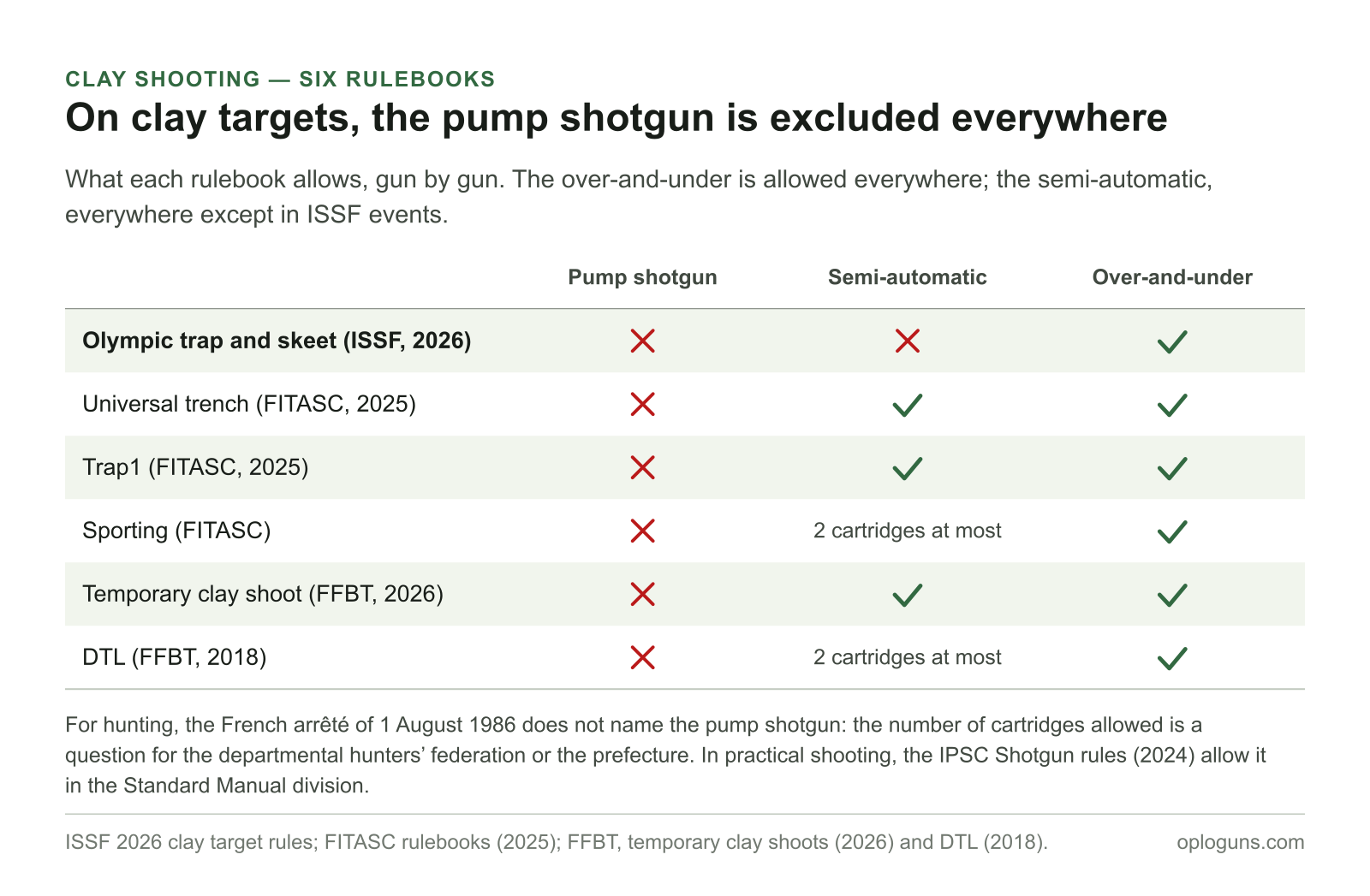
If you shoot universal trench, Sporting or DTL (Down-The-Line), the answer is the same, in other words. Each rulebook carries its own edition:
| Rulebook | What it allows | Pump shotgun |
|---|---|---|
| FITASC, universal trench (2025) | All guns, semi-automatics included, 12 gauge at most | « excepté » [except]8 |
| FITASC, Trap1 (2025) | Same wording | « excepté » [except]9 |
| FITASC, Sporting (parcours de chasse) | Hunting guns, 12 gauge at most, barrel of at least 66 cm | « à l'exception » [with the exception]10 |
| FFBT, temporary clay shoot (2026) | Stocked shotguns, barrels of at least 60 cm, 12 gauge at most | « pas autorisés » [not allowed]11 |
| FFBT, DTL (2018) | Smoothbore barrels of at least 66 cm, 12 gauge at most | Excluded12 |
The semi-automatic is allowed everywhere except in ISSF events. The DTL rulebook and FITASC Sporting limit it to two cartridges1210. The cartridges of each discipline are compared in clay shooting cartridges.
IPSC Shotgun: pump shotguns allowed in Standard Manual
Practical shooting — tir sportif de vitesse (TSV) in France — does welcome it. With conditions. The IPSC Shotgun rulebook, January 2024 edition, defines the Standard Manual division: any manual-action shotgun, "pump action" included, produced by a factory and sold to the public13. Extraction and loading come entirely from the shooter's own movement.
The discipline, its divisions and its guns are described in IPSC Shotgun and practical shooting with long guns. To take part, you need a shooting license, as detailed in shooting license or hunting license.
Pump, semi-automatic or over-and-under: pros and cons
Pump shotgun
Pros
Semi-automatic
Pros
Over-and-under
Pros
Cons
- Two shots, one per barrel, before reloading.
To hunt and shoot clays with a single gun
A Category C over-and-under or semi-automatic covers both, the semi-automatic outside ISSF events. In return, the over-and-under fires only two shots. The choice is detailed in your first hunting shotgun.
For hunting alone
A Category C pump-action gun, with a rifled barrel, can be bought on a validated license. In return, it stays away from clay targets, the gun must shoulder without a rest, and the number of cartridges allowed is a question for the departmental federation or the prefecture.
For practical shooting
The pump shotgun has its own division. The price: a shooting license, plus an authorization for a smooth bore.
Three misconceptions about pump shotguns for hunting
- "The 1986 arrêté clearly settles the pump shotgun." It does not name it and leaves its details to an instruction from the minister in charge of hunting1: the departmental hunters' federation or the prefecture answers.
- "A hunting license covers any pump shotgun." It opens Category C; the smooth bore is in Category B35.
- "At the Sunday clay shoot, a pump gets through." The FFBT's 2026 instructions for temporary clay shoots exclude it11.
The texts prevail. The arrêté of 1 August 1986 and article R311-2 are cited in their version in force on 15 November 2026, the sporting rulebooks in the edition stated for each. A local rule, whether set by the prefecture or specific to a hunting ground, is not covered here: the prefecture provides it.
Sources 13 references
The texts were reread on Légifrance on 15 November 2026, the sporting rulebooks read the same day in the edition stated. Unless noted, the documents are in French. Click a note marker in the text to highlight the matching source.
- Légifrance — arrêté du 1er août 1986 relatif à divers procédés de chasse, de destruction des animaux nuisibles et à la reprise du gibier vivant dans un but de repeuplement [order on various methods of hunting, pest destruction and the capture of live game for restocking], version in force on 15 November 2026 (article 1 amended by the arrêté of 28 December 2023, in force since 31 December 2023; article 5 amended on 3 August 2025; last amended by the arrêté of 25 June 2026, applicable since 10 July 2026), reread on 15 November 2026: article 1, « l'emploi de toute arme à rechargement automatique permettant le tir de plus de trois coups sans réapprovisionnement » [the use of any automatically reloading firearm allowing more than three shots without reloading]; « l'emploi des armes à feu non susceptibles d'être épaulées sans appui » [the use of firearms that cannot be shouldered without a rest]; « l'emploi de la canne-fusil » [the use of the cane gun]; « l'emploi des armes à air ou gaz comprimé dénommées aussi armes à vent » [the use of compressed air or gas guns, also called wind guns]; article 5, « Toute arme de chasse ne peut être transportée à bord d'un véhicule que placée sous étui ou démontée » [any hunting firearm may be transported in a vehicle only in a case or dismantled], « l'arme doit être déchargée et non-approvisionnée » [the firearm must be unloaded, with no ammunition in the magazine]. Last sentence of article 1, « Les modalités d'application de ces interdictions sont précisées par instruction du ministre chargé de la chasse » [the implementing details of these prohibitions are set out by instruction of the minister in charge of hunting] (instruction not reproduced in the arrêté, not consulted). The words « pompe », « semi-automatique » and « réducteur » appear in no article.
- Légifrance — article R311-1 du code de la sécurité intérieure, « En vigueur depuis le 07 septembre 2025 » [in force since 7 September 2025], reread on 15 November 2026: I, 7°, manual repeating firearm, « arme qui, après chaque coup tiré, est rechargée manuellement par introduction dans le canon d'une munition » [a firearm which, after each shot fired, is reloaded manually by introducing into the barrel a round] taken from a feed system and carried by a mechanism.
- Légifrance — article R311-2 du code de la sécurité intérieure, « En vigueur depuis le 07 septembre 2025 » (decree no. 2025-894 of 5 September 2025), reread on 15 November 2026: B, 2°, f), long guns « A répétition manuelle munies d'un dispositif de rechargement à pompe » [manual repeating, fitted with a pump reloading device], « armes à canon lisse » [smoothbore firearms] and rifled-barrel firearms other than those of b) and d) of 1° of III; C, 1°, a), « A répétition semi-automatique dont le projectile a un diamètre inférieur à 20 mm équipées de systèmes d'alimentation inamovibles permettant le tir de 3 munitions au plus » [semi-automatic repeating, with a projectile under 20 mm in diameter, fitted with fixed feed systems allowing 3 rounds at most to be fired]; C, 1°, c), « A un coup par canon » [one shot per barrel]; C, 1°, d), « A répétition manuelle à canon rayé munies d'un dispositif de rechargement à pompe chambré pour les calibres 8, 10, 12, 14, 16, 20, 24, 28, 32, 36 et 410, d'une capacité inférieure ou égale à 5 coups, dont la longueur totale est supérieure à 80 cm, dont la longueur du canon est supérieure à 60 cm et dont la crosse est fixe » [manual repeating with a rifled barrel, fitted with a pump reloading device, chambered for gauges 8, 10, 12, 14, 16, 20, 24, 28, 32, 36 and 410, with a capacity of 5 shots or fewer, an overall length above 80 cm, a barrel length above 60 cm and a fixed stock].
- Ministère de l'Intérieur, SCAE, data.gouv.fr — Référentiel général des armes (RGA), export of 11 September 2026, counted on 15 November 2026: 33 pump shotgun entries in B 1°, including CI303 Mossberg Model 88, 650 mm overall, 470 mm barrel; the export does not say whether a gun can be shouldered without a rest.
- Légifrance — article R312-53 du code de la sécurité intérieure, « En vigueur depuis le 10 février 2022 » (decree no. 2022-144 of 8 February 2022), reread on 15 November 2026: acquisition of a Category C firearm by an adult on presentation of a hunting license accompanied by a « titre de validation annuel ou temporaire » [annual or temporary validation document] or that of the previous year, of a shooting, clay shooting or biathlon license, or of a collector's card.
- Guide on this site — shooting license or hunting license, citing article R312-40 of the code de la sécurité intérieure (read on 1 November 2026): for sport shooting, Category B opens only to members of an association « membre d'une fédération sportive ayant reçu […] délégation pour la pratique du tir » [that is a member of a sports federation holding a delegation for the practice of shooting]; the hunting license does not appear there.
- FFTir — Règles techniques ISSF du tir aux plateaux, édition 2026 (PDF, « Effective au 01/09/2026 »), consulted on 15 November 2026: 9.4.2.1 a), « Lors de tous les événements supervisés par l'ISSF, tous les types de fusils à canon lisse, à l'exception des semi-automatiques et des fusils à pompe, peuvent être utilisés » [at all ISSF-supervised events, all types of smoothbore shotguns, except semi-automatics and pump shotguns, may be used], 12 gauge at most.
- FITASC — règlement international Fosse Universelle-UT (PDF, version of 1 January 2025), consulted on 15 November 2026: 2.01, « Toutes les armes, excepté les fusils à pompe, sont admises, y compris les modèles semi-automatiques » [all guns, except pump shotguns, are allowed, including semi-automatic models], 12 gauge at most.
- FITASC — règlement international Trap1 (PDF, version of 1 January 2025), consulted on 15 November 2026: 8.1, « Toutes les armes, excepté les fusils à pompe, sont admises, y compris les modèles semi-automatiques » [all guns, except pump shotguns, are allowed, including semi-automatic models], 12 gauge at most.
- FITASC — règlement international Parcours de chasse - Sporting (PDF, pages dated 1 January 2025), consulted on 15 November 2026: 7.1, « Toutes les armes de chasse, y compris les modèles semi-automatiques (à l'exception des fusils à pompe), sont admises à condition que leur calibre n'excède pas le calibre 12, équipé d'un canon de 66 cm minimum » [all hunting guns, including semi-automatic models (with the exception of pump shotguns), are allowed provided their gauge does not exceed 12 gauge, with a barrel of 66 cm minimum]; 8.5, semi-automatic shotguns must be loaded with two cartridges only.
- Fédération française de ball-trap — consignes d'organisation pour ball-trap temporaire, 2026 (PDF), consulted on 15 November 2026, article 7: « Tous les fusils de chasse ou de tir, munis d'une crosse sont autorisés à condition que la longueur des canons ne soit pas inférieure à 60 cm et que le calibre ne soit pas supérieur au calibre 12. Les fusils à pompe ne sont pas autorisés. » [All hunting or target shotguns fitted with a stock are allowed provided the barrels are not shorter than 60 cm and the gauge is not larger than 12 gauge. Pump shotguns are not allowed.]
- Fédération française de ball-trap — règlement DTL (PDF, updated on 5 January 2018), consulted on 15 November 2026, 4.1: shotguns « à canons lisses » [with smoothbore barrels]; « Toutes les armes sont admises, à condition que la longueur de leur canon soit égale ou supérieure à 66 cm, que leur calibre ne soit pas supérieur au calibre 12 sauf : les fusils à pompe » [all guns are allowed, provided their barrel is 66 cm or longer and their gauge is not larger than 12 gauge, except: pump shotguns]; semi-automatics « ne peuvent être chargés que de deux cartouches au maximum » [may be loaded with two cartridges at most].
- IPSC — IPSC Shotgun Competition Rules, January 2024 Edition (PDF in English, hosted by the IPSC Czech region), read on 15 November 2026: Standard Manual Division, 22, "Any complete manual action shotgun (i.e. pump action, slide action, break-open, lever action, bolt action) produced by a factory and available to the general public, where extraction of a spent case and loading of a new round are caused entirely by a competitor's physical manipulation".
Frequently asked questions
Is a pump shotgun allowed for hunting in France?
The arrêté of 1 August 1986 on hunting methods does not name it. Its limit of three shots without reloading targets any automatically reloading firearm; it does not say whether the pump shotgun falls within that, and it leaves its implementing details to an instruction from the minister in charge of hunting. The departmental hunters' federation or the prefecture answers that point. The same arrêté bans firearms that cannot be shouldered without a rest. For a specific hunting ground or driven hunt, the question goes to the prefecture.
Which pump shotgun for hunting?
With only a validated hunting license (permis de chasser), a Category C pump-action gun: rifled barrel, shotgun gauge, 5 shots at most, more than 80 cm long, barrel longer than 60 cm and a fixed stock (article R311-2, III, 1°, d). A smoothbore pump shotgun is in Category B, which the hunting license does not open. The exact version is checked on its entry in the référentiel général des armes, the French state firearms reference list.
Can you shoot clays with a pump shotgun?
Not in regulated events. The 2026 ISSF rules for trap and skeet, the FITASC rulebooks for universal trench, Trap1 and Sporting, the DTL rulebook and the 2026 instructions of the Fédération française de ball-trap for temporary clay shoots all exclude it, in so many words.
Does a pump shotgun need a magazine plug for hunting?
The arrêté of 1 August 1986 names neither the pump shotgun nor the magazine plug. Its three-shot limit targets any automatically reloading firearm, and its implementing details are set out in an instruction from the minister in charge of hunting, which is not reproduced in the arrêté. The question goes to the departmental hunters' federation or the prefecture, before the season.
Is the pump shotgun allowed in sport shooting?
Yes in practical shooting: the IPSC Shotgun rulebook, January 2024 edition, allows any factory-produced manual-action shotgun, pump included, in the Standard Manual division. It remains excluded from clay target events.
Spotted an error, or a rule that has changed since we checked? Report an error